
Quick answer: Promotional gift advent calendar boxes should be designed around the campaign product mix, retail channel, insert protection, artwork schedule, sample approval, MOQ, and export packing method. Buyers should confirm the number of compartments, product sizes, weight, opening style, insert material, printing finish, barcode or label area, carton packing, and quotation details before production. For seasonal campaigns, the safest process is to build a clear product-loading plan first, approve a dieline and prototype, test product fit, check color proofing, and then move to mass production only after the pre-production sample is approved.
For overseas brands, wholesalers, retail buyers, Amazon sellers, gift companies, and packaging purchasing teams, promotional gift advent calendar boxes are not only display packaging. They are campaign tools that combine product sampling, retail presentation, gifting value, and logistics protection in one structure. A cosmetics promotion may need small trays for mini tubes and jars. A chocolate calendar may require food-safe inner packing and careful temperature planning. A jewelry campaign may need anti-scratch cards and soft inserts. A tea, coffee, or beverage sample calendar may need stronger compartments because the loaded weight is higher than it looks on a dieline.
Giftpackpro works as a custom advent calendar boxes manufacturer for B2B buyers who need practical packaging decisions before sampling, quotation, and bulk production. This guide explains how to compare structures, inserts, materials, artwork, sampling, MOQ, QC, and export packing for seasonal promotional campaigns.
What should buyers decide before designing promotional gift advent calendar boxes?
Buyers should decide the campaign goal, product category, sales channel, opening experience, product-loading plan, target quantity, and delivery deadline before requesting a dieline. Without these details, the factory can only estimate a generic box, and the sample may fail during insert testing or export packing.
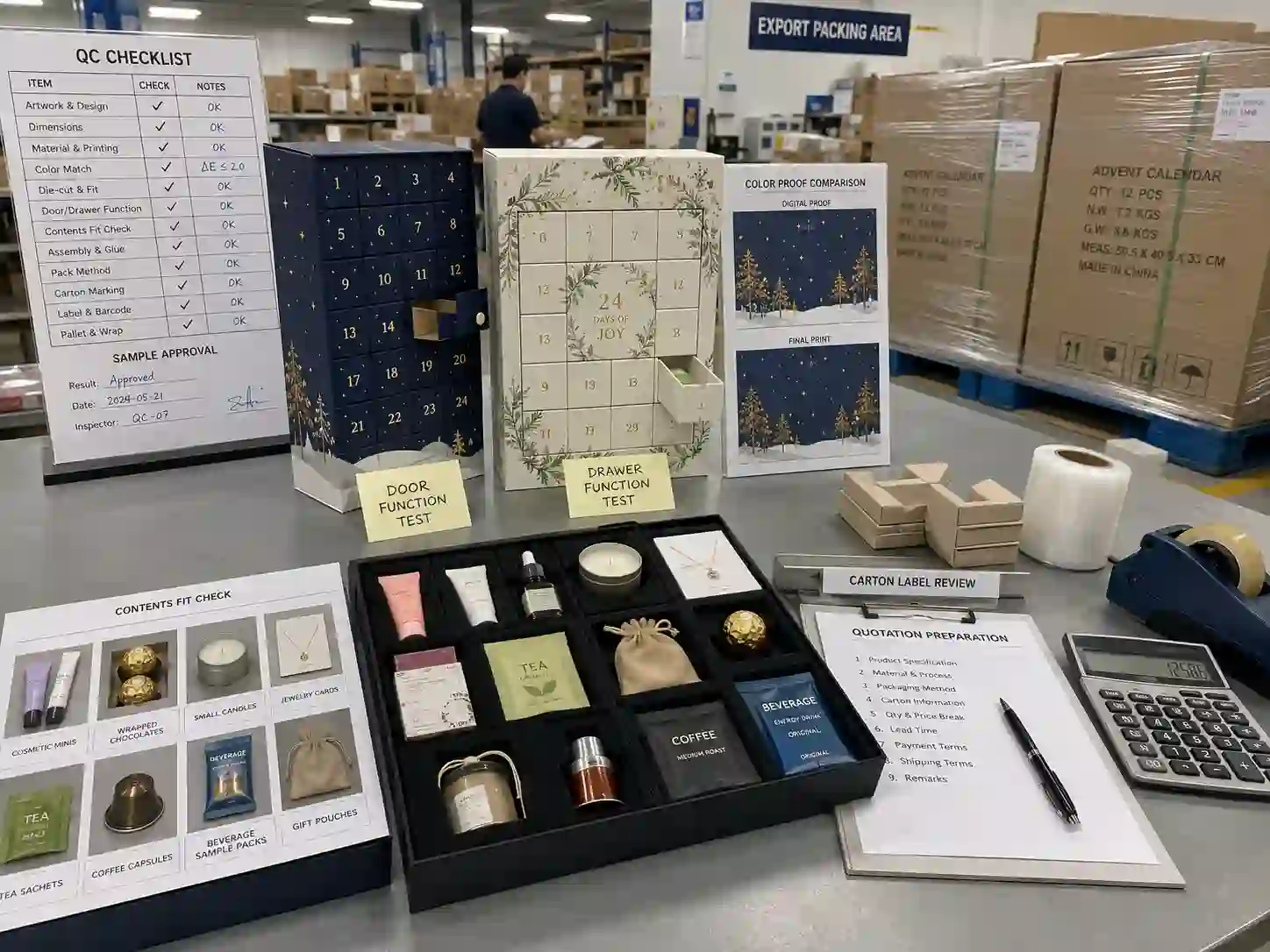
A promotional gift calendar can support many product categories, including cosmetic minis, chocolate pieces, small candles, jewelry cards, toy accessories, tea sachets, coffee capsules, beverage sample packs, coupon cards, and mixed gift items. Each category affects the box structure. Lightweight flat items may work with folding carton paperboard. Fragile, heavy, or premium gift sets often need greyboard rigid box construction. Products that vary in size may require custom inserts instead of equal compartments.
Buyer tip: Do not start with only “24 doors” or “12 drawers.” Start with the actual product list, including length, width, height, weight, packaging type, and whether each item is fragile, oily, scented, food-related, liquid-filled, or scratch-sensitive.
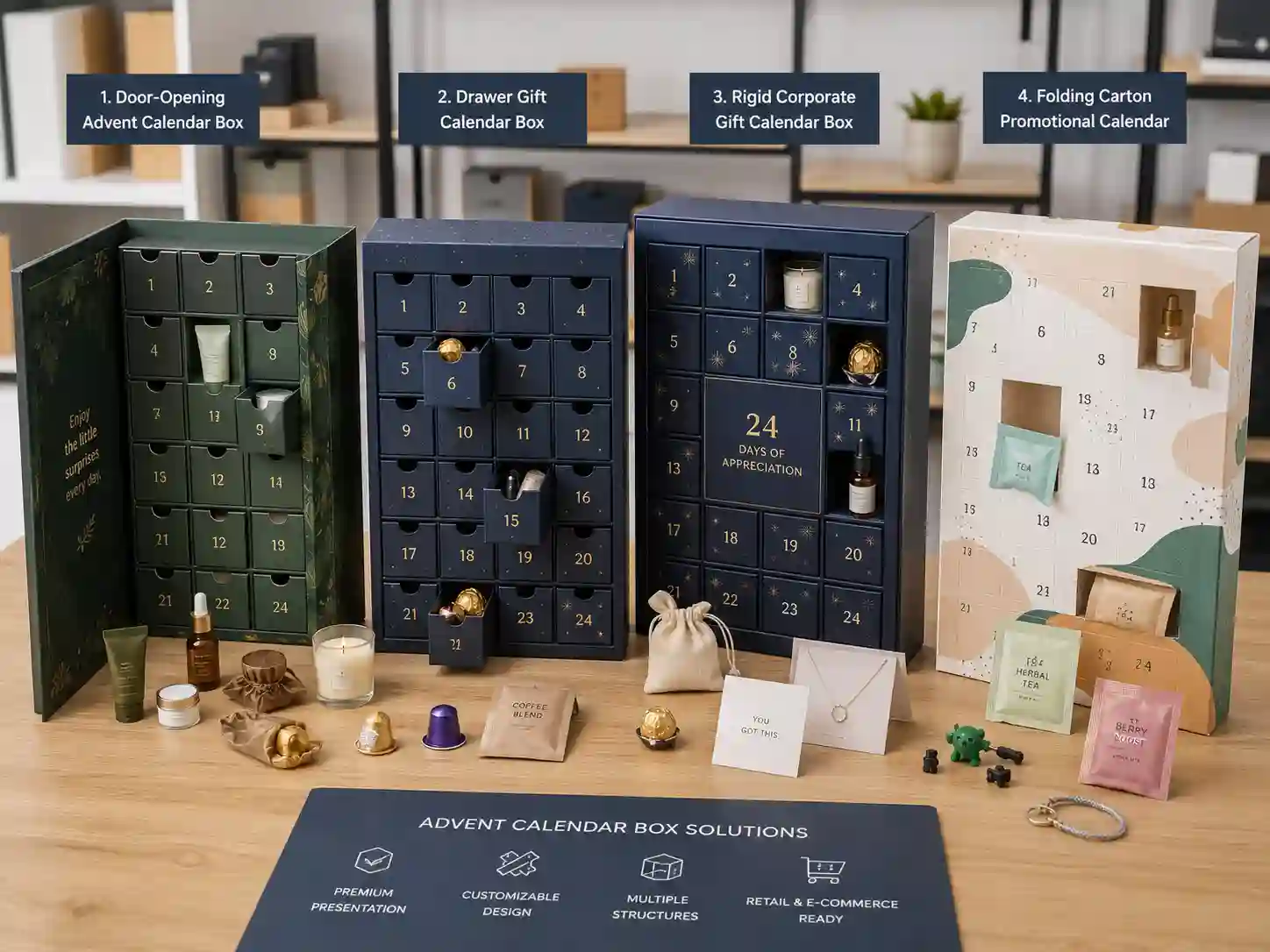
Which structure is best for different seasonal campaign applications?
The best structure depends on product weight, retail display needs, budget, assembly tolerance, and how buyers want users to open the calendar. Door-opening boxes are common for lightweight samples, drawer boxes feel premium and reusable, rigid boxes suit corporate gifts, and folding cartons can support large-volume promotional runs.
| Structure option | Best-fit product applications | Main advantages | Buyer checks before sampling |
|---|---|---|---|
| Door-opening box | Cosmetics, chocolate, tea sachets, toys, gift coupons, mini accessories | Clear countdown effect, efficient shelf display, good for numbered compartments | Door perforation strength, finger access, compartment spacing, artwork alignment |
| Drawer box | Jewelry, candles, premium gifts, corporate promotional sets, mixed accessories | Premium opening experience, good perceived value, reusable structure | Drawer sliding tolerance, pull ribbon strength, drawer stop design, loaded weight |
| Rigid gift calendar | Luxury cosmetics, fragrance samples, candles, jewelry, high-value gift sets | Strong greyboard structure, premium finish options, better protection | Board thickness, insert fixing method, corner strength, export carton size |
| Folding carton calendar | High-volume promotional gifts, flat items, light snacks, paper gifts | Lower unit weight, faster packing, suitable for larger promotional quantities | Paperboard grade, folding strength, glue area, retail shelf stability |
| Fold-out calendar layout | Story-style campaigns, mixed gift cards, stationery, toys, tea, coffee samples | Large visual area, strong campaign display, good for e-commerce unboxing photos | Hinge durability, opening balance, insert retention, shipping compression |
For product categories such as cosmetics, chocolate, candles, jewelry, toys, tea, coffee, beverages, and gifts, the same box style can behave very differently after loading. A 24-compartment cosmetic calendar with tubes may need vertical locking points. A chocolate calendar may need shallow cavities and separation from the printed surface. A candle calendar needs stronger support because small candles are dense. Jewelry calendars often need card slots, soft pads, or anti-scratch wrapping.
How should buyers match inserts to the products inside?
The insert should hold each item in place during handling, shelf display, e-commerce delivery, and user opening. Buyers should choose the insert based on product shape, weight, fragility, sustainability preference, and the required opening experience.
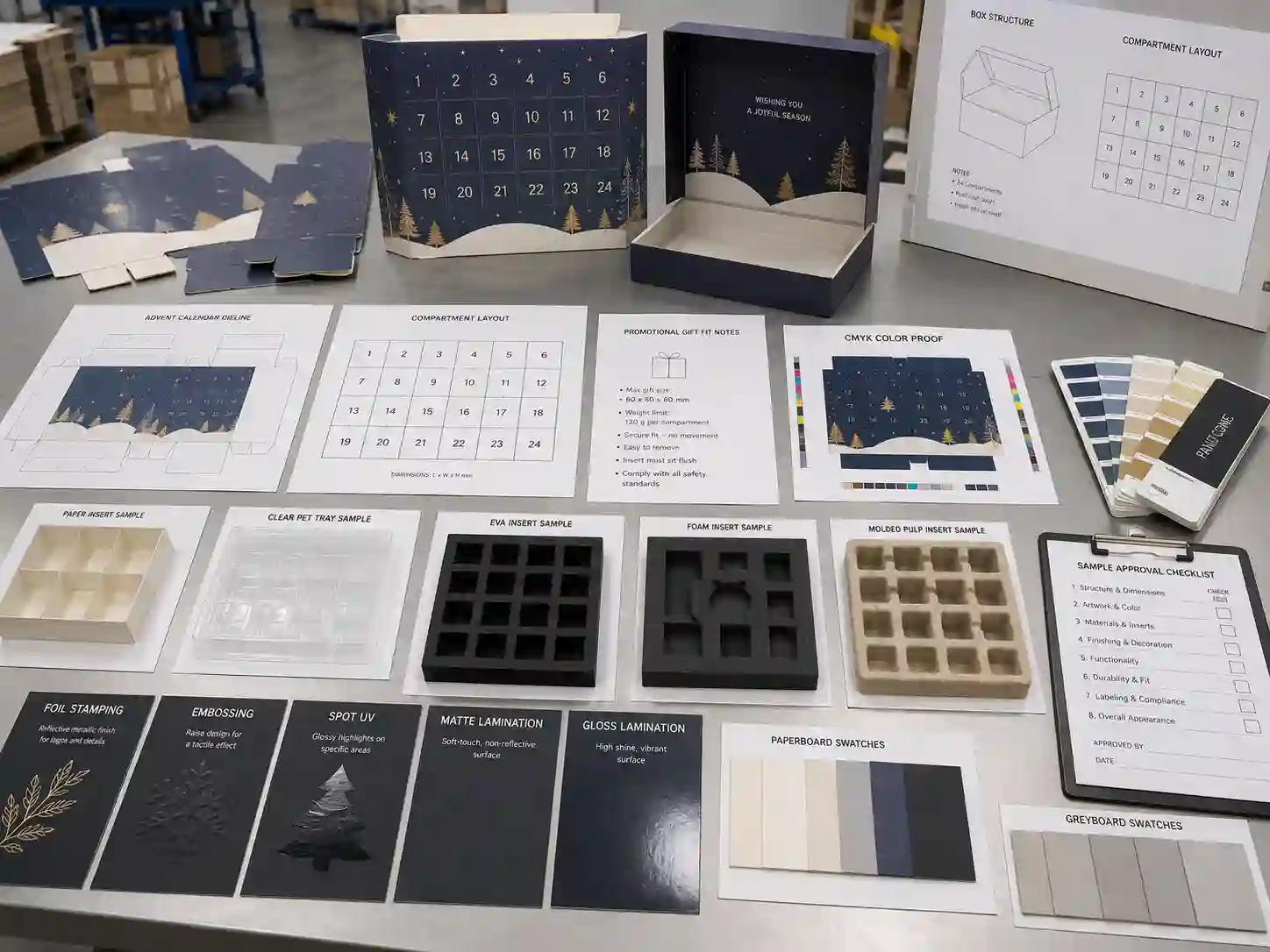
Common insert options include paper insert, PET tray, EVA insert, foam, and molded pulp. Paper inserts are widely used for light promotional items and can match paper-based packaging goals. PET trays work well when accurate cavities and visibility are needed, although buyers should confirm recycling requirements in the destination market. EVA and foam provide soft protection for jewelry, glass, candles, or fragile gift accessories. Molded pulp can support sustainability-focused campaigns, but cavity tolerance and surface texture should be checked carefully during sampling.
Factory tip: A good insert is not only a cavity shape. It should also consider finger access, item removal direction, product orientation, compression during transport, and whether the item can fall behind the door or drawer during shaking.
What product-fit information should be sent to the factory?
Before a factory creates a dieline, buyers should prepare product dimensions, loaded weight, product photos, preferred compartment sequence, safety clearance, and any retail labeling needs. For mixed promotional gift advent calendar boxes, a spreadsheet with one row per compartment is often more useful than a general description.
- Number of compartments, such as 12, 24, 25, or a custom campaign count.
- Product size for each item, including primary packaging such as pouch, blister, tube, sachet, capsule, jar, tin, card, or small box.
- Weight per item and estimated total loaded box weight.
- Fragility notes, such as glass, wax, chocolate, jewelry surface, or crushable accessories.
- Opening direction, finger notch position, door size, drawer pull, or display angle.
- Barcode, warning label, recycling mark, shipping label, or distributor sticker area.
Which materials and finishes matter for promotional campaigns?
Material and finishing choices should support product weight, visual positioning, campaign budget, and production lead time. Rigid greyboard gives a stronger premium feel, while paperboard folding structures are often better for lighter, high-volume campaigns.
Promotional gift calendars usually use printed paperboard, mounted paper over greyboard, or a hybrid structure with paperboard sleeves and internal inserts. For a premium campaign, buyers may specify matte lamination, gloss lamination, foil stamping, embossing, debossing, or spot UV. For a cost-sensitive retail program, a clean CMYK print with matte lamination may be more practical than multiple special finishes.
Artwork should be checked against the dieline before sampling. Important checks include bleed, safe area, door number placement, panel orientation, barcode readability, Pantone color references, CMYK conversion, foil stamping area, embossing registration, and whether small text crosses a fold, cut, perforation, or drawer edge.
For paper sourcing and responsible material claims, buyers can review official guidance from FSC and ask suppliers to verify documentation where required. Do not place certification logos or recycling claims on artwork unless the buyer has confirmed permission, documentation, and market requirements.
How should buyers compare application choices for cosmetics, chocolate, candles, jewelry, toys, tea, coffee, beverages, and gifts?
Each product category creates different packaging-engineering risks. Buyers should compare options by product protection, insert accuracy, filling process, finishing durability, shelf presentation, and export packing method.
Cosmetics and skincare samples
Cosmetic mini tubes, jars, ampoules, sachets, and small bottles need clean compartment positioning and enough clearance around caps or pumps. If the products are oily or liquid-filled, buyers should confirm whether primary packaging can leak and whether the insert or printed paper surface needs extra protection. Rigid boxes or strong paperboard calendars are common when the campaign targets retail gift sets or influencer sampling.
Chocolate, candy, tea, coffee, and beverage samples
Food and beverage promotional calendars require more careful planning around primary packaging, hygiene, weight, and storage conditions. The advent calendar box is usually secondary packaging, so buyers should confirm the food-contact status of the direct-contact wrapper, pouch, capsule, sachet, or bottle. For food-contact questions, buyers may review official guidance such as the FDA food-contact substances page when selling into relevant markets.
Coffee capsules and beverage sample packs can be heavier than tea sachets or small chocolate pieces. Drawer structures may need stronger side walls, while door-opening boxes may need reinforced trays to prevent items from shifting behind the doors.
Candles, jewelry, toys, and mixed gift items
Small candles are compact but heavy, so buyers should test bottom support and carton stacking. Jewelry campaigns need anti-scratch packing, card slots, foam pads, or soft pouches. Toy accessories may require different cavity shapes, while mixed gifts need a compartment map that prevents larger items from creating uneven pressure during shipping.
Buyer tip: Mixed promotional gift calendars should be engineered from the heaviest and most fragile items first. The lightest item should not control the structure if one dense candle, glass mini bottle, or metal accessory can damage the box during transport.
What sampling process reduces risk before mass production?
A practical sampling process starts with a dieline, moves to a white sample or structural prototype, then a printed sample, and finally a pre-production sample before mass production. Buyers should not approve bulk production from flat artwork alone.
The first sample should check structure and product fit. A white sample is useful for confirming size, compartment sequence, insert tightness, door-opening force, drawer sliding, and product loading. A printed sample then checks color, finishing, lamination, foil stamping, embossing, spot UV, barcode area, and panel alignment. For repeat or high-volume orders, a pre-production sample should represent the approved materials, printing, insert, assembly method, and packing method.
Giftpackpro’s custom advent calendar box services can support structure planning, material discussion, sample development, printing proof review, and production preparation for buyers who need a controlled B2B packaging process.
What should be checked on the sample approval checklist?
- Dieline size, fold lines, cut lines, perforation lines, and glue areas.
- Door opening, drawer movement, fold-out hinge strength, and compartment access.
- Insert fit for each product, including finger space and shaking resistance.
- Artwork position, number sequence, panel orientation, and print registration.
- CMYK result, Pantone reference, foil stamping, embossing, spot UV, matte lamination, or gloss lamination.
- Loaded weight, carton packing quantity, export carton size, and shipping mark position.
How do MOQ, cost, and lead time affect design choices?
MOQ, cost, and lead time are affected by structure complexity, material type, insert tooling, printing process, finishing steps, sample rounds, and final packing method. A simple folding carton calendar normally has different cost drivers than a rigid drawer calendar with EVA inserts and foil stamping.
Key cost drivers include box size, board thickness, paper grade, insert material, number of compartments, manual assembly time, special finishing, color proofing, packing labor, export carton strength, and pallet requirements. Buyers should also consider the cost of product loading if the supplier is asked to assemble the calendar with goods inside.
Factory tip: The cheapest unit price is not always the lowest total project cost. A weak insert, unstable drawer, or poor export carton can create replacement costs, delay costs, and retail complaints after the seasonal selling window has already started.
How should buyers select a supplier for promotional gift advent calendar boxes?
Buyers should compare suppliers by engineering ability, sample communication, material options, printing control, QC process, export packing experience, and quotation transparency. A supplier that only quotes from a picture may miss product-fit and shipping risks.
Useful supplier questions include whether the factory can adjust the dieline, recommend insert materials, test loaded samples, provide printing proofs, control color tolerance, inspect assembly, and pack for export shipment. Buyers can also review Giftpackpro packaging factory information when evaluating factory-side capability and communication fit.
Supplier selection checklist
- Can the supplier create or adjust a dieline based on the real product list?
- Can they suggest rigid box, folding carton, drawer box, or door-opening box structures based on loaded weight?
- Can they provide paper insert, PET tray, EVA insert, foam, or molded pulp options?
- Do they check artwork details before printing plates or mass production?
- Do they provide a sample approval process before bulk production?
- Can they explain MOQ, lead time, packing method, and quotation exclusions clearly?
- Do they understand export carton strength, pallet packing, shipping marks, and carton label requirements?
What QC and export packing details should be controlled before shipment?
QC should verify structure, printing, insert fit, assembly quality, loaded product stability, carton packing, and shipping marks before shipment. Export packing is especially important because promotional gift calendars are often large, multi-compartment, and easy to crush if cartons are poorly planned.
Final inspection should include size measurement, visual print check, color comparison with approved proof, door or drawer function test, insert position check, glue strength check, corner and edge review, barcode or label area check, and carton quantity count. For loaded calendars, buyers should also request a shaking check or handling simulation that reflects the shipping channel.
Export packing details include individual polybag or protective wrapping if needed, inner carton, master export carton, corner protectors, carton label, shipping marks, gross weight, net weight, carton dimensions, pallet pattern, and moisture protection where relevant. E-commerce campaigns may need stronger drop and compression protection than retail pallet shipments.
Buyers can browse custom advent calendar box products and related advent calendar box buying guides to compare structures before confirming a final packing plan.
What information should buyers prepare before requesting a quotation?
Buyers should prepare the product list, quantity, structure preference, insert requirement, material expectation, artwork status, destination market, packing method, and deadline before requesting a quotation. Better RFQ information leads to faster pricing and fewer revisions.
| RFQ item | What to prepare | Why it matters |
|---|---|---|
| Product list | Dimensions, weight, photos, and compartment sequence | Controls dieline, insert design, and box size |
| Structure | Door-opening, drawer, rigid, folding carton, or fold-out style | Controls material, assembly process, cost, and lead time |
| Insert | Paper insert, PET tray, EVA, foam, molded pulp, or mixed insert | Controls product fit, protection, and tooling needs |
| Printing | CMYK, Pantone, foil stamping, embossing, spot UV, lamination | Controls artwork checking, proofing, and finishing cost |
| Quantity and MOQ | Target order quantity and future reorder expectation | Controls unit price, setup cost, and production planning |
| Packing and shipping | Export carton, pallet, shipping marks, Amazon or retail label needs | Controls carton design, logistics protection, and inspection checklist |
When the project is ready, buyers can request a custom quote with drawings, product photos, campaign quantity, and delivery schedule. If the product list is not final, it is still useful to share estimated item sizes so the factory can suggest a flexible structure.
Decision guide: which design route should you choose?
Buyers can narrow the design route by matching product value, loaded weight, retail channel, and campaign timeline. The right choice is the one that balances presentation, protection, production speed, and budget.
- Choose a door-opening paperboard calendar when the campaign uses light items, needs a classic countdown layout, and has a moderate to high quantity target.
- Choose a rigid drawer calendar when the gift value is higher, items are varied, and the campaign needs a premium unboxing experience.
- Choose a folding carton calendar when the budget is tighter, the items are light, and fast packing is more important than a luxury structure.
- Choose a stronger greyboard structure when the calendar contains candles, beverage samples, mini bottles, heavy coffee capsules, or multiple dense accessories.
- Choose a custom insert package when products vary in size, are fragile, or must stay in a fixed display position after shipping.
What common mistakes should buyers avoid?
Most problems come from designing the box before confirming the products, approving artwork without checking the dieline, or ignoring export packing until production is almost finished. These mistakes can increase cost and delay seasonal launch schedules.
- Using equal compartment sizes when the product mix is uneven.
- Choosing a premium finish before confirming the board, insert, and structure budget.
- Ignoring total loaded weight when selecting paperboard or greyboard thickness.
- Placing numbers, logos, or small text too close to cut lines, perforations, or drawer edges.
- Approving a printed sample without loading real products inside the insert.
- Forgetting barcode, warning label, recycling mark, carton label, or distributor sticker areas.
- Requesting a quotation without quantity, product dimensions, destination, or packing requirements.
- Using weak export cartons for large calendars that need stacking or pallet shipment.
FAQ: promotional gift advent calendar boxes for seasonal campaigns
Can one promotional gift calendar hold cosmetics, chocolate, jewelry, tea, coffee, and other gifts together?
Yes, but mixed products need a careful compartment map and insert design. Buyers should group items by weight, fragility, size, and opening sequence so one heavy or sharp item does not damage a lighter item during shipping.
Is a rigid box always better than a folding carton?
No. A rigid box is stronger and more premium, but a folding carton may be more practical for lightweight, high-volume promotional campaigns. The better choice depends on product weight, retail channel, budget, and lead time.
Should buyers choose paper inserts, PET trays, EVA, foam, or molded pulp?
Choose paper inserts for many light promotional items, PET trays for precise cavities, EVA or foam for fragile and premium items, and molded pulp for campaigns that prioritize paper-based materials. The final choice should be confirmed through product-fit testing.
How early should buyers start a seasonal advent calendar project?
Buyers should start as early as possible because structure development, sample revisions, printing proofing, insert testing, mass production, QC, export packing, and sea or air shipment all add time. A rushed project usually limits structure choices and increases approval risk.
What is the most important sample to approve before mass production?
The most important sample is the approved pre-production sample because it should reflect the final structure, material, insert, printing, finishing, assembly, and packing method. It becomes the reference for QC during mass production.
What should be included in a quotation for promotional gift advent calendar boxes?
A practical quotation should include structure, size, material, insert type, printing method, finishing, MOQ, unit price, sample cost, sample time, production lead time, packing method, carton details, shipping terms if requested, and any tooling or special process charges.
How can buyers start a safer custom packaging project with Giftpackpro?
To develop promotional gift advent calendar boxes for a seasonal campaign, prepare your product list, target quantity, preferred structure, artwork status, sample deadline, delivery market, and packing requirements. Share photos or drawings of the items, note fragile or heavy products, and confirm whether the calendar will be sold through retail shelves, e-commerce, wholesale distribution, corporate gifting, or promotional events.
Giftpackpro can help buyers compare structures, inserts, materials, printing options, sampling steps, QC points, and export packing details before moving into bulk production. For a faster quotation, send product dimensions, campaign quantity, artwork files if available, and any specific requirements for carton labels, shipping marks, pallets, or retailer packing rules.


