
Quick answer: Promotional gift advent calendar boxes are custom seasonal packaging used to present branded gifts, samples, coupons, accessories, mini products, or campaign items in a numbered calendar format. For B2B buyers, the most important decisions are structure, insert fit, material strength, artwork accuracy, printing method, surface finishing, sample approval, MOQ, lead time, QC, and export packing. A good supplier should help check the dieline, confirm product dimensions, test inserts, review CMYK or Pantone color proofs, produce a reliable pre-production sample, and pack bulk goods safely for international shipping.
For promotional campaigns, the box is not only a container. It is a campaign tool that must protect different gift items, display branding clearly, support retail or e-commerce handling, and arrive without crushed corners, color variation, weak inserts, or barcode problems. This guide explains how overseas brands, wholesalers, retail buyers, Amazon sellers, gift companies, and procurement teams can plan promotional gift advent calendar boxes before requesting a sample or quotation from a custom advent calendar boxes manufacturer.
What should buyers confirm before choosing promotional gift advent calendar boxes?
Buyers should confirm the campaign purpose, gift item list, sales channel, target quantity, delivery date, artwork status, and packing requirements before selecting a box structure. Promotional gift advent calendar boxes can look similar from the outside, but the engineering behind a 12-day mini gift set, a 24-door retail display box, and a drawer-style VIP promotional kit can be very different.
The first question is not “Which box looks best?” but “What must the box do during the campaign?” A retail shelf promotion may need a strong front panel, clear numbered doors, scannable barcode area, and durable outer carton. An e-commerce gift set may need better corner protection and internal movement control. A corporate promotional gift calendar may need rigid greyboard, premium finishing, and a clean unboxing sequence.
Buyer tip: Prepare the product list before requesting the dieline. Include item name, length, width, height, weight, material, fragile points, pouch thickness, bottle cap height, cable bend radius, or any part that may affect the compartment size. A supplier cannot design accurate inserts from only a front-view product image.
Which box structure is best for promotional gift campaigns?
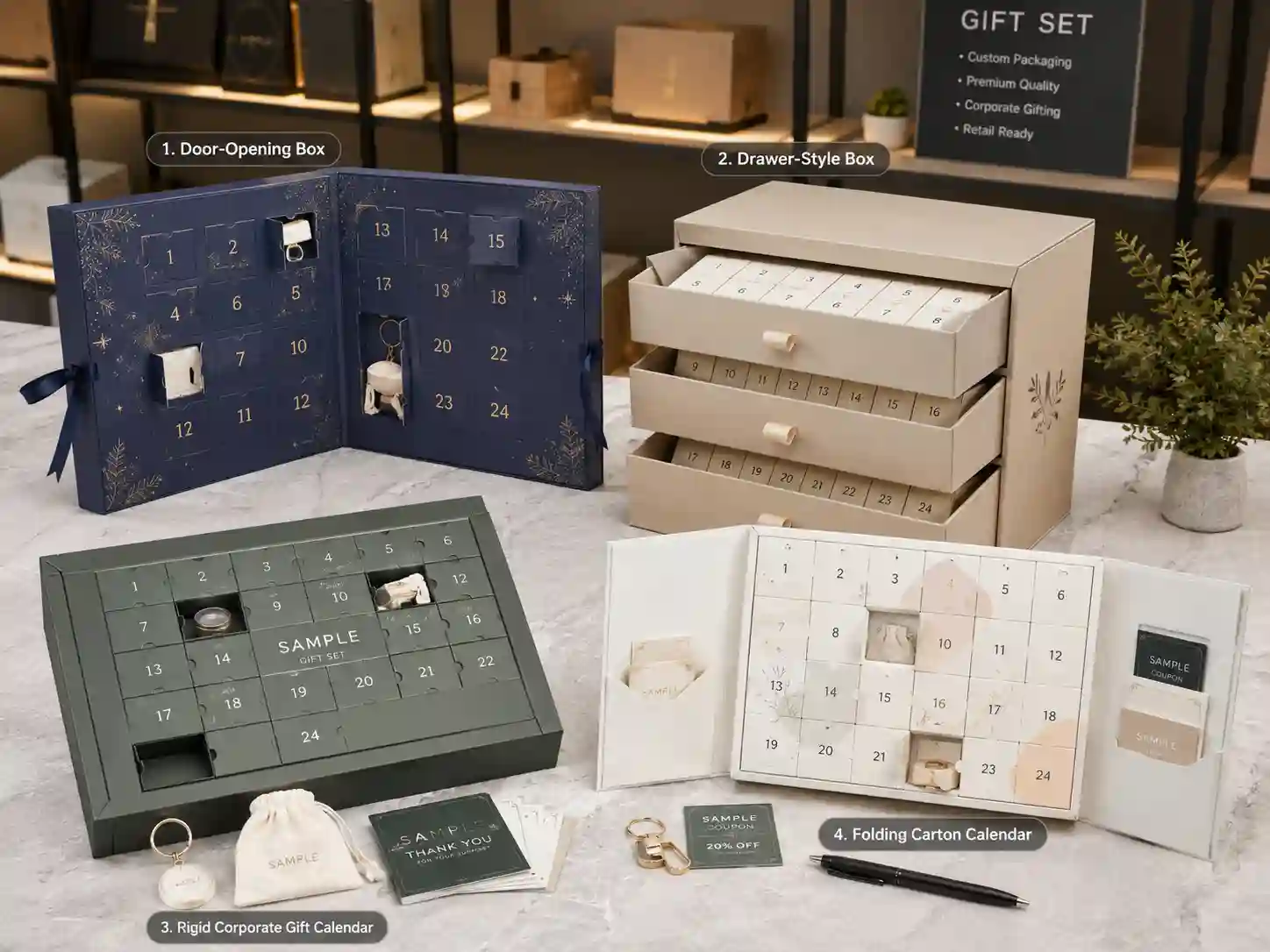
The best structure depends on product weight, campaign positioning, assembly budget, shipping method, and how users open each compartment. Door-opening boxes are common for retail campaigns, drawer boxes feel more premium, rigid boxes support heavier gifts, and folding cartons can be efficient for lightweight promotional items.
| Structure option | Best use case | Key advantage | Buyer checks before approval |
|---|---|---|---|
| Door-opening box | Retail promotional gift calendars, sample campaigns, small accessories, stationery, beauty samples, coupons, mini tools | Strong visual impact with numbered windows and large branding area | Door tear line strength, product access, compartment alignment, front panel flatness, artwork position around doors |
| Drawer box | Premium gift programs, corporate promotional kits, loyalty gifts, influencer or VIP mailers | Better unboxing experience and stronger perceived value | Drawer sliding tolerance, pull-tab strength, drawer depth, insert stability during shipping |
| Rigid box | Higher-value promotional items, mixed gifts, heavier components, retail display sets | Strong greyboard structure and premium finishing options | Greyboard thickness, corner wrapping, hinge strength, magnetic closure if used, export carton protection |
| Folding carton | Lightweight promotional samples, high-volume seasonal campaigns, lower freight-volume projects | Efficient material use and easier flat or semi-flat packing options | Paperboard grade, lock structure, assembly method, compression resistance, door function |
| Fold-out calendar | Campaign storytelling, multi-panel brand messages, display-based gift promotions | Large communication area for instructions, QR codes, or product education | Panel folding accuracy, hinge crease durability, insert bonding, final folded thickness |
Promotional items often vary more than a single-category calendar. One compartment may hold a keychain, another a sample pouch, another a coupon card, and another a small bottle or accessory. This makes structure planning more important than for a uniform product set.
Factory tip: If the promotional gift list is mixed, ask the supplier to mark heavy, fragile, sharp, liquid, and flexible items on the layout. The heaviest items should not sit only behind weak perforated doors without reinforcement or a stable insert wall.
How should inserts be engineered for mixed promotional gift items?
Inserts should be designed around real product dimensions, not approximate compartment counts. For promotional gift advent calendar boxes, the insert must prevent product movement, support easy removal, avoid crushing lightweight items, and keep each door or drawer aligned after mass production.
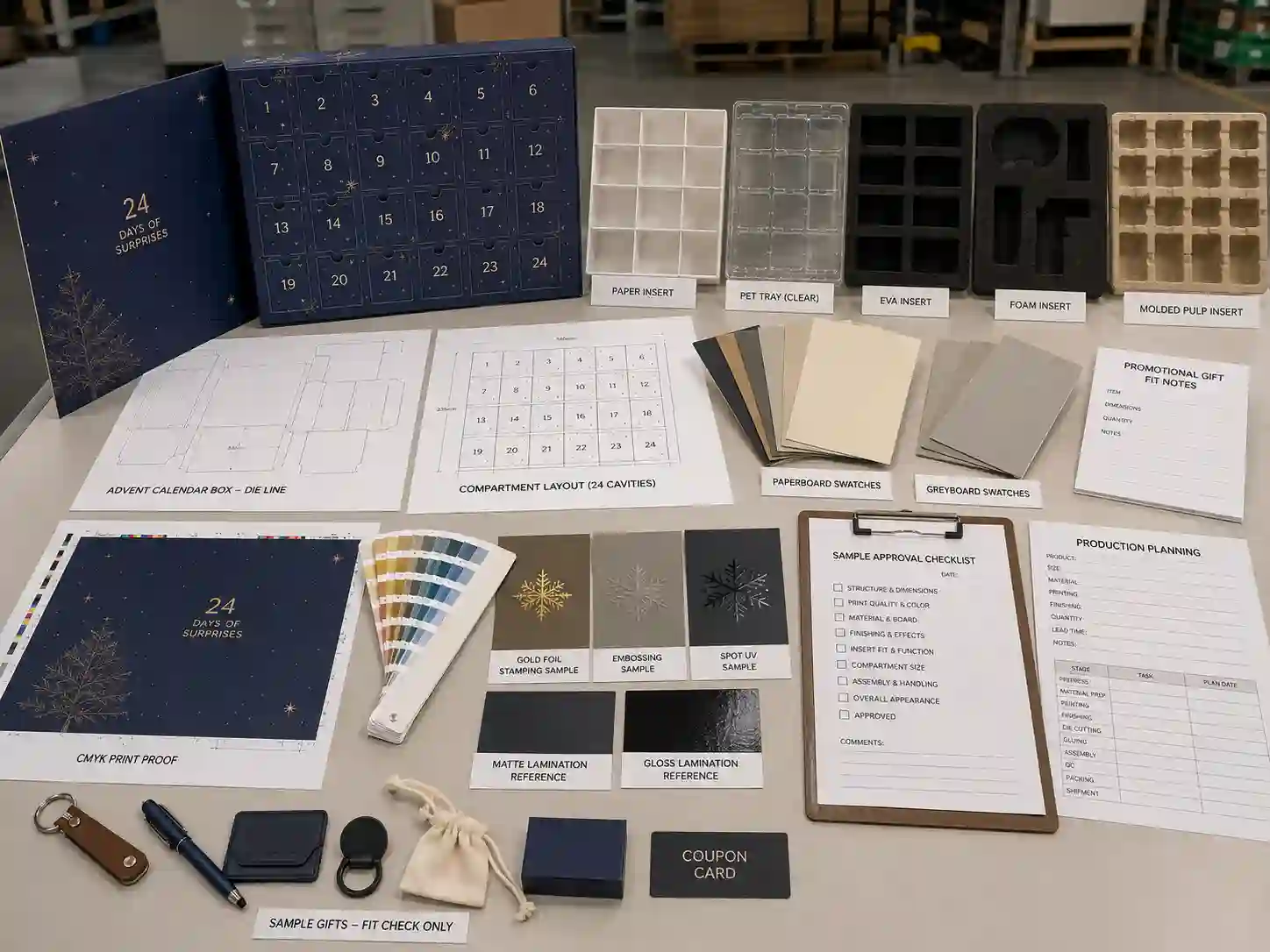
Common insert choices include paper insert, PET tray, EVA insert, foam, and molded pulp. Each option changes the cost, appearance, protection level, sustainability discussion, tooling needs, and assembly process.
When is a paper insert suitable?
A paper insert is suitable for flat, lightweight, or moderately shaped promotional items such as cards, sachets, small stationery, stickers, badges, and sample pouches. It can be printed, folded, and glued into compartments, making it a practical choice for paperboard-based custom advent calendar boxes.
However, paper inserts need careful testing when products are heavy, thick, or irregular. If the paper wall is too low, the item may shift. If the wall is too tight, workers may struggle during packing and consumers may damage the door when removing the item.
When should buyers consider PET tray, EVA, foam, or molded pulp?
PET trays work well when buyers need clear formed cavities and consistent placement for small items. EVA and foam provide a premium fitted look and stronger cushioning, especially for metal accessories, small electronics, glass items, or fragile promotional gifts. Molded pulp can support sustainability goals and molded protection, but tooling, texture, color, and tolerance should be reviewed early.
For overseas promotional campaigns, buyers should also consider the recycling or material communication requirements of the target market. If sustainability claims are important, ask suppliers for material details and avoid making unsupported environmental claims. Buyers can review official guidance from organizations such as FSC when paper sourcing verification is required.
How do CMYK and Pantone choices affect promotional gift advent calendar boxes?
CMYK is suitable for full-color images, seasonal graphics, gradients, and campaign artwork, while Pantone is useful when brand colors must stay more consistent across production. For promotional gift advent calendar boxes, color accuracy matters because the package often carries brand identity, sponsor messages, retail campaign graphics, and QR or barcode areas.
CMYK printing can create rich visual designs, but colors may shift depending on paper type, lamination, ink density, drying time, and machine conditions. Pantone spot colors can improve consistency for key brand colors, but they may increase cost and require clear artwork separation.
Buyer tip: If your brand color is critical, provide Pantone references and previous approved samples when possible. A screen preview is not enough for factory color matching because monitors, lighting, substrate, and lamination all affect the final appearance.
Which finishing options should brands compare?
Finishing should match the campaign level, handling environment, and artwork design. Matte lamination, gloss lamination, foil stamping, embossing, debossing, and spot UV can improve shelf impact, but each finish affects cost, lead time, production tolerance, and artwork setup.
| Finishing option | Best for | Practical B2B consideration |
|---|---|---|
| Matte lamination | Premium, soft, modern brand presentation | May show scratches or fingerprints depending on film quality; test on dark artwork before approval |
| Gloss lamination | Bright retail graphics, colorful campaign designs | Improves shine but can increase reflection around barcode or QR code areas |
| Foil stamping | Logo, campaign title, numbered highlights, premium gift effect | Needs separate foil artwork layer and enough spacing from creases, edges, and perforated doors |
| Embossing or debossing | Logo, icons, premium texture, tactile brand effect | Requires tooling and accurate registration; avoid overly fine details on small panels |
| Spot UV | Logo contrast, pattern highlight, visual depth | Needs registration tolerance review, especially near door cuts and fold lines |
| Soft-touch film | Luxury promotional gifts and corporate campaigns | Feels premium but should be tested for scuff resistance during packing and export shipping |
Factory tip: Do not place foil stamping, spot UV, or small text too close to tear lines, creases, drawer edges, or die-cut windows. During mass production, small registration tolerance is normal, so artwork should allow safe margins.
What artwork checks prevent printing and finishing problems?
Artwork should be checked against the final dieline before sampling and again before mass production. The most common mistakes are missing bleed, wrong color mode, low-resolution images, unclear door numbers, barcode placement issues, incorrect text direction on drawers, and finishing layers that do not match the dieline.
For promotional gift campaigns, artwork may involve brand logos, partner messages, QR codes, redemption instructions, safety text, item descriptions, and campaign dates. These elements must remain readable after folding, lamination, cutting, and assembly.
Practical artwork checklist for buyers
- Confirm the dieline version number before sending final artwork.
- Keep important text and logos away from crease lines, glue areas, perforations, and cutting edges.
- Use CMYK for process printing and clearly mark any Pantone spot colors.
- Provide separate layers for foil stamping, embossing, debossing, and spot UV.
- Add enough bleed around every panel and door edge.
- Check door numbers, product sequence, language versions, and legal or campaign text.
- Reserve a clean barcode or QR code area with enough contrast and quiet space.
- Confirm whether the barcode is printed on the box, a label, or an outer export carton.
- Review matte lamination, gloss lamination, and special finish effects on a physical proof whenever color is important.
For barcode planning, buyers can refer to official guidance from GS1 barcode standards and confirm retailer-specific barcode size, position, and scanning requirements before mass production.
How should buyers approve samples and color proofs?
Buyers should approve a structural sample first, then an artwork or digital proof, and finally a pre-production sample when print color, finishing, and insert fit are important. For promotional gift advent calendar boxes, sample approval should include structure, insert, product fit, opening function, color, finish, assembly, and packing method.
A white sample or blank prototype is useful for confirming size, door layout, drawer movement, insert position, and product removal. A printed sample helps check color, artwork position, lamination, foil stamping, embossing, spot UV, and overall presentation. A pre-production sample should represent the agreed production materials and processes as closely as possible.
QC tip: Do not approve mass production only from a flat artwork PDF if the campaign requires accurate brand color or premium finishing. A physical proof is the safest reference for print color, foil position, lamination effect, and insert fit.
What MOQ, cost, and lead-time factors matter most?
MOQ, cost, and lead time are affected by structure, size, material, insert type, printing method, finishing, tooling, labor, packing method, and order season. Buyers should compare quotations by full specification, not just by unit price.
A rigid box with EVA insert, foil stamping, embossing, and spot UV usually has a different cost structure from a folding carton with paper inserts and CMYK printing. A drawer box may require more assembly labor than a simple door-opening paperboard box. Molded pulp or PET trays may need tooling, while special paper, Pantone inks, and premium films may extend sample or production time.
Decision guide: how to choose a practical specification
| Buyer priority | Recommended direction | What to avoid |
|---|---|---|
| Lowest practical bulk cost | Paperboard door-opening box, paper insert, CMYK printing, simple matte or gloss lamination | Too many special finishes, over-thick materials, complex hand assembly |
| Premium corporate gifting | Rigid box or drawer box, greyboard structure, EVA or foam insert, foil stamping or embossing | Thin inserts, loose drawers, untested heavy item placement |
| E-commerce shipping | Stronger outer box, stable insert, corner protection, tested export carton layout | Weak corners, oversized empty space, loose mixed items |
| Retail shelf display | Clear front design, strong standing structure, scannable barcode area, consistent color proof | Reflective barcode area, confusing door sequence, weak front panel |
| Sustainability-focused campaign | Paperboard, paper insert, molded pulp, verified material claims, recyclable design where suitable | Unsupported claims, mixed materials that are hard to explain, unnecessary plastic windows |
Quotable buyer statement: The cheapest promotional gift advent calendar box is not always the lowest-risk option; a weak insert, inaccurate color proof, or poor export carton can create higher campaign costs than a slightly stronger packaging specification.
How should buyers compare suppliers for promotional gift advent calendar boxes?
Buyers should compare suppliers by engineering support, sample quality, artwork checking, production control, communication, export packing experience, and quotation clarity. A reliable supplier should ask detailed product-fit questions before quoting, not only provide a fast price from a reference picture.
When evaluating a supplier, ask whether they can support dieline creation, structure recommendations, insert testing, CMYK and Pantone proofing, finishing samples, pre-production sample approval, mass production QC, and export carton planning. Giftpackpro offers custom advent calendar box services for buyers who need help turning a campaign concept into a practical structure, sample, and production-ready specification.
Supplier comparison checklist
- Can the supplier explain the difference between rigid box, folding carton, drawer box, and door-opening box options?
- Can they recommend paperboard, greyboard, and insert materials based on product weight and shipping channel?
- Do they check artwork against the dieline before sampling?
- Can they provide CMYK and Pantone guidance instead of relying only on screen color?
- Do they review foil stamping, embossing, and spot UV artwork layers separately?
- Can they provide a pre-production sample before mass production when needed?
- Do they define QC checkpoints for print, lamination, assembly, inserts, door function, and export packing?
- Do they provide carton size, gross weight, packing quantity, pallet suggestion, and shipping marks when requested?
What QC checks are important before export packing?
QC should confirm that the box structure, printing, finishing, inserts, assembly, product fit, and export packing match the approved sample. For promotional campaigns, quality issues can affect retailer acceptance, campaign launch timing, and customer experience.
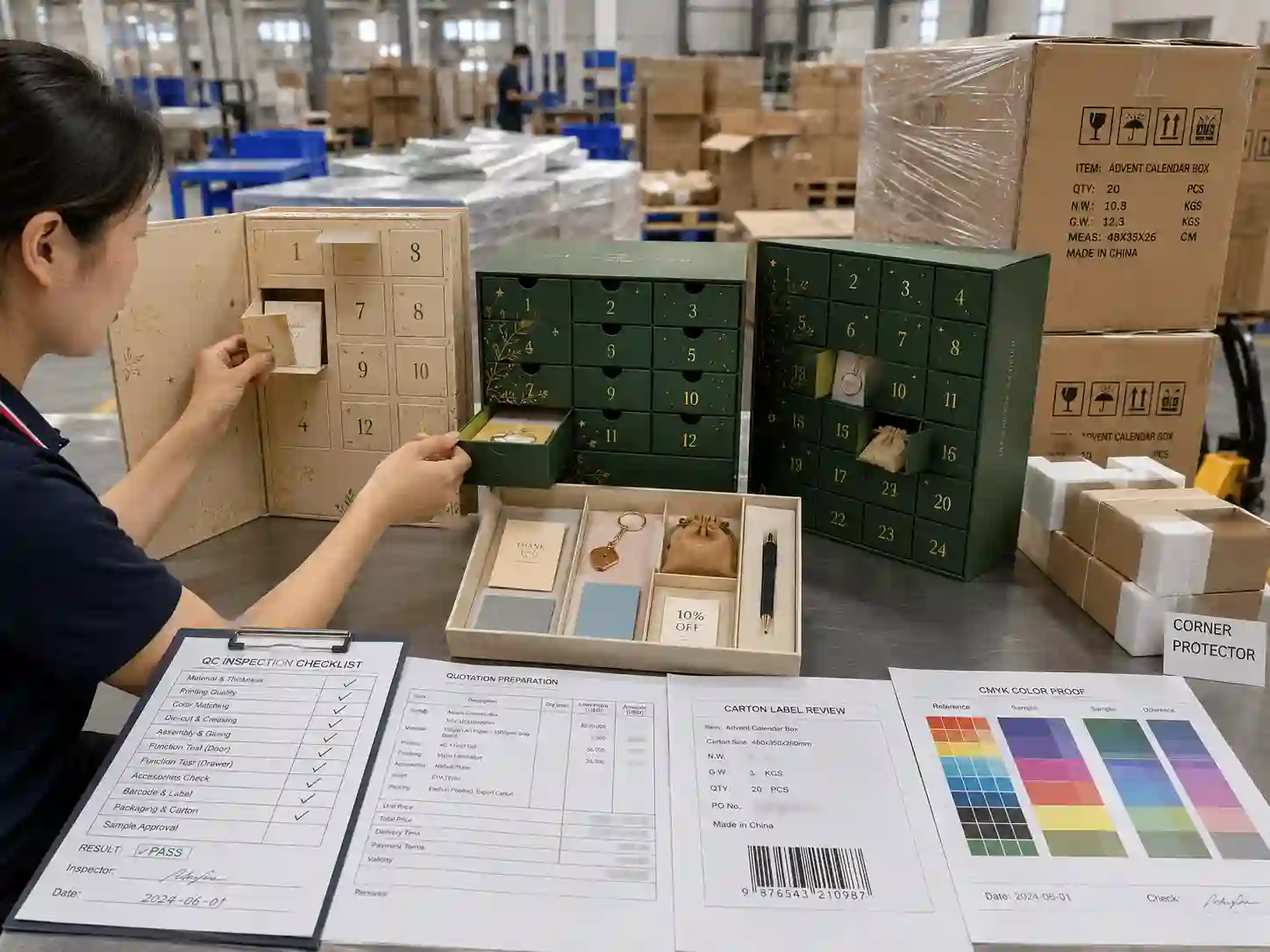
Final inspection should include visual checks and functional checks. A door-opening calendar should open cleanly without tearing the surrounding panel. A drawer box should slide smoothly without being too loose. Inserts should hold items in place but still allow removal. Printed panels should match the approved proof within agreed tolerance. Foil, embossing, and spot UV should align with the artwork layer and not shift into creases or cut lines.
Practical QC checklist before shipment
- Compare finished goods with the approved sample and color proof.
- Check dimensions, structure, door layout, drawer movement, and fold accuracy.
- Inspect lamination for bubbles, scratches, peeling, or heavy scuff marks.
- Check foil stamping, embossing, debossing, and spot UV registration.
- Confirm insert fit with actual promotional gifts or approved dummy samples.
- Check product loading sequence against the buyer’s compartment plan.
- Review barcode or QR code print clarity and label position.
- Check export carton strength, packing quantity, carton label, and shipping marks.
- Confirm corner protectors, pallet wrap, and pallet arrangement when palletized shipping is required.
QC tip: For mixed-item promotional calendars, inspect several packed units from different production cartons. One perfect top sample does not prove that every compartment is loaded in the correct sequence across mass production.
How should export packing be planned for overseas delivery?
Export packing should protect the finished calendar boxes during long-distance handling, carton stacking, container loading, warehouse movement, and last-mile delivery. Buyers should confirm export carton size, master carton quantity, gross weight, corner protection, moisture control if needed, pallet requirements, and shipping marks before shipment.
Promotional gift advent calendar boxes often have decorated surfaces, corners, drawers, doors, and inserts that can be damaged by compression or friction. A premium rigid box may need individual polybagging, tissue protection, corner protectors, or stronger corrugated cartons. A high-volume folding carton calendar may need efficient carton loading to control freight volume while still protecting printed surfaces.
Shipping marks should be generic unless the buyer requires specific brand or retailer information. Carton labels may include item number, quantity, carton number, gross weight, net weight, dimensions, destination, barcode area, and handling marks where appropriate. Buyers should provide retailer routing requirements early if the goods are going to a distribution center.
What information should buyers prepare before requesting a quotation?
Buyers should prepare product dimensions, quantity, structure preference, artwork status, material expectations, finishing needs, sample requirements, packing method, delivery deadline, and destination details before requesting a quotation. The more accurate the RFQ, the more useful the quotation will be.
Before contacting Giftpackpro, buyers can review custom advent calendar box products and related advent calendar box buying guides to compare possible structures and planning details. If the project is ready for supplier discussion, use the request a custom quote page and include the information below.
RFQ preparation checklist
- Project name and campaign type, such as retail promotion, corporate gift, e-commerce set, or distributor program.
- Target quantity or estimated MOQ range.
- Number of compartments, such as 7, 12, 24, 25, or custom layout.
- Product list with size, weight, material, and fragile points for every item.
- Preferred structure: door-opening box, drawer box, rigid box, folding carton, or fold-out calendar.
- Insert preference: paper insert, PET tray, EVA insert, foam, molded pulp, or supplier recommendation.
- Material preference: paperboard, greyboard, corrugated support, specialty paper, or sustainability requirement.
- Printing requirements: CMYK, Pantone color, inside printing, outside printing, or multilingual artwork.
- Finishing requirements: matte lamination, gloss lamination, foil stamping, embossing, debossing, spot UV, or soft-touch film.
- Artwork status: final artwork, rough layout, brand guide, or need for dieline first.
- Sample requirement: white sample, printed sample, pre-production sample, or production reference sample.
- Export packing needs: individual packing, master carton, pallet, shipping marks, Amazon or retailer label area.
- Destination country, delivery deadline, and preferred shipping method if known.
Factory tip: A complete RFQ should include both marketing goals and engineering details. “Premium promotional calendar for 24 gifts” is not enough; the factory also needs item sizes, weight distribution, insert preference, artwork requirements, finish effects, and packing expectations.
What common mistakes should buyers avoid?
Buyers should avoid approving artwork before the final dieline, choosing finishes without physical proof, ignoring insert tolerance, using weak export cartons, and comparing quotations without matching specifications. These mistakes can delay sampling, increase cost, or create problems during mass production.
- Mistake 1: Choosing structure from appearance only. A beautiful reference image may not support the actual product weight, shipping method, or campaign quantity.
- Mistake 2: Sending incomplete product information. Without accurate product dimensions, the insert may be too loose, too tight, or difficult to assemble.
- Mistake 3: Treating digital color as final color. CMYK, Pantone, paper surface, lamination, and lighting can all change the final result.
- Mistake 4: Placing special finishes too close to creases or die cuts. Foil stamping, embossing, and spot UV need safe margins and realistic registration tolerance.
- Mistake 5: Ignoring barcode and label zones. Glossy finishes, curved panels, small quiet zones, or busy graphics can affect scanning.
- Mistake 6: Requesting the lowest price without checking packing. Weak cartons, poor palletization, and unprotected corners may create damage during export shipping.
FAQ: Promotional gift advent calendar boxes for B2B buyers
What are promotional gift advent calendar boxes used for?
Promotional gift advent calendar boxes are used for seasonal campaigns, corporate gifting, retail promotions, e-commerce gift sets, product sampling, distributor programs, and loyalty campaigns. They organize multiple branded gifts or samples into numbered compartments for planned daily or staged opening.
Can one advent calendar box hold different types of promotional gifts?
Yes, but mixed items require careful compartment planning and insert testing. Buyers should provide item dimensions, weight, shape, and fragile points so the supplier can design paper inserts, PET trays, EVA inserts, foam, or molded pulp inserts correctly.
Is CMYK or Pantone better for brand color matching?
CMYK is practical for full-color artwork, while Pantone is better for important brand colors that need more controlled matching. Many promotional gift advent calendar boxes use CMYK for the main design and Pantone for key brand colors or campaign elements.
Should buyers approve a printed sample before mass production?
Yes, especially when color, foil stamping, embossing, spot UV, matte lamination, or gloss lamination is important. A printed sample or pre-production sample gives the buyer and factory a physical reference for mass production QC.
What affects the MOQ of custom advent calendar boxes?
MOQ is affected by box structure, material sourcing, printing setup, finishing process, insert type, tooling, and assembly labor. A simple paperboard folding carton may have different MOQ logic from a rigid drawer box with EVA insert and foil stamping.
How long does production take?
Lead time depends on sample approval, material availability, artwork complexity, finishing, tooling, order quantity, and factory schedule. Buyers should plan enough time for dieline confirmation, sample making, revisions, pre-production approval, mass production, QC, and export packing.
Can Giftpackpro help with structure and artwork checks?
Yes. Giftpackpro can support structure selection, dieline review, insert planning, sample development, printing proof checks, production planning, and export packing discussion through its custom advent calendar box services. Buyers can also learn more about the Giftpackpro packaging factory before starting a project.
How can buyers start a promotional gift advent calendar box project with Giftpackpro?
To start a promotional gift advent calendar boxes project, prepare the product list, target quantity, preferred structure, insert requirement, artwork files or brand guide, finishing preferences, delivery schedule, and export packing needs. Giftpackpro can then review the packaging direction, recommend structure and insert options, prepare a quotation, and discuss sample development.
For a faster response, include product photos, dimensions, weight, number of compartments, destination country, and whether you need a white sample, printed sample, or pre-production sample. Clear information helps the factory reduce assumptions, compare options accurately, and quote a practical production solution for your seasonal campaign.
If your team is planning promotional gift advent calendar boxes for retail, e-commerce, wholesale, or corporate gifting, contact Giftpackpro to request a custom quote with your structure, artwork, insert, MOQ, lead time, QC, and export-packing requirements.


