
Quick answer: Cat treat advent calendar boxes should be designed around product fit first, then structure, inserts, printing, sampling, QC, and export packing. For B2B buyers, the key decisions are compartment size, pouch or treat protection, insert material, opening style, artwork tolerance, sample approval, MOQ planning, and carton packing method. A reliable supplier should help check the dieline, test the loaded product, confirm printing proofs, inspect assembly quality, and prepare export cartons that reduce damage in transit. The best quotation starts with clear product dimensions, quantity, structure preference, artwork files, packing method, and delivery requirements.
What should buyers understand before ordering cat treat advent calendar boxes?
Buyers should understand that the box is not only a seasonal retail display; it is a packaging system that must hold small pet treat pouches, sachets, dental treats, sample packs, or mixed SKUs securely across production, warehousing, shipping, and retail handling.
For overseas brands, wholesalers, e-commerce sellers, and purchasing teams, the most important question is not only “How does the calendar look?” but “Can each product stay in the correct compartment after assembly, export shipment, and customer handling?” This is why cat treat advent calendar boxes require early product-fit testing, insert planning, and sample approval before mass production.
Giftpackpro works as a custom advent calendar boxes manufacturer for B2B buyers who need packaging that supports seasonal campaigns, retail gift sets, online bundles, and private-label programs. A practical project should define the structure, insert, material, printing, MOQ, lead time, and export packing method before the buyer confirms a production order.
Which box structure is best for cat treat advent calendar boxes?
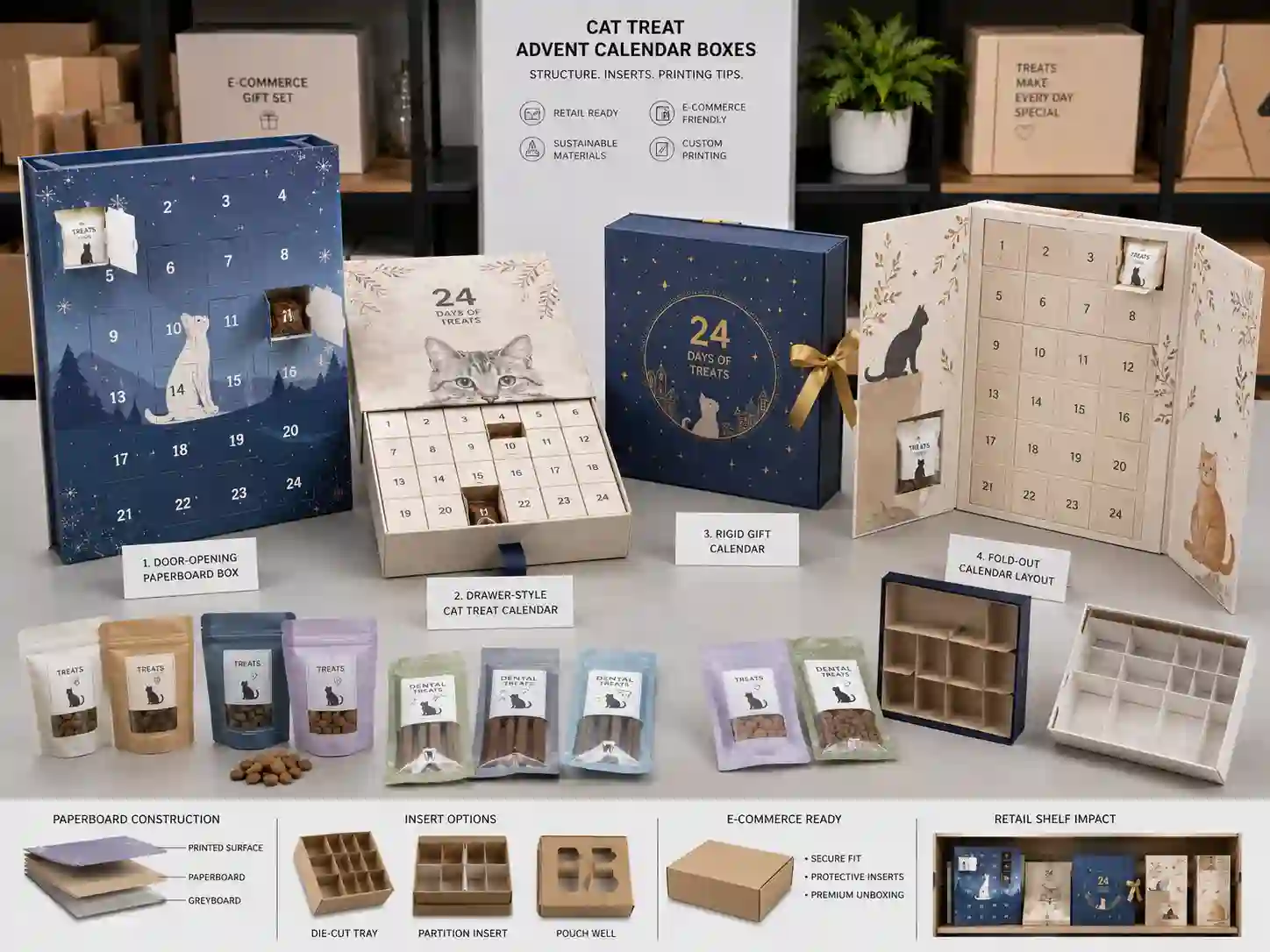
The best structure depends on treat format, campaign quantity, retail channel, budget, and expected unboxing style. Door-opening paperboard boxes are common for lightweight pouches, drawer boxes work well for premium gift sets, rigid boxes support heavier or higher-value campaigns, and fold-out formats help display multiple products across a wider layout.
| Structure option | Best use case | Product-fit advantage | Buyer consideration |
|---|---|---|---|
| Door-opening paperboard box | Lightweight cat treat sachets, small pouches, daily reward packs | Numbered doors keep the seasonal format familiar and efficient for retail | Door perforation and compartment tolerance must be tested before production |
| Drawer box | Premium cat treat sets, mixed flavors, limited-edition campaigns | Drawers can separate flavors, sachets, or dental treat packs more securely | Drawer sliding tolerance affects user experience and assembly speed |
| Rigid box with greyboard | Higher-value gift sets, retail display, influencer or subscription campaigns | Strong greyboard structure improves protection and shelf presence | Higher material, labor, and shipping volume usually increase cost |
| Folding carton calendar | Large-volume campaigns with cost-sensitive pricing | Can be flat-packed or assembled efficiently for lightweight treats | Needs careful board selection to avoid bending during shipment |
| Fold-out calendar layout | Multi-SKU flavor stories, promotional bundles, retail display openings | Allows wider compartment spread and better visual merchandising | Requires accurate dieline control and stability testing when opened |
Buyer tip: Do not choose a rigid box only because it looks premium. If the packed cat treats are light, a well-engineered paperboard door-opening box may meet retail needs at a lower landed cost. If the treats include glassine packs, larger dental pieces, or multiple pouch sizes, a drawer or rigid structure may reduce product movement more effectively.
How should inserts be selected for cat treat product fit?
Inserts should be selected according to product weight, pouch shape, fragility, hygiene requirements, assembly speed, and sustainability expectations. The insert is the part that controls movement, so it often matters more than the outer box style.
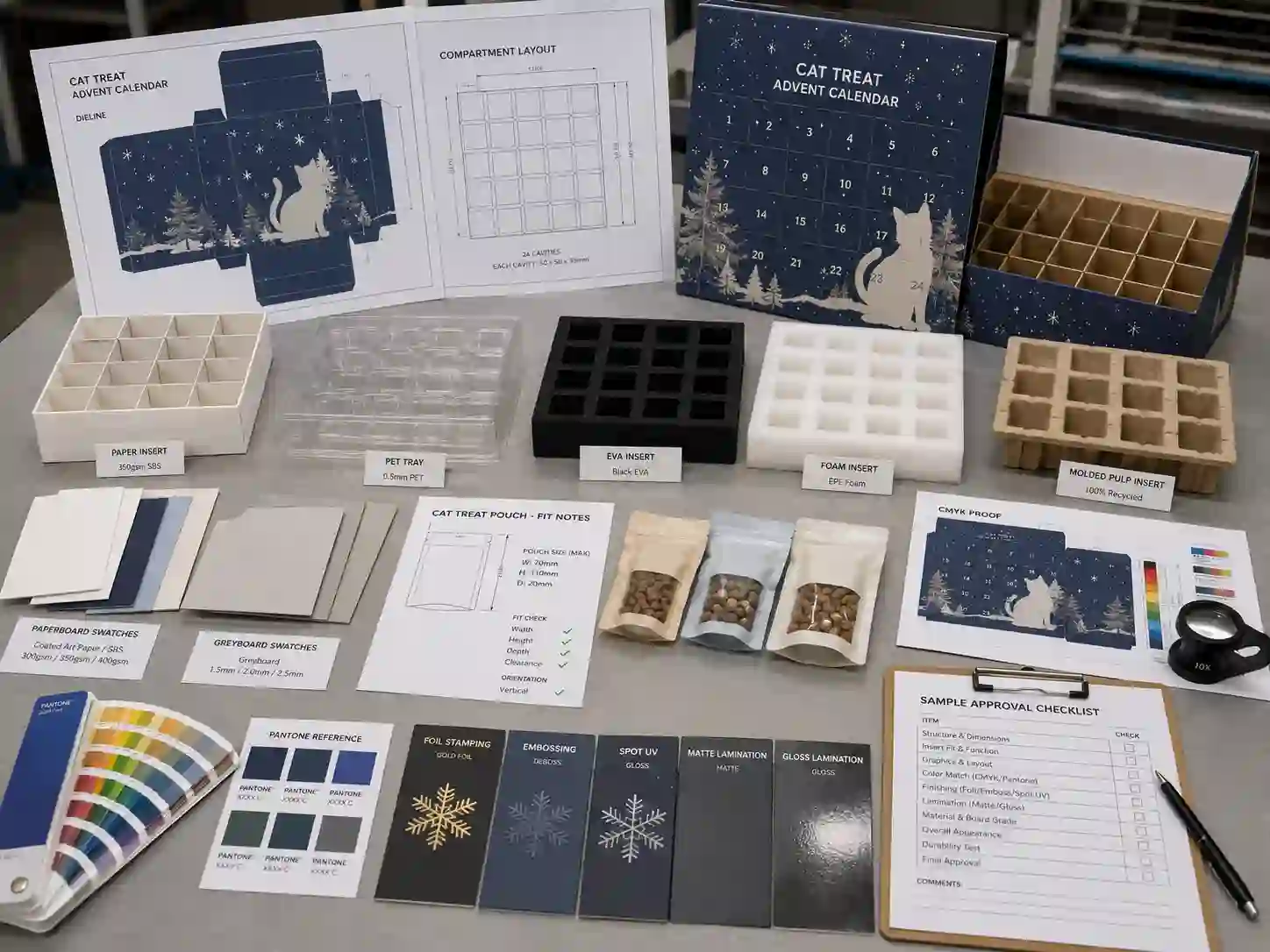
Common insert choices include paperboard insert, PET tray, EVA insert, foam insert, and molded pulp insert. Each option affects tooling, cost, appearance, product hold, and recyclability. Buyers should send real filled samples or accurate dummy samples to the factory before finalizing the insert layout.
When should buyers choose a paperboard insert?
A paperboard insert is suitable for lightweight cat treat pouches, small sachets, and simple compartment layouts. It is often preferred when buyers want a paper-based packaging solution, efficient mass production, and easier flat shipping.
Paper inserts can be die-cut, folded, glued, or locked into the calendar body. They are cost-effective for many custom advent calendar boxes, but the compartment walls must be strong enough to prevent sachets from shifting behind doors. For uneven treat packs, the supplier should test whether the pouch corners catch on the opening or push against the outer door.
When is a PET tray useful?
A PET tray is useful when each treat pouch or small sample pack needs a molded cavity and clear position control. It can improve product placement consistency, especially when the box contains different shapes or small fragile items.
The buyer should check whether the tray is acceptable for the retail market and recycling message. If the campaign requires a paper-focused sustainability claim, molded pulp or paperboard may be better. If precise cavity shape and quick factory loading are more important, PET may be a practical option.
When should buyers consider EVA or foam inserts?
EVA and foam inserts are useful when the calendar contains premium accessories, fragile components, or non-standard pieces that need cushioning. For ordinary soft cat treat pouches, EVA or foam may be unnecessary unless the campaign includes fragile gift items.
These inserts can provide a clean premium look, but they also add material cost, tooling requirements, and potential sustainability concerns. Buyers should ask whether the material surface may leave marks on packaging film, printed sachets, or delicate product labels during long-distance shipping.
When is molded pulp a good option?
Molded pulp is a practical choice when buyers want paper-based cushioning and a more sustainable presentation for heavier or irregular items. It can hold products better than a flat paper insert but usually requires more development time than simple die-cut paperboard.
For cat treat advent calendar boxes, molded pulp may be useful when the pack includes small tins, jars, rigid sample cups, or mixed pet gift items. For flexible sachets, it may be over-engineered unless the brand requires a molded, paper-based positioning system.
How should compartments be engineered for cat treat pouches and dental treats?
Compartments should be based on the actual loaded product size, not the empty pouch size. Cat treat packs can become thicker, rounded, or uneven after filling, so buyers should measure length, width, thickness, sealing edge, and natural bulge.
A common mistake is approving a compartment based only on the flat pouch artwork. During real loading, a filled sachet may sit diagonally, press against a door, or block the opening. The supplier should test real product samples in the prototype and confirm whether the door opens cleanly without pulling the pouch out too early.
- Measure filled product thickness: Include the thickest point, not only the printed pouch dimensions.
- Check sealing edges: Heat-sealed edges can catch on paper insert cuts or narrow compartments.
- Allow loading tolerance: Factory workers need enough space to place products quickly without damaging doors.
- Test vertical and horizontal positions: Some pouches fit better standing upright; others need a flat cavity.
- Separate heavy items: Dental treat packs or larger pouches should not crush smaller sachets during transit.
- Confirm numbering logic: Compartment sequence should match the buyer’s flavor plan, allergen notes, or product rotation if applicable.
Factory tip: For mixed cat treat sizes, design the calendar around the largest and thickest item first, then adjust smaller compartments with insert locks, bridges, or cavity reductions. This approach reduces late-stage dieline revisions.
What materials matter for structure, inserts, and durability?
Material selection should balance strength, appearance, product weight, export distance, and price target. Paperboard is suitable for many folding and door-opening calendars, while greyboard is suitable for many folding and commonly used for rigid box structures that need stronger shelf presence.
For a seasonal pet treat campaign, buyers should consider the full supply chain. A box may look acceptable in a sample room but still bend inside a master carton if the board grade, insert support, or export packing is too weak. The correct material should be confirmed through a loaded sample and carton packing test, not only by a swatch photo.
| Material or component | Role in the calendar | Practical buying note |
|---|---|---|
| Paperboard | Outer folding carton, doors, sleeves, and paper inserts | Good for lightweight packs, but thickness and grain direction affect stiffness |
| Greyboard | Rigid box walls, drawers, premium calendar base | Improves strength and presentation, but increases weight and freight volume |
| Paper insert | Separates pouches and supports door openings | Cost-efficient, but must be tested for compartment movement |
| PET tray | Molded cavity positioning | Useful for precise placement, but recycling and market requirements should be checked |
| EVA or foam | Cushioning and premium product hold | Best for fragile or premium mixed items, not always needed for soft pouches |
| Molded pulp | Paper-based molded support | Good for shaped protection, but may need more development time |
Buyers who need responsible sourcing claims should verify material documentation directly with the supplier and certification body. For example, buyers can review the official FSC website when planning certified paper sourcing requirements. Do not assume any certification applies unless it is stated on the supplier’s quotation, sample documentation, and production paperwork.
How do printing and finishing choices affect pet treat calendar production?
Printing and finishing choices affect brand presentation, color consistency, lead time, and cost. CMYK is commonly used for full-color seasonal artwork, Pantone helps control brand colors, and finishes such as foil stamping, embossing, spot UV, matte lamination, and gloss lamination should be tested on the actual board surface.
Cat treat advent calendar boxes often include many small numbered doors, flavor names, feeding notes, icons, or product callouts. These design elements must stay readable after die-cutting, folding, gluing, and assembly. Buyers should keep critical text away from cut lines, crease lines, perforations, and drawer edges.
What should buyers check in artwork files?
Buyers should check dieline accuracy, bleed, safe area, barcode position, color mode, finishing layers, and compartment numbering before approving artwork. A packaging dieline is a manufacturing document, not only a design template.
- Confirm the latest dieline version before placing artwork.
- Keep important text away from doors, folds, glue flaps, and drawer cuts.
- Use CMYK files unless the supplier requests another print setup.
- Specify Pantone colors for brand-critical areas where needed.
- Mark foil stamping, embossing, debossing, and spot UV as separate layers.
- Reserve a clear barcode label area if the box will be used for retail or e-commerce.
- Check language, feeding information, ingredient callouts, and market compliance with the buyer’s own regulatory team.
For barcode planning, buyers can reference official guidance from GS1 barcode standards. The packaging supplier can reserve the barcode area, but the brand or importer should confirm barcode ownership, data accuracy, and retail acceptance.
Buyer tip: If the calendar has 24 or 25 numbered doors, ask the supplier to provide a low-resolution structural proof or blank sample before final artwork locking. This reduces the risk of placing key graphics across perforation lines or hidden assembly areas.
How should samples and prototypes be approved before mass production?
Samples should be approved in stages: structure sample, printed sample, loaded fit test, and pre-production sample when needed. This staged approval process helps buyers catch structural, insert, printing, and assembly issues before mass production.
A blank prototype is useful for checking size, opening function, insert layout, and product loading. A printed sample is useful for color, finish, artwork placement, and retail appearance. A pre-production sample is important when the buyer needs the final material, printing, insert, assembly method, and packing approach confirmed before bulk production.
What should a loaded sample test include?
A loaded sample test should simulate how the calendar will be filled, closed, packed, shipped, opened, and displayed. It should not stop at checking whether the product can physically fit inside the cavity.
- Place real filled cat treat pouches or accurate dummy samples in each compartment.
- Close doors, drawers, sleeves, or fold-out panels using the planned assembly method.
- Shake or tilt the sample gently to check whether products move between compartments.
- Open each door or drawer to confirm the product can be removed without tearing the structure.
- Check whether pouch corners, sachet seals, or dental treat packs press against the print surface.
- Pack the loaded sample in the proposed inner carton or export carton arrangement.
- Review photos or videos with the supplier before approving the final production method.
QC tip: Sample approval should include a written record of material, size, insert type, printing process, finishing process, packing method, and approved tolerance. Verbal approval is risky when multiple teams handle purchasing, artwork, production, and logistics.
What are the main MOQ, cost, and lead time drivers?
The main cost drivers are structure complexity, material grade, insert type, printing coverage, finishing process, assembly labor, sample development, order quantity, and export packing method. MOQ depends on material sourcing, printing setup, tooling, finishing, and production efficiency.
For cat treat advent calendar boxes, cost can change significantly when the buyer switches from a folding carton to a rigid box, from a paper insert to a molded tray, or from standard printing to multiple premium finishes. Lead time can also increase when the project requires new tooling, several sample revisions, or complex manual assembly.
| Decision | Cost impact | Lead time impact | How buyers can control risk |
|---|---|---|---|
| Custom structure | Higher when the dieline is complex or unique | More time for engineering and sample revision | Share product dimensions early and approve structure before artwork |
| Insert material | Paper insert is usually more economical than EVA, foam, or molded tray options | Tooling or mold work can extend development | Choose the simplest insert that protects the product reliably |
| Printing and finishing | Foil stamping, embossing, spot UV, and special lamination add cost | Extra processes require scheduling and proof checking | Use premium finishes on high-impact areas instead of every panel |
| Manual assembly | More drawers, compartments, and inserts increase labor | Assembly testing may be needed before bulk packing | Ask for assembly photos, loading instructions, and packing samples |
| Export packing | Stronger cartons, dividers, corner protectors, and pallets add packing cost | May require carton testing and packing confirmation | Balance protection with freight volume and warehouse handling needs |
Buyers can discuss MOQ, sampling, and production planning through Giftpackpro’s custom advent calendar box services. For early benchmarking, it is also useful to review custom advent calendar box products and compare which structures are closest to the planned pet treat campaign.
How should buyers compare suppliers for cat treat advent calendar boxes?
Buyers should compare suppliers by engineering support, sample quality, insert testing, printing control, communication speed, QC process, export packing experience, and quotation clarity. The lowest unit price is not always the lowest project cost if it causes late revisions, damaged cartons, or missed seasonal delivery windows.
A capable supplier should be able to explain how the structure is made, how the insert holds the product, which materials are being quoted, which finishes are included, how sampling will be handled, and how final cartons will be packed. Buyers should also ask whether the supplier can provide photos of sample review, production inspection, and packing confirmation.
Supplier comparison checklist
- Can the supplier review real product dimensions before quoting?
- Can they recommend a suitable paper insert, PET tray, EVA insert, foam insert, or molded pulp insert?
- Do they provide a dieline for artwork placement and approval?
- Can they make a blank sample or printed sample before bulk production?
- Do they define material thickness, board type, printing method, and finishing process clearly?
- Do they check door-opening, drawer sliding, insert fit, and loaded product stability?
- Do they provide QC photos, final inspection details, and export carton information?
- Do they understand overseas shipment needs, pallet requirements, shipping marks, and carton label review?
- Do they give a clear quotation with MOQ, lead time, packing method, payment terms, and revision limits?
Buyers can learn more about production capability through the Giftpackpro packaging factory page and continue comparing planning topics in the advent calendar box buying guides.
What QC checks matter before export shipment?
QC should check structure, insert fit, printing, finishing, assembly, loaded stability, carton packing, and shipping marks. For seasonal campaigns, final inspection is especially important because late defects may be difficult to replace before the retail launch date.
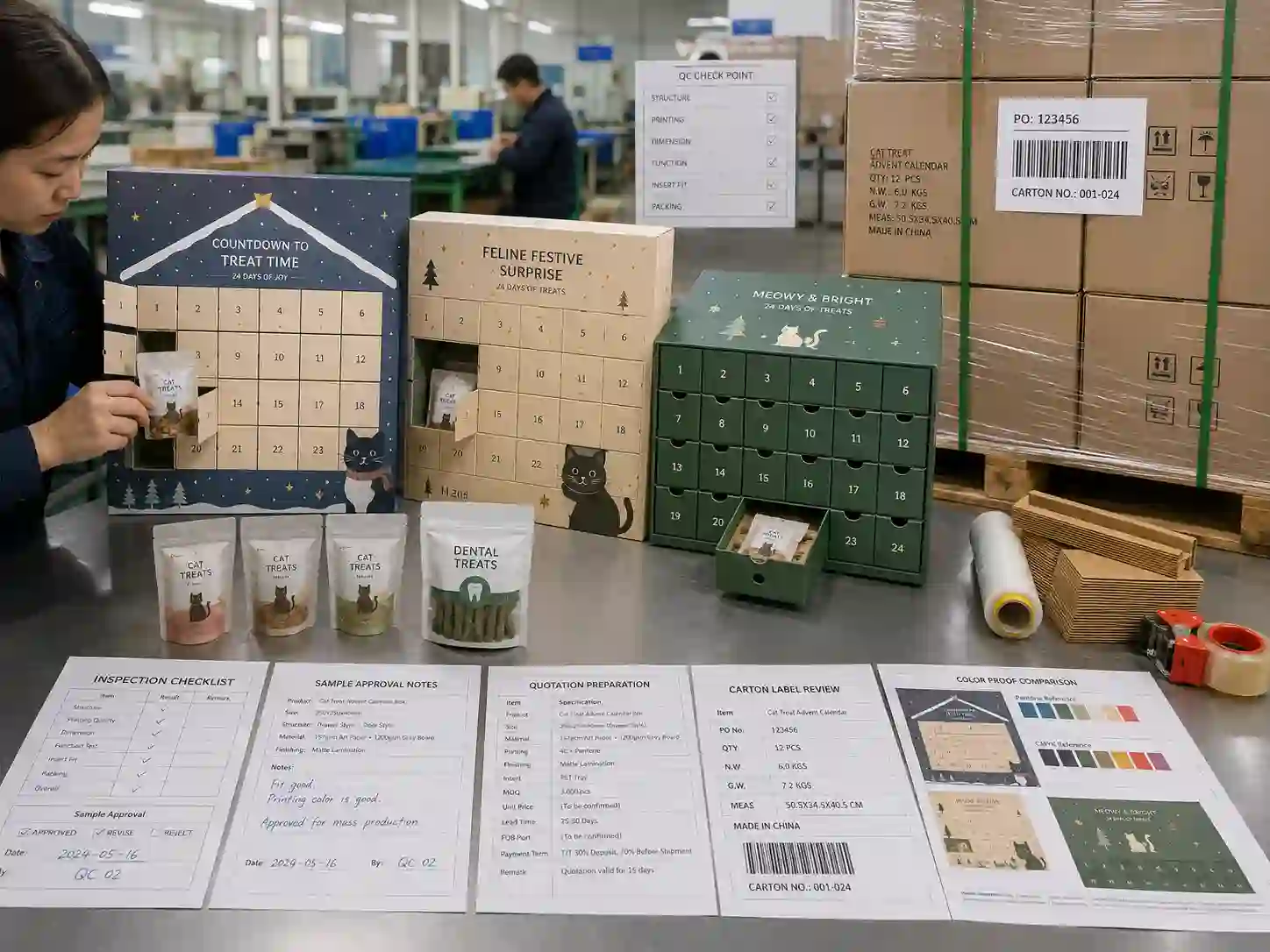
For cat treat advent calendar boxes, quality control should not only inspect the outside artwork. The factory should also open doors, slide drawers, check compartment positions, inspect glued areas, confirm insert placement, review color consistency, and verify that the export carton protects the packed calendars during handling.
Practical QC checklist for buyers
- Size check: Confirm outer dimensions, compartment dimensions, and insert position against the approved sample.
- Function check: Open doors and drawers to test tearing, sliding, locking, and removal experience.
- Insert check: Confirm that paper inserts, trays, foam, EVA, or molded pulp parts are correctly placed and stable.
- Print check: Review CMYK color, Pantone areas, registration, scratches, scuffing, and barcode space.
- Finish check: Inspect foil stamping, embossing, spot UV, matte lamination, or gloss lamination for alignment and defects.
- Assembly check: Check glue strength, panel alignment, drawer fit, folding lines, and door perforation.
- Loaded product check: Confirm that cat treat pouches or dummy packs stay in the intended compartments.
- Carton check: Review master carton strength, carton label, shipping marks, corner protection, and pallet plan.
QC tip: For mixed-product calendars, request inspection photos showing the inside structure, not only closed-box exterior photos. Interior photos help confirm that inserts and compartment loading match the approved sample.
How should export packing be planned for bulk orders?
Export packing should be planned according to assembled size, carton strength, loading method, pallet requirements, and destination handling. Advent calendar boxes can be bulky, so carton quantity and pallet efficiency can affect landed cost as much as unit price.
Buyers should decide whether the calendars ship flat, semi-assembled, or fully assembled. Flat packing may reduce volume but can shift assembly labor to the buyer or co-packer. Fully assembled packing is convenient for retail programs but requires stronger export cartons and careful internal protection. Corner protectors, dividers, shrink wrap, pallet wrap, and clear shipping marks may be needed depending on the route and order size.
Export-packing decision guide
- Choose flat packing when freight volume is a priority and the buyer has a reliable local packing or assembly team.
- Choose assembled packing when the buyer wants faster receiving, retail-ready handling, or direct e-commerce preparation.
- Use stronger master cartons when rigid boxes, drawer boxes, or premium printed surfaces need better protection.
- Use pallet packing when the shipment volume is large or warehouse handling requires palletized goods.
- Confirm shipping marks before production finishes, especially when multiple SKUs, languages, or destination warehouses are involved.
Buyers should ask the supplier to include carton dimensions, gross weight, net weight, pieces per carton, and pallet quantity in the quotation when available. These details help purchasing and logistics teams compare suppliers on total landed cost, not only product price.
What information should buyers prepare before requesting a quotation?
Buyers should prepare product dimensions, product weight, quantity, structure preference, insert preference, artwork expectations, sample needs, packing method, destination, and target delivery date. A clear RFQ helps the supplier quote faster and reduces assumptions that may later change price.
For cat treat advent calendar boxes, the most useful quotation package includes real filled pouch samples or detailed drawings, because insert engineering depends on the actual product shape. If the product is not ready, buyers can provide estimated filled dimensions and update them before sample approval.
RFQ preparation checklist
- Calendar format: 12-day, 24-day, 25-day, monthly sampler, or custom compartment count.
- Product list: pouch size, sachet size, dental treat pack size, weight, and quantity per compartment.
- Structure preference: rigid box, folding carton, drawer box, door-opening box, or fold-out layout.
- Insert preference: paper insert, PET tray, EVA insert, foam insert, molded pulp insert, or supplier recommendation.
- Material expectation: paperboard, greyboard, recycled paper, special paper, or certified paper request.
- Printing details: CMYK, Pantone, foil stamping, embossing, spot UV, matte lamination, or gloss lamination.
- Artwork status: ready artwork, rough design, dieline needed, or design revision required.
- Sample requirement: blank sample, printed sample, loaded sample, or pre-production sample.
- Order quantity and MOQ target: estimated launch quantity, reorder possibility, and market destination.
- Packing requirement: flat packed, assembled, retail-ready, export carton, pallet, shipping marks, or warehouse label.
- Schedule: sample deadline, mass production deadline, shipment date, and retail launch date.
To move from planning to supplier review, buyers can request a custom quote from Giftpackpro and include product dimensions, target quantity, preferred structure, insert requirements, artwork files, and destination information.
What common mistakes should buyers avoid?
The most common mistakes are choosing the outer box before testing product fit, approving artwork before confirming the dieline, ignoring insert movement, underestimating assembly labor, and comparing quotations without checking material and packing details.
- Approving based on empty pouches: Filled treats may be thicker and less flexible than artwork files suggest.
- Using one compartment size for all products: Mixed cat treat packs often need different cavity sizes or insert supports.
- Placing graphics across cut lines: Door perforations, folds, and drawer edges can interrupt important artwork.
- Skipping loaded sample review: A blank sample cannot confirm real product movement during export shipment.
- Ignoring carton packing: Premium calendars can arrive damaged if export cartons are weak or overpacked.
- Comparing only unit price: Tooling, sample cost, assembly, finishing, carton quantity, pallet plan, and freight volume all affect total cost.
- Leaving RFQ details vague: Suppliers may quote different materials or structures, making price comparison unreliable.
Factory tip: A quotation for cat treat advent calendar boxes should always state the structure, size, material, insert type, printing process, finishing process, sample plan, MOQ, lead time, packing method, and quotation validity. If these details are missing, buyers should request clarification before comparing prices.
FAQ: Cat treat advent calendar boxes for B2B buyers
What is the best insert for cat treat advent calendar boxes?
The best insert depends on the product. Paperboard inserts are suitable for many lightweight sachets and pouches, PET trays help with precise cavity control, EVA and foam support premium or fragile mixed items, and molded pulp works when buyers want shaped paper-based protection.
Can one advent calendar box hold different cat treat sizes?
Yes, but the insert and compartment layout must be engineered for mixed sizes. Buyers should provide the largest, thickest, and most irregular product samples first so the supplier can prevent movement, pressure, or door-opening problems.
Should buyers choose a rigid box or folding carton?
A rigid box is better for premium retail presentation and stronger structure, while a folding carton can be more cost-efficient for lightweight treats and larger-volume campaigns. The right choice depends on budget, product weight, retail positioning, and export packing needs.
What sample should be approved before bulk production?
Buyers should approve at least a structure sample and, for custom printed orders, a printed sample. For mixed cat treat pouches or premium campaigns, a loaded sample or pre-production sample is strongly recommended before mass production.
How does printing affect lead time?
Standard CMYK printing is usually more straightforward than artwork with Pantone matching, foil stamping, embossing, spot UV, matte lamination, or gloss lamination. Each added process may require proofing, setup, drying, alignment checks, and extra inspection.
What should be included in the quotation request?
A quotation request should include product dimensions, compartment count, structure preference, insert type, material request, printing and finishing details, quantity, sample requirement, packing method, destination, and target delivery date.
Conclusion: how to plan cat treat advent calendar boxes with fewer production risks
Cat treat advent calendar boxes should be planned from the inside out: confirm product size, choose the correct insert, select a suitable structure, check the dieline, approve samples, control printing, inspect assembly, and protect the boxes with proper export packing. This process helps buyers reduce revisions, compare suppliers more accurately, and prepare a clearer quotation request.
For B2B seasonal campaigns, the best packaging decision is the one that balances product fit, retail presentation, MOQ, lead time, QC control, and landed cost. Buyers preparing a new pet treat calendar can share their product list, filled pouch sizes, artwork status, quantity target, and packing requirements with Giftpackpro for structure and insert review.


