Quick answer: To design cat treat advent calendar boxes for seasonal campaigns, buyers should start with the treat format, sales channel, target carton size, and opening experience. The best structure depends on whether the calendar holds flat sachets, small pouches, dental treats, freeze-dried snacks, or mixed cat gifts. Door-opening paperboard boxes suit lightweight retail programs, drawer boxes improve premium presentation, rigid boxes protect heavier gift sets, and fold-out layouts create stronger shelf impact. Before requesting a quotation, prepare product dimensions, filled weight, 12-day or 24-day layout, insert preference, artwork requirements, sample schedule, export packing needs, and barcode or label zones.
What should buyers decide before designing cat treat advent calendar boxes?
Buyers should decide the treat count, product dimensions, filled weight, retail channel, and opening style before choosing the box structure. These decisions control the dieline, compartment layout, insert material, paperboard thickness, sample cost, MOQ, and mass production lead time.
For cat treat advent calendar boxes, the packaging must do more than look seasonal. It must separate small food pouches or sachets, prevent compartment collapse, support repeated opening, keep artwork aligned with numbered doors or drawers, and survive export shipping. A calendar for 24 lightweight sachets can often use folding carton paperboard with a paper insert, while a premium mixed set with pouches, dental treats, and small toys may need greyboard, drawer construction, or a reinforced rigid box.
Before structure work starts, purchasing teams should confirm whether the treats are individually sealed. Most paper advent calendar boxes are secondary packaging. If any treat touches the packaging directly, buyers must raise food-contact material requirements during RFQ discussion, not after sampling.
Buyer tip: Treat dimensions should be measured from filled products, not empty pouches. A pouch with air, crimped seals, or an uneven freeze-dried treat shape may need 2-5 mm more clearance than the flat artwork file suggests.
Which box structure fits a seasonal cat treat campaign?
The right structure depends on product weight, price positioning, display channel, and how buyers want consumers to open each day. Door-opening boxes are efficient for high-volume campaigns, drawer boxes feel more premium, rigid boxes offer better protection, and fold-out boxes create a larger storytelling area for retail displays.
| Structure option | Best for | Key advantages | Buyer watch-outs |
|---|---|---|---|
| Door-opening paperboard box | 12-day or 24-day cat treat sachet programs, supermarket promotions, e-commerce bundles | Cost-efficient, lightweight, strong numbered-door experience, suitable for bulk production | Door perforation strength, compartment crush risk, pouch thickness variation, front panel bowing |
| Drawer box | Premium cat treat sets, mixed treat formats, gift companies, subscription-style programs | Better product reveal, reusable feeling, stronger perceived value, easy product loading | Higher assembly labor, drawer sliding tolerance, heavier export carton weight |
| Rigid box | High-value seasonal gift sets, heavier pouch mixes, brand launches, retail buyer presentations | Strong protection, premium finish, good for foil stamping, embossing, and matte lamination | Higher unit cost, longer sampling time, larger storage volume, stricter export packing needs |
| Folding carton calendar | Lightweight sachets, promotional retail campaigns, price-sensitive programs | Efficient material usage, faster packing, easier flat shipping before assembly in some designs | Less premium feel, lower crush resistance, insert must be engineered carefully |
| Fold-out calendar box | Campaigns needing large artwork area, multiple treat groups, retail shelf storytelling | Strong visual impact, flexible layout, good for product education panels | More complex dieline, hinge durability, possible higher manual assembly cost |
When is a door-opening structure the best choice?
A door-opening structure is usually best when the buyer needs a recognizable advent calendar experience at scale. It works well for individually packed cat treat sachets, small pouches, or dental treat portions that fit behind numbered windows.
The most important engineering detail is the balance between easy opening and transport strength. If the perforation is too weak, doors may pop open during packing or shipping. If it is too strong, users may tear the front panel. During sample review, buyers should test door opening with actual loaded treats, not with empty compartments.
When should buyers choose drawer cat treat advent calendar boxes?
Drawer boxes are suitable when the campaign needs a premium gift feel or when product sizes vary across days. Each drawer can hold a pouch, sachet, small toy, or dental treat pack with less pressure on perforated front doors.
Drawer construction is especially useful for mixed cat treat campaigns where some days include larger pouches and others include sample sachets. However, drawer sliding tolerance must be checked carefully. If the drawer is too tight after lamination or humidity exposure, the user experience suffers. If it is too loose, drawers may shift during export transport.
When does a rigid box make sense?
A rigid box makes sense for premium seasonal campaigns where protection and presentation are more important than the lowest unit cost. It is often selected for retail buyer pitches, high-value gift sets, and campaigns using thicker pouches or mixed pet gift items.
Rigid cat treat advent calendar boxes usually use greyboard wrapped with printed paper. Buyers should confirm greyboard thickness, wrap paper specification, corner construction, glue quality, and whether the design can pass the intended drop, compression, or handling requirements. Rigid structures also create more opportunities for foil stamping, embossing, spot UV, matte lamination, and gloss lamination.
How should compartment size and layout be planned?
Compartment size should be based on the largest filled treat pack, not the average item. A good layout gives every pouch enough clearance, keeps the box balanced, and leaves safe space for door hinges, drawer walls, insert bridges, and barcode or label areas.
For 24-day cat treat calendars, buyers often try to make all compartments identical for production efficiency. This works when all treats use the same sachet size. If the campaign includes mixed pouches, crunchy treats, freeze-dried pieces, and dental treats, a mixed compartment layout may be safer. The dieline should mark each product position clearly so the loading team does not place the wrong item into the wrong day.
Important layout decisions include:
- 12-day, 24-day, or custom countdown format
- Vertical, horizontal, book-style, or fold-out orientation
- Compartment depth based on filled pouch thickness
- Number sequence for retail display and user experience
- Extra clearance for sealed edges and pouch crimping
- Space for ingredient labels, nutrition panels, barcode, QR code, and warning statements if required by the brand
- Outer carton size and pallet efficiency for export shipments
Factory tip: A calendar layout that looks beautiful on screen can become unstable in mass production if too many heavy products are placed on one side. Weight distribution should be checked during prototype loading.
Which insert material should hold cat treats securely?
The insert should match the treat format, pack weight, sustainability target, and loading method. Paper inserts are common for lightweight sachets, PET trays offer precise cavities, EVA and foam provide cushioning for premium mixed gifts, and molded pulp can support paper-based packaging goals when the shape allows it.
| Insert type | Suitable cat treat format | Strengths | Questions to ask supplier |
|---|---|---|---|
| Paper insert | Flat sachets, small pouches, lightweight samples | Paper-based, printable, cost-efficient, easy to recycle in many markets where facilities exist | What paperboard thickness is used? Will the insert bridge collapse under loaded weight? |
| PET tray | Uniform pouches, cups, small sealed packs, shaped treat packs | Accurate cavities, good product visibility during packing, stable for repeated handling | What tray thickness is required? Is recycled-content or market-specific material documentation needed? |
| EVA insert | Premium mixed gifts, fragile accessories, heavier small items | Good cushioning, clean presentation, suitable for high-value sets | Does the buyer accept foam material? Will odor, color, or indentation affect the product presentation? |
| Foam insert | Protective premium sets with varied product sizes | Flexible cushioning, easy custom cutting, useful for uneven items | Is foam suitable for the brand’s sustainability policy and target retail market? |
| Molded pulp insert | Bulkier sealed pouches or paper-based seasonal gift programs | Paper-fiber appearance, protective shape, good for plastic-reduction positioning | Can the cavity tolerance hold small sachets tightly enough? What tooling time is needed? |
For cat treat advent calendar boxes, insert testing should include shaking, tilting, opening, and repacking. A pouch may remain stable when the box is flat but slide behind the door when the box is displayed vertically. Buyers should also test whether treats create bulging on the front panel after loading.
How do material choices affect structure, cost, and retail quality?
Material choice affects box stiffness, print result, assembly tolerance, export protection, and unit cost. Folding carton paperboard is efficient for lighter programs, while greyboard is better for rigid boxes and premium gift sets.
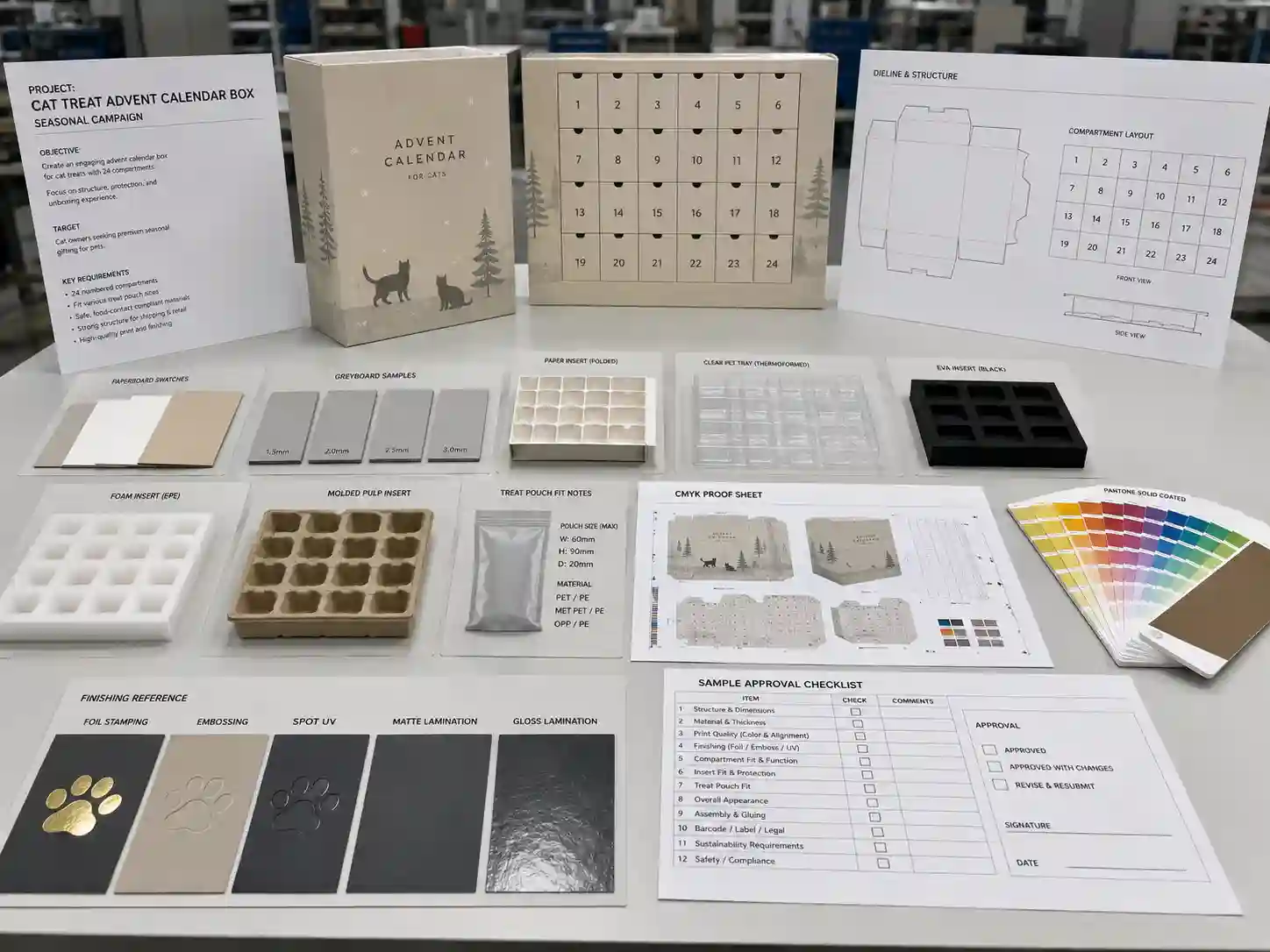
For door-opening calendars, common decisions include front paperboard thickness, back panel strength, internal grid design, and whether the structure needs reinforcement around perforated doors. For rigid calendars, buyers should review greyboard thickness, wrapped paper quality, corner finishing, and the strength of glue areas.
Material planning should also consider market expectations. Some retailers request paper sourcing documentation or chain-of-custody verification. Buyers can review official information from FSC paper and packaging guidance when responsible fiber sourcing is part of the purchasing brief.
Quotable B2B statement: “For cat treat advent calendar boxes, the lowest paper weight is rarely the safest choice; the correct material is the one that holds the loaded treat weight, keeps doors aligned, and protects the box through export handling.”
What dieline details should be checked before artwork starts?
The dieline should be approved before final artwork because structure controls print safety zones, door cuts, fold lines, glue areas, and compartment positions. Artwork created before dieline confirmation often needs revision when the sample is engineered.
A production-ready dieline for cat treat advent calendar boxes should show:
- Outer dimensions and internal usable dimensions
- Cut lines, crease lines, perforation lines, and glue areas
- Numbered door or drawer positions
- Insert layout and product loading direction
- Bleed, safe area, and no-print zones
- Barcode, QR code, ingredients label, and retail sticker areas
- Hanging hole, display base, sleeve, belly band, or outer shipper details if required
Buyers should request a blank mock-up or white sample when the structure is new. This allows teams to check size, folding, loading, and opening before paying for full printed sample work.
Buyer tip: Number placement should be checked against the real door-opening direction. A number that looks centered on the flat dieline may appear visually off-center after creasing, folding, or wrapping.
How should printing and finishing be selected for seasonal retail?
Printing and finishing should support the brand position while staying realistic for the structure and budget. CMYK is suitable for full-color seasonal artwork, Pantone helps control brand colors, and finishes such as foil stamping, embossing, spot UV, matte lamination, and gloss lamination should be tested on the chosen material.
For cat treat advent calendar boxes, artwork often includes numbered compartments, product icons, flavor groups, feeding guidance areas, or retail campaign graphics. The supplier should check whether small text remains readable after printing and whether numbers align with doors or drawers.
Common print and finish decisions include:
- CMYK printing: suitable for colorful illustrations, seasonal graphics, and photo-style artwork.
- Pantone color: useful when brand color consistency matters across packaging lines.
- Foil stamping: adds premium detail for rigid or drawer calendars, but needs enough flat area and pressure control.
- Embossing: creates tactile branding but should not interfere with perforated doors or folding areas.
- Spot UV: highlights logos, numbers, or icons, but registration tolerance must be checked.
- Matte lamination: gives a premium soft look and can reduce glare in product photography.
- Gloss lamination: creates strong color impact but may show scratches more easily during handling.
For barcode and retail label planning, buyers should reserve a flat, scannable area and confirm requirements with their sales channel. Official barcode guidance is available from GS1 barcode standards.
What sample process should buyers expect?
Buyers should expect a staged sample process: dieline confirmation, white sample or structural prototype, printed sample, pre-production sample, and mass production approval. Skipping structural sampling increases the risk of wrong compartment size, poor door opening, weak inserts, and export damage.
A practical sample flow for custom advent calendar boxes is:
- RFQ review: buyer provides product dimensions, weight, quantity, structure preference, artwork status, and shipping destination.
- Dieline proposal: supplier prepares a structure layout and insert concept.
- White sample: buyer checks size, loading, opening, and display position without printed artwork.
- Printed sample: buyer reviews CMYK or Pantone color, lamination, foil, embossing, spot UV, and finishing quality.
- Pre-production sample: buyer approves final material, structure, artwork, insert, and packing method before mass production.
- Mass production: supplier follows approved sample, QC checklist, and packing specification.
Factory tip: A printed sample should not be approved only for color. It should also be loaded with real cat treat pouches and opened repeatedly to confirm the structure works after finishing.
How do MOQ, cost, and lead time change by structure?
MOQ, cost, and lead time depend on structure complexity, material usage, insert type, printing process, finishing, assembly labor, and export packing requirements. Simple paperboard door-opening calendars are generally more efficient than rigid drawer boxes, but the best choice depends on campaign value and retail expectations.
| Cost driver | Why it matters | How buyers can control it |
|---|---|---|
| Structure complexity | Drawer, fold-out, and rigid structures need more material, labor, and tolerance control. | Choose the simplest structure that still protects the product and fits the campaign position. |
| Insert tooling | PET tray, molded pulp, EVA, or foam inserts may require tooling, cutting, or forming work. | Standardize pouch sizes where possible and confirm insert type early. |
| Printing and finishing | Pantone, foil stamping, embossing, spot UV, and special lamination add setup and production steps. | Use premium finishes on key areas instead of covering the full box unnecessarily. |
| Manual assembly | Calendars often need hand assembly, drawer insertion, insert placement, or loaded-set checking. | Ask the supplier to review loading efficiency during sample development. |
| Export packing | Large calendar boxes can increase carton volume, pallet count, and freight cost. | Optimize outer dimensions and carton quantity during dieline planning, not after production. |
Buyers should avoid requesting a quotation with only a product photo and target price. A reliable supplier needs dimensions, materials, quantity, print requirements, and packing details to estimate accurately. Giftpackpro supports buyers through custom advent calendar box services, including structure planning, sample development, production review, and export packing discussion.
What QC checks matter most before mass production ships?
QC should check structure, printing, insert fit, loading accuracy, function, carton strength, and export marks. For cat treat advent calendar boxes, the most important inspection point is whether the loaded calendar still opens correctly and arrives without crushed compartments or loose products.
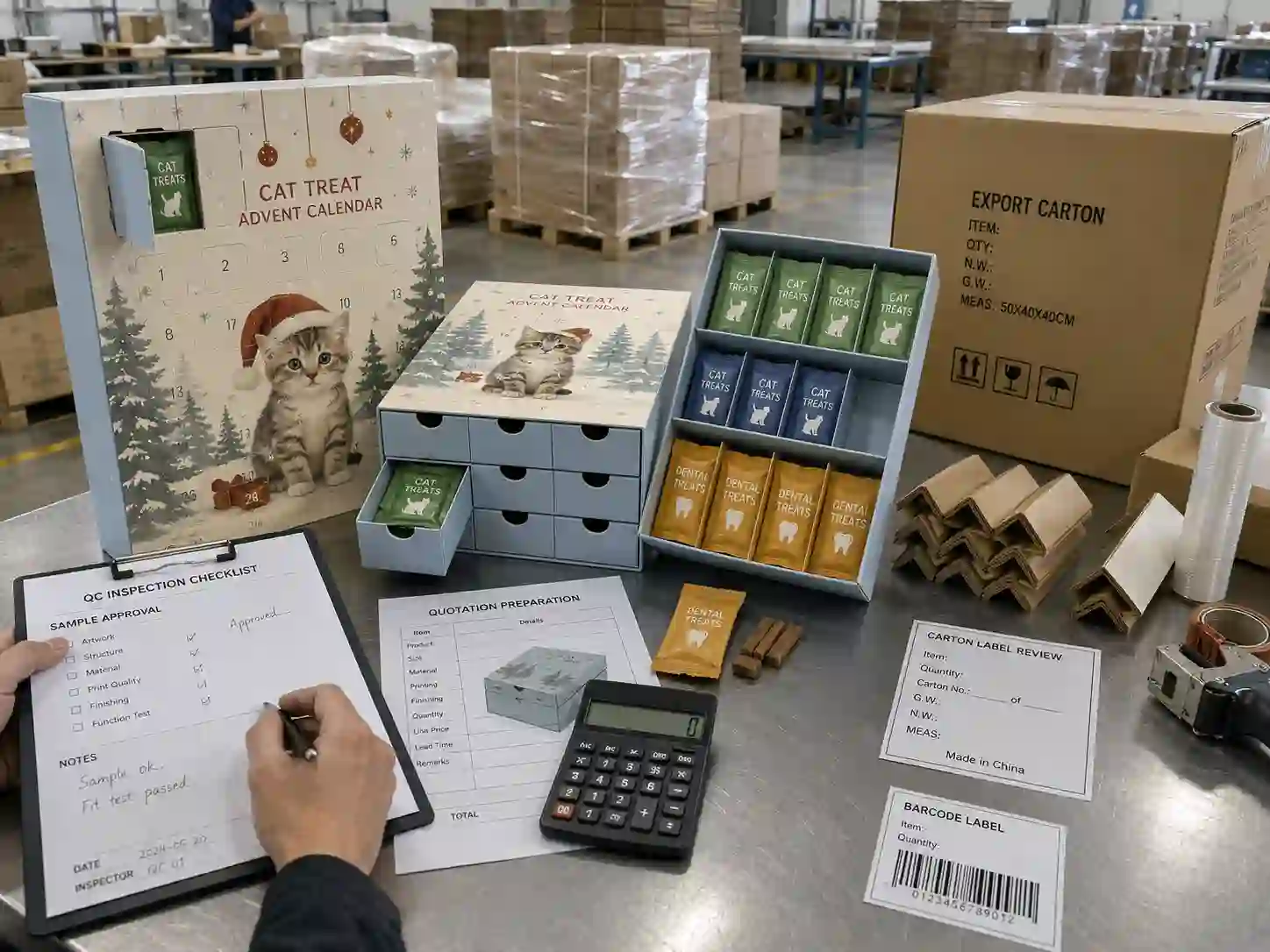
A practical QC checklist includes:
- Outer size and internal compartment size match the approved sample
- Paperboard or greyboard thickness matches the production specification
- Door perforations open cleanly without tearing surrounding artwork
- Drawers slide smoothly without sticking or falling out
- Paper insert, PET tray, EVA insert, foam, or molded pulp insert holds actual products securely
- CMYK color, Pantone color, foil stamping, embossing, spot UV, matte lamination, or gloss lamination match approved proof
- Number sequence, barcode area, label area, and shipping marks are correct
- Glue areas, corners, folds, and hinges are clean and strong
- Loaded box passes reasonable shake, tilt, handling, and carton packing checks
- Export carton quantity, carton label, corner protection, pallet plan, and moisture protection follow the buyer’s shipment requirements
QC tip: Inspectors should check both empty and loaded samples. Some defects only appear after the calendar is filled, such as front panel bulging, drawer friction, door stress, or insert deformation.
How should export packing be planned for overseas shipments?
Export packing should be planned during structure development because calendar size directly affects carton size, pallet loading, freight cost, and damage risk. A beautiful calendar can still fail commercially if it arrives with crushed corners, popped doors, or unreadable carton labels.
For overseas shipments, buyers should confirm export carton strength, inner packing method, corner protectors, carton quantity, pallet wrapping, shipping marks, and whether the cartons will ship by sea, air, courier, or mixed logistics. If the calendar is sold through e-commerce channels, the buyer may also need extra drop or compression testing based on the fulfillment route.
Shipping marks should be generic during factory handling unless the buyer requests specific carton information. Carton labels may include item number, quantity, gross weight, net weight, carton size, destination, PO number, and barcode if needed.
How should buyers compare cat treat advent calendar box suppliers?
Buyers should compare suppliers by structural engineering ability, sample accuracy, insert testing, printing control, QC process, communication quality, export packing experience, and quotation transparency. A low unit price is not useful if the supplier cannot solve product fit, loading, and shipping risks.
When reviewing a supplier, ask these questions:
- Can the supplier design a dieline based on actual cat treat pouch dimensions and filled weight?
- Can they provide a white sample before printed sampling?
- Can they compare paper insert, PET tray, EVA insert, foam, and molded pulp options?
- Can they explain material thickness, printing process, and finishing limitations?
- Can they control door-opening or drawer tolerance during mass production?
- Can they provide pre-production sample approval before bulk manufacturing?
- Can they prepare export cartons, shipping marks, and pallet packing suitable for overseas buyers?
- Can they communicate quotation details clearly, including structure, material, MOQ, sample cost, tooling, packing, and lead time?
As a custom advent calendar boxes manufacturer, Giftpackpro works with overseas brands, wholesalers, gift companies, retail buyers, purchasing teams, and packaging distributors that need custom seasonal paper gift packaging. Buyers can review custom advent calendar box products, learn more about the Giftpackpro packaging factory, or browse additional advent calendar box buying guides before starting a project.
Decision guide: which design route should you choose?
The best design route depends on campaign priority. Buyers should match the box structure to the sales channel, product value, and operational requirements rather than choosing by appearance alone.
| Buyer priority | Recommended route | Why it works |
|---|---|---|
| High-volume retail promotion | Door-opening paperboard calendar with paper insert | Balances cost, recognizable advent experience, and efficient mass production. |
| Premium gift positioning | Rigid box or drawer box with upgraded finishing | Improves perceived value and protects heavier mixed cat treat sets. |
| Mixed treat sizes | Drawer box or custom insert layout | Allows different pouch sizes without forcing one uniform compartment. |
| Plastic reduction goal | Paperboard box with paper insert or molded pulp insert | Supports paper-based packaging direction when product fit and market requirements allow it. |
| E-commerce shipping | Reinforced structure with tested export carton | Reduces risk from parcel handling, compression, corner damage, and product shifting. |
What information should buyers prepare before requesting a quotation?
Buyers should prepare product specifications, design expectations, quantity, market requirements, packing method, and timeline before requesting a quotation. Complete RFQ details help suppliers quote the right structure instead of guessing.
Prepare this checklist before contacting Giftpackpro:
- Project name and target launch season
- 12-day, 24-day, or custom day count
- Product type: sachet, pouch, dental treat pack, freeze-dried treat, toy, or mixed set
- Each product’s filled dimensions and weight
- Preferred structure: door-opening box, drawer box, rigid box, folding carton, or fold-out box
- Insert preference: paper insert, PET tray, EVA insert, foam, molded pulp, or open to recommendation
- Artwork status: finished artwork, rough layout, or need dieline first
- Printing requirements: CMYK, Pantone, foil stamping, embossing, spot UV, matte lamination, gloss lamination
- Target order quantity and expected MOQ flexibility
- Sample requirement: white sample, printed sample, or pre-production sample
- Retail channel: supermarket, pet store, Amazon, e-commerce, subscription, wholesale, or gift company
- Export destination, carton requirements, pallet requirements, and shipping marks
- Required quotation terms, lead time target, and delivery schedule
What common mistakes should buyers avoid?
The most common mistakes are choosing structure before measuring products, approving artwork before dieline confirmation, ignoring insert tolerance, underestimating export packing, and comparing suppliers only by unit price. These mistakes can create delays, sampling revisions, and avoidable production risk.
- Using empty pouch size: filled cat treat pouches are thicker and less uniform than flat packaging artwork.
- Making doors too small: small doors may trap pouches or make the opening experience frustrating.
- Ignoring crumbs and product settling: some treats shift inside sachets, changing thickness and loading behavior.
- Overusing finishes: foil, embossing, and spot UV can look premium but may complicate door cuts or crease areas.
- Skipping pre-production samples: mass production should follow an approved final sample, not only a PDF proof.
- Forgetting carton optimization: a few extra millimeters on the calendar can increase carton volume and freight cost.
- Unclear RFQ details: vague requests lead to inaccurate quotations and slow supplier comparison.
FAQ: Cat treat advent calendar boxes for B2B buyers
What is the best structure for cat treat advent calendar boxes?
The best structure depends on product weight and sales positioning. Door-opening paperboard boxes are efficient for lightweight sachets, drawer boxes suit premium mixed sets, and rigid boxes work best when the campaign needs stronger protection and a higher-value gift presentation.
Can one calendar hold different cat treat pouch sizes?
Yes, but the dieline and insert should be designed around the largest filled product. Mixed pouch sizes may need custom compartments, drawers, or a tray design that prevents smaller items from moving during shipping and display.
Should buyers choose a paper insert or PET tray?
A paper insert is often suitable for lightweight sachets and paper-based packaging goals. A PET tray may be better when the products need precise cavities, stable positioning, or faster loading visibility during production.
Is a white sample necessary?
A white sample is strongly recommended for new structures or new product sizes. It helps buyers check size, loading, door opening, drawer movement, insert fit, and display balance before printed sample costs are added.
What affects MOQ for custom cat treat advent calendar boxes?
MOQ is affected by structure, material purchasing, printing setup, finishing, insert tooling, assembly method, and export packing. More complex structures and custom inserts usually require more planning and may have higher economic production quantities.
How long should buyers allow for sampling and production?
Lead time depends on design complexity, sample revisions, artwork readiness, material availability, finishing process, and order quantity. Buyers should build in time for dieline confirmation, white sample review, printed sample approval, pre-production sample approval, mass production, QC, and export shipping.
What should be checked during final inspection?
Final inspection should check dimensions, material, print color, finishing, door or drawer function, insert fit, product loading, barcode area, carton labels, export carton strength, shipping marks, and pallet packing if required.
CTA: How to start a custom cat treat advent calendar box project
To start a reliable project, prepare your treat dimensions, filled weight, day count, preferred structure, insert idea, artwork status, order quantity, destination market, sample needs, and export packing requirements. Giftpackpro can then review the dieline, structure, insert, printing, sampling, MOQ, lead time, QC, and quotation details more accurately.
If you are planning seasonal cat treat advent calendar boxes for retail, wholesale, e-commerce, or gift campaigns, use the checklist above and request a custom quote with your product details. Clear information at the RFQ stage helps reduce sample revisions, improve cost accuracy, and support smoother mass production.