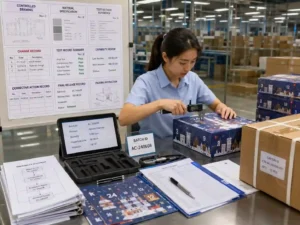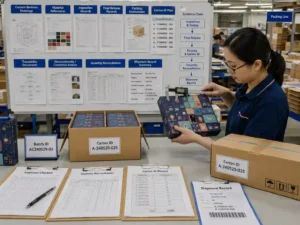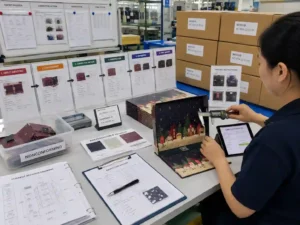
Quick answer: Beverage advent calendar boxes are custom seasonal packaging systems designed to hold small bottles, cans, sachets, concentrate packs, drink vials, or sample-size beverage products in numbered compartments. For B2B buyers, the most important decisions are structure strength, insert protection, glass or liquid-product stability, artwork accuracy, MOQ, sample approval, QC checks, and export packing. Because beverage samples are often heavier and more fragile than cosmetics, candy, or stationery items, buyers should confirm product weight, bottle dimensions, insert material, carton compression, pallet loading, and shipping marks before requesting a quotation.
This guide is written for overseas brands, wholesalers, retail buyers, e-commerce sellers, gift companies, and purchasing teams comparing beverage advent calendar boxes for seasonal launches, tasting kits, retail promotions, and distributor campaigns. It focuses on practical packaging decisions rather than consumer holiday storytelling.
What should buyers understand before choosing beverage advent calendar boxes?
Buyers should understand that beverage sample packaging is not only a visual display box; it is a weight-bearing, insert-driven, export-packed product protection system. A good design must balance shelf presentation, compartment access, bottle stability, artwork, production efficiency, and international shipping safety.
Beverage samples can include mini glass bottles, aluminum cans, sachets, concentrate sticks, powder drink packs, tea-shot vials, syrup bottles, wellness drink samples, or mixed tasting sets. Each product type changes the packaging decision. A glass vial needs anti-impact spacing and secure insert grip. A small can needs compression resistance and accurate cavity sizing. A sachet or powder stick may need a flatter paperboard insert and a lower-cost folding carton structure.
For a purchasing team, the first question is not “Which calendar looks best?” The first question is “Can this structure hold the real product weight through sampling, assembly, warehousing, export shipping, and retail handling?” Once that is answered, design, finishing, MOQ, and quotation details become much easier to compare.
Buyer tip: For beverage advent calendar boxes, always calculate the loaded box weight early. A beautiful door-opening design may fail if 12, 24, or 25 liquid samples create too much front-panel stress, insert sagging, or carton compression during ocean freight.
Which beverage advent calendar box structure fits your product?
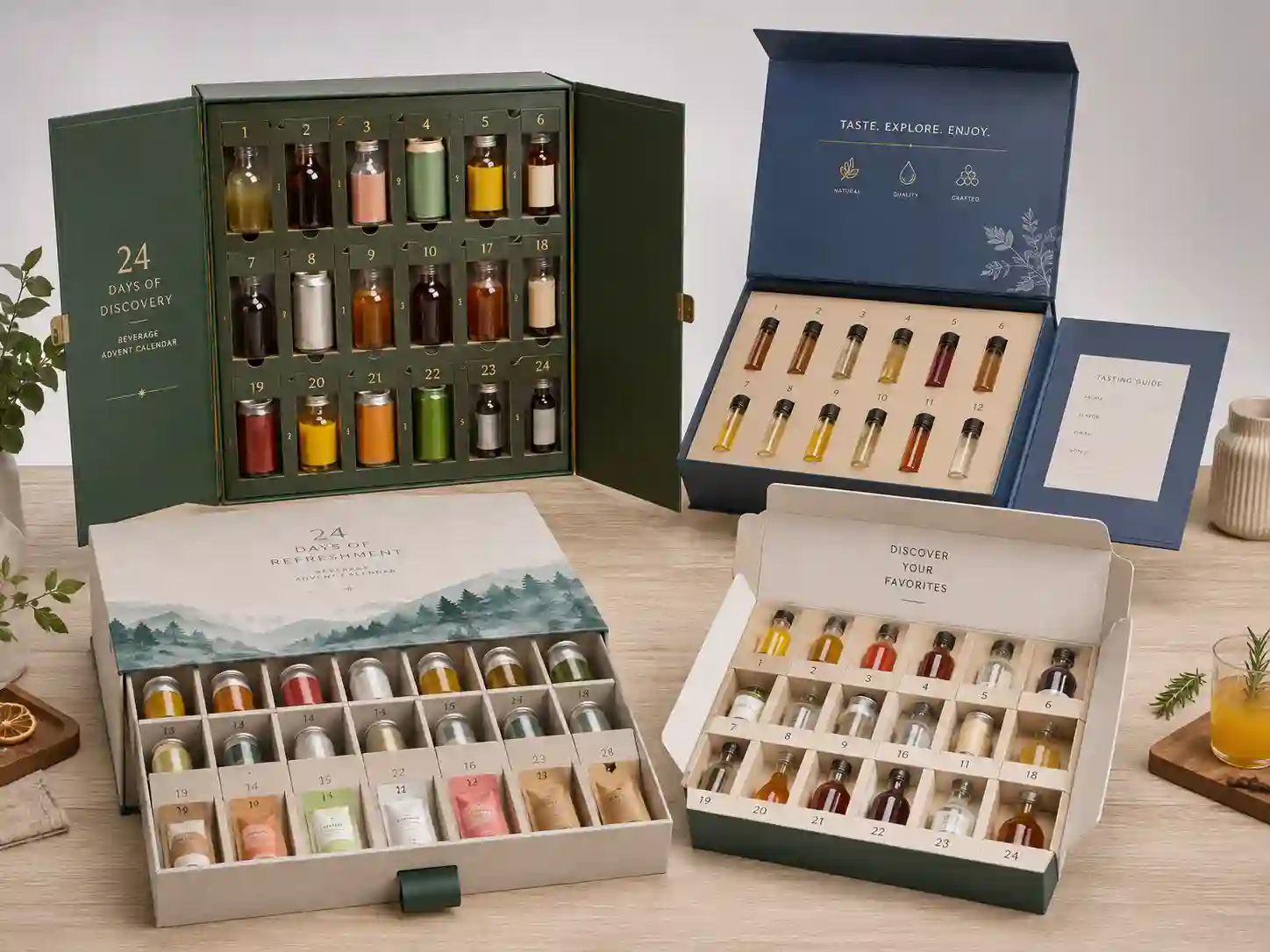
The right structure depends on product weight, display plan, price point, and assembly method. Rigid boxes are usually better for premium glass bottles, while folding cartons can work for lighter sachets, concentrate sticks, and lower-weight sample campaigns.
| Structure option | Best for | Advantages | Buyer checks |
|---|---|---|---|
| Rigid door-opening box | Mini glass bottles, premium tasting sets, retail gift displays | Strong greyboard body, premium presentation, good front display, suitable for foil stamping and embossing | Door tear resistance, loaded front-panel stress, insert locking, outer carton compression |
| Rigid drawer box | Heavier beverage samples, mixed bottle-and-can kits, reusable gift packaging | Strong sliding structure, good product access, premium unboxing, suitable for thick inserts | Drawer pull strength, rail friction, stopper design, assembly tolerance after lamination |
| Book-style tasting calendar | Brand storytelling, guided tasting kits, sample collections with printed information | Large artwork area, clear opening experience, good for inserts plus printed tasting notes | Magnetic closure strength, hinge durability, weight balance when opened |
| Folding carton calendar | Sachets, powder sticks, lightweight cans, cost-sensitive campaigns | Lower material cost, efficient flat packing, faster assembly for lighter products | Board grade, locking tabs, crush resistance, door perforation accuracy |
| Hybrid sleeve and tray design | E-commerce beverage sample sets, promotional packs, distributor kits | Good outer protection, simple access, practical for shipping and storage | Sleeve tightness, tray stiffness, insert shift prevention, barcode label area |
Rigid box structures usually use greyboard wrapped with printed paper. They are suitable when buyers want stronger support, a premium retail image, and better protection for glass or liquid-filled samples. Folding carton structures usually use paperboard and are more efficient for lighter beverage formats, but the dieline must be carefully checked to prevent weak corners or unstable compartment walls.
Quotable B2B statement: For beverage packaging, box structure should be selected by loaded weight and insert performance before surface finishing is selected by appearance.
How should buyers choose inserts for bottles, cans, sachets, and drink vials?
The insert is the main protection system inside beverage advent calendar boxes. It must hold each sample in position, prevent product movement, support weight, and reduce glass-to-glass or bottle-to-board impact during transport.
Common insert options include paper insert, PET tray, EVA insert, foam, and molded pulp. Each material has different cost, appearance, protection, sustainability, and tooling considerations.
When is a paper insert suitable?
A paper insert is suitable for lightweight cans, sachets, slim bottles, powder sticks, and brands that prefer recyclable paper-based packaging. It can be folded, layered, or reinforced to improve strength, but it must be tested with the real loaded product weight.
Paper inserts are cost-effective and visually consistent with paperboard packaging. For beverage samples, buyers should ask the factory to test cavity height, wall thickness, folding direction, and whether the insert collapses when the calendar is placed vertically.
When should buyers consider PET trays, EVA, foam, or molded pulp?
PET trays, EVA, foam, and molded pulp are useful when the product needs more accurate positioning, stronger grip, or better impact resistance. Glass bottles, irregular vials, and heavier mini beverages often need stronger inserts than a simple paper divider.
- PET tray: Good for clear product positioning and accurate cavities, but buyers should consider material preference and recycling rules in the target market.
- EVA insert: Suitable for premium glass protection and tight fit, often used when appearance and cushioning matter.
- Foam insert: Useful for impact protection, but it may not match every brand’s sustainability requirements.
- Molded pulp: A practical option for protective paper-based positioning, especially when buyers want a more natural material look.
Factory tip: Insert design should be tested with filled samples, not only empty bottles. Liquid weight changes the load on each cavity, the base panel, the glue areas, and the master carton during stacking.
Which materials and printing options matter most for beverage sample calendars?
Material selection should match product weight, retail position, target cost, and finishing requirements. For beverage advent calendar boxes, the most common outer materials are paperboard for folding cartons and greyboard with printed wrap paper for rigid box structures.
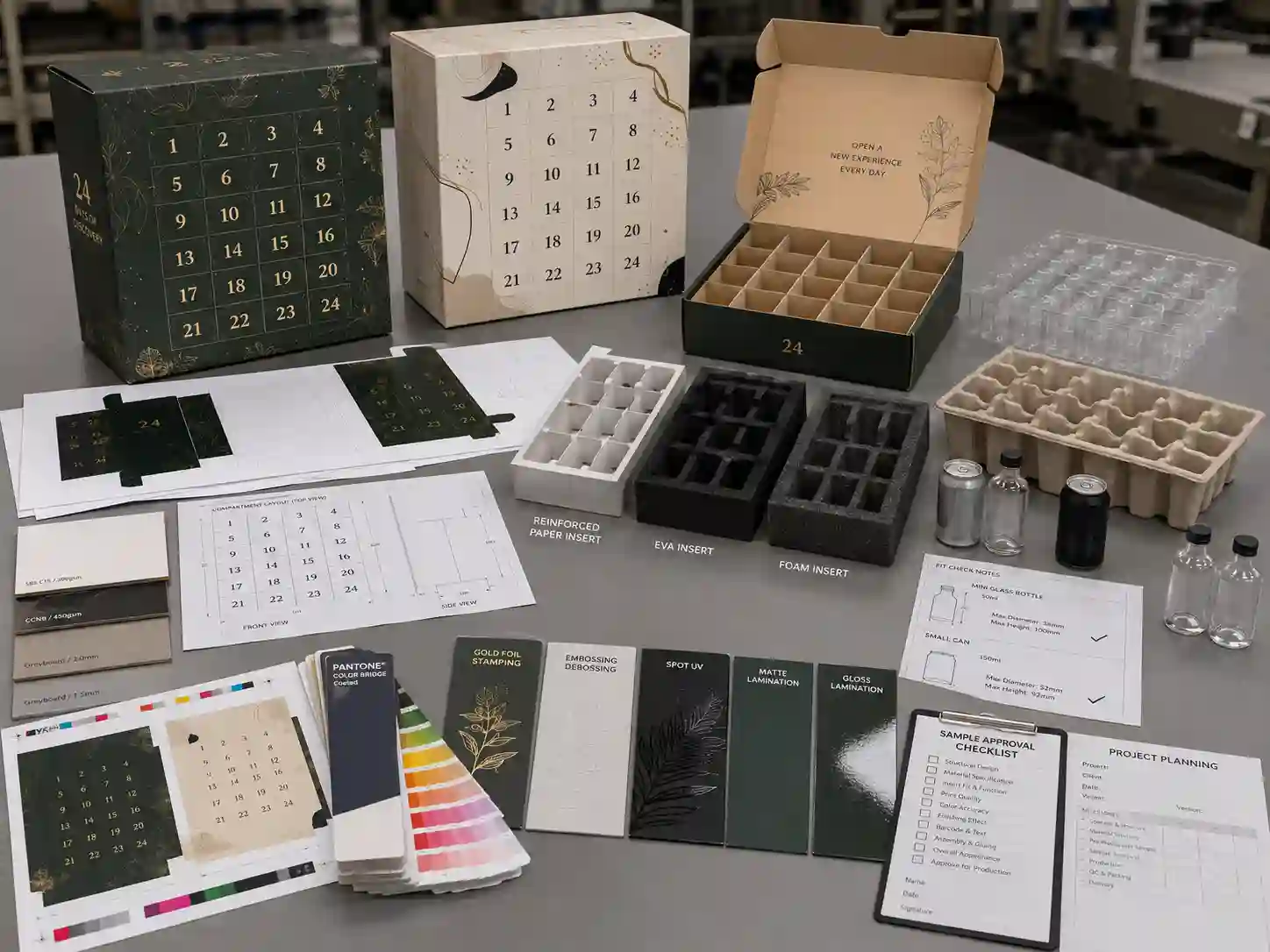
For premium beverage kits, buyers often choose rigid box construction with wrapped art paper, matte lamination, spot UV, foil stamping, embossing, or debossing. For cost-sensitive sample campaigns, folding carton paperboard with CMYK printing and matte or gloss lamination may be enough.
Artwork should be prepared with a correct dieline, bleed, safe zone, cut line, crease line, perforation area, barcode area, and shipping mark requirements if the box also functions as an e-commerce pack. Beverage packaging often needs numbered doors, tasting sequence instructions, ingredient or compliance text, and product orientation marks for assembly workers.
How should buyers handle CMYK, Pantone, and finishing?
CMYK is practical for full-color seasonal artwork, while Pantone colors help control brand color consistency. Foil stamping, embossing, spot UV, matte lamination, and gloss lamination can improve shelf impact, but each process adds cost, sample time, and production control points.
Buyers should ask for digital proofing first, then a physical color proof or printed sample when color accuracy matters. If a beverage brand uses metallic effects or dark backgrounds, it should confirm scuff resistance and lamination performance because heavier boxes experience more friction during packing and shipping.
Buyer tip: A premium finish cannot compensate for a weak insert. Confirm cavity fit, bottle support, and compression resistance before adding expensive surface effects.
What information should buyers prepare before requesting a quotation?
A quotation for custom beverage advent calendar boxes is only accurate when the supplier knows the real product size, weight, structure, insert, printing, quantity, packing method, and shipping requirements. Vague RFQs usually create price gaps that make supplier comparison unreliable.
Before contacting Giftpackpro or another supplier, prepare the following details:
- Product type: mini glass bottle, can, sachet, vial, concentrate pack, powder stick, or mixed beverage set.
- Product dimensions: length, width, height, diameter, cap size, and special shape details.
- Filled product weight for each sample and total loaded calendar weight.
- Number of compartments: 12, 24, 25, or a custom layout.
- Preferred structure: rigid box, folding carton, drawer box, door-opening box, book-style box, or fold-out design.
- Insert preference: paper insert, PET tray, EVA insert, foam, molded pulp, or factory recommendation.
- Artwork status: final dieline artwork, rough design concept, brand color requirements, CMYK or Pantone needs.
- Finishing options: matte lamination, gloss lamination, foil stamping, embossing, debossing, or spot UV.
- Estimated order quantity and expected MOQ range.
- Required sample type: blank sample, digital mockup, printed prototype, or pre-production sample.
- Packing method: flat packed, semi-assembled, fully assembled, with or without products loaded.
- Export requirements: master carton size limits, pallet requirements, shipping marks, barcode labels, and destination market.
Giftpackpro provides custom advent calendar box services for buyers who need help turning product dimensions, dielines, inserts, and artwork into a workable production plan. Buyers can also review custom advent calendar box products to compare common structures before preparing an RFQ.
How do MOQ, lead time, and cost drivers usually work?
MOQ and cost depend on structure, materials, insert tooling, printing, finishing, assembly complexity, and packing method. Beverage sample calendars often cost more than lightweight paper gift boxes because they need stronger materials, reinforced inserts, more QC points, and safer export cartons.
The main cost drivers include:
- Box structure: Rigid boxes require greyboard, wrapping, more handwork, and longer production time than basic folding cartons.
- Insert material: Paper inserts are usually economical, while EVA, PET, foam, and molded pulp may require tooling or more fitting tests.
- Product weight: Heavier beverage items may require thicker board, stronger glue, reinforced trays, or upgraded master cartons.
- Printing and finishing: Pantone, foil stamping, embossing, spot UV, and special lamination add setup and inspection requirements.
- Assembly method: Fully assembled beverage calendars occupy more carton volume than flat-packed boxes and may increase freight cost.
- Sampling revisions: Each structural or artwork change can affect timeline, especially if insert cavities or door perforations need adjustment.
Lead time should be discussed in stages: dieline confirmation, blank sample, artwork proof, printed sample, pre-production sample, mass production, final inspection, export packing, and shipment. Buyers should avoid approving mass production before the loaded sample has been checked with real beverage items.
Factory tip: For heavy beverage calendars, the pre-production sample should be tested in the same direction the product will be packed, stored, displayed, and shipped. Vertical display, horizontal carton packing, and pallet stacking create different stress points.
What should buyers check during sampling and prototype approval?
Sampling should confirm structure, insert fit, artwork, finishing, assembly tolerance, and loaded product performance. A beverage advent calendar prototype should be reviewed as a functional packaging sample, not only as a printed visual mockup.
Use this practical sample approval checklist:
- Confirm the outer size matches retail shelf, e-commerce, or gift campaign requirements.
- Place real filled bottles, cans, sachets, or vials into every compartment.
- Check whether each insert cavity holds the product without shaking, tilting, or scratching.
- Open each numbered door or drawer to confirm access is smooth but not too loose.
- Check bottle cap clearance, product removal angle, and finger space.
- Review dieline alignment, perforation position, crease lines, glue areas, and safe zones.
- Check CMYK or Pantone color, barcode readability, text position, and finishing registration.
- Review lamination, foil stamping, embossing, spot UV, and edge wrapping quality.
- Check the loaded box for bending, door popping, drawer jamming, or insert sagging.
- Confirm export carton quantity, carton strength, shipping marks, and pallet plan before mass production.
If buyers need more planning content, Giftpackpro’s advent calendar box buying guides cover related decisions for custom advent calendar boxes, inserts, printing, sampling, and export packing.
How should buyers compare suppliers for beverage advent calendar boxes?
Buyers should compare suppliers by engineering ability, sampling accuracy, communication, QC process, export packing knowledge, and quotation transparency. The lowest unit price is not always the lowest landed cost if the box fails during assembly, warehousing, or shipping.
A practical supplier comparison should include these questions:
- Can the supplier recommend a structure based on filled product weight, not just artwork style?
- Can they create or check the dieline for doors, drawers, inserts, glue areas, and assembly tolerance?
- Do they request product dimensions and weight before quoting the final insert?
- Can they provide a blank prototype before printed sampling?
- Do they explain MOQ, tooling, finishing, packing volume, and lead time clearly?
- Can they inspect insert fit, door function, drawer movement, color proof, and carton packing before shipment?
- Can they support export carton planning, pallet loading, shipping marks, and carton labels?
As a custom advent calendar boxes manufacturer, Giftpackpro focuses on B2B seasonal paper packaging where buyers need structure planning, sample checking, mass production control, and export packing coordination. Buyers can also learn more about the Giftpackpro packaging factory when evaluating supplier reliability.
What QC and export packing checks are important for beverage sample calendars?
QC for beverage calendars should check both appearance and functional protection. Export packing should be planned around loaded weight, carton compression, bottle protection, pallet stacking, and shipping marks.
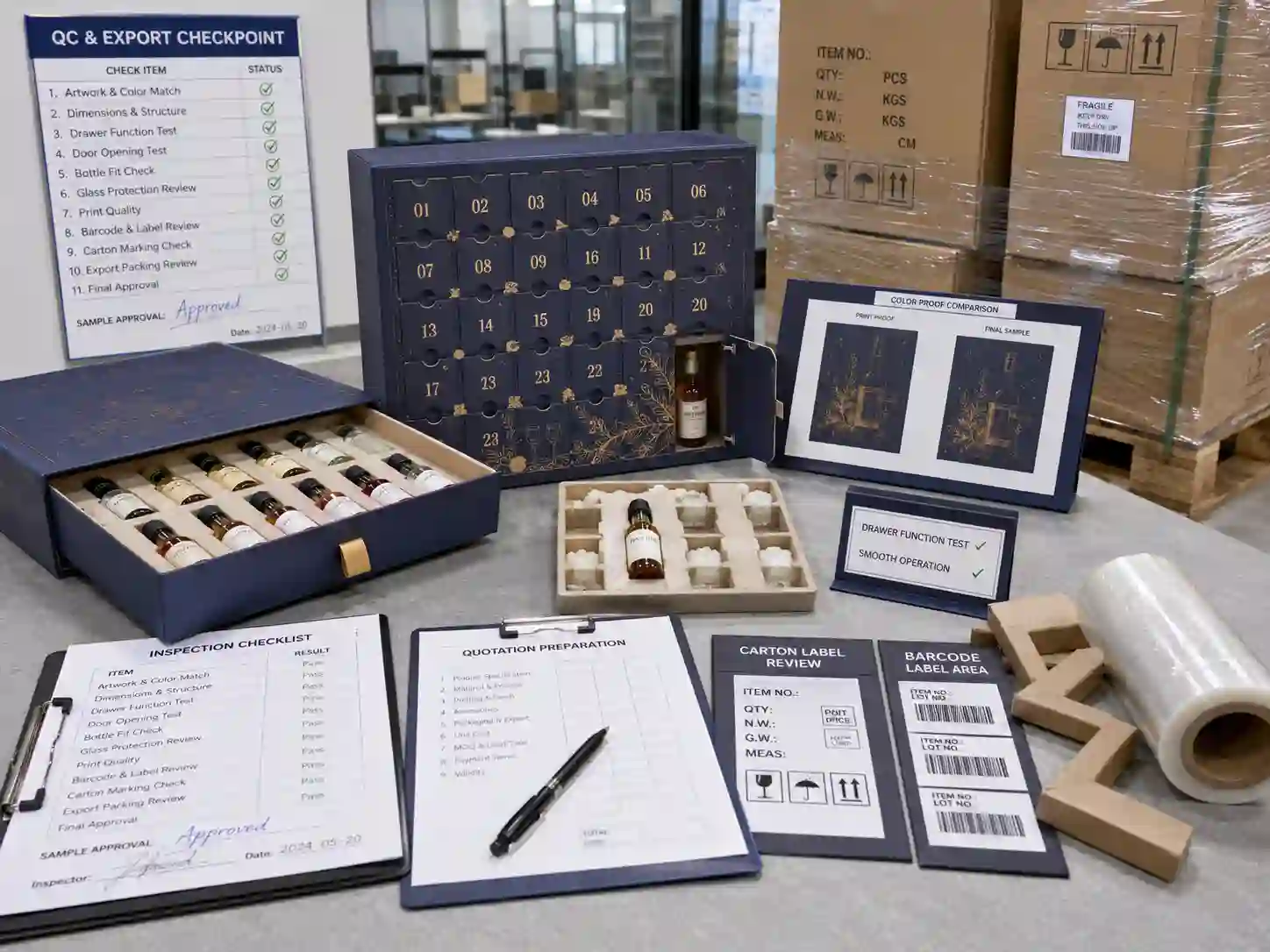
Because beverage products can be heavy, fragile, or liquid-filled, final inspection should include more than printing color and surface defects. QC teams should review carton drop risk, insert movement, door tearing, drawer friction, corner crushing, glue strength, and whether the calendar keeps its shape under normal handling.
Practical QC checklist for beverage advent calendar boxes
- Confirm approved sample, artwork proof, dieline, and production specification are available at inspection.
- Check greyboard or paperboard thickness against the approved sample.
- Inspect printing color, Pantone matching, text clarity, barcode area, and finishing registration.
- Check every critical structure: doors, drawers, book-style hinge, magnetic closure, sleeve, tray, and glue joints.
- Test insert fit with real or equivalent-weight beverage samples.
- Check glass protection spacing and whether bottles contact each other during movement.
- Review loaded-box stability in the intended display direction.
- Check export carton strength, inner packing, corner protection, carton labels, and shipping marks.
- Confirm pallet pattern, carton stacking direction, and stretch-wrap requirements where needed.
For transit testing, buyers can discuss procedures based on their retail or logistics requirements. Organizations such as ISTA provide packaging performance test resources that many logistics and retail teams reference. For paper sourcing claims or responsible material preferences, buyers can verify requirements through official sources such as FSC rather than relying only on supplier statements.
QC tip: A beverage calendar should be inspected as a loaded unit. Empty-box approval is not enough when glass bottles, cans, or liquid samples create real pressure on inserts, doors, and export cartons.
What common mistakes should buyers avoid?
The most common mistakes are quoting too early without product data, choosing structure only by appearance, underestimating product weight, and approving artwork before the insert and dieline are stable. These mistakes can cause cost changes, sampling delays, weak packaging, or shipping damage.
- Mistake 1: Sending only a reference photo. A supplier needs product size, weight, compartment count, structure preference, quantity, artwork status, and packing method to quote accurately.
- Mistake 2: Ignoring glass protection. Mini glass bottles need spacing, grip, cushioning, and carton protection. A loose cavity can create damage even if the outer box looks premium.
- Mistake 3: Choosing a weak folding carton for heavy samples. Folding cartons can be efficient, but heavy liquid products may need reinforced paperboard, a rigid box, or a stronger insert.
- Mistake 4: Approving printing before dieline testing. If the insert or door layout changes later, artwork may need to be revised.
- Mistake 5: Forgetting export carton planning. A well-made inner calendar can still arrive damaged if carton compression, corner protection, pallet loading, and shipping marks are not controlled.
Decision guide: which option should your team choose?
Use the following decision guide to narrow your packaging direction before asking for pricing. It helps buyers compare options based on product weight, display needs, budget, and shipping risk.
| Buyer situation | Recommended direction | Reason |
|---|---|---|
| Premium mini glass bottle tasting set | Rigid door-opening box or book-style rigid box with EVA, PET, molded pulp, or reinforced paper insert | Better support, stronger retail presentation, and more protection for fragile samples |
| Mixed cans, sachets, and small vials | Rigid drawer box or hybrid tray structure with custom insert | Different product heights need controlled cavities and stable opening experience |
| Lightweight powder sticks or concentrate sachets | Folding carton calendar with paper insert | More cost-efficient and easier to flat pack when product weight is low |
| E-commerce gift campaign | Stronger outer box, secure insert, barcode area, and tested export carton | Parcel handling creates more impact risk than controlled shelf display |
| Distributor or wholesale launch kit | Practical rigid or sleeve-and-tray structure with clear product labeling and shipping marks | Balances presentation, assembly speed, and bulk logistics |
FAQ: Beverage advent calendar boxes for B2B buyers
What are beverage advent calendar boxes used for?
Beverage advent calendar boxes are used for sample-size drink promotions, tasting sets, seasonal retail campaigns, e-commerce gift packs, wholesale launch kits, and distributor marketing programs. They can hold mini bottles, cans, sachets, concentrate packs, powder sticks, or mixed beverage samples.
Are rigid boxes better than folding cartons for beverage samples?
Rigid boxes are usually better for heavier or fragile beverage samples because greyboard structures provide stronger support and a more premium display. Folding cartons can work well for lightweight sachets, powder sticks, or low-weight sample programs when the board grade and insert are properly tested.
Which insert is best for glass bottles?
The best insert depends on bottle weight, shape, fragility, and budget. EVA, foam, PET trays, molded pulp, and reinforced paper inserts can all work, but buyers should test real filled bottles in the sample before approving mass production.
Can beverage advent calendar boxes be customized with brand artwork?
Yes. Buyers can customize structure, compartment layout, CMYK printing, Pantone colors, matte lamination, gloss lamination, foil stamping, embossing, spot UV, barcode areas, and numbered doors. The artwork should be built on the final dieline after insert and structure testing.
What affects the MOQ for custom beverage calendars?
MOQ is affected by structure, material purchasing, printing setup, finishing process, insert tooling, assembly labor, and packing method. A simple paperboard folding carton usually has a different MOQ from a rigid drawer box with a custom molded insert.
Should buyers request a blank sample or printed sample first?
For beverage products, a blank structural sample is often useful before printed sampling because it confirms size, insert fit, loaded weight, and opening function. After the structure is approved, a printed sample or pre-production sample can confirm color, finishing, and mass production details.
What export packing details should be confirmed?
Buyers should confirm export carton size, carton material, quantity per carton, gross weight, corner protection, inner packing, pallet plan, shipping marks, barcode labels, and whether calendars are packed flat, semi-assembled, or fully assembled.
How can buyers start a beverage advent calendar box project with Giftpackpro?
To start a beverage advent calendar box project, prepare product dimensions, filled sample weight, compartment count, preferred structure, insert requirements, artwork status, quantity, target launch schedule, and export packing needs. This information helps Giftpackpro evaluate structure, insert strength, sample steps, MOQ, lead time, and quotation details more accurately.
If your team is comparing beverage advent calendar boxes for a retail launch, e-commerce campaign, wholesale program, or seasonal tasting kit, you can request a custom quote with your product details, target quantity, and packaging references. Giftpackpro can then help review structure options, sample requirements, artwork preparation, insert testing, QC focus points, and export packing before mass production.