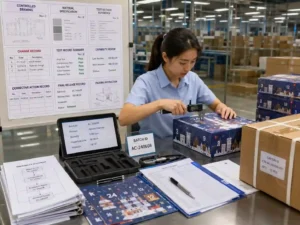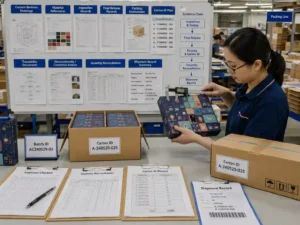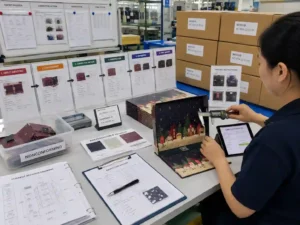
Quick answer: Toy advent calendar boxes need more than an attractive seasonal design. For B2B buyers, the most important decisions are structure, insert material, compartment layout, artwork control, sample approval, MOQ planning, QC standards, and export packing. A good toy calendar must hold mixed product sizes securely, open smoothly, protect fragile or small accessories, show clear retail information, and survive carton handling during international shipping. Before requesting a quotation, prepare the toy list, dimensions, weight, quantity, artwork requirements, insert preference, packing method, delivery deadline, and any retail labeling or barcode requirements.
What should buyers confirm before choosing toy advent calendar boxes?
Buyers should confirm the toy range, sales channel, target retail price, packaging size limit, and required delivery date before choosing toy advent calendar boxes. These details decide whether a rigid box, folding carton, drawer box, door-opening box, or fold-out structure is practical for the campaign.
Toy advent calendars often contain mixed small items such as mini blocks, toy cars, puzzle pieces, stickers, activity accessories, craft parts, or generic figurine-shaped items. The packaging must control product movement without making the calendar too heavy, too expensive, or difficult to assemble. For purchasing teams, the right solution is usually the one that balances product fit, assembly efficiency, retail display, freight cost, and bulk production reliability.
When working with a custom advent calendar boxes manufacturer, buyers should share the real product dimensions instead of only sending reference photos. A 24-compartment calendar for flat stickers needs a very different insert and box depth from a calendar containing mixed toys with different heights and weights.
Which box structure is best for different toy calendar projects?
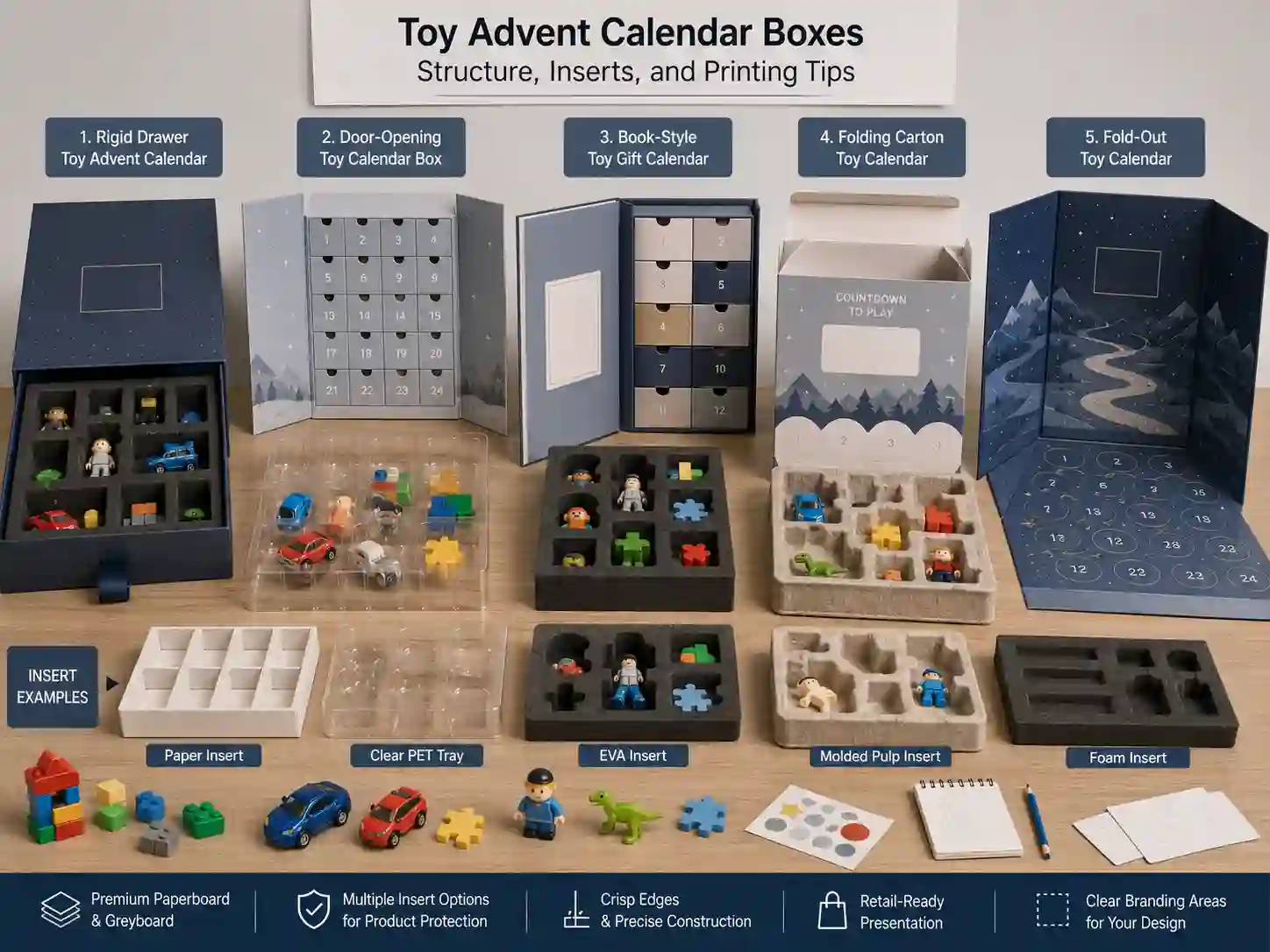
The best structure depends on product weight, opening experience, retail shelf position, and packing budget. Rigid boxes are usually better for premium mixed-toy sets, while folding cartons can be suitable for lighter toys and larger promotional runs.
For toy advent calendar boxes, structure affects not only appearance but also compartment strength, assembly tolerance, and carton durability. A structure that looks good in one handmade sample may become slow or unstable during mass production if the dieline, insert, and toy list are not tested together.
| Structure option | Best use case | Buyer advantages | Points to check before ordering |
|---|---|---|---|
| Door-opening box | Classic retail toy advent calendar with numbered windows | Strong seasonal display, clear daily reveal layout, familiar shelf format | Door tear strength, toy clearance, paper thickness, window spacing, insert alignment |
| Drawer box | Premium toy gift sets with reusable drawers | Better perceived value, good for mixed toy sizes, easier to separate heavier items | Drawer sliding tolerance, pull tab strength, inner tray stability, final assembled weight |
| Rigid box | Premium brand campaigns, influencer kits, high-value toy sets | Durable greyboard structure, luxury finish options, strong gift presentation | Higher unit cost, higher freight volume, longer sampling and production planning |
| Folding carton | Lightweight toys, promotional calendars, large-volume retail programs | Lower material cost, easier flat packing, efficient for high MOQ projects | Load capacity, insert support, carton compression, display stability |
| Book-style or fold-out calendar | Story-based activity sets, craft kits, puzzle or sticker programs | Large artwork area, strong display impact, flexible layout planning | Hinge durability, magnetic or ribbon closure, unfolded footprint, packing method |
Buyer tip: Do not choose structure based only on a reference image. Ask the factory to check toy weight distribution, compartment depth, opening direction, display angle, and export packing before confirming the final dieline.
How should inserts be selected for mixed toy sizes?
Inserts should be selected according to toy size variation, fragility, weight, sustainability target, and assembly method. For mixed toy sizes, the insert must stop movement while keeping the calendar easy to load during bulk production.
A toy calendar rarely contains 24 identical items. Some toys may be flat, some tall, some fragile, and some packed in small polybags or paper sleeves. The insert design should divide products by size group and weight group instead of forcing all compartments to be identical. This helps prevent crushed windows, uneven surfaces, and loose products during shipping.
When is a paper insert suitable?
A paper insert is suitable for lightweight toys, stickers, puzzles, small activity parts, and buyers who prefer a plastic-free packaging direction. Paperboard inserts can be folded, glued, or locked into compartments, and they are often easier to recycle than plastic trays when designed correctly.
The limitation is that paper inserts may need reinforcement for heavy or sharp-edged toys. Buyers should confirm paper thickness, folding direction, glue points, and whether the insert can keep its shape after vibration during transport. If the calendar uses door openings, paper inserts must align accurately with each window.
When should buyers use PET trays, EVA, foam, or molded pulp?
PET trays are useful when buyers need accurate cavities and high visibility during assembly. EVA and foam are better for premium or fragile toy components, while molded pulp can support plastic-reduction goals for suitable product shapes.
PET trays provide clean cavities for small toys, but buyers should consider local recycling expectations and retail sustainability requirements. EVA and foam offer better cushioning, especially for painted items, miniature accessories, or delicate toy parts, but they may increase cost and are less suitable for plastic-free positioning. Molded pulp can be a strong option for simple shapes and eco-focused campaigns, but it requires tooling evaluation and enough volume to justify development.
- Paper insert: good for lightweight toys, plastic-free direction, and cost control.
- PET tray: good for precise cavities, fast loading, and consistent product placement.
- EVA insert: good for premium protection and clean presentation.
- Foam insert: good for cushioning fragile or painted toy parts.
- Molded pulp insert: good for selected plastic-reduction projects with suitable shapes and volume.
Factory tip: Insert samples should be tested with real toys, not only with digital dimensions. Soft parts, uneven shapes, and bagged accessories can behave differently after loading, closing, and carton vibration.
How should the compartment layout be planned?
The compartment layout should group toys by height, weight, and opening sequence. A balanced layout prevents one side of the calendar from becoming too heavy and reduces the risk of product movement during shipping.
For toy advent calendar boxes, layout planning is a manufacturing decision as much as a design decision. If heavy toys are placed near weak door areas, the front panel may deform. If tall toys are placed in shallow cavities, doors may bulge or fail to close cleanly. If very small toys are placed in oversized compartments, buyers may receive complaints about a loose or low-value presentation.
Procurement teams should request a compartment layout drawing before sample production. This drawing should show cavity length, width, depth, opening direction, product number, product weight, and any label or barcode area. It should also show whether the box will be shipped flat, semi-assembled, or fully assembled.
Decision guide: how to match toys with insert and structure
- Light stickers, cards, and paper activities: folding carton with paper insert is often practical.
- Mixed mini toys with different sizes: door-opening or drawer structure with paperboard or PET tray can improve fit control.
- Fragile painted toys or delicate accessories: rigid box with EVA or foam insert may reduce movement and surface damage.
- Plastic-free campaign target: paper insert or molded pulp should be reviewed early in the dieline stage.
- Premium retail or gifting program: rigid drawer box, book-style box, or reinforced door-opening box can support higher perceived value.
Which materials affect strength, cost, and retail presentation?
Material choice affects box strength, print quality, unit cost, and export durability. Buyers should compare greyboard thickness, paperboard grade, insert material, lamination, and carton packing together instead of evaluating the outer box alone.
Rigid toy calendars normally use greyboard wrapped with printed paper. Folding carton calendars use printed paperboard that is cut, creased, and folded. A heavy toy calendar may need thicker greyboard, reinforced corners, or a stronger back panel. A lightweight retail program may use paperboard to control cost and shipping volume.
For sustainability-oriented buyers, material claims should be verified with suppliers instead of assumed. If FSC-certified paper is required, ask for valid documentation and confirm the certificate scope with the supplier. Buyers can learn more from the official Forest Stewardship Council website when planning paper sourcing requirements.
What printing and finishing choices matter for toy advent calendar boxes?
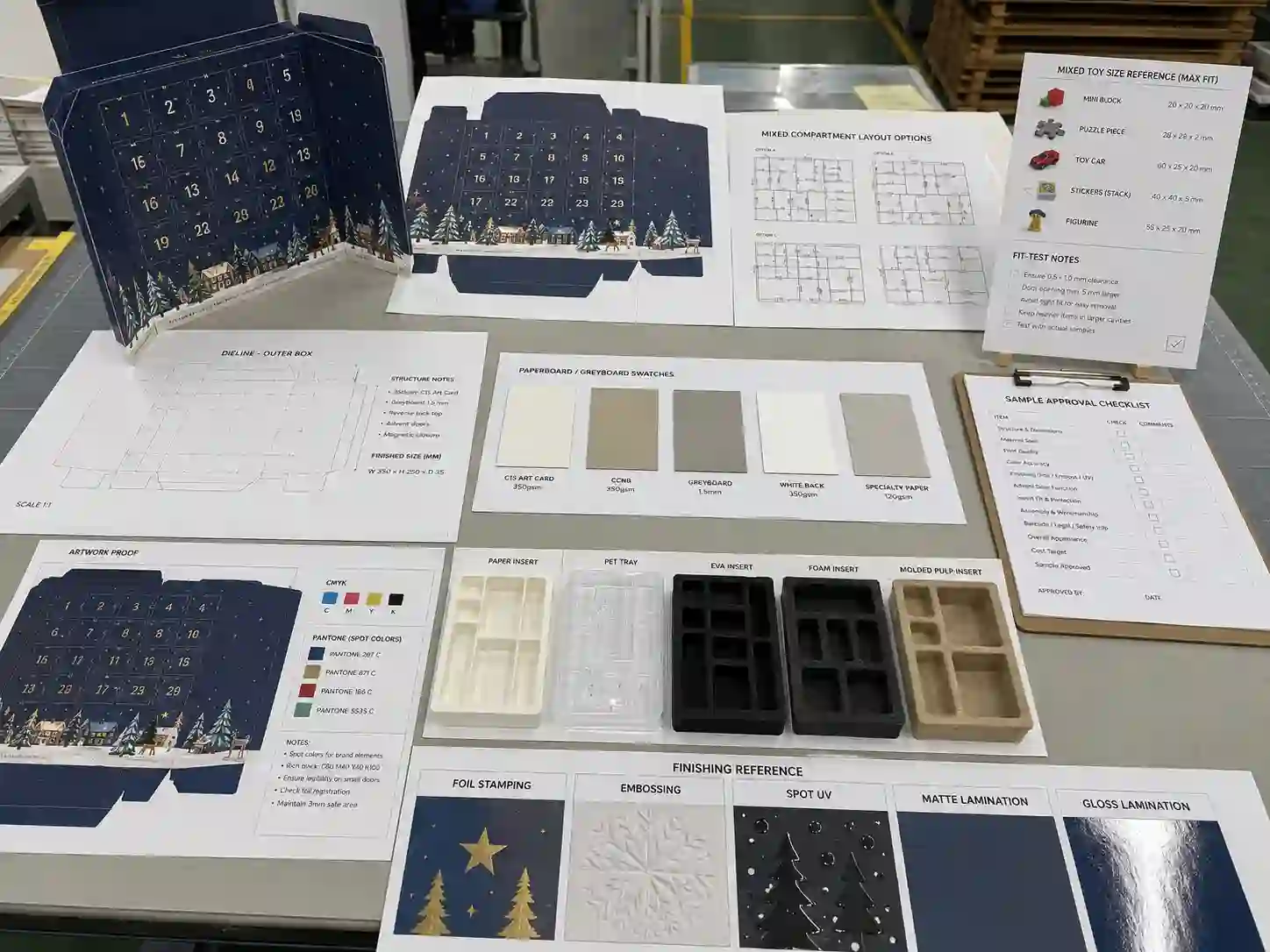
Printing and finishing should support brand presentation, retail visibility, and production consistency. CMYK is common for full-color artwork, Pantone is useful for brand color control, and finishes such as foil stamping, embossing, spot UV, matte lamination, and gloss lamination should be selected according to budget and handling risk.
Toy packaging usually needs clear age-range areas, warning areas if applicable, barcode zones, product information panels, recycling marks, and import labeling spaces. These areas should be planned in the dieline before artwork approval. For B2B buyers selling through retail or e-commerce, a beautiful front panel is not enough if the back panel lacks space for required labels or barcode placement.
Matte lamination can create a premium feel and reduce glare in photography. Gloss lamination can make colors brighter but may show scratches depending on handling. Spot UV can highlight numbers, toy icons, or seasonal design elements. Foil stamping and embossing can improve premium perception, but they require accurate files and additional proof checks.
Buyer tip: Ask for a digital proof and, when color accuracy matters, a printed proof before mass production. Color viewed on a screen is not a reliable approval standard for CMYK or Pantone-sensitive artwork.
How should buyers manage dielines and artwork approval?
Buyers should approve the dieline before final artwork and approve the artwork before the pre-production sample. This sequence reduces the risk of misplaced windows, wrong compartment numbers, barcode issues, and printing errors.
A toy advent calendar dieline should show cut lines, crease lines, glue areas, window openings, drawer positions, insert cavities, safety margins, and visible artwork panels. If the project includes multiple toy sizes, the dieline must connect with the insert drawing and loading plan. Numbered doors should be checked carefully so the opening order matches the buyer’s product plan.
Artwork files should be supplied in editable format when possible, with embedded or outlined fonts, high-resolution images, CMYK settings, Pantone references if used, and separate layers for foil stamping, embossing, or spot UV. Buyers should also confirm whether barcode artwork follows retailer requirements. For global barcode planning, the official GS1 barcode standards resource is a useful reference.
What sample process is recommended before mass production?
The recommended sample process is blank structure sample, printed sample if needed, then pre-production sample before mass production. Each stage checks a different risk: structure, appearance, and repeatability.
A blank sample helps confirm box size, compartment layout, insert fit, opening function, and loading method without waiting for final printing. A printed sample helps check color, finishing, numbering, barcode position, and retail presentation. A pre-production sample should represent final materials, final artwork, final insert, and final packing method as closely as possible.
- Confirm toy list: provide dimensions, weight, photos, and quantity per compartment.
- Review structure proposal: compare rigid box, folding carton, drawer box, or door-opening box.
- Approve dieline: check windows, compartments, glue areas, and labeling zones.
- Test insert: load real toys and check movement, pressure, and removal experience.
- Approve printed sample: confirm CMYK, Pantone, foil, embossing, spot UV, lamination, and barcode area.
- Confirm packing: review inner protection, export carton size, pallet plan, and shipping marks.
Quotable B2B statement: A toy advent calendar sample should be approved with real products loaded inside, because empty samples cannot reveal insert movement, door pressure, drawer friction, or export-packing risk.
What MOQ and cost drivers should buyers expect?
MOQ and cost are mainly driven by structure, material thickness, insert type, printing complexity, finishing, assembly labor, packing method, and order quantity. A simple folding carton with paper insert usually has different cost logic from a rigid drawer calendar with EVA insert and foil stamping.
Buyers should avoid asking only for a unit price without specifying the structure and packing requirements. Two suppliers may quote very different prices because one includes assembled packing, thicker greyboard, stronger export cartons, or more detailed QC, while another quotes a simplified version. For accurate comparison, request quotations based on the same dieline, material, finish, insert, quantity, and packing method.
For custom projects, MOQ may also be affected by paper purchase, printing setup, die-cut tooling, molded pulp tooling, tray tooling, and assembly efficiency. Instead of assuming one universal MOQ, buyers should ask the factory which cost items change when quantity increases from sample order to bulk production.
How should buyers compare toy calendar packaging suppliers?
Buyers should compare suppliers by development support, sample accuracy, production control, communication quality, export experience, and quotation transparency. The lowest unit price is not always the safest option if the supplier cannot control insert fit, assembly tolerance, or carton durability.
A reliable supplier should be able to explain the structure, material, insert, printing, sample process, MOQ, lead time, QC plan, and export packing in practical terms. They should ask for product dimensions and loading requirements before quoting a final price. They should also provide clear feedback if a buyer’s requested structure is too weak, too expensive, or difficult to assemble at scale.
Giftpackpro provides custom advent calendar box services for buyers who need structure planning, sample development, insert matching, artwork proofing, and production coordination. Buyers can also review custom advent calendar box products to compare common formats before preparing an RFQ.
What QC checks are important before shipment?
QC should check structure, insert fit, printing, finishing, assembly, barcode area, carton strength, and packing accuracy before shipment. Toy calendar packaging has many small parts, so inspection should cover both appearance and function.
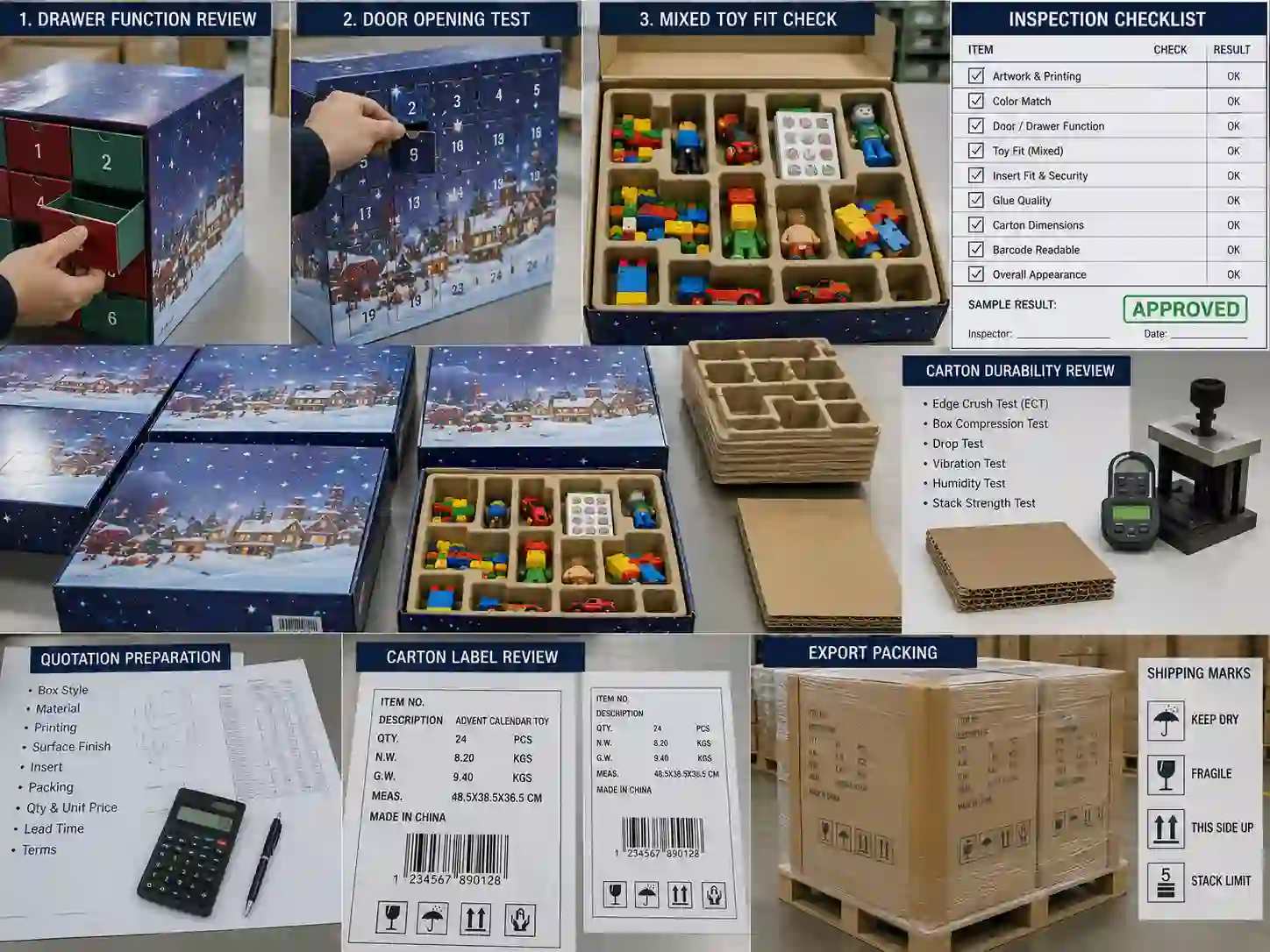
During production, the factory should check paper mounting, die-cut accuracy, glue strength, drawer sliding, door opening, insert position, numbering order, color consistency, lamination defects, foil registration, embossing pressure, and spot UV alignment. For toy fit, inspectors should load samples from production batches and confirm that products do not shift, scratch, crush doors, or fall out when opened.
Practical QC checklist for toy advent calendar boxes
- Confirm outer dimensions and compartment dimensions against approved sample.
- Check paperboard or greyboard thickness and surface quality.
- Test door-opening function, drawer sliding, and fold-out movement.
- Load real toys and check cavity fit, pressure marks, and shaking movement.
- Review CMYK color, Pantone matching, foil stamping, embossing, spot UV, matte lamination, or gloss lamination.
- Check barcode label area, shipping marks, retail labels, and warning or information panels.
- Inspect glue points, edges, corners, magnets, ribbons, pull tabs, and window tearing lines.
- Confirm inner packing, export carton quality, carton label, pallet plan, and final quantity.
QC tip: For mixed-toy calendars, inspection should include a loaded shake check and opening check. A box that passes visual inspection may still fail if the toys move inside the compartments during transport.
How should export packing be planned for international shipments?
Export packing should protect the box structure, control carton weight, and reduce damage during loading, storage, and delivery. Buyers should confirm whether the calendars will be shipped flat, semi-assembled, or fully assembled because this changes carton size, labor cost, and damage risk.
Fully assembled toy advent calendar boxes are easier for retail or e-commerce fulfillment but usually take more carton volume. Flat packing can reduce freight volume for some folding carton structures, but it may shift assembly labor to the buyer or a local packing partner. Premium rigid boxes often require corner protection, inner sleeves, or stronger master cartons to prevent crushed edges.
Export cartons should be matched to product weight and shipping route. Carton durability, pallet wrapping, shipping marks, barcode labels, and carton quantity should be approved before shipment. For projects with strict distribution requirements, buyers may also discuss transit or packaging performance testing with their logistics team and refer to resources from organizations such as the International Safe Transit Association.
What information should buyers prepare before requesting a quotation?
Buyers should prepare product dimensions, box style, insert preference, artwork requirements, quantity, packing method, destination, and deadline before requesting a quotation. The more complete the RFQ, the more accurate the sample plan, unit price, lead time, and packing proposal will be.
For Giftpackpro, buyers can start with a reference structure or ask the Giftpackpro packaging factory to recommend a practical option based on the toy list. If the buyer is still comparing ideas, the advent calendar box buying guides can help clarify structure, insert, printing, sampling, and export-packing decisions before submitting a formal request.
Quotation preparation checklist
- Target box type: rigid box, folding carton, drawer box, door-opening box, book-style box, or fold-out box.
- Product list: toy name, dimensions, weight, material, fragility, and quantity per compartment.
- Calendar layout: number of compartments, opening order, window size, and product placement plan.
- Insert preference: paper insert, PET tray, EVA insert, foam insert, molded pulp insert, or factory recommendation.
- Artwork needs: CMYK, Pantone, foil stamping, embossing, spot UV, matte lamination, gloss lamination, barcode area, and label zones.
- Order details: estimated MOQ, target quantity, sample deadline, mass production deadline, and delivery destination.
- Packing method: flat packed, semi-assembled, fully assembled, master carton requirements, pallet requirements, and shipping marks.
- Compliance notes: buyer-supplied labeling, retailer requirements, recycling claims, age-grade information, or documentation to verify.
What common mistakes should buyers avoid?
The most common mistakes are choosing structure before product fit testing, approving artwork before dieline confirmation, underestimating assembly labor, and comparing quotations without matching specifications. These mistakes can cause sample delays, cost changes, carton damage, and production disputes.
- Using only reference photos: photos do not show product weight, insert tolerance, or compartment depth.
- Ignoring mixed product sizes: one uniform cavity size may not protect varied toy items.
- Leaving no labeling area: retail labels, barcode areas, and shipping marks need space from the beginning.
- Approving empty samples: loaded samples are needed to test door pressure and toy movement.
- Choosing excessive finishes: foil, embossing, and spot UV should support the design, not create avoidable cost and production risk.
- Forgetting export cartons: weak cartons can damage otherwise well-made toy advent calendar boxes.
FAQ: What do B2B buyers ask about toy advent calendar boxes?
Can toy advent calendar boxes be made with plastic-free inserts?
Yes, many toy advent calendar boxes can use paper inserts or molded pulp inserts, depending on toy weight, shape, and protection needs. Buyers should test plastic-free options with real products before approving mass production.
Are rigid boxes always better than folding cartons?
No. Rigid boxes offer stronger presentation and durability, but folding cartons can be better for lightweight toys, large-volume retail programs, and freight cost control. The right choice depends on product value, channel, and budget.
How early should buyers start sampling?
Buyers should start sampling as early as possible after the toy list and target structure are known. Sampling may require dieline adjustment, insert testing, artwork proofing, and pre-production confirmation before mass production.
What affects lead time most?
Lead time is affected by dieline development, sample revisions, material sourcing, printing, finishing, insert production, hand assembly, QC, export packing, and shipping schedule. Complex structures and custom inserts usually need more planning time.
Can one calendar hold toys with very different sizes?
Yes, but the layout should be designed around grouped product dimensions. Large, heavy, fragile, and flat items should not be placed randomly because weight balance and cavity depth affect box performance.
How can buyers start a toy advent calendar packaging project with Giftpackpro?
To start a toy advent calendar project, prepare the toy list, preferred structure, insert direction, artwork requirements, quantity, sample deadline, shipping destination, and packing method. Giftpackpro can then help review structure, dieline, insert fit, printing process, sample plan, MOQ, QC points, export carton requirements, and quotation details.
For B2B buyers comparing toy advent calendar boxes, the most useful first step is to send real product dimensions and a target sales channel. This allows the packaging team to recommend a practical structure instead of guessing from a visual reference. When your specifications are ready, you can request a custom quote for sample development and bulk production planning.