Quick answer: Earring advent calendar boxes are custom seasonal packaging systems designed to hold earrings securely in dated compartments, drawers, trays, or doors for retail and e-commerce gift campaigns. For B2B buyers, the main decisions are structure, insert fit, material strength, artwork proofing, MOQ, sample approval, production lead time, QC control, export packing, and supplier reliability. When sourcing from China, buyers should compare factories by engineering ability, quotation detail, communication speed, sample accuracy, packing method, and risk-control process—not only by the lowest unit price.
For overseas brands, wholesalers, retail buyers, Amazon sellers, and gift companies, earring advent calendar boxes must protect small, delicate jewelry while also presenting a premium seasonal product. Earrings are light, but they are easy to lose, scratch, tangle, or mix between compartments. This makes insert design, compartment sizing, closure strength, and assembly tolerance especially important.
Giftpackpro works as a custom advent calendar boxes manufacturer for B2B seasonal packaging projects, including jewelry, beauty, gifts, candles, food, and promotional sets. This guide explains how to compare earring calendar structures, evaluate China suppliers, prepare a quotation request, and avoid production mistakes before mass production.
What should buyers understand before sourcing earring advent calendar boxes?
Buyers should understand that earring advent calendar boxes are not only printed paper boxes; they are engineered packaging sets with small-part protection, display logic, artwork alignment, and export-packing requirements. The best supplier must control structure, insert fit, printing, assembly, QC, and carton packing together.
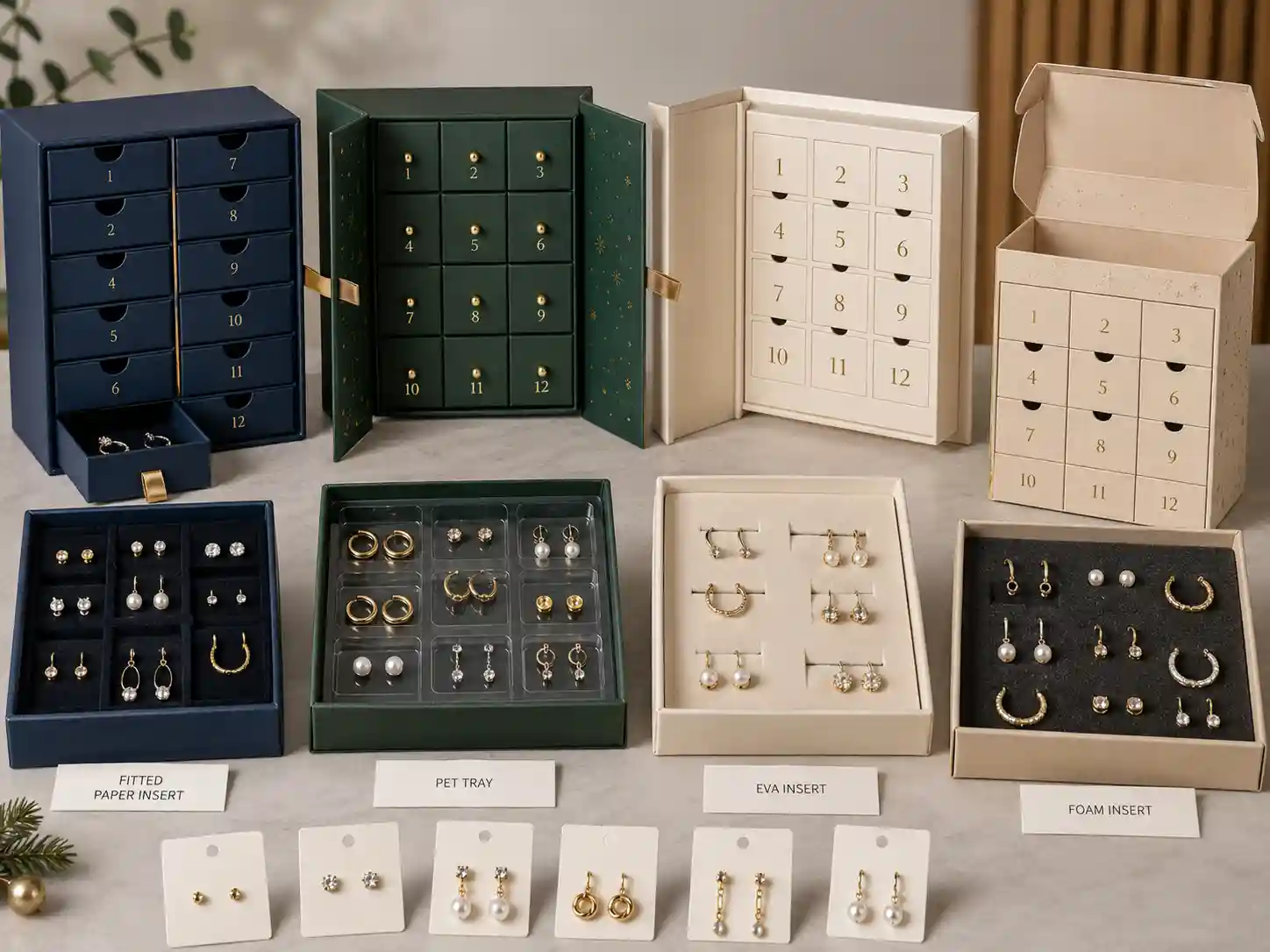
Unlike simple jewelry gift boxes, earring advent calendars usually include 12, 24, or 25 compartments. Each compartment may hold studs, hoops, huggies, drops, cuffs, or small charm earrings. These items may require different insert depths and holding methods. A pair of studs may sit on an earring card, while small hoops may need a paper slot, PET tray cavity, EVA insert, or foam cutout.
Buyer tip: Before asking for a quotation, decide whether the calendar will be sold empty, filled by your team, or assembled by the packaging factory with supplied earrings. The packing workflow changes the insert design, carton quantity, labor cost, QC process, and lead time.
Which earring advent calendar box structure is best for your campaign?
The best structure depends on retail positioning, jewelry weight, filling method, budget, and shipping plan. Rigid boxes feel more premium and protect better, while folding carton calendars reduce cost and shipping volume for price-sensitive projects.
| Structure option | Best for | Advantages | Watch points |
|---|---|---|---|
| Rigid door-opening box | Premium retail earring sets, department store gift ranges, influencer gift campaigns | Strong display value, good flat front artwork, premium greyboard structure | Higher unit cost, more assembly labor, needs door tolerance testing |
| Rigid drawer box | Luxury jewelry advent calendars and reusable gift packaging | Smooth opening experience, strong protection, suitable for nested trays | Drawer friction, insert height, and pull-ribbon strength must be tested |
| Book-style calendar box | Story-based product layouts, mixed earring and accessory sets | Premium presentation, good for printed inside artwork and product information | Magnetic closure or ribbon closure adds cost and must pass transit testing |
| Folding carton calendar | High-volume retail, e-commerce bundles, cost-controlled seasonal promotions | Lower cost, lighter weight, easier flat packing before assembly | Less rigid protection; insert and outer carton strength become more important |
| Tray-and-sleeve design | Minimalist earring sets and clean branded campaigns | Simple structure, efficient assembly, good for repeated product formats | Sleeve tightness and tray pulling force must be controlled |
For delicate earrings, the structure should prevent compartment mixing during transport. A door-opening box looks attractive, but small earrings can move if the insert is loose. A drawer box can feel premium, but each drawer must open smoothly without shaking the earring card out of position. A folding carton can be practical for large-volume promotions, but buyers should request a compression and drop-packing review before confirming mass production.
Factory tip: For earrings, a small difference in compartment size can create a large QC problem. A 1-2 mm insert tolerance may decide whether an earring card stays upright or slides under the door flap during shipping.
How should inserts be designed for studs, hoops, and drop earrings?
The insert should match the exact earring type, card size, backing method, and filling direction. Earring inserts must stop movement, prevent scratches, and keep each pair visible when the compartment is opened.
Common insert choices include paper insert, PET tray, EVA insert, foam, and molded pulp. Paperboard inserts are cost-effective and recyclable in many markets, but they need careful scoring, slotting, and folding. PET trays hold shapes accurately and work well for small cavities, but buyers should consider plastic-use requirements in the destination market. EVA and foam inserts offer strong holding power for premium jewelry, but they add cost and may not fit every sustainability brief. Molded pulp can support eco-positioned projects, but tooling, surface texture, and small-cavity accuracy need early testing.
Which insert works best for different earring formats?
Stud earrings often work well with earring cards placed into paper slots or small foam cuts. Hoops and huggies may need deeper cavities or card-holding channels to stop rolling. Drop earrings require extra height clearance because the hanging part can bend, tangle, or press against the compartment door.
- Stud earrings: Use earring cards, paperboard slots, foam cuts, or EVA holes to keep pairs aligned.
- Small hoops: Use PET tray cavities or card channels to avoid rolling inside the compartment.
- Drop earrings: Add height clearance so the drop part does not press against the door or drawer front.
- Mixed earring sets: Create different cavity depths instead of forcing one universal compartment size.
- Earring cards: Confirm card thickness, hole position, backing height, and whether cards are inserted manually or by assembly line.
QC tip: During sample review, shake the closed calendar gently in multiple directions and then open every compartment. If earrings move into neighboring spaces, the insert needs revision before pre-production sample approval.
What material and printing choices matter for earring advent calendar boxes?
Material and printing decisions affect price, appearance, durability, and production risk. For earring advent calendar boxes, buyers should balance premium visual impact with stable structure and repeatable mass production.
Rigid box projects usually use greyboard wrapped with printed art paper. Common greyboard thickness may vary by box size and strength requirement, so buyers should request supplier recommendations instead of selecting thickness blindly. Folding carton calendars usually use paperboard, such as white card, kraft board, or specialty board, depending on branding and cost targets.
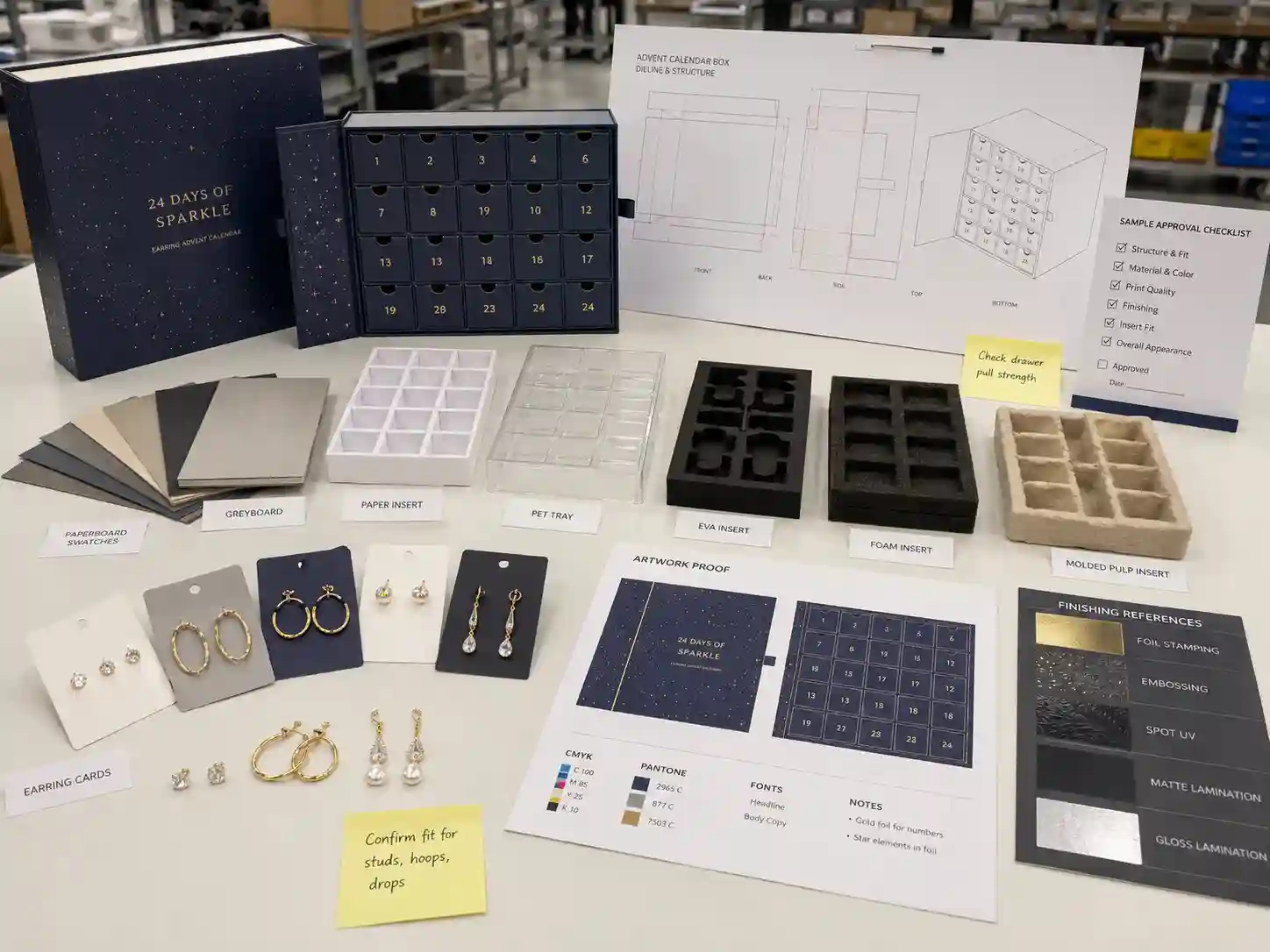
Artwork should be prepared on the correct dieline. The dieline should mark cut lines, fold lines, bleed, glue areas, window areas, door numbers, drawer fronts, insert positions, and safe zones. For earring calendars, number alignment matters because a printed door number that shifts even slightly can make the product look poorly made.
Which finishing options are useful for jewelry packaging?
Jewelry advent calendars often benefit from premium finishing, but every finish should support the brand position and production budget. Foil stamping, embossing, spot UV, matte lamination, and gloss lamination can improve shelf impact when used selectively.
- CMYK printing: Suitable for full-color seasonal graphics, patterns, and product illustrations.
- Pantone color: Useful when brand color consistency is important across packaging, inserts, and marketing materials.
- Foil stamping: Adds metallic detail for jewelry positioning, especially on logos, numbers, borders, or icons.
- Embossing: Creates a raised tactile effect, often used with foil or simple premium graphics.
- Spot UV: Highlights selected artwork areas, but registration must be checked carefully on small numbered doors.
- Matte lamination: Gives a soft premium look and helps protect printed surfaces.
- Gloss lamination: Creates a brighter finish but may show scratches more easily on dark artwork.
Buyer tip: Ask the factory to confirm whether foil stamping, embossing, and spot UV are quoted as separate charges. Low quotations may exclude finishing molds, setup fees, or extra spoilage allowance.
How should importers compare China factories for earring advent calendar boxes?
Importers should compare China suppliers by project understanding, sample accuracy, quotation transparency, communication quality, QC process, and export-packing experience. A low unit price is not useful if the factory cannot control insert fit, artwork alignment, lead time, or carton protection.
A reliable supplier should be able to discuss structure options, insert materials, dieline preparation, printing proof, sample timeline, MOQ, production schedule, inspection criteria, and shipping-mark requirements. Buyers can review Giftpackpro packaging factory information to understand how factory-side packaging support differs from simple trading communication.
| Supplier comparison point | What to ask | Why it matters |
|---|---|---|
| Engineering ability | Can you adjust the dieline, insert, drawer clearance, and compartment depth for actual earring samples? | Earrings are small and easy to move, so structure and insert testing reduce returns and complaints. |
| Quotation detail | Does the quotation list structure, size, material, printing, finishing, insert, packing, MOQ, sample cost, and lead time? | Clear quotations reduce surprise charges during sample or bulk production. |
| Sample process | Can you provide blank sample, printed sample, and pre-production sample when needed? | Different sample types verify structure, artwork, and production readiness. |
| Communication | Does the supplier ask practical questions about earring size, card style, filling method, and shipping plan? | Good questions usually indicate real manufacturing experience. |
| QC control | What inspection points are checked before shipment? | Function, printing, insert fit, and packing checks protect the campaign launch. |
| Export packing | How are master cartons, corner protectors, pallet wrapping, and shipping marks handled? | Seasonal packaging often travels long distances and cannot arrive crushed or mixed. |
What should a professional quotation include?
A professional quotation should show more than a unit price. It should define the complete packaging specification so buyers can compare suppliers fairly and avoid hidden differences.
When requesting pricing for custom advent calendar box services, prepare a clear RFQ instead of sending only a reference photo. The factory needs enough detail to estimate material use, printing cost, insert labor, assembly time, packing volume, and production risk.
Quotation preparation checklist for buyers
- Target quantity or quantity range for MOQ comparison.
- Calendar format, such as 12-day, 24-day, or 25-day layout.
- Preferred structure: rigid box, drawer box, door-opening box, book-style box, tray-and-sleeve box, or folding carton.
- Outer box size or product-size information for the supplier to calculate structure.
- Actual earring dimensions, weight, card size, backing height, and packaging orientation.
- Insert preference: paper insert, PET tray, EVA insert, foam, molded pulp, or supplier recommendation.
- Artwork status: finished artwork, rough concept, brand guide, or need for dieline first.
- Printing and finishing requirements: CMYK, Pantone, foil stamping, embossing, spot UV, matte lamination, or gloss lamination.
- Sample requirement: blank prototype, printed sample, or pre-production sample.
- Bulk packing preference: flat packing, assembled empty packing, or filled calendar packing.
- Destination country, shipping method, pallet requirement, and shipping-mark format.
- Expected delivery date and any retail launch deadline.
Factory tip: If you are comparing three suppliers, send the same RFQ to all of them. Otherwise, one quote may include PET tray and export carton packing while another includes only a simple paper insert and weak carton specification.
How do MOQ, lead time, and cost drivers usually work?
MOQ and lead time depend on structure, size, material, printing, finishing, insert complexity, and assembly method. Custom earring advent calendar boxes usually require more planning than standard jewelry boxes because they involve many compartments and repeated fitting checks.
Buyers should avoid treating MOQ as a single fixed number. A folding carton design may support a lower-cost high-volume campaign, while a rigid drawer box with EVA insert, foil stamping, and magnetic closure may require more setup, labor, and production time. Sample timing also depends on whether the supplier is making a structural blank sample, printed sample, or pre-production sample.
Decision guide: when should you choose each sourcing route?
| Buyer situation | Recommended route | Reason |
|---|---|---|
| You need fast structure confirmation before artwork is final | Request a blank prototype first | It verifies size, compartment layout, insert fit, and opening function before printing cost is added. |
| You need buyer or retail approval | Request a printed sample | It shows material, artwork, color, finishing, and presentation quality. |
| You are placing a large order with strict launch timing | Approve a pre-production sample before mass production | It locks structure, printing, insert, assembly, and packing standards. |
| You sell through e-commerce | Strengthen insert and export packing review | Parcel handling can cause movement, corner damage, and compression issues. |
| You sell through retail stores | Prioritize shelf appearance and barcode or shipping-mark coordination | Retail buyers need consistent presentation, carton labels, and receiving information. |
For responsible material sourcing, buyers can ask suppliers whether paper materials can be verified through recognized programs such as FSC, where relevant to the project. For transport validation, buyers may also discuss packaging performance references such as ISTA testing methods when the shipment risk or retail requirement justifies it.
What sample process reduces production risk?
The safest sample process moves from structural confirmation to printed appearance and then to pre-production approval. Buyers should not approve mass production based only on a photo or artwork mockup.
A blank sample checks the structure, insert, and opening function without final printing. A printed sample checks color, surface finish, logo position, door number alignment, foil stamping, embossing, lamination, and overall brand presentation. A pre-production sample confirms that the mass production team can repeat the approved result using the final material, dieline, insert, artwork, and packing method.
For earring calendars, sample review should include real earrings or accurate dummy products. If the factory tests only with paper cards and no actual earring thickness, compartment clearance may be wrong. If the earring backs are thicker than expected, doors may bulge or drawers may jam.
Sample approval checklist
- Confirm outer size, compartment count, and layout.
- Check door, drawer, or sleeve opening function.
- Test earring card fit, backing height, and product movement.
- Review paperboard or greyboard thickness and edge quality.
- Check printed color against approved CMYK proof or Pantone reference.
- Inspect foil stamping, embossing, spot UV, matte lamination, or gloss lamination.
- Confirm barcode, warning text, recycling marks, or buyer-required labels if applicable.
- Check assembly tolerance, glue position, and door perforation strength.
- Review master carton size, inner packing, and shipping marks.
- Sign off the approved sample with clear written notes before mass production.
QC tip: Keep one signed approved sample with the buyer and one with the factory. During mass production inspection, the approved sample becomes the reference for color, structure, insert fit, finishing, and packing.
Which QC points matter most before shipment?
The most important QC points are structure function, insert fit, printing accuracy, finishing quality, assembly strength, quantity control, and export carton protection. For earring advent calendar boxes, QC should also check whether each small earring space remains separate after handling.
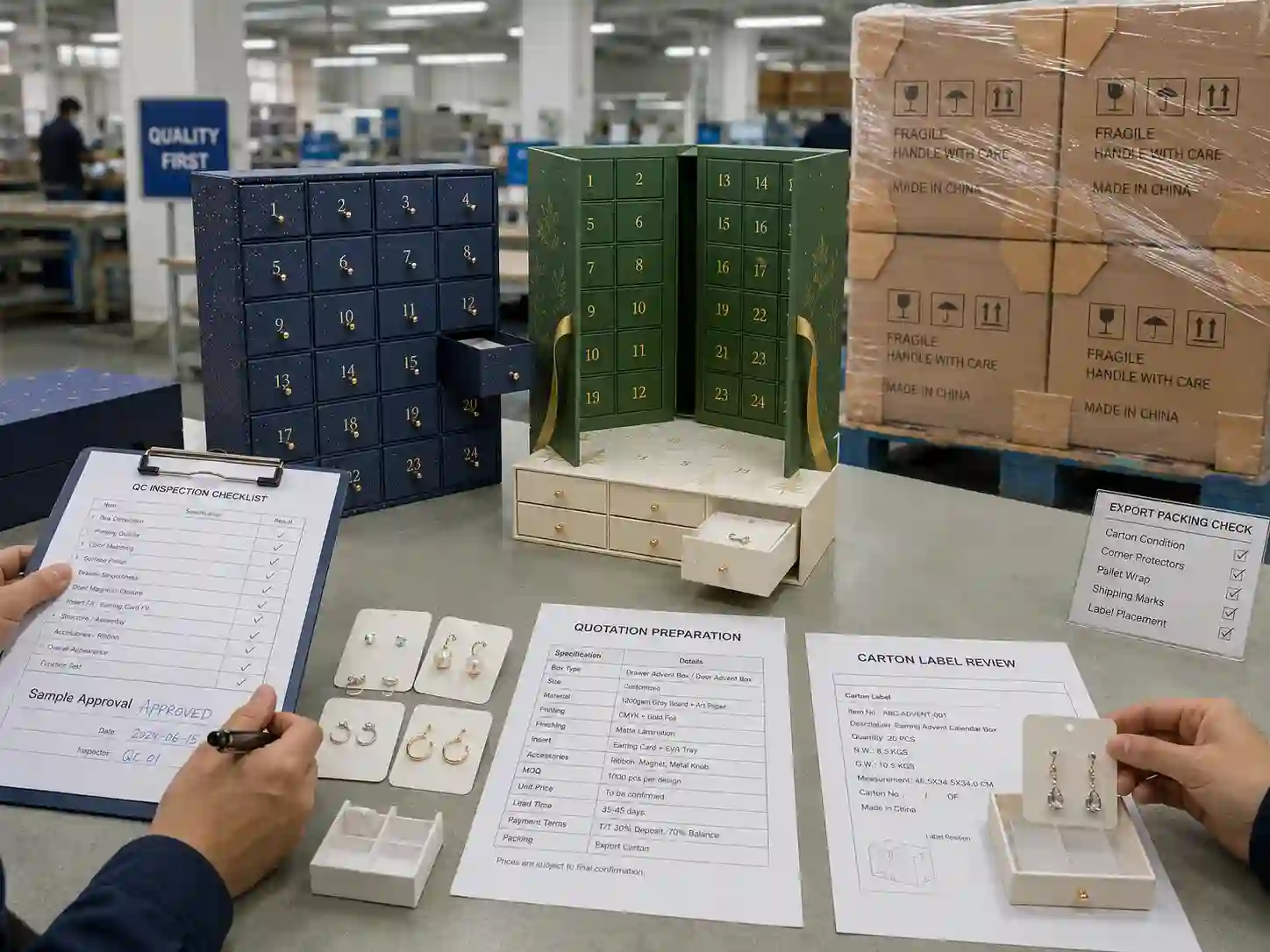
Final inspection should include both visual checks and functional checks. Visual checks cover color variation, scratches, glue marks, dirty surfaces, foil defects, misaligned numbers, and uneven lamination. Functional checks cover door tearing, drawer sliding, insert tightness, compartment separation, closure strength, and carton compression risk.
- Structure inspection: Check door opening, drawer sliding, book-style closing, tray pulling, and corner strength.
- Insert inspection: Confirm each cavity or slot holds the earring card securely without bending it.
- Printing inspection: Compare mass production color with approved sample and confirm number alignment.
- Finishing inspection: Look for foil missing, embossing shift, spot UV registration problems, and lamination bubbles.
- Assembly inspection: Check glue strength, flap closure, magnetic closure, ribbon pull, and drawer stop position.
- Packing inspection: Confirm master carton quality, inner protection, carton labels, pallet plan, and shipping marks.
Giftpackpro’s custom advent calendar box products include different structures and insert approaches that can be adapted for earring sets and other small gift products. Buyers can use these product references to discuss which format is realistic for their budget, MOQ, and launch schedule.
How should export packing be planned for earring calendar shipments?
Export packing should protect the finished calendar from compression, corner damage, moisture, shifting, and carton confusion during international transport. Good export packing is part of the packaging specification, not an afterthought.
For assembled earring advent calendar boxes, suppliers may use individual polybagging, tissue wrapping, paper sleeves, inner cartons, corner protectors, and strong master cartons depending on the product value and shipping route. For flat-packed folding carton calendars, buyers should confirm how inserts, sleeves, and outer cartons are separated and labeled for destination assembly.
Shipping marks should be clear and generic unless the buyer requests branded carton markings. Typical carton information may include item number, quantity, carton number, gross weight, net weight, measurement, destination, and handling marks. Retail buyers and distributors may also require barcode labels, pallet labels, or receiving labels. These details should be confirmed before carton printing.
Buyer tip: Ask for carton packing photos before shipment. Photos should show the opened carton, inner protection, carton label, shipping marks, and pallet wrapping if pallets are used.
What common mistakes should buyers avoid?
Most problems come from incomplete RFQ details, untested inserts, rushed sample approval, unclear artwork files, and weak export packing. These mistakes are preventable if buyers control the project before mass production starts.
- Choosing by unit price only: A cheaper quote may use thinner board, simpler insert, fewer finishing steps, or weaker export cartons.
- Sending only a reference image: Factories need actual earring dimensions, card sizes, target quantity, structure preference, and packing requirements.
- Ignoring earring backing height: Stud backs and clip parts can create unexpected pressure inside small compartments.
- Approving artwork without dieline checking: Door numbers, fold lines, glue areas, and safe zones must be reviewed before printing.
- Skipping insert testing: If the insert is loose, earrings can move, mix, scratch, or fall out when opened.
- Not confirming sample type: Blank samples, printed samples, and pre-production samples serve different purposes.
- Leaving carton labels until the end: Shipping marks, carton labels, and pallet requirements should be confirmed before packing.
What information should buyers prepare before contacting Giftpackpro?
To quote earring advent calendar boxes accurately, prepare product details, structure preferences, artwork status, quantity, sample needs, and shipment requirements. Clear information helps the factory recommend realistic options and reduce back-and-forth communication.
Before you request a custom quote, prepare the calendar format, product dimensions, earring card size, target quantity, preferred structure, insert idea, artwork files or brand guide, finishing requirements, sample schedule, destination market, packing method, and deadline. If you are still comparing structures, Giftpackpro can discuss practical options through its custom advent calendar box services.
Buyers who are still planning their seasonal packaging range can also review more advent calendar box buying guides to compare structure, inserts, printing, MOQ, production, and export packing across different product categories.
FAQ: Earring advent calendar boxes for B2B buyers
What are earring advent calendar boxes?
Earring advent calendar boxes are custom multi-compartment packaging boxes designed to display and protect earring sets in a seasonal calendar format. They may use doors, drawers, trays, sleeves, or book-style openings with paper, PET, EVA, foam, or molded pulp inserts.
Are rigid boxes better than folding cartons for earring calendars?
Rigid boxes are better for premium presentation and protection, while folding cartons are better for high-volume cost control and lighter shipping. The best choice depends on retail price, product weight, insert design, and export-packing needs.
What insert is best for stud earrings?
Stud earrings often work well with earring cards held by paperboard slots, EVA holes, or foam cuts. The supplier should test the card thickness, backing height, and movement during sample review.
Can one calendar hold mixed earring styles?
Yes, but mixed styles usually need different compartment depths or insert shapes. Studs, hoops, huggies, and drop earrings should not be forced into one identical cavity unless the fit has been tested.
What is the difference between a blank sample and a printed sample?
A blank sample checks structure, size, opening function, and insert fit. A printed sample checks artwork, color, finishing, lamination, foil stamping, embossing, and overall presentation.
What should be checked before mass production?
Buyers should approve the dieline, material, insert, artwork, printing proof, finishing, structure function, sample notes, QC criteria, master carton plan, and shipping marks before mass production starts.
How can buyers compare supplier quotations fairly?
Send the same RFQ to each supplier and compare structure, material, board thickness, insert type, printing, finishing, sample cost, MOQ, lead time, packing method, and payment terms. Do not compare only the headline unit price.
Why is export packing important for earring calendars?
Earring calendars include many small compartments and finished surfaces. Weak export cartons can cause crushed corners, shifted inserts, scratched surfaces, or mixed products before the shipment reaches the buyer.
Conclusion: how to source earring advent calendar boxes with less risk
Earring advent calendar boxes require careful sourcing because small jewelry products depend on accurate insert fit, clean printing, controlled assembly, and strong export packing. Buyers should compare suppliers by factory-side problem solving, not only price. The strongest projects start with a clear RFQ, move through structured sample approval, and use written QC and packing standards before shipment.
For brands, wholesalers, distributors, retail buyers, and e-commerce sellers planning a custom seasonal jewelry campaign, Giftpackpro can help evaluate structure, inserts, dieline, printing, finishing, MOQ, lead time, sample approval, mass production, and export packing for earring advent calendar boxes.