
Quick answer: Bracelet advent calendar boxes are custom seasonal packaging solutions designed to hold bracelets, charms, jewelry cards, small pouches, and accessory sets in numbered compartments. For B2B buyers, the key decisions are box structure, insert type, bracelet size range, sample approval, artwork accuracy, MOQ, production tolerance, QC, and export packing. A good supplier should help confirm bracelet fit before mass production, provide blank and printed samples when needed, check dielines and printing proofs, and prepare export cartons with clear shipping marks. The most reliable RFQ starts with bracelet dimensions, set quantity, target retail style, artwork files, order quantity, and delivery deadline.
Bracelet advent calendar boxes are not only decorative retail packaging. For brands, wholesalers, and purchasing teams, they are engineered packaging systems that must protect flexible jewelry products, present each bracelet clearly, support seasonal launch timing, and survive international shipping. A bracelet can shift, twist, tangle, scratch, or look uneven if the insert and compartment layout are not tested early.
Giftpackpro works as a custom advent calendar boxes manufacturer for overseas buyers who need practical sampling, prototyping, production, and export-packing support. This guide explains how to plan custom bracelet calendar packaging from the first sample request to pre-production approval and final quotation.
What should buyers understand before sourcing bracelet advent calendar boxes?
Buyers should understand that bracelet packaging needs more fit testing than many flat paper gift boxes because the product is flexible, often metallic, and may include chains, beads, charms, elastic cords, or cards. The box must control movement while still making daily opening easy for retail customers.
The main risk is not only whether the bracelet fits inside the compartment. The real question is whether each bracelet stays in position after handling, carton vibration, warehouse storage, and repeated door or drawer opening. A small chain bracelet may need a card slot, elastic band, velvet pad, or paperboard pocket. A bangle may need a deeper compartment and stronger insert wall. A charm bracelet set may require separate spaces for the bracelet base and loose charms.
For purchasing teams comparing suppliers, the most important early discussions should include:
- How many bracelet pieces or charm accessories are included in one calendar?
- Are the bracelets packed loose, on cards, in mini pouches, or in small jewelry boxes?
- Does the buyer need a rigid box, folding carton, drawer box, or door-opening box?
- Will the insert be paperboard, PET tray, EVA insert, foam, molded pulp, or velvet-covered material?
- Is a blank sample enough first, or is a printed sample required before order approval?
- What artwork finishing is required: CMYK, Pantone, foil stamping, embossing, spot UV, matte lamination, or gloss lamination?
- What lead time is needed for sampling, revision, pre-production sample approval, mass production, and export shipping?
Buyer tip: For bracelet advent calendar boxes, send the supplier real bracelet samples or exact product drawings before confirming the insert. A bracelet measured only by chain length may still fail fit testing if the charm, bead, clasp, pouch, or card changes the packed size.
Which box structure works best for bracelet calendar packaging?
The best structure depends on bracelet weight, retail price point, opening experience, and order budget. Rigid boxes are stronger and more premium, while folding cartons are lighter and usually more cost-efficient for larger seasonal promotions.
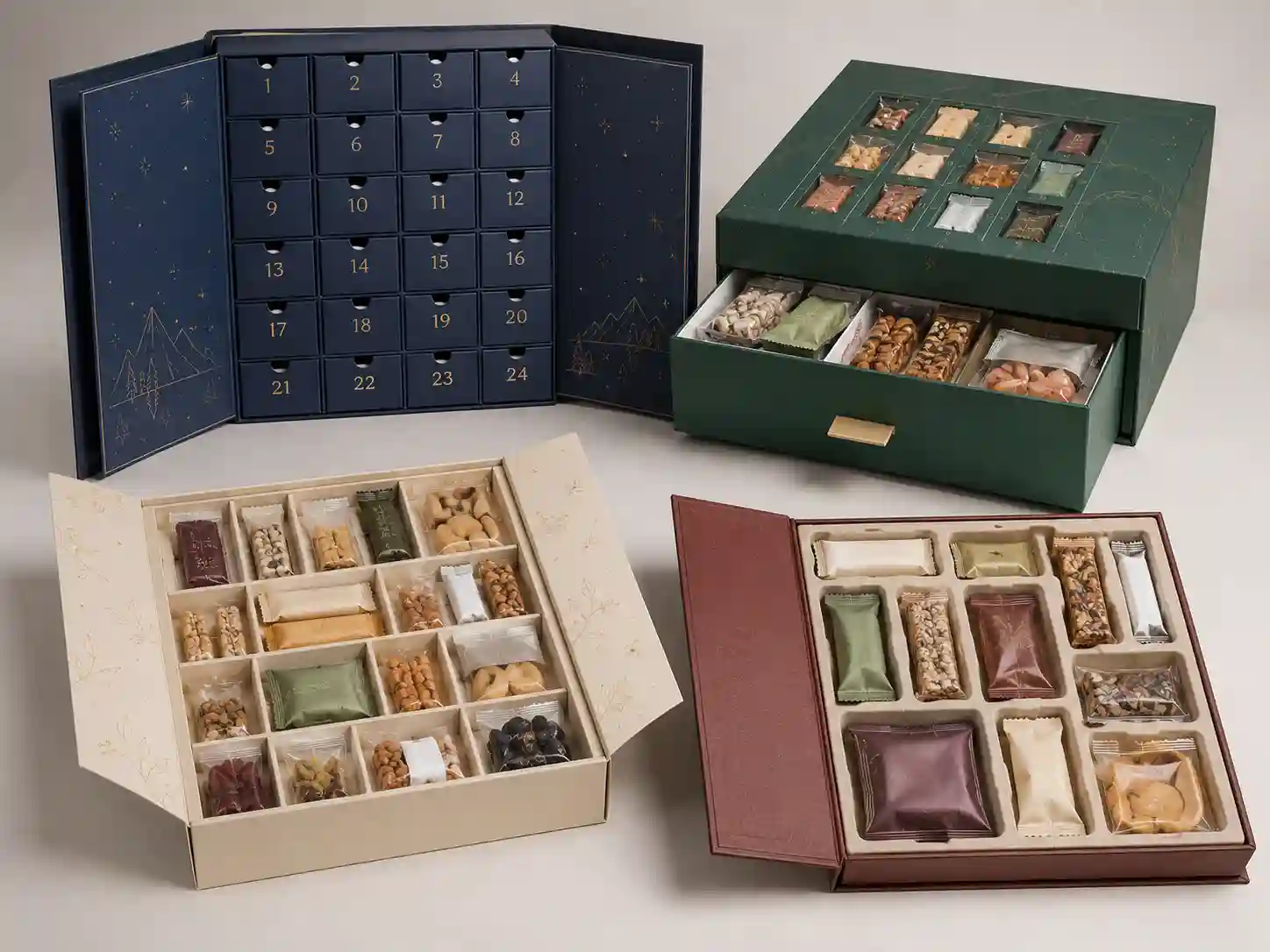
Bracelet calendars are commonly produced as door-opening boxes, drawer boxes, book-style rigid boxes, or folding carton calendars. Each structure has a different impact on tooling cost, hand assembly, insert stability, shipping weight, and shelf presentation.
| Structure option | Best use case | Buyer advantages | Sampling points to check |
|---|---|---|---|
| Rigid door-opening box | Premium bracelet sets, brand launches, gift retail, boutique collections | Strong greyboard structure, high perceived value, good for foil stamping and embossing | Door tear line, hinge strength, compartment depth, insert bonding, outer wrap alignment |
| Drawer bracelet advent calendar box | Charm sets, daily bracelet accessories, reusable packaging concepts | Smooth daily opening, good product separation, strong unboxing effect | Drawer sliding tolerance, pull-tab strength, drawer wall thickness, product movement inside each drawer |
| Book-style rigid box | Luxury jewelry presentation and influencer or PR campaigns | Premium opening, large branding area, suitable for magnetic closure or ribbon closure | Magnet position, spine folding, insert height, closure force, shipping compression |
| Folding carton calendar | Higher-volume retail programs and cost-sensitive promotions | Lighter weight, efficient packing, lower material use compared with rigid formats | Board stiffness, die-cut accuracy, window or door tearing, carton collapse risk |
| Hybrid paperboard sleeve with tray | E-commerce kits, gift bundles, subscription-style bracelet sets | Good balance between presentation and shipping efficiency | Sleeve friction, tray pull-out force, insert fit, barcode and shipping label position |
Factory tip: A bracelet calendar with 12 or 24 openings should not be approved only from a flat dieline. The prototype should be opened, closed, tilted, and lightly shaken with real or dummy bracelet weight inside each compartment.
When should buyers choose a rigid box?
Choose a rigid box when the bracelet set has a higher retail value, heavier pieces, premium finishes, or a giftable presentation requirement. Rigid greyboard can improve structure stability and support decorative effects such as foil stamping, embossing, debossing, spot UV, and soft-touch or matte lamination.
Rigid bracelet advent calendar boxes usually require more hand assembly and longer sampling time than folding cartons. The buyer should check corner wrapping, glue marks, board thickness, magnetic closure position if used, and whether the insert is fixed firmly enough to prevent bracelet migration.
When is a folding carton suitable?
A folding carton is suitable when the project needs a lighter, more economical structure for larger retail quantities. It can work well for lightweight bracelets on cards, small charm accessories, or promotional jewelry sets.
The main limitation is strength. A thin paperboard structure may bend if the bracelet compartments are deep or the outer calendar size is large. Buyers should ask the factory to recommend paperboard thickness and perform a blank sample test before investing in full printed prototypes.
How should inserts be designed for bracelets, charms, and accessories?
Bracelet inserts should hold the product in a controlled position without damaging metal surfaces, stones, coatings, beads, or cords. The insert decision affects both product presentation and failure rate during packing.
Unlike rigid products, bracelets can coil, fold, slide, or tangle. For this reason, the insert should be designed around the packed presentation method, not only the bracelet’s full length. A bracelet on a card has different requirements from a loose chain bracelet, bangle, charm bracelet, friendship bracelet, or elastic bead bracelet.
Common insert options for bracelet advent calendar boxes
- Paper insert: Good for lightweight bracelet cards, paper-based campaigns, and cost-sensitive projects. It can be printed, folded, and die-cut with slots or pockets.
- PET tray: Suitable when clear formed cavities are needed. It gives accurate positioning but buyers should check surface contact and sustainability requirements.
- EVA insert: Useful for premium bracelets, bangles, and heavier pieces. It can be die-cut to shape and covered with paper or velvet-like material when a softer presentation is needed.
- Foam insert: Good cushioning for delicate bracelet surfaces, but density, odor, color transfer, and edge cutting quality should be reviewed during sampling.
- Molded pulp insert: A practical option for buyers looking for a paper-based molded structure, especially when product shapes are repeatable and cavity depth can be controlled.
- Velvet-covered insert: Suitable for premium jewelry presentation, but it requires careful checking for lint, glue marks, color consistency, and bracelet contact points.
QC tip: Insert testing should include product loading, closing, vertical storage, carton movement, and opening review. If the bracelet looks good only when the box is lying flat, the insert may not be reliable for real retail handling.
What sampling path should buyers follow before mass production?
For bracelet advent calendar boxes, the safest path is usually blank sample first, revised blank sample if needed, printed sample, then pre-production sample before mass production. This sequence helps buyers separate structure problems from printing and finishing decisions.
Sampling is the main focus of Month 07 planning because many seasonal packaging failures start with rushed sample approval. A printed sample may look attractive, but if the insert does not hold the bracelet correctly, the mass production order can still fail. A blank prototype is often the fastest way to check dimensions, opening function, product fit, and insert engineering before artwork cost is added.
What is a blank sample?
A blank sample is an unprinted prototype used to test structure, size, compartment layout, insert fit, and opening method. It may use similar paperboard or greyboard but does not show final CMYK printing, Pantone color, foil stamping, embossing, spot UV, or lamination.
Buyers should use blank samples to answer engineering questions: Do all bracelets fit? Are compartments too tight? Does the door tear cleanly? Does the drawer slide smoothly? Does the box stand upright? Is the insert easy for workers to load during packing?
What is a printed sample?
A printed sample is used to review visual branding, artwork placement, color, surface finishing, and the combined effect of structure and graphics. It helps confirm whether the dieline, logo position, numbering, barcode area, instruction text, and finishing layers are correct before bulk order release.
Printed samples can be digital printed, offset printed, or produced with partial final processes depending on project requirements. Buyers should clarify whether the sample uses the exact mass production printing method. Digital sample color may not perfectly match offset printing, so Pantone targets and production proofing should be discussed in advance.
What is a pre-production sample?
A pre-production sample is made close to the final production method, materials, structure, and artwork. It becomes the main reference for mass production QC and buyer approval.
The approved pre-production sample should be kept by both the buyer and the factory. It should define the acceptable standard for board thickness, paper surface, printing color, foil position, door opening, drawer movement, insert fit, glue cleanliness, and export packing method.
What should buyers check during sample approval?
Buyers should check product fit, structure function, artwork accuracy, finishing quality, assembly tolerance, and packing feasibility before approving the sample. Approval should be written and based on a clear checklist, not only visual preference.
A practical sample approval checklist for bracelet advent calendar boxes should include:
- Outer box dimensions match the quotation and product specification.
- Each bracelet, charm, pouch, or jewelry card fits the assigned compartment.
- Compartments are deep enough to prevent products from pressing against doors or lids.
- Door-opening panels tear cleanly without damaging nearby compartments.
- Drawer boxes open smoothly but are not loose during handling.
- Insert holes, slots, pockets, or cavities hold bracelets in the correct position.
- Bracelet surfaces do not scratch against sharp insert edges or staples.
- Dieline, numbering, barcode area, warning text, and legal copy are correct.
- CMYK or Pantone color targets are approved under agreed lighting conditions.
- Foil stamping, embossing, spot UV, matte lamination, or gloss lamination are correctly placed.
- Glue marks, paper wrinkles, board warping, and corner wrapping are within acceptable limits.
- Final packed calendar fits the export carton plan and pallet-loading method.
Buyer tip: Mark sample comments directly on photos or a PDF proof. Written comments such as “make the insert better” are too vague; comments such as “increase bracelet card slot width by 2 mm” help the factory revise accurately.
How do artwork, dieline, and printing choices affect sample results?
Artwork quality affects both appearance and production accuracy. Buyers should not approve mass production until the dieline, print file, color targets, finishing layers, and opening numbers are checked together.
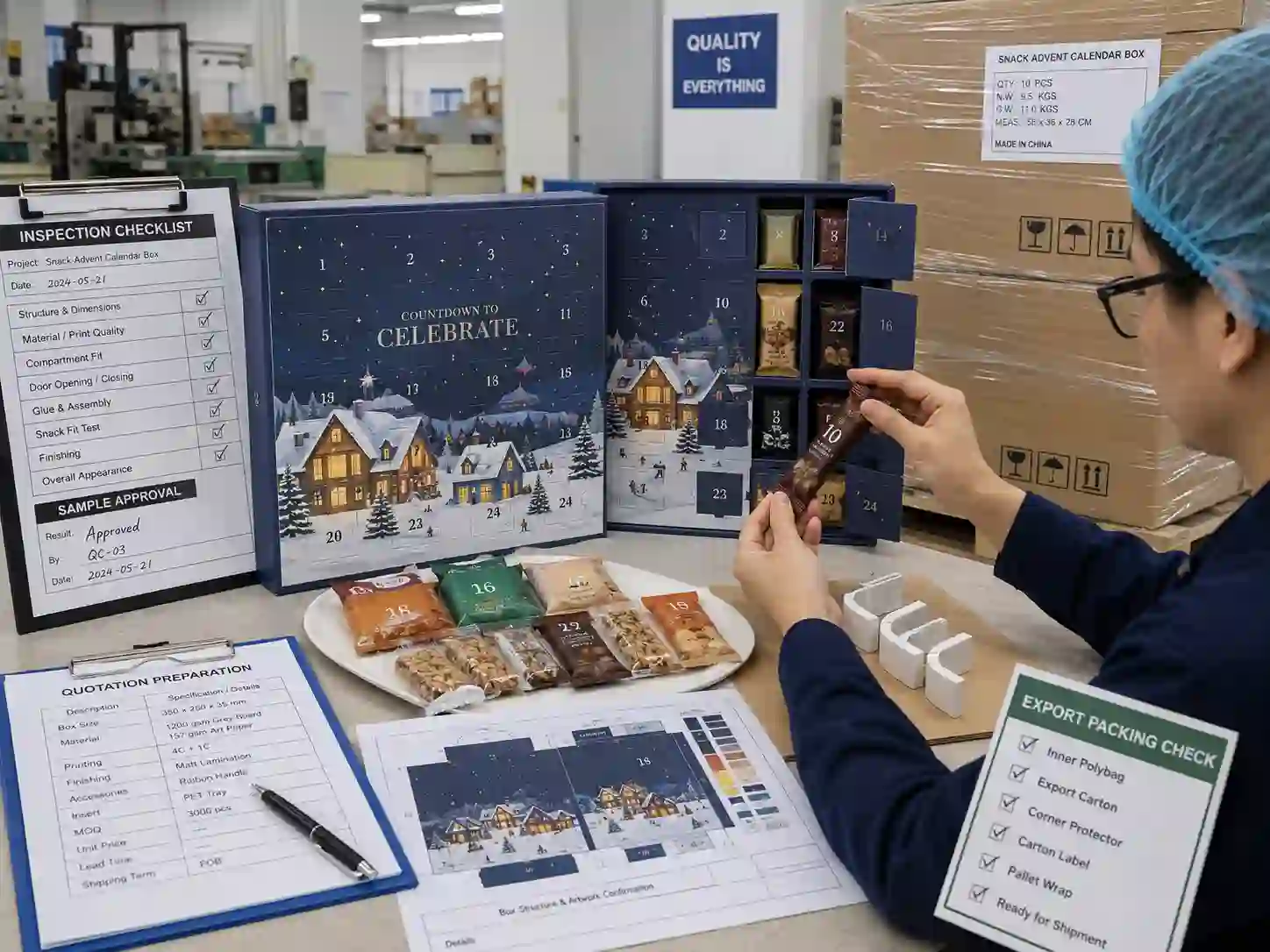
For custom advent calendar boxes, the dieline is the bridge between design and manufacturing. It shows cutting lines, folding lines, glue areas, door openings, drawer panels, insert positions, and safe zones. If the artwork is placed too close to a cut line or door perforation, important graphics may shift or be damaged during opening.
Buyers should prepare layered artwork files with clear instructions for:
- CMYK artwork and any Pantone spot colors.
- Separate layers for foil stamping, embossing, debossing, spot UV, and white ink if applicable.
- Bleed area, safe area, barcode position, warning text, and country-specific recycling marks.
- Numbering sequence for 12-day, 24-day, or customized bracelet calendar layouts.
- Finish direction, such as matte lamination on the outer wrap and gloss spot UV on numbers.
- Any material claims that must be verified before printing.
Buyers considering paper sourcing claims can review official information from the Forest Stewardship Council and then ask suppliers what documentation can be verified for the actual order. Do not print certification marks, recycling claims, or compliance icons unless the usage is approved and documented.
Which cost drivers affect MOQ, sampling, and quotation?
The main cost drivers are structure type, box size, board thickness, insert complexity, printing method, finishing process, hand assembly, packing method, MOQ, and shipping volume. A lower unit price is not always better if the structure creates higher damage risk or longer assembly time.
Bracelet advent calendar boxes often require several cost-sensitive components: outer box, inner tray, insert, printed doors or drawers, pull tabs, ribbons, magnets, labels, instruction sheets, and export cartons. The more components involved, the more important sample approval and QC become.
How MOQ affects the project
MOQ depends on structure, material, printing setup, finishing process, and supplier production planning. A simple folding carton bracelet calendar may support a different MOQ from a rigid drawer calendar with custom EVA insert and multiple finishing effects.
Buyers should ask whether the MOQ applies to one design, one size, one artwork version, or one shipment. If a buyer wants several colorways or language versions, each version may affect printing setup, inventory control, carton labels, and inspection workload.
How sampling cost should be evaluated
Sampling cost is not only a sample fee. It includes engineering time, dieline adjustment, material preparation, printing proofing, insert cutting, hand assembly, courier cost, and revision time.
A serious buyer should compare whether the supplier provides practical feedback during sampling. A cheaper sample that does not test bracelet fit, insert tolerance, and packing method may create higher risk later. Review custom advent calendar box services to understand what information is usually needed before sample development.
How should buyers compare bracelet advent calendar box suppliers?
Buyers should compare suppliers by engineering support, sampling process, communication accuracy, material options, QC system, export packing experience, and quotation clarity. The best supplier is not simply the one with the lowest sample price.
Use this decision guide when comparing options:
| Decision point | Weak supplier signal | Strong supplier signal |
|---|---|---|
| Structure recommendation | Quotes one structure without asking bracelet size, weight, or packing method | Asks for product dimensions, bracelet card style, opening count, and retail channel |
| Insert engineering | Uses generic compartments without product-fit testing | Suggests paper insert, PET tray, EVA, foam, molded pulp, or card slots based on actual product |
| Sampling process | Pushes directly to printed sample before checking structure | Explains blank sample, printed sample, revisions, and pre-production sample approval |
| Artwork review | Only accepts finished artwork without checking dieline risks | Checks bleed, safe zone, numbering, finishing layers, barcode area, and color references |
| QC and packing | Mentions inspection only in general terms | Defines inspection points for structure, insert fit, printing, assembly, export carton, and shipping marks |
| Quotation clarity | Gives a unit price without material, size, MOQ, packing, or lead time details | Breaks down structure, material, printing, finishing, sample, MOQ, carton packing, and lead time assumptions |
Buyers can also review Giftpackpro packaging factory information to understand factory-side production capability, then compare it with project requirements such as sample timing, bulk order quantity, and seasonal delivery schedule.
What QC checks matter before shipment?
QC for bracelet advent calendar boxes should check structure, insert fit, printing, finishing, assembly, product loading, carton packing, and shipping marks. Final inspection should compare production goods against the approved sample and written specification.
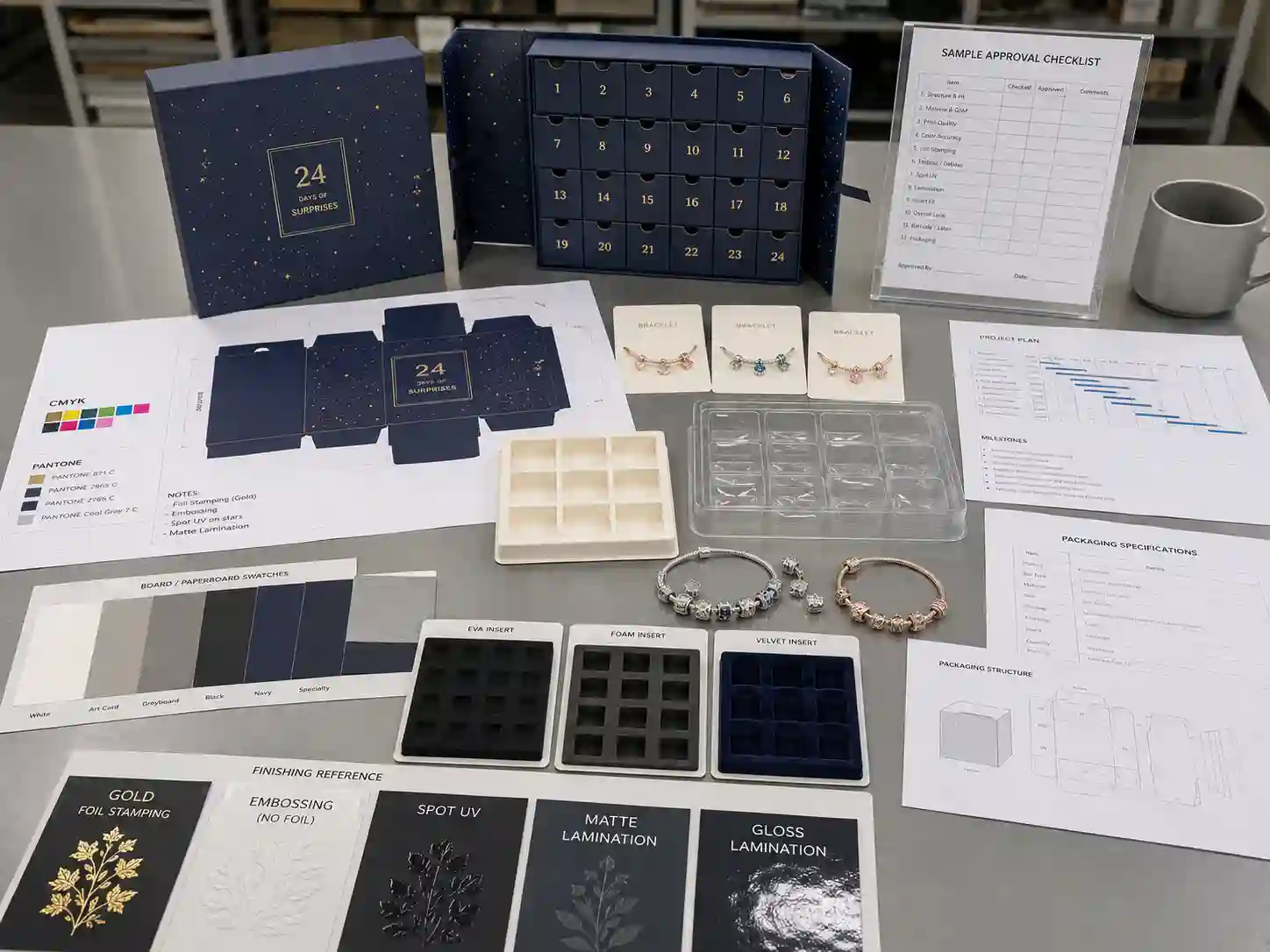
For bracelet calendars, QC should pay special attention to product movement and compartment reliability. If a bracelet slips out of position before the customer opens the numbered door, the calendar experience is damaged. If a drawer is too tight, the buyer may receive complaints even when the printing looks acceptable.
Practical QC points include:
- Board thickness and paper material match the approved sample.
- Printed color is within agreed tolerance against approved proof or Pantone target.
- Foil stamping, embossing, spot UV, matte lamination, and gloss lamination are correctly registered.
- Doors, drawers, ribbons, magnets, and pull tabs function consistently.
- Insert cavities, card slots, and pockets match the approved dimensions.
- Bracelets do not scratch, tangle, or shift excessively after handling tests.
- Glue areas are clean and strong, with no visible overflow on premium surfaces.
- Carton quantity, carton label, shipping marks, and pallet plan match the packing list.
For transport testing and packaging performance planning, buyers can review guidance from the International Safe Transit Association and discuss appropriate test expectations with the supplier or logistics partner. Not every order requires the same testing level, but fragile or high-value jewelry calendars benefit from a defined shipping-risk plan.
How should export packing be planned for overseas shipments?
Export packing should protect the bracelet calendars from compression, moisture, carton abrasion, and handling damage during international transport. The plan should be confirmed before mass production because carton size affects freight cost, pallet loading, and warehouse receiving.
Common export-packing decisions include master carton strength, inner polybag or tissue protection, corner protectors, pallet wrap, carton labels, generic shipping marks, and whether the calendars are packed retail-ready or bulk-packed for local fulfillment. For e-commerce sellers, the buyer may also need barcode placement, FBA-style carton information, or channel-specific receiving labels.
Factory tip: A premium rigid bracelet calendar can still arrive damaged if the export carton is too large or weak. The master carton should limit movement, support stacking, and match the realistic weight of finished packed calendars.
What information should buyers prepare before requesting a quotation?
Buyers should prepare product dimensions, bracelet quantity, preferred structure, insert requirements, artwork expectations, order quantity, target delivery date, and export packing needs before requesting a quotation. The more complete the RFQ, the more accurate the sample plan, MOQ discussion, and unit price will be.
Before contacting Giftpackpro, prepare this RFQ checklist:
- Project name and target market.
- Required quantity and possible reorder plan.
- Calendar format: 7-day, 12-day, 24-day, 25-day, or custom count.
- Bracelet type: chain bracelet, bangle, charm bracelet, bead bracelet, elastic bracelet, or mixed jewelry accessory set.
- Product dimensions and weight for each bracelet or packed bracelet card.
- Preferred structure: rigid box, folding carton, drawer box, door-opening box, book-style box, or undecided.
- Insert preference: paper insert, PET tray, EVA insert, foam, molded pulp, velvet insert, or supplier recommendation.
- Artwork status: finished dieline artwork, design concept, brand color guide, or need for technical dieline support.
- Printing and finishing requirements: CMYK, Pantone, foil stamping, embossing, spot UV, matte lamination, gloss lamination, or special paper.
- Sampling request: blank sample, printed sample, revised prototype, or pre-production sample.
- Export requirements: carton quantity, shipping marks, pallet, destination port, logistics label, or warehouse delivery rules.
- Target lead time for sample approval, mass production, inspection, and shipment.
Buyers can explore custom advent calendar box products for structure references, read more advent calendar box buying guides, or request a custom quote with product photos and size details.
What common mistakes should buyers avoid?
The most common mistakes are approving artwork before testing bracelet fit, choosing an insert only by appearance, underestimating sampling revisions, and requesting a quotation without clear product information. These mistakes can increase cost, delay lead time, and create QC problems during mass production.
- Mistake 1: Treating bracelets like flat accessories. Flexible chains and charms move during transport, so insert testing is essential.
- Mistake 2: Skipping the blank sample. A printed sample is more expensive to revise if the structure is wrong.
- Mistake 3: Ignoring packing labor. Complex inserts may look premium but slow down loading during mass production.
- Mistake 4: Using unclear artwork layers. Foil, embossing, spot UV, and cutting lines must be separated and labeled.
- Mistake 5: Comparing only unit price. A low unit price may exclude sample revision, export carton quality, special finishing, or pallet requirements.
- Mistake 6: Approving color without a reference. Pantone targets, printed proof, or approved production sample should guide final QC.
- Mistake 7: Leaving shipping marks until the end. Carton labels and pallet information should match the buyer’s warehouse or retailer requirements.
FAQ: Bracelet advent calendar boxes for B2B buyers
Can bracelet advent calendar boxes be customized for different bracelet sizes?
Yes. The structure and insert can be customized for chain bracelets, bangles, charm bracelets, bead bracelets, or bracelet cards. Buyers should provide exact packed dimensions and product samples whenever possible.
Is a blank sample necessary before a printed sample?
For most custom bracelet calendars, a blank sample is strongly recommended because it checks size, insert fit, door opening, drawer movement, and assembly tolerance before printing costs are added.
Which insert is best for premium bracelet packaging?
EVA, foam, velvet-covered inserts, and well-designed rigid paperboard inserts are common premium options. The best choice depends on bracelet surface, weight, packed position, and the buyer’s sustainability and cost goals.
Can suppliers provide a pre-production sample before mass production?
A capable supplier should be able to provide or confirm a pre-production sample for buyer approval. This sample should become the reference for mass production QC.
What affects lead time most?
Lead time is affected by sample revisions, artwork approval, material availability, insert complexity, printing and finishing processes, hand assembly, inspection, export packing, and shipping schedule.
What should be included in a quotation?
A useful quotation should state box size, structure, material, insert type, printing method, finishing, MOQ, sample cost, sample lead time, mass production lead time, packing method, carton details, and shipping assumptions if included.
Ready to develop bracelet advent calendar boxes with proper samples?
Bracelet advent calendar boxes should be developed through practical sampling, product-fit testing, artwork checking, pre-production approval, and export-packing planning. The right process helps brands avoid loose bracelets, poor insert fit, inaccurate printing, weak cartons, and unclear quotation details.
To start a project with Giftpackpro, prepare bracelet photos, packed product dimensions, target quantity, preferred structure, insert requirements, artwork status, finishing expectations, delivery deadline, and destination details. Then send the information through request a custom quote so the factory team can recommend a sample path, structure option, MOQ range, and quotation basis for your custom bracelet advent calendar packaging.


