Quick answer: To design snack advent calendar boxes for seasonal campaigns, buyers should start with the sales channel, snack size, filling method, display plan, and shipping route before choosing the box structure. A retail shelf program may need a rigid door-opening box with strong artwork impact, while an e-commerce gift set may need better carton protection, tighter insert fit, and stronger outer packaging. The most important decisions are structure, insert material, food separation, artwork layout, sample approval, MOQ, QC standards, export packing, and quotation details. A reliable supplier should help test the dieline, insert tolerance, snack fit, printing proof, and packed carton strength before mass production.
What should buyers decide before designing snack advent calendar boxes?
Buyers should decide the campaign channel, snack count, snack dimensions, filling process, delivery method, and target price before confirming the packaging structure. These decisions affect the dieline, insert design, material choice, printing method, assembly time, MOQ, and export packing plan.
Snack advent calendar boxes are not only seasonal gift packaging. For B2B buyers, they are retail display units, e-commerce gift sets, promotional campaign tools, and sometimes multi-SKU sampling kits. A box designed for a supermarket shelf may need a large front panel, barcode area, hanging or standing stability, and strong shelf recognition. A box designed for direct-to-consumer delivery may need stronger corner protection, reduced movement inside the box, and more durable sealing during parcel handling.
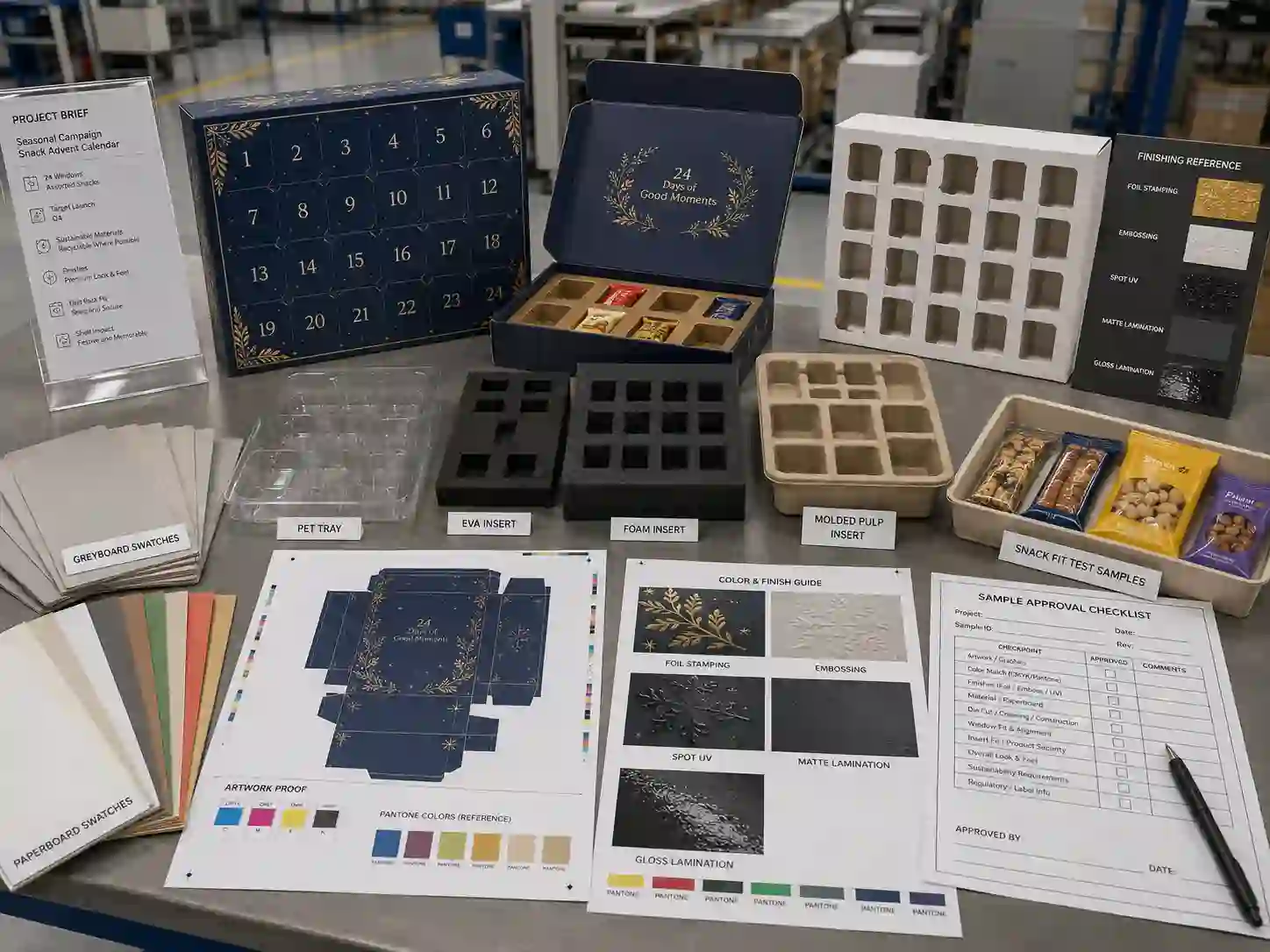
Before discussing price, prepare the product list. Include each snack bar, cracker pack, cookie pouch, candy sachet, nut pack, or dried fruit sachet with length, width, height, weight, fragrance intensity, and wrapping material. This helps the factory decide whether the insert should be paperboard, PET tray, EVA insert, foam, molded pulp, or a combined solution.
Buyer tip: A snack calendar quotation based only on “24 doors” is usually incomplete. A useful RFQ should include snack dimensions, quantity per set, box style, insert type, artwork requirements, packing method, shipping destination, and expected launch date.
Which snack advent calendar box structure fits your campaign?
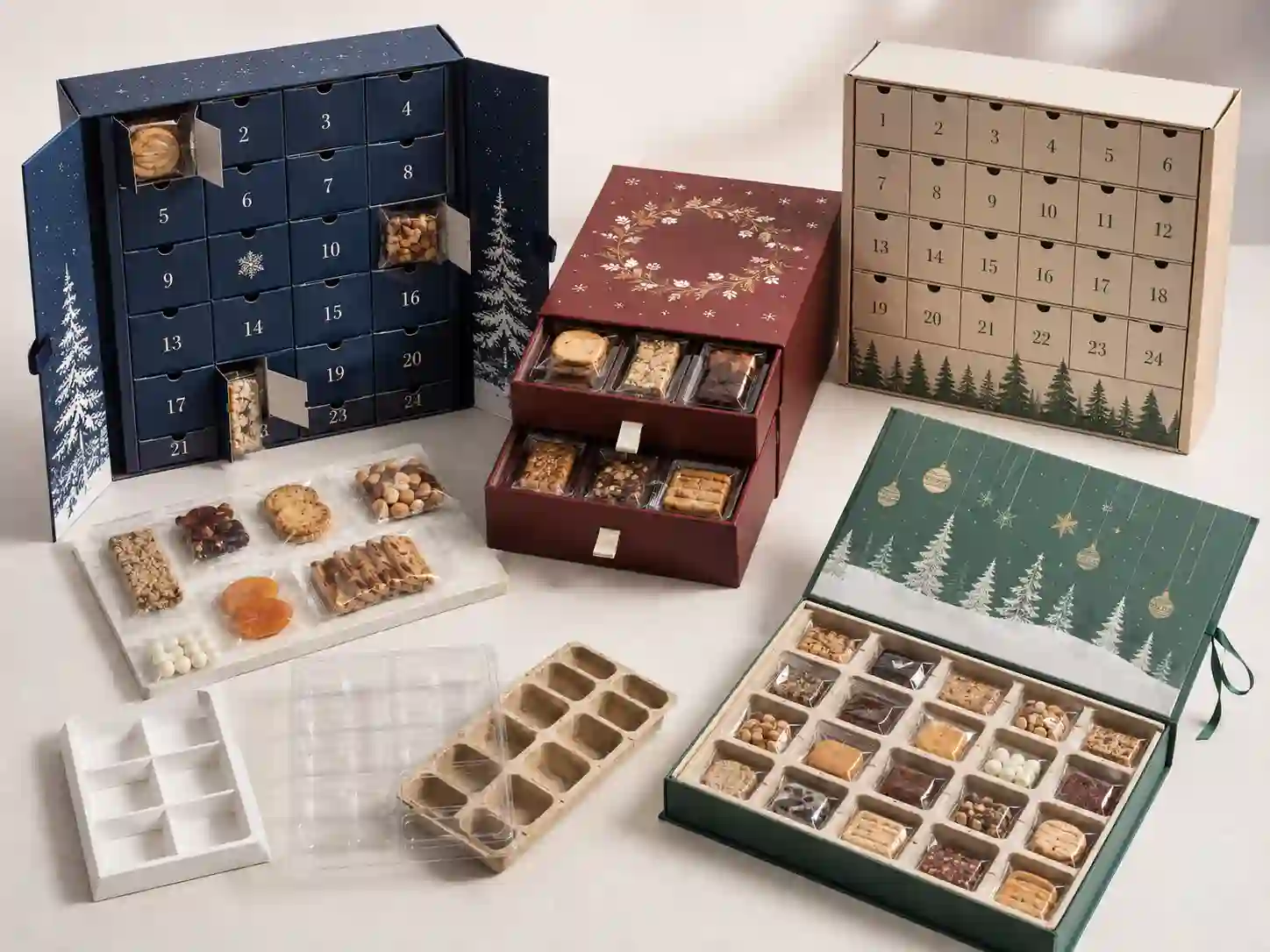
The right structure depends on how the calendar will be displayed, opened, shipped, and filled. Rigid boxes create a premium gift impression, folding cartons improve cost and shipping efficiency, drawer boxes support repeat opening, and book-style boxes work well for curated gift collections.
| Box structure | Best use case | Buyer advantages | Points to confirm |
|---|---|---|---|
| Rigid door-opening box | Premium retail shelf, gift campaign, influencer kit, high-value snack assortment | Strong display impact, durable greyboard structure, good surface for foil stamping, embossing, spot UV, matte lamination, or gloss lamination | Higher unit cost, larger packing volume, insert accuracy, door opening tolerance, corner protection |
| Folding carton calendar | Large-volume promotional campaigns, price-sensitive retail, lighter snack packs | Lower material cost, lighter weight, efficient flat packing, easier mass production | Board stiffness, tear-door strength, assembly control, protection during e-commerce shipping |
| Drawer box | Reusable gift set, subscription-style snack sampling, premium seasonal launch | Smooth unboxing, separate compartments, good perceived value | Drawer sliding tolerance, stopper design, filling speed, heavier export cartons |
| Book-style magnetic box | Gift company collections, corporate gifting, luxury snack bundle | Premium presentation, large artwork area, strong storytelling surface without relying on consumer holiday clichés | Magnet position, hinge durability, closure strength, shipping protection |
A door-opening box is common for snack campaigns because each compartment can hide a different product. However, the door shape must match the snack height and consumer opening force. If the door is too small, the snack may be hard to remove. If the perforation is too weak, doors may break during filling or transport.
A drawer calendar is useful when snacks are heavier or when the buyer wants a reusable gift box. It can separate flavors or product types by row, but drawer alignment must be checked during sampling. Folding carton calendars are more economical for high-volume promotional campaigns, but buyers should confirm whether the assembled box can resist bending when all compartments are filled.
For more structure examples, buyers can review custom advent calendar box products or compare options with a custom advent calendar boxes manufacturer before locking the design.
How should inserts be designed for snack separation and product fit?
Snack inserts should hold each product firmly, separate flavors or fragrances, and support the door or drawer opening experience. The insert must be tested with real packed snacks, not only estimated dimensions from a spreadsheet.
Snack calendars often include mixed products such as bars, crackers, cookies, candy pouches, nuts, dried fruit, instant drinks, and small gift items. These products may have different weights, shapes, and odor levels. Chocolate-coated snacks, coffee-flavored snacks, spicy packs, and dried fruit sachets should not move freely inside one shared cavity because odor transfer, crushing, and moisture awareness can become practical buyer concerns.
Common insert options include paper insert, PET tray, EVA insert, foam, and molded pulp. Paperboard inserts are suitable for many dry snack packs and are easier to align with paper packaging goals. PET trays offer precise cavity shapes and better product visibility during packing, but buyers should check recycling expectations in the destination market. EVA and foam can protect premium or fragile items but may increase material cost and sustainability questions. Molded pulp can support a natural packaging story, but tooling, texture, and cavity precision should be checked through samples.
Factory tip: Insert tolerance is a cost and quality issue. If cavities are too loose, snacks move during shipping; if cavities are too tight, workers slow down during assembly and products may deform during insertion.
What food and gift packaging issues should buyers consider?
Snack advent calendar boxes usually hold individually wrapped food items, so buyers should discuss food-contact risk based on the actual contact situation. If the snack is fully sealed in its own primary wrapper, the calendar box may function as secondary packaging. If any insert, window, or inner surface may directly touch food, buyers should verify the intended material and regulatory requirements for the sales market. For U.S. projects, buyers can review official FDA information on food packaging and food-contact substances.
Buyers should also plan label space. A beautiful front cover is not enough for retail. The artwork layout may need room for ingredients, allergen statements, nutrition facts, barcode, QR code, product origin, recycling marks, importer information, age or choking warnings where relevant, and retailer-required data. GS1 barcode size and quiet zones should be checked before final printing.
How do materials and finishes affect retail shelf and e-commerce performance?
Material choice should match the selling channel, product weight, retail price point, and transport risk. Greyboard rigid boxes provide a premium structure, while paperboard folding cartons are usually better for lighter, higher-volume campaigns.
Rigid boxes often use wrapped paper over greyboard. They are suitable for premium snack gift calendars, corporate seasonal gifts, and retail displays where the box must feel substantial. Folding cartons usually use coated paperboard or kraft paperboard and can be shipped flat before assembly, reducing freight volume. For heavy snack assortments, board thickness, glue area, opening design, and insert support should be tested together.
Printing and finishing should be chosen for both brand appearance and production stability. CMYK printing is suitable for full-color artwork, while Pantone color matching is helpful for strict brand colors. Foil stamping can highlight a seasonal title or logo area. Embossing adds texture, spot UV creates contrast, matte lamination gives a soft premium appearance, and gloss lamination increases shine. However, each finish adds cost, setup time, and proofing requirements.
Buyer tip: Do not approve a finish from a screen mockup only. Foil stamping, embossing, matte lamination, gloss lamination, and spot UV should be checked on a printed sample or material swatch because light reflection and color shift can affect shelf appearance.
How should artwork and dielines be prepared for seasonal campaigns?
Artwork should be prepared after the structural dieline and insert layout are confirmed. If artwork starts too early, door positions, fold lines, glue areas, and barcode placement may shift after sample testing.
For door-opening snack advent calendar boxes, every numbered door must align with the correct cavity. Buyers should confirm door size, opening direction, perforation, thumb notch, and safety margin around important graphics. For drawer boxes, artwork should account for drawer fronts, pull ribbons, side panels, and inner tray surfaces. For folding carton calendars, fold lines and glue flaps must not cut through important product claims or barcode areas.
Ask the supplier for an editable dieline with clear layers for cutting, creasing, perforation, glue, safe area, bleed, and artwork. The design team should mark CMYK, Pantone, foil stamping, embossing, spot UV, matte lamination, gloss lamination, and any window or insert position. Before mass production, a pre-production sample should verify the artwork proof, color target, structural function, and product fit.
Giftpackpro provides custom advent calendar box services for buyers who need help converting product dimensions and campaign goals into a workable packaging structure.
What sampling steps reduce risk before mass production?
Sampling should prove structure, fit, print appearance, assembly efficiency, and export-packing protection before mass production starts. A strong sample process usually includes a blank sample, printed sample, and pre-production sample when the campaign has custom structure or strict retail requirements.
- Blank sample: Confirms box size, door layout, drawer movement, insert cavity, product fit, and basic assembly.
- Printed sample or digital proof: Confirms artwork position, color direction, finishing effect, barcode space, and text readability.
- Pre-production sample: Confirms final material, structure, printing, insert, packing method, and approved tolerance before bulk production.
For snack calendars, send real filled snack samples whenever possible. If physical products are unavailable, provide accurate dummy dimensions and target weights. Weight matters because a calendar that looks correct when empty may bend, tilt, or fail when filled with heavier snack packs.
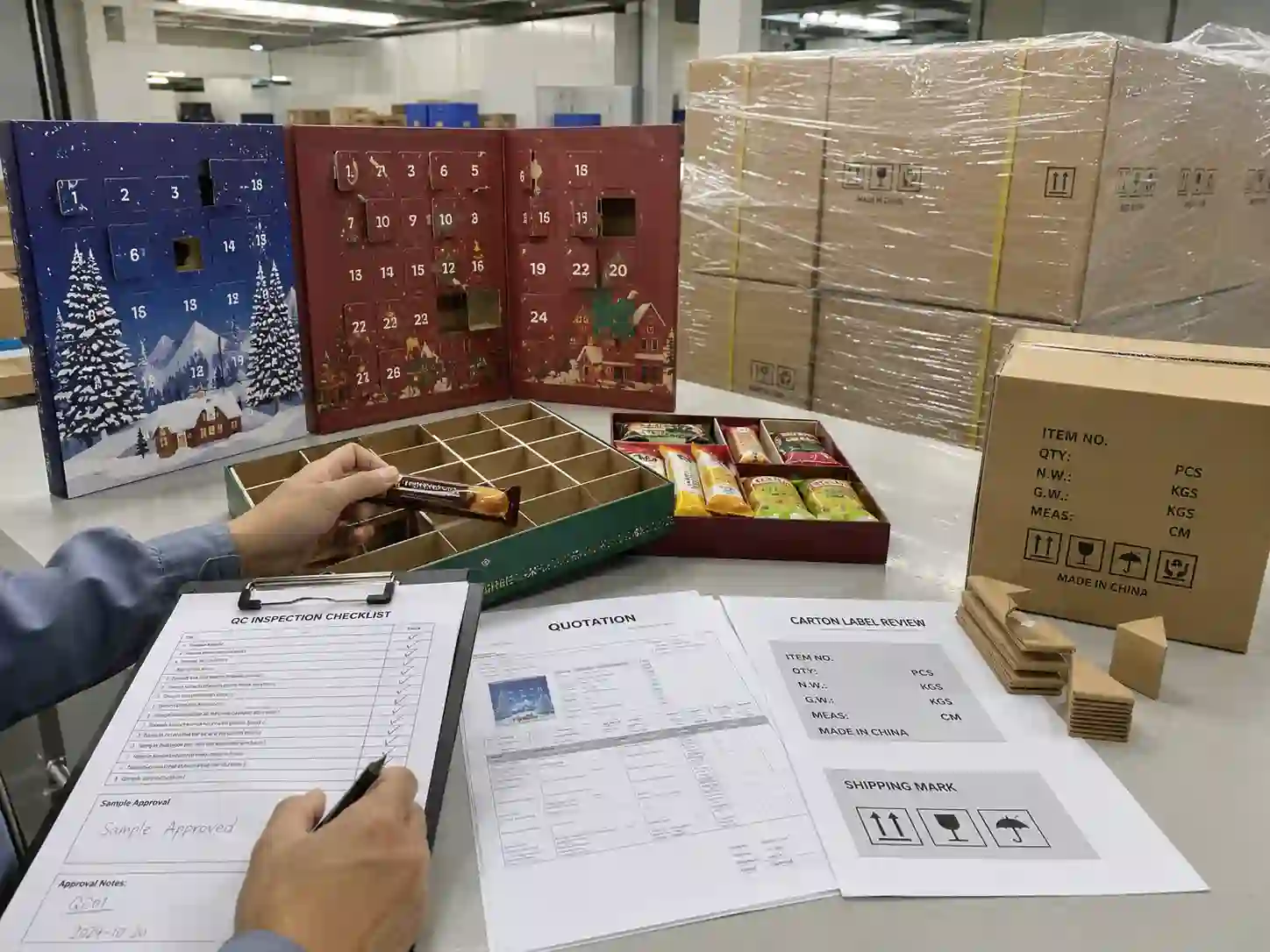
QC tip: Sample approval should record measurable points: outer size, cavity size, door opening force, drawer sliding tolerance, color reference, finish placement, insert material, carton quantity, and drop-protection method.
What MOQ, lead time, and cost drivers should buyers expect?
MOQ and lead time depend on structure complexity, material availability, printing setup, insert tooling, finishing process, and assembly labor. Buyers should avoid comparing suppliers only by unit price unless the quotation includes the same structure, material, insert, finish, packing method, and inspection standard.
Rigid boxes with greyboard, complex inserts, foil stamping, embossing, spot UV, or custom molded trays normally require more setup and sampling time than simple folding cartons. Large seasonal campaigns also need production capacity planning because snack advent calendar boxes are often ordered before peak retail or holiday shipping windows. Buyers should confirm whether the supplier can reserve production time after sample approval.
Cost drivers usually include material thickness, box size, number of doors or drawers, insert type, printing colors, Pantone matching, finishing effects, hand assembly, individual polybag or paper wrap, master carton strength, pallet requirements, and inspection level. Export packing also affects cost because stronger cartons, corner protectors, pallet wrap, and shipping marks add material and labor but may reduce damage risk.
Quotable B2B statement: The cheapest snack calendar box is rarely the lowest-cost campaign solution if weak inserts, poor carton protection, or late sample approval causes retail delay, returns, or rework.
How should buyers compare suppliers for seasonal snack campaigns?
Buyers should compare suppliers by engineering support, sampling accuracy, communication speed, production control, QC process, export packing experience, and quotation transparency. A supplier that can identify structure and packing risks early is more valuable than one that only sends a low unit price.
When comparing factories, ask whether they can review snack dimensions, create dielines, make blank samples, provide printed prototypes, test inserts, manage finishing processes, inspect door alignment, and prepare export cartons for the target shipping method. Also confirm how revisions are handled after sample feedback.
The Giftpackpro packaging factory works with overseas brands, wholesalers, gift companies, retail buyers, and packaging purchasing teams that need custom seasonal paper gift packaging. Buyers can also read more advent calendar box buying guides to prepare before supplier comparison.
Decision guide: which option should you choose?
| Buyer priority | Recommended direction | Reason |
|---|---|---|
| Premium retail shelf impact | Rigid door-opening box with paper insert or PET tray | Strong display surface, controlled compartments, good finishing options |
| Large-volume promotional campaign | Folding carton with paperboard insert | Better cost control and efficient production for lighter snack packs |
| E-commerce gift set | Rigid or reinforced folding structure with tight insert and stronger export carton | Reduces movement and damage during parcel handling |
| Eco-positioned campaign | Paperboard, molded pulp, FSC-verifiable paper options, reduced plastic window use | Supports paper-based packaging goals, but claims must be verified by documents |
| Mixed snack sizes | Custom insert with varied cavities | Improves fit, separation, and packing efficiency |
What QC and export packing details matter for snack advent calendar boxes?
QC should check structure, printing, finishing, insert fit, assembly, product loading, and packed-carton protection. Export packing should be designed for the real shipping route, not only for a clean factory floor.
Important inspection points include outer dimensions, board thickness, glue strength, door alignment, drawer movement, magnet position, color consistency, foil or spot UV registration, lamination bubbles, insert placement, cavity size, barcode readability, label area, and carton marking. For filled calendars, QC should also check whether snacks remain in position after handling simulation.
Export cartons should match box weight and shipping conditions. Confirm carton quantity per master carton, carton board strength, inner protection, corner protectors, pallet pattern, pallet wrap, shipping marks, and whether the goods will ship by sea, air, truck, or parcel network. Buyers with strict transit requirements can discuss test methods with their logistics team and review official ISTA packaging test procedure information.
What should buyers prepare before requesting a quotation?
A good quotation request should help the factory calculate structure, material, printing, insert, labor, packing, and shipping assumptions clearly. The more complete the RFQ, the easier it is to compare suppliers fairly.
- Target box style: rigid door-opening box, drawer box, folding carton, book-style box, or reference structure.
- Snack list: product type, dimensions, weight, primary wrapping, odor or moisture sensitivity, and quantity per calendar.
- Calendar format: number of compartments, opening sequence, display orientation, and filled or unfilled delivery.
- Material preference: paperboard, greyboard, kraft paper, coated paper, PET tray, paper insert, EVA insert, foam, or molded pulp.
- Artwork needs: dieline, CMYK, Pantone colors, foil stamping, embossing, spot UV, matte lamination, gloss lamination, barcode, label space, and warning text.
- Sampling needs: blank sample, printed sample, pre-production sample, and approval deadline.
- Order details: target MOQ, estimated order quantity, destination country, sales channel, launch date, and required lead time.
- Packing requirements: individual packing, master carton size limit, pallet requirement, shipping marks, export carton strength, and warehouse instructions.
Buyers can request a custom quote from Giftpackpro after preparing these details. If some information is not final, provide the closest estimate and ask the factory which details must be confirmed before sampling.
What common mistakes should buyers avoid?
The most common mistakes are choosing a box style before confirming snack dimensions, approving artwork before dieline testing, ignoring insert tolerance, and comparing quotations with different packing assumptions. These mistakes can cause sample delays, weak structure, higher freight cost, or campaign launch pressure.
- Using only product photos for sizing: Always provide measured dimensions and weight for every snack pack.
- Ignoring odor and moisture awareness: Separate strong-flavor snacks and discuss primary wrapping quality with the food supplier.
- Leaving no label space: Retail and e-commerce packaging often needs barcode, product data, importer information, and compliance-related text.
- Approving color without proofing: CMYK and Pantone results vary by paper, lamination, and finishing process.
- Underestimating assembly labor: More compartments, drawers, ribbons, and inserts can slow production and increase cost.
- Choosing weak export cartons: Seasonal packaging can be damaged before it reaches the shelf if carton protection is treated as an afterthought.
FAQ: Snack advent calendar boxes for B2B seasonal campaigns
Are snack advent calendar boxes considered food-contact packaging?
It depends on the actual contact situation. If all snacks are sealed in individual primary wrappers, the calendar box may be secondary packaging. If paperboard, PET, window film, or an insert directly touches food, buyers should verify food-contact suitability for the destination market and request relevant material documentation from the supplier.
Which insert is best for mixed snack sizes?
A custom paper insert or PET tray with varied cavities is often practical for mixed snack sizes. Paper inserts work well for many dry wrapped snacks, while PET trays can provide more precise cavities. The best choice should be confirmed by sample testing with real products.
Can one box design work for both retail and e-commerce?
Yes, but the design must account for both shelf display and shipping protection. Retail needs strong front artwork, label space, and display stability. E-commerce needs better internal fit, stronger outer cartons, and protection against parcel handling.
What is the difference between a prototype and a pre-production sample?
A prototype is used to test size, structure, product fit, and design direction. A pre-production sample should represent the final approved material, printing, finishing, insert, and packing method before mass production begins.
How early should buyers start snack calendar packaging development?
Buyers should start early enough to allow structure planning, dieline design, blank sampling, artwork proofing, printed sample approval, material purchasing, mass production, QC, export packing, and international shipping. Seasonal campaigns should also allow extra time for revisions and retailer approval.
What makes a snack advent calendar quotation reliable?
A reliable quotation clearly states box structure, size, material, insert type, printing, finishing, MOQ, sample cost, sample lead time, bulk lead time, packing method, carton details, shipping marks, and any assumptions. Vague quotations are difficult to compare and may hide later cost changes.
How should you move from design idea to production-ready packaging?
To move from concept to production, define the snack assortment, choose the structure, test the insert, prepare the artwork on the confirmed dieline, approve samples, lock the QC standard, and confirm export packing. This process keeps snack advent calendar boxes aligned with retail shelf needs, e-commerce delivery, seasonal launch timing, and promotional campaign budgets.
Giftpackpro can support buyers who need custom advent calendar boxes for snack campaigns, gift sets, retail programs, and overseas seasonal launches. Prepare your snack dimensions, target quantity, preferred structure, artwork requirements, packing needs, and launch schedule before asking for a sample or quotation. A clear brief helps the factory recommend the right structure, insert, material, lead time, and export-packing plan from the beginning.