
Quick answer: Snack advent calendar boxes are custom seasonal packaging solutions designed to hold individually packed snacks in separated compartments, usually with numbered doors, drawers, trays, or sleeves. For B2B buyers sourcing from China, the best supplier is not simply the lowest quotation. Buyers should compare box structure, insert fit, material thickness, artwork control, sampling process, MOQ, production lead time, QC standards, export packing method, and communication reliability. A strong RFQ should include snack dimensions, weight, quantity, packaging style, artwork requirements, destination market, carton limits, and expected delivery schedule.
This guide is written for brand owners, wholesalers, gift companies, retail buyers, e-commerce sellers, and procurement teams comparing China factories for snack advent calendar boxes. It focuses on practical sourcing decisions: how to choose a structure, how to test inserts, what affects cost, how to review samples, and how to prepare a quotation request that a factory can price accurately.
What should buyers understand before sourcing snack advent calendar boxes from China?
Buyers should first understand that snack advent calendar packaging is a structural packaging project, not only a printed box order. The factory must control compartment size, door opening, insert stability, snack separation, outer box strength, artwork position, and export packing so the final product works in retail and survives international transport.
Snack items vary widely: cookies, candies, crackers, tea snacks, mini chocolate packs, dried fruit, nuts, granola bites, snack bars, coffee snacks, and mixed gift assortments all have different dimensions, weight, odor sensitivity, and moisture considerations. Before comparing suppliers, buyers should decide whether the box will hold primary food packaging, secondary wrapped snacks, or a combination of small retail units.
Buyer tip: For overseas importers, the snack itself should normally be individually wrapped or packed before it enters the advent calendar box. The paperboard box supplier can discuss food-contact material options and packaging structure, but buyers should verify food-contact requirements, labeling rules, and import requirements for their own market. For U.S. food-contact guidance, buyers can refer to the official FDA food contact substances page.
Which snack advent calendar box structure is best for your sales channel?
The best structure depends on product weight, retail price point, shelf display, assembly budget, and shipping plan. Rigid boxes look premium and support heavier gift sets, while folding cartons are better for cost-sensitive or higher-volume campaigns.
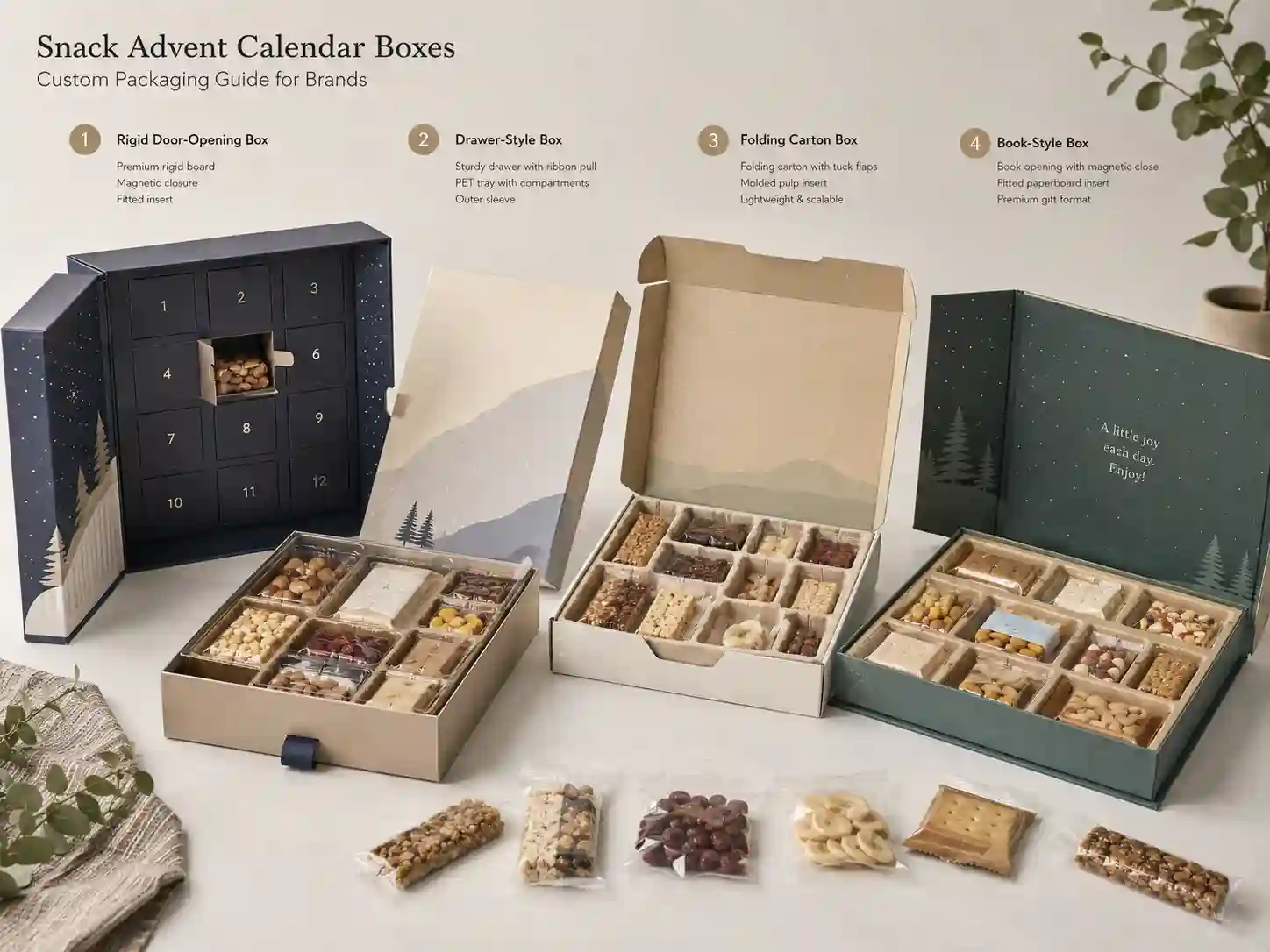
| Structure option | Best use case | Buyer advantages | Watch points when comparing factories |
|---|---|---|---|
| Door-opening box | Classic 12-day, 24-day, or countdown snack calendar | Strong shelf recognition, clear numbered doors, good for retail campaigns | Door perforation strength, window alignment, compartment tolerance, insert support |
| Drawer box | Premium snack gift sets, reusable gift packaging, heavier snack units | Better unboxing feel, strong perceived value, easier item removal | Drawer sliding tolerance, paper wrapping quality, labor cost, assembled packing volume |
| Rigid box with paperboard insert | Mid-to-premium gift channels, wholesale gift buyers, seasonal retail | Good structural strength, premium appearance, supports foil stamping and embossing | Greyboard thickness, lid fit, insert height, corner protection during export |
| Folding carton calendar | Large quantity promotions, lighter snacks, e-commerce bundles | Lower unit cost, flat packing possible, efficient carton loading | Paperboard stiffness, glue strength, assembly instructions, crush resistance |
| Book-style or fold-out box | Storytelling retail display, gift companies, mixed snack assortments | Large print area, strong branding surface, good for limited seasonal editions | Magnet or ribbon details, spine tolerance, open-flat testing, export carton orientation |
A door-opening box is often the first option for brands that want a recognizable advent calendar format. However, the door panel must be engineered correctly. If the paperboard is too weak, the door may tear badly. If the perforation is too light, the consumer may struggle to open it. If the snack is too close to the door, the product may press against the panel during shipping.
A drawer box usually costs more because of manual assembly, wrapping, and multiple components. It can be worth the cost when the gift set targets specialty retail, corporate gifting, boutique grocery, or premium holiday merchandising. For large-volume supermarket promotions, a folding carton may be more practical.
Giftpackpro works as a custom advent calendar boxes manufacturer for B2B buyers that need structure comparison, sample review, and export-ready packaging planning before placing bulk orders.
How should buyers compare China factories for snack advent calendar boxes?
Buyers should compare China suppliers by engineering ability, quotation transparency, communication quality, sampling discipline, QC process, export experience, and willingness to discuss risks. A low price is not useful if the factory cannot control inserts, color, assembly tolerance, or carton protection.
When reviewing suppliers, ask whether they can provide dieline support, blank samples, printed samples, material swatches, finishing references, insert prototypes, and pre-production confirmation. A factory that asks detailed questions about snack size, weight, quantity per box, packing method, and destination country is usually doing better project preparation than a supplier that quotes from a picture only.
Supplier comparison checklist for importers
- Can the factory explain the difference between rigid box, drawer box, folding carton, and door-opening structures for your snack weight?
- Can they make a dieline based on actual snack dimensions instead of estimated sizes?
- Do they test paper insert, PET tray, EVA insert, foam, or molded pulp options before mass production?
- Do they provide a clear quotation with material, size, printing, finishing, insert, packing, sample, and shipping assumptions?
- Can they show how they control CMYK, Pantone color, foil stamping, embossing, spot UV, matte lamination, and gloss lamination?
- Do they discuss MOQ honestly instead of promising unrealistic low prices at small quantities?
- Do they define sample lead time, mass production lead time, and approval deadlines?
- Do they inspect door opening, glue, insert fit, color, carton marks, and export packing before shipment?
- Can they prepare export cartons, pallet recommendations, shipping marks, and carton labels for your logistics team?
Factory tip: A serious factory will usually need the snack size, snack weight, number of compartments, box style, material preference, artwork status, finishing effects, order quantity, packing method, and destination before giving a reliable quotation. If any supplier gives a final price without these details, the quotation may change later.
Which inserts work best for snack separation and product protection?
The insert should keep each snack in position, prevent flavor or odor transfer between items, support the calendar doors, and reduce movement during shipping. The best insert is chosen according to snack shape, weight, wrapping material, required appearance, budget, and sustainability preference.
Paper inserts are common for snack advent calendars because they are printable, foldable, recyclable in many markets, and cost-effective. PET trays provide stronger cavity definition for irregular snack packs, but buyers should check recycling and market requirements. EVA insert and foam can support premium or fragile products, but they may not fit every sustainability brief. Molded pulp can be useful for buyers who want a more natural material appearance and good cushioning, but tooling, tolerance, and surface finish should be reviewed early.
Snack packaging also needs odor and moisture awareness. Paperboard can absorb odor if strong-flavor items are packed without proper primary packaging. Crispy snacks, cookies, and flavored nuts should be sealed in their own packaging before assembly. If snacks are not individually wrapped, buyers must discuss suitable food-contact material and verify compliance in the destination market; unsupported compliance claims should not be accepted without documentation.
How do insert options compare for snack advent calendars?
| Insert type | Good for | Advantages | Potential limitation |
|---|---|---|---|
| Paper insert | Wrapped snack bars, candies, cookies, tea snacks, small pouches | Cost-effective, flexible, printable, usually easy to customize | May need reinforcement for heavy or tall snack packs |
| PET tray | Irregular snack shapes, mixed assortments, high-precision cavities | Good shape holding, clear product positioning, stable cavities | Tooling and recycling requirements should be checked |
| EVA insert | Premium snack gifts, glass jars, small bottles, delicate accessories | Strong cushioning and premium presentation | Higher cost and may not match sustainability goals |
| Foam insert | Fragile gift components or mixed snack-and-accessory sets | Good shock absorption and easy cavity cutting | Not ideal for every food packaging or recycling requirement |
| Molded pulp insert | Natural-positioned gift sets and heavier wrapped snacks | Good protection, molded shape, natural material appearance | Surface texture and tooling tolerance require sample confirmation |
Quotable sourcing note: “For snack advent calendar boxes, the insert is not an accessory; it is the part that controls product separation, door function, box strength, and customer experience.”
What materials and printing choices affect cost and brand presentation?
Material and printing choices affect unit cost, sample time, production stability, and shelf impact. Buyers should choose paperboard or greyboard thickness based on snack weight, box size, structure, and shipping risk, not only visual preference.
For folding carton calendars, common options include white card, kraft paperboard, coated paperboard, or specialty paper depending on the project. For rigid boxes, greyboard thickness and wrapping paper quality are key. A larger snack calendar with heavy items may need thicker greyboard, stronger paper insert support, and tighter export carton protection.
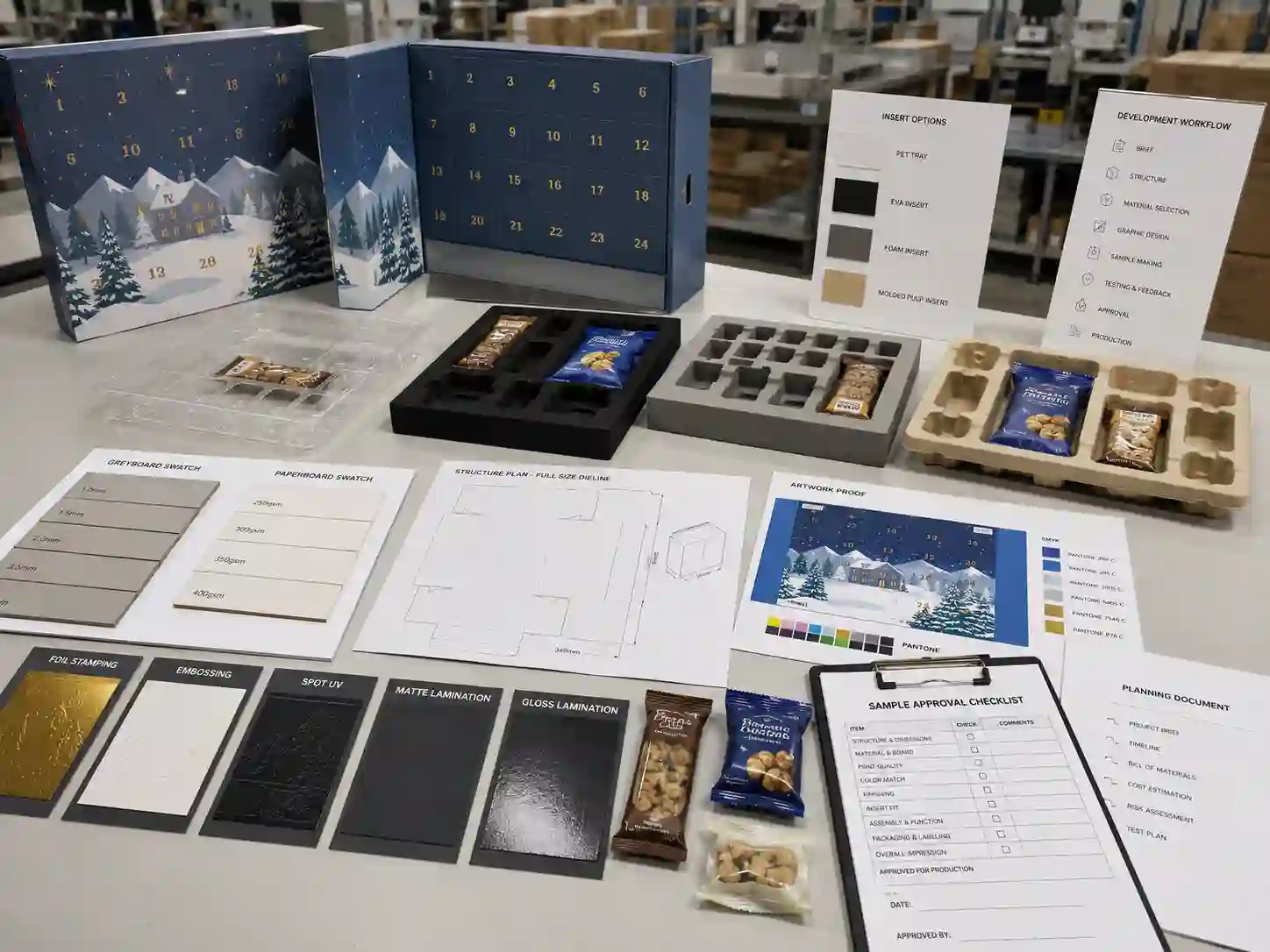
Printing choices also need early planning. CMYK is suitable for full-color artwork, while Pantone colors are useful when brand color consistency is important. Foil stamping, embossing, debossing, spot UV, matte lamination, and gloss lamination can raise perceived value, but each effect adds setup cost, production steps, and sample review requirements.
For sustainability positioning, buyers may ask about FSC-certified paper options and should verify documentation with the supplier when needed. The official FSC website can help buyers understand responsible forest management claims and certification basics.
Which print and finishing decisions should be confirmed before sampling?
- Final box size, number of doors or drawers, and snack compartment layout
- Dieline version and artwork position on front, back, sides, and inside panels
- CMYK or Pantone color requirements, including brand color references
- Matte lamination, gloss lamination, or uncoated paper surface preference
- Foil stamping area, embossing area, spot UV area, and registration tolerance
- Barcode, ingredient label, warning text, recycling mark, or importer label space
- Retail display requirements, hanging hole, sleeve, belly band, or outer carton plan
Buyer tip: Keep legal and food labeling content separate from decorative artwork approval. A packaging factory can reserve label space and print supplied information, but the buyer should verify market-specific labeling requirements with qualified compliance support.
How do MOQ, lead time, and cost drivers work when buying from a China factory?
MOQ and lead time depend on box structure, material availability, printing method, finishing process, insert tooling, assembly labor, and export packing method. Buyers should expect more complex snack advent calendar boxes to need more sampling and production coordination than simple folding cartons.
Common cost drivers include box size, greyboard thickness, paperboard grade, number of compartments, insert type, printing coverage, special finishing, manual assembly, quantity, carton packing, and inspection requirements. A 24-compartment rigid door-opening snack calendar with foil stamping and a custom PET tray will usually cost more and take longer than a 12-compartment folding carton with a paper insert.
Lead time should be planned backward from the retail launch date, not from the purchase order date. Buyers need time for RFQ review, dieline creation, blank sample, artwork adjustment, printed sample, pre-production sample, mass production, final QC, export packing, sea or air shipment, customs clearance, and warehouse intake.
Decision guide: which sourcing route fits your project?
| Buyer situation | Recommended route | Why it fits |
|---|---|---|
| Early concept, snack sizes not finalized | Start with structure consultation and rough cost range | Prevents wasted sampling before the product layout is stable |
| Snack dimensions confirmed, artwork not ready | Request blank sample and dieline first | Allows insert and compartment testing before graphic design is locked |
| Retail buyer needs premium presentation | Compare rigid box, drawer box, and finishing samples | Supports better shelf appearance and perceived gift value |
| Large promotion with strict cost target | Compare folding carton and simplified paper insert | Improves packing efficiency and lowers labor complexity |
| Mixed snack assortment with fragile items | Prototype insert with actual packed products | Reduces risk of movement, crushing, and door pressure |
Buyers can review custom advent calendar box services to understand which project steps may be needed before ordering mass production, including structure development, material selection, printing, sampling, and packing support.
What should be included in a sample and prototype process?
A good sample process should confirm structure before decoration and confirm decoration before mass production. Buyers should not approve bulk production based only on a rendering or a similar previous sample.
The first step is often a blank sample or structural prototype. This checks size, door opening, insert fit, snack placement, assembly method, and carton packing direction. Once the blank structure is approved, a printed sample can confirm color, artwork, finishing, lamination, barcode position, and overall presentation. Before mass production, a pre-production sample should represent the approved material, printing, insert, finishing, and assembly method as closely as possible.
Sample approval checklist for snack advent calendar boxes
- Check the dieline version number and make sure it matches the latest artwork file.
- Place actual wrapped snacks inside every compartment and test movement.
- Open sample doors or drawers repeatedly to check tearing, sliding, and user access.
- Review whether snack packs press against doors, sleeves, windows, or outer panels.
- Confirm paperboard or greyboard thickness against the final snack weight.
- Compare CMYK or Pantone color against approved proof or brand standard.
- Check foil stamping, embossing, spot UV, matte lamination, or gloss lamination alignment.
- Confirm barcode, importer information, nutritional label area, and recycling mark space.
- Review export carton quantity, carton size, gross weight, and shipping marks.
- Sign and archive the approved sample standard before mass production starts.
QC tip: The approved sample should not stay only with the buyer. The factory production team and inspection team should also have access to the approved sample or clear approved sample records so mass production is checked against the same standard.
What QC points matter most during mass production?
QC should focus on functional performance, visual consistency, assembly quality, and packing strength. For snack advent calendar boxes, a visually attractive sample is not enough if doors fail, inserts collapse, compartments are inconsistent, or cartons are weak.
Important inspection points include material thickness, printing color, lamination adhesion, glue position, door perforation, drawer fit, insert height, compartment size, smell, dust, scratches, barcode readability, carton label, and shipping mark accuracy. Buyers should also confirm that snacks or snack sample weights used during fit testing match the actual production plan.
Factories should inspect during production, not only at the end. In-process checks can catch printing shift, lamination bubbles, glue overflow, wrong insert folding, or inconsistent door cutting before the whole order is completed.
What should buyers ask the factory to inspect?
- Incoming paperboard, greyboard, wrapping paper, insert material, and print sheets
- Dieline cutting accuracy and door-opening performance
- Insert slot size, tray cavity size, and snack fit tolerance
- Artwork position, color consistency, foil stamping, embossing, and spot UV alignment
- Glue strength, corner wrapping, drawer sliding, and folding carton assembly
- Odor, dust, stains, scratches, crushed corners, and surface defects
- Export carton strength, carton labels, shipping marks, gross weight, and pallet plan
Buyers can compare structure ideas through custom advent calendar box products and then use those references to discuss more precise QC standards for their own snack program.
How should snack advent calendar boxes be packed for export?
Export packing should protect the calendar structure from compression, corner damage, moisture exposure, and carton handling during international shipping. The right method depends on whether the boxes ship flat, semi-assembled, fully assembled, or filled by the buyer after arrival.
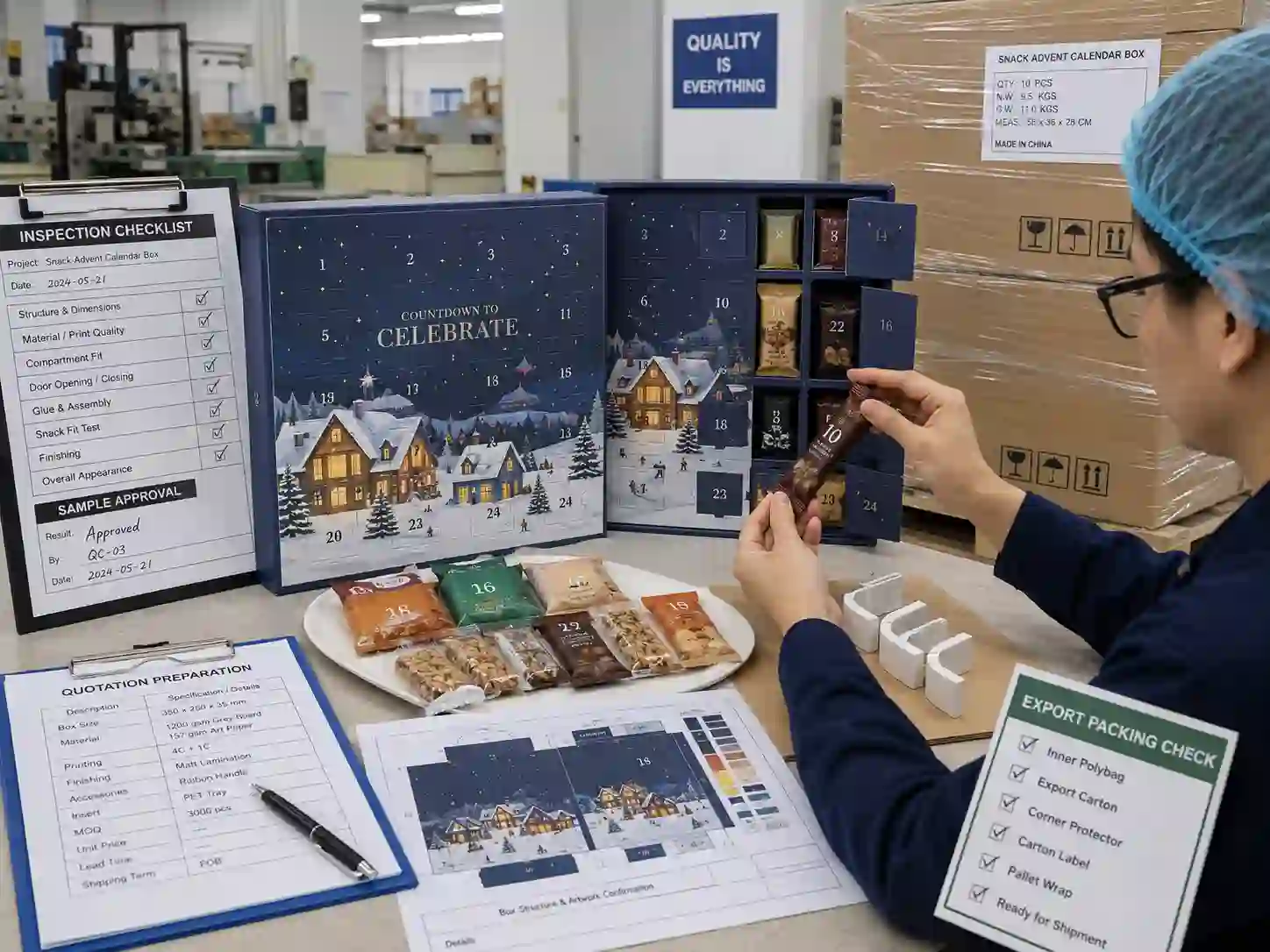
Flat packing can reduce freight volume for folding carton structures, but it requires clear assembly instructions and may shift labor to the buyer or co-packer. Fully assembled packing is easier for retail-ready gift boxes but increases carton volume and may require stronger master cartons, corner protectors, dividers, and pallet planning.
Shipping marks should be generic, accurate, and consistent with the buyer’s logistics documents. Carton labels may include item number, carton number, quantity, gross weight, net weight, carton size, country of origin marking if applicable, and handling instructions. Palletization should consider carton crush strength, container loading, warehouse handling, and retail delivery requirements.
Quotable export note: “For advent calendar packaging, export carton design is part of product quality; a perfect sample can still fail if the master carton allows corner crushing or panel deformation.”
What information should buyers prepare before requesting a quotation?
Buyers should prepare product dimensions, box style, quantity, material preference, artwork status, insert requirements, packing method, delivery schedule, and destination details before requesting a quotation. A complete RFQ helps the factory quote faster and reduces later price changes.
For snack advent calendar projects, the most useful information is actual product size and weight. Even a 2 mm difference in snack pack thickness can affect door pressure, insert depth, carton quantity, and box structure. If the assortment includes different snacks, provide the largest, smallest, heaviest, and most fragile items.
RFQ preparation checklist
- Target box style: rigid box, folding carton, drawer box, door-opening box, book-style box, or open to factory suggestions
- Calendar format: 7-day, 12-day, 24-day, 25-day, or custom compartment count
- Snack dimensions and weight for each item, including primary packaging
- Insert preference: paper insert, PET tray, EVA insert, foam, molded pulp, or undecided
- Outer box size target or retail shelf limits
- Material preference: paperboard, greyboard, kraft paper, coated paper, specialty paper, or FSC request
- Printing: CMYK, Pantone, inside printing, outside printing, or plain sample first
- Finishing: foil stamping, embossing, spot UV, matte lamination, gloss lamination, ribbon, magnet, sleeve, or handle
- Artwork status: ready AI/PDF file, draft artwork, or need dieline first
- Order quantity, expected MOQ flexibility, and annual reorder estimate
- Required sample type: blank prototype, printed sample, or pre-production sample
- Export packing method: flat packed, assembled empty, filled by co-packer, or retail-ready
- Destination country, delivery deadline, shipping method, and carton or pallet restrictions
Buyers who are ready to compare options can request a custom quote from Giftpackpro with the above details. For early-stage projects, the advent calendar box buying guides can help purchasing teams clarify structure, insert, printing, and packing questions before sending an RFQ.
What common sourcing mistakes should importers avoid?
The most common mistakes are quoting too early, approving artwork before confirming structure, ignoring insert testing, comparing suppliers only by unit price, and leaving export packing until the end. These mistakes often create delays, sample revisions, or hidden cost increases.
Another common issue is using only product photos instead of real snack dimensions. Photos cannot show weight, thickness, softness, odor, or how the snack behaves during transport. Buyers should also avoid assuming that one structure fits every market. A boutique gift shop, supermarket chain, Amazon seller, and wholesale distributor may need different packing, labeling, and carton strategies.
Common mistakes and better sourcing actions
| Mistake | Why it causes problems | Better action |
|---|---|---|
| Comparing only the lowest quotation | Important details such as insert, material thickness, packing, and sample cost may be missing | Compare quotations line by line and ask what is included |
| Starting artwork before dieline approval | Artwork may need resizing after structure changes | Confirm dieline and blank sample before final artwork |
| Using estimated snack sizes | Compartments may be too tight, too loose, or too shallow | Send actual dimensions, weights, and packed samples if possible |
| Ignoring odor and moisture | Snack aroma or humidity may affect paper packaging or neighboring items | Use sealed primary packaging and discuss suitable material choices |
| Approving sample without carton review | Boxes may arrive with crushed corners or warped panels | Review export carton, pallet plan, and shipping marks before shipment |
Why does factory communication matter when sourcing from China?
Good communication reduces risk because snack advent calendar boxes involve many linked decisions. A change in snack size may affect insert, box size, material, carton quantity, sample lead time, and quotation.
When comparing suppliers, buyers should notice whether the factory records decisions clearly. Important project details should be confirmed in writing: dieline version, sample standard, material, printing, finishing, quantity, packing, carton mark, delivery term, payment term, inspection plan, and shipment schedule. A reliable factory should also warn buyers when a requested design may create production risk.
For example, very thin door strips may look attractive in artwork but tear during opening. A heavy snack pack near the front panel may deform the door. A glossy black surface may show scratches more easily during handling. A large rigid box may need stronger export cartons than a buyer originally expected.
Giftpackpro shares factory-side packaging guidance through the Giftpackpro packaging factory page for buyers who want to understand production capability, communication process, and project support before choosing a supplier.
FAQ: What do buyers ask before ordering snack advent calendar boxes?
Can snack advent calendar boxes be made for different snack sizes in one set?
Yes. Mixed snack sizes can be packed in one calendar, but the insert and dieline must be designed around the full assortment. Buyers should provide dimensions and weights for every item, especially the largest and most fragile snacks.
Should buyers choose a paper insert or PET tray?
Choose a paper insert when cost control, folding flexibility, and paper-based presentation are priorities. Choose a PET tray when precise cavity shape and stronger item positioning are more important. The final choice should be confirmed by sample testing with real packed snacks.
What is the typical MOQ for custom snack advent calendar boxes?
MOQ varies by structure, material, printing, finishing, insert tooling, and production schedule. Folding carton designs may support lower entry quantities than complex rigid boxes or drawer calendars, but buyers should request a factory quotation based on exact specifications.
Can a factory guarantee food-contact compliance?
Buyers should be careful with broad guarantees. A packaging factory can discuss material options, provide available documentation, and print buyer-supplied labeling, but importers should verify food-contact and labeling requirements for their destination market through official sources or qualified compliance support.
How long should buyers allow for sampling?
Sampling time depends on structure complexity, material availability, printing, finishing, and revisions. Buyers should plan for blank sample review, printed sample review, and pre-production sample approval before mass production, especially for retail launch schedules.
What should be checked before mass production starts?
Before mass production, confirm approved dieline, material, artwork, colors, finishing, insert fit, sample standard, packing method, carton label, shipping marks, quantity, production schedule, and final inspection plan.
How can Giftpackpro help with snack advent calendar boxes?
Giftpackpro helps B2B buyers develop snack advent calendar boxes with practical structure advice, insert comparison, dieline preparation, material selection, printing and finishing review, sample development, production coordination, QC checking, and export packing support.
Before contacting the factory, prepare your snack dimensions, target structure, compartment count, order quantity, artwork status, insert preference, destination market, expected delivery date, and any carton or pallet requirements. These details help Giftpackpro recommend a suitable structure and prepare a more accurate quotation for sampling or bulk production.
For brands, wholesalers, retail buyers, gift companies, and purchasing teams comparing China suppliers, the right decision is not simply “which factory is cheapest.” The better question is: which factory can control the structure, insert, printing, sampling, QC, lead time, export packing, and communication well enough to protect your seasonal launch?


