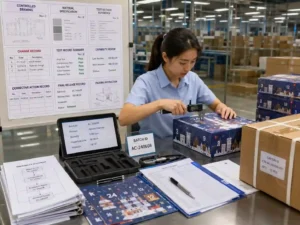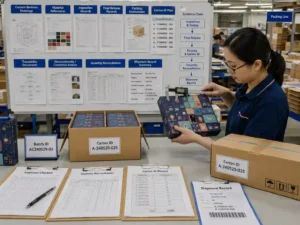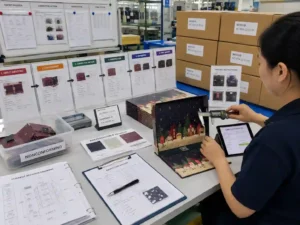
Quick answer: Coffee advent calendar boxes are custom seasonal packaging systems designed to hold coffee sachets, capsules, drip coffee pouches, pods, or small inner boxes in a fixed compartment sequence. For B2B buyers, the best solution is not only the most attractive structure; it is the structure that protects aroma-sensitive products, keeps every item in the correct position, supports efficient filling, survives export shipping, and presents clearly on retail or e-commerce channels. The key decisions include box format, insert material, dieline accuracy, printing method, sample approval, MOQ, QC checks, master carton design, palletizing, shipping marks, and whether the boxes should ship flat or fully assembled.
For brands, wholesalers, retail buyers, and purchasing teams, coffee advent calendar boxes usually combine marketing value with strict production control. A coffee calendar may look like a gift box, but from the factory side it is a structured packaging project with many checkpoints: compartment size, door strength, insert tolerance, artwork alignment, filling order, outer carton strength, and export packing method.
Giftpackpro works as a custom advent calendar boxes manufacturer for B2B buyers who need paper-based seasonal packaging for overseas markets. This guide explains how to compare structures, inserts, printing, sampling, QC, and export packing before requesting a quotation.
What should buyers understand before choosing coffee advent calendar boxes?
Buyers should understand the product format, filling method, sales channel, and shipping route before choosing the box structure. A design that works for lightweight sachets may not work for capsules, glass coffee concentrate bottles, or small retail-ready coffee boxes.
The first planning question is simple: what exactly will each compartment hold? Coffee advent calendar boxes may contain flat sachets, stick packs, drip coffee pouches, capsules, pods, sample bags, mini tins, or small paper cartons. Each format has different requirements for depth, movement control, aroma protection, moisture awareness, and door-opening force.
For example, a flat sachet calendar can use a thinner folding carton or rigid paperboard structure with shallow compartments. A capsule calendar usually needs deeper cavities, stronger insert support, and better resistance against shaking during transport. A premium retail gift calendar may use greyboard, a wrapped paper finish, and a rigid door-opening structure, while an e-commerce seller may prioritize compact master cartons and lower volumetric weight.
Buyer tip: Do not start with the artwork only. Start with the coffee unit size, weight, packing sequence, filling process, and shipping route. The visual design should be built around the product and logistics requirements, not the other way around.
Which coffee advent calendar box structure fits your sales channel?
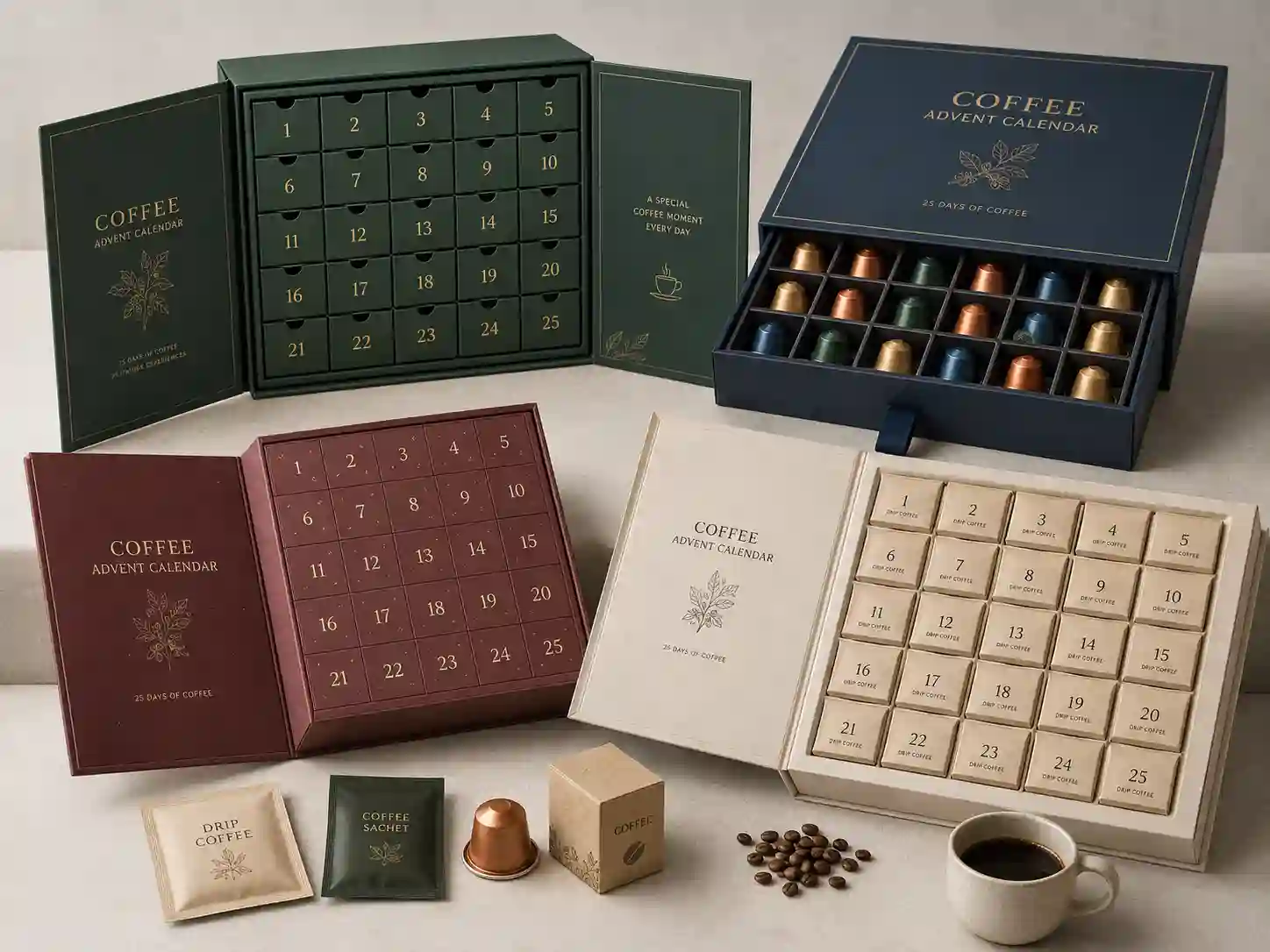
The right structure depends on whether the box needs premium shelf impact, lower freight cost, easy assembly, or strong e-commerce protection. Door-opening rigid boxes, drawer boxes, folding cartons, and book-style calendars each solve different buyer problems.
| Structure option | Best use case | Main advantages | Buyer watch point |
|---|---|---|---|
| Rigid door-opening box | Premium coffee gift sets, retail promotions, brand campaigns | Strong presentation, stable structure, good for foil stamping, embossing, spot UV, matte lamination, and luxury paper wrapping | Higher unit cost, more assembly labor, larger export carton volume if shipped assembled |
| Drawer box calendar | Reusable gift packaging, premium sample collections, subscription-style coffee sets | Smooth user experience, strong perceived value, good compartment separation | Drawer tolerance must be tested; tight drawers can jam after lamination or humidity change |
| Folding carton calendar | Higher-volume campaigns, supermarket promotions, lighter sachet or pouch sets | Lower material weight, efficient flat packing, better freight efficiency | Needs careful board selection and tearing test around doors and perforation lines |
| Book-style calendar | Gift-ready coffee assortments, premium seasonal launches, influencer kits | Large artwork area, strong opening experience, clear storytelling space for blends or origins | Magnet, ribbon, hinge, and spine tolerance must be reviewed during sampling |
| Small inner box calendar | Products needing extra protection or labeling space | Each day can have its own small printed box, useful for flavor names, instructions, or batch labels | More paper usage, longer assembly time, and more complex QC sequence control |
For B2B purchasing, structure selection should connect directly to order volume, filling location, and shipping plan. A rigid box may look stronger, but if the buyer needs to import empty packaging and fill locally, a flat-packed folding carton may reduce freight and warehouse cost. If the factory fills the calendar before export, the master carton and pallet design become more important because the finished gift set is heavier and more vulnerable to crushing.
Giftpackpro’s custom advent calendar box products can be reviewed as structure references when buyers compare door-opening boxes, drawer formats, folding paperboard calendars, and rigid gift box formats.
How should inserts be selected for sachets, capsules, pouches, or small boxes?
Insert selection should be based on product fit, movement control, filling speed, and presentation. A good insert holds every coffee item in the correct sequence without crushing sachets, denting capsules, or letting pouches slide behind the door panel.
Paper insert, PET tray, EVA insert, foam, and molded pulp each have different cost, appearance, sustainability, and tolerance behavior. For coffee packaging, buyers should also think about aroma and moisture awareness. The advent calendar box is usually secondary packaging, so each coffee item should already be individually packed in a suitable barrier sachet, pouch, capsule, or inner bag. The box and insert should not be treated as the primary aroma barrier unless tested and specified.
When is a paper insert suitable?
A paper insert is suitable for flat sachets, drip coffee pouches, lightweight sample bags, and small paper boxes. It is often preferred when buyers want a paper-based structure, lower plastic use, and easier printing or numbering around compartments.
Paper inserts can be folded, layered, or die-cut into compartments. The challenge is tolerance. If the slot is too loose, the sachet may move during shipping. If it is too tight, filling becomes slow and workers may bend the product or deform the box. For large orders, a paper insert should be checked in blank sample, printed sample, and pre-production sample stages.
When is a PET tray better?
A PET tray is useful when capsules, pods, or irregularly shaped coffee items need clear cavity control. It can hold a product more precisely than a simple paper insert and can speed up filling when the cavity layout is stable.
Buyers should confirm tray thickness, cavity depth, anti-shake tolerance, and whether the tray will be visible when doors are opened. PET trays may increase tooling or mold preparation requirements, so the final capsule or pouch dimensions should be confirmed before mass production.
When should buyers consider EVA, foam, or molded pulp?
EVA and foam inserts are usually selected for heavier, fragile, or premium items, while molded pulp can be considered when a buyer wants a shaped insert with a paper-based appearance. For most coffee sachet calendars, these materials may be unnecessary, but for capsule assortments, glass sample bottles, or premium accessories, they can reduce movement and improve presentation.
Factory tip: Insert testing should use real filled products, not empty wrappers. A filled drip coffee pouch, capsule, or small box behaves differently under compression and vibration than a flat artwork mockup.
What artwork and printing details matter for coffee calendar packaging?
Artwork must be checked against the dieline, door positions, compartment sequence, barcode area, labeling space, and finishing process. For coffee advent calendar boxes, printing errors are not only cosmetic; they can cause wrong flavor sequence, unclear day numbering, or misaligned opening doors.
Buyers should prepare print-ready artwork with correct dieline layers, bleed, safe area, color references, and finishing notes. CMYK is commonly used for full-color printing, while Pantone references may be needed for brand colors. Foil stamping, embossing, debossing, spot UV, matte lamination, and gloss lamination should be marked clearly on separate artwork layers.
Door-opening calendars need extra care because numbers, perforation lines, and product names may sit close to cut lines. If the artwork is shifted even slightly, the calendar can look uneven or the printed number may be cut through the door edge. For small compartments, buyers should avoid putting critical text too close to opening edges.
What labeling space should be planned?
Labeling space should be reserved early for barcode, SKU, product name, net weight statement, distributor information, recycling icons, batch coding area, and shipping or market-specific labels. E-commerce sellers may also need FNSKU or platform label space on the outer packaging or master carton.
For food-related packaging, buyers should verify applicable food-contact and labeling requirements in their market. If any component may directly contact food, official guidance such as the U.S. FDA food-contact information can help buyers understand the type of regulatory questions to discuss with their compliance team: FDA food contact substances guidance.
QC tip: During printing proof review, check day numbers, compartment sequence, barcode readability, color tolerance, foil position, lamination bubbles, glue overflow, and whether the opening doors tear cleanly without damaging adjacent panels.
How do flat packing and assembled packing change cost and risk?
Flat packing saves shipping volume and can reduce freight cost, while assembled packing saves local labor and reduces assembly variation. The best choice depends on buyer filling location, labor cost, warehouse space, and damage-risk tolerance.
| Packing method | Suitable for | Benefits | Risks to control |
|---|---|---|---|
| Flat-packed empty boxes | Buyers filling coffee products in their own facility or with a local co-packer | Lower carton volume, better container utilization, easier storage | Requires clear assembly instructions, local labor, and packaging line training |
| Semi-assembled packing | Projects needing balance between freight savings and easier setup | Some parts are pre-glued or pre-folded, reducing local work | Needs protection against deformation during export shipping |
| Fully assembled empty boxes | Premium rigid calendars, complex drawer boxes, tight launch timelines | Consistent factory assembly, easier buyer-side filling | Higher freight volume and more need for corner protection |
| Filled and finished calendars | Turnkey projects where the buyer arranges product supply and factory packing | Ready for retail or distribution after import | Requires stricter QC, stronger master cartons, and clear responsibility for product compliance |
For rigid coffee advent calendar boxes, assembled packing is common because the structure may involve wrapped greyboard, glued trays, drawer systems, or magnetic closures. For folding carton calendars, flat packing is often more practical, especially for high-volume seasonal campaigns. Buyers should ask suppliers to compare carton quantity, carton dimensions, gross weight, pallet quantity, and estimated cubic meters for both options.
Quotable B2B statement: Export packing is not an afterthought for coffee advent calendar boxes; it is part of the product specification because the structure must survive stacking, handling, warehouse movement, and final retail presentation.
What export carton and palletizing details reduce damage?
Damage reduction depends on correct master carton strength, internal arrangement, corner protection, pallet pattern, wrapping method, and clear shipping marks. A beautiful coffee calendar loses commercial value if doors are crushed, corners are dented, or inserts shift before arrival.
Export cartons should be matched to the box weight and shipping method. For empty packaging, cartons should prevent deformation and moisture exposure during transit. For filled coffee calendars, the gross weight can rise quickly, so buyers should confirm carton board grade, carton size, maximum stacking height, and whether dividers or inner protection are required.
Palletizing should avoid overhang. Cartons should sit within the pallet edge, and corner protectors may be used to reduce compression damage from stretch wrap. Pallet wrap should secure the load without crushing cartons. For ocean freight, buyers may also discuss container loading plan, pallet height, fumigation requirements for wooden pallets if applicable, and moisture control in long transit routes.
Shipping marks should be simple, readable, and consistent with the purchase order and packing list. Common marks include item name, PO number, carton number, gross weight, net weight, dimensions, country of origin statement where required, handling symbols, and destination information. Buyers who sell through retail or e-commerce channels should confirm whether carton labels need SKU, barcode, FNSKU, or warehouse routing information.
For transport testing, buyers can discuss recognized packaging test methods with their logistics or quality teams. ISTA provides widely used package performance testing procedures for distribution environments: ISTA packaging test resources.
Which MOQ, lead time, and cost drivers should buyers compare?
MOQ, lead time, and cost are driven by structure complexity, material selection, insert type, printing, finishing, assembly labor, packing method, and order quantity. Buyers should compare suppliers using the same specification, not only the same outer size.
A rigid greyboard calendar with foil stamping, embossing, spot UV, PET tray, and assembled packing will usually require more labor and longer production time than a simple folding carton calendar with a paper insert. A drawer box with multiple small drawers may require more hand assembly and QC time than a single-panel door-opening calendar. Molded pulp or PET trays may require additional sampling or tooling confirmation.
Lead time should be divided into artwork checking, blank sample, printed sample, pre-production sample, material purchasing, printing, surface finishing, die-cutting, gluing, assembly, final inspection, export packing, and shipping. Seasonal campaigns should build in revision time because small changes to compartment size, door sequence, or insert layout can affect the dieline and production schedule.
Buyer tip: When comparing quotations, ask whether the price includes sample cost, mold or tooling cost, insert cost, surface finishing, inner packing, export carton, palletizing, shipping marks, and any special label application. A low unit price can become expensive if these items are excluded.
How should buyers evaluate a coffee advent calendar box supplier?
Buyers should evaluate a supplier by its ability to control dielines, samples, inserts, printing, assembly, QC, and export packing—not only by showing attractive product photos. A reliable supplier should ask detailed questions before quoting.
Useful supplier-selection questions include:
- Can the supplier create or adjust the dieline based on real sachet, capsule, pouch, or small box dimensions?
- Does the supplier provide blank samples and printed samples before mass production?
- Can the supplier test insert fit using the buyer’s real filled product?
- Can the supplier explain tolerance control for doors, drawers, hinges, magnets, and glued parts?
- Does the quotation separate structure, insert, printing, finishing, packing, and shipping assumptions?
- Can the supplier provide export carton dimensions, gross weight, pallet quantity, and shipping mark requirements?
- Does the supplier perform final inspection before shipment and share QC photos or reports when requested?
Buyers can learn more about Giftpackpro’s workflow through its custom advent calendar box services and background as a Giftpackpro packaging factory. For related purchasing topics, the advent calendar box buying guides section can support early project planning.
What should be checked during sampling and pre-production approval?
Sampling should confirm structure, size, insert fit, printing effect, assembly method, and export packing assumptions before mass production. The pre-production sample should represent the approved production standard as closely as possible.
For coffee advent calendar boxes, sampling should not be limited to a visual mockup. Buyers should test how the actual product fits, whether each door opens cleanly, whether the compartment sequence is correct, and whether the filled calendar can be handled without product movement. If the calendar includes 12, 24, or 25 compartments, the sequence should be checked against the artwork and packing list.
Practical sampling checklist for buyers
- Confirm outer size, compartment size, and insert depth with real products.
- Check sachet, capsule, pouch, or small box movement after light shaking.
- Review dieline, bleed, safe area, door lines, and day numbering.
- Compare CMYK and Pantone color targets against printed proof.
- Inspect foil stamping, embossing, spot UV, matte lamination, or gloss lamination areas.
- Open sample doors to check tearing, bending, and user experience.
- Check glue position, drawer movement, hinge strength, and magnet alignment where applicable.
- Review labeling space for barcode, SKU, product description, and market labels.
- Confirm flat packing or assembled packing method with carton arrangement.
- Approve the pre-production sample before bulk production begins.
Quotable B2B statement: A coffee advent calendar sample should be approved as a working packaging system, not just as a printed display model.
Decision guide: which option should your team choose?
The best option is the one that matches your product format, budget, launch timeline, and logistics plan. Use the following guide to narrow the specification before asking for a formal quote.
| Buyer situation | Recommended direction | Reason |
|---|---|---|
| You are packing lightweight coffee sachets for a high-volume retail campaign | Folding carton or lightweight door-opening paperboard calendar with paper insert | Efficient production, easier flat packing, and better cost control |
| You are launching a premium capsule gift set | Rigid box or drawer box with PET tray, EVA, foam, or molded pulp insert | Better cavity control and stronger gift presentation |
| You need local filling after import | Flat-packed or semi-assembled structure with clear assembly guide | Reduces shipping volume and supports local product compliance control |
| You need ready-to-distribute seasonal packaging | Assembled or filled calendars with stronger export cartons and final QC | Reduces buyer-side assembly but requires better shipping protection |
| Your artwork has many flavor names or day-by-day content | Structure with larger labeling space and carefully checked door sequence | Reduces risk of wrong numbering, unreadable labels, or artwork misalignment |
What common mistakes should buyers avoid?
Most mistakes happen when buyers approve visual concepts before confirming product fit, packing method, or export protection. Early technical checks can prevent delays, rework, and damaged shipments.
- Using empty wrappers for fit testing: Real filled coffee products are thicker, heavier, and less flexible than artwork mockups.
- Ignoring compartment sequence: Wrong day numbering or flavor order can create costly repacking work.
- Placing text too close to door cuts: Perforation, die-cutting, and folding tolerance can cut through important information.
- Choosing premium finishing without testing: Foil stamping, embossing, and spot UV need correct substrate and alignment control.
- Forgetting export carton design: Thin cartons or poor palletizing can damage corners and door panels.
- Comparing quotes without the same scope: One supplier may include inserts, cartons, and palletizing while another excludes them.
- Starting too late: Seasonal coffee campaigns need time for prototype revisions, pre-production approval, mass production, QC, and shipping.
What information should buyers prepare before requesting a quotation?
Buyers should prepare product dimensions, quantity, structure preference, insert requirement, artwork plan, packing method, destination, and expected launch schedule. A clear RFQ helps the supplier quote accurately and identify risks early.
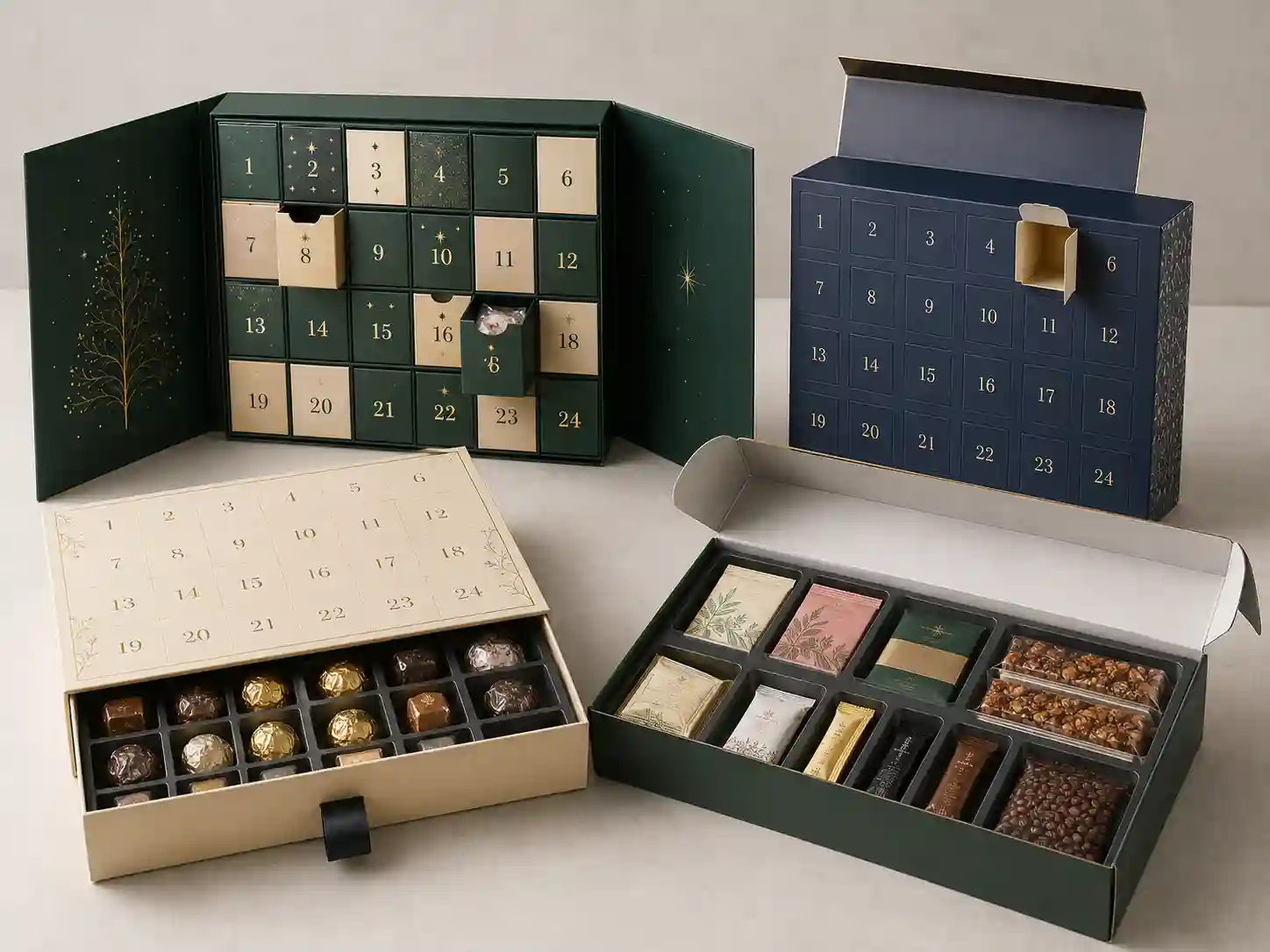
Before contacting Giftpackpro or another supplier, prepare the following details:
- Product type: sachet, capsule, pouch, pod, drip coffee bag, mini tin, or small paper box.
- Exact product size and weight for each item, preferably with filled samples or technical drawings.
- Number of compartments, such as 12-day, 24-day, or 25-day calendar.
- Preferred structure: rigid box, folding carton, drawer box, door-opening box, or book-style box.
- Insert preference: paper insert, PET tray, EVA insert, foam, molded pulp, or supplier recommendation.
- Material expectations: paperboard, greyboard thickness, wrapping paper, recycled paper preference, or FSC-related request for supplier verification.
- Printing requirements: CMYK, Pantone color, foil stamping, embossing, spot UV, matte lamination, or gloss lamination.
- Artwork status: finished design, rough concept, dieline needed, or design adaptation required.
- MOQ target, estimated annual quantity, and whether repeat orders are expected.
- Sample requirement: blank prototype, printed sample, pre-production sample, or all stages.
- Packing method: flat packed, semi-assembled, fully assembled, or filled calendar.
- Export requirements: master carton size limits, pallet requirements, shipping marks, barcode labels, and destination country.
- Timeline: required sample date, mass production deadline, shipping date, and in-warehouse date.
For buyers ready to develop coffee advent calendar boxes, Giftpackpro can review structure, inserts, sampling, printing, QC, and export packing details. Prepare the information above and request a custom quote with your product dimensions, target quantity, artwork status, and shipping plan.
FAQ: Coffee advent calendar boxes for B2B buyers
What is the best structure for coffee advent calendar boxes?
The best structure depends on the coffee format and sales channel. Sachets and drip coffee pouches often work well in folding carton or rigid door-opening calendars, while capsules and premium gift sets may need drawer boxes, rigid boxes, or shaped inserts for better movement control.
Can coffee advent calendar boxes be shipped flat?
Yes, some folding carton and semi-assembled structures can be shipped flat to reduce freight volume. However, rigid boxes, drawer calendars, and complex gift structures are often shipped assembled because factory assembly improves consistency and reduces local setup problems.
Which insert is best for coffee capsules?
PET trays, EVA, foam, or molded pulp inserts are often better for capsules because they provide shaped cavity support. Paper inserts may also work if the capsule is lightweight and the cavity is engineered carefully, but fit testing with real capsules is necessary.
Do coffee advent calendar boxes protect aroma and moisture?
The calendar box is usually secondary packaging, so aroma and moisture protection should mainly come from the coffee sachet, capsule, pouch, or inner bag. Buyers should not rely on paperboard alone as the aroma barrier unless the full packaging system has been tested.
What affects the MOQ for custom coffee advent calendar boxes?
MOQ is affected by material sourcing, printing setup, die-cut tooling, insert type, surface finishing, assembly labor, and factory production planning. More complex rigid boxes, special inserts, and multiple finishing processes usually require higher planning commitment than simple paperboard calendars.
How can buyers reduce damage during export shipping?
Buyers can reduce damage by confirming master carton strength, carton layout, internal protection, corner protectors, pallet pattern, stretch wrapping method, shipping marks, and handling instructions. For filled calendars, carton compression and movement control are especially important.
What should be approved before mass production?
Buyers should approve the dieline, material, insert fit, printed sample, color standard, finishing effect, door-opening performance, assembly method, packaging method, master carton arrangement, and pre-production sample before mass production begins.
Why export packing should be part of the original design
Coffee advent calendar boxes must satisfy both marketing and logistics requirements. The same packaging needs to display well, hold coffee products in sequence, protect printed surfaces, control insert movement, and arrive without crushed corners or shifted compartments. That is why structure, inserts, printing, QC, and export packing should be discussed together from the first RFQ.
For B2B buyers, the safest process is to define the coffee product first, choose the structure second, test the insert third, approve the printed sample, and then confirm export cartons, palletizing, shipping marks, and inspection criteria. When these details are aligned, coffee advent calendar boxes become easier to quote, sample, produce, inspect, ship, and reorder for future seasonal campaigns.