Quick answer: Coffee advent calendar boxes are custom seasonal packaging systems designed to hold coffee sachets, capsules, drip bags, pouches, or small coffee boxes in a fixed daily sequence. For B2B buyers, the most important decisions are structure, insert fit, moisture and aroma awareness, artwork accuracy, sampling process, MOQ, QC method, and export packing. A reliable supplier should help check the dieline, product dimensions, compartment order, printing proof, blank sample, printed sample, pre-production sample, carton packing, and quotation details before mass production begins.
This guide is written for overseas brands, wholesalers, gift companies, retail buyers, Amazon sellers, packaging distributors, and purchasing teams comparing custom coffee advent calendar boxes for seasonal retail, e-commerce, corporate gifting, and promotional campaigns. It focuses on factory-side decisions rather than consumer holiday storytelling.
What should buyers understand before choosing coffee advent calendar boxes?
Buyers should understand that coffee advent calendar boxes are not only printed gift boxes; they are structured packaging projects with many small compartments, repeated opening actions, insert tolerances, and export-packing requirements. The box must protect the coffee items, present them in the correct sequence, and remain stable during assembly, shipping, retail display, and end-user opening.
Coffee products create several packaging questions that are different from cosmetics, toys, or stationery. Sachets, capsules, pouches, drip coffee bags, and small box packs may have different thickness, sealing edges, aroma-barrier requirements, and weight distribution. The outer calendar box normally does not touch coffee directly, but the structure must still avoid crushing, product movement, wrong compartment order, and moisture exposure during storage or transit.
For B2B planning, buyers should define the sales channel first. A supermarket display program may need strong shelf presence and fast carton unpacking. An e-commerce program may need better outer protection and lower damage risk. A corporate gifting project may prioritize premium rigid box presentation and a clean unboxing experience. A wholesale project may focus on repeatable MOQ, cost control, and clear shipping marks for mixed destinations.
Buyer tip: Before asking for a quote, prepare the actual coffee item size, item weight, packing format, daily sequence, target quantity, and target delivery date. Without these details, suppliers can only provide a rough estimate, not a reliable production quotation.
Which coffee advent calendar box structure fits your campaign?
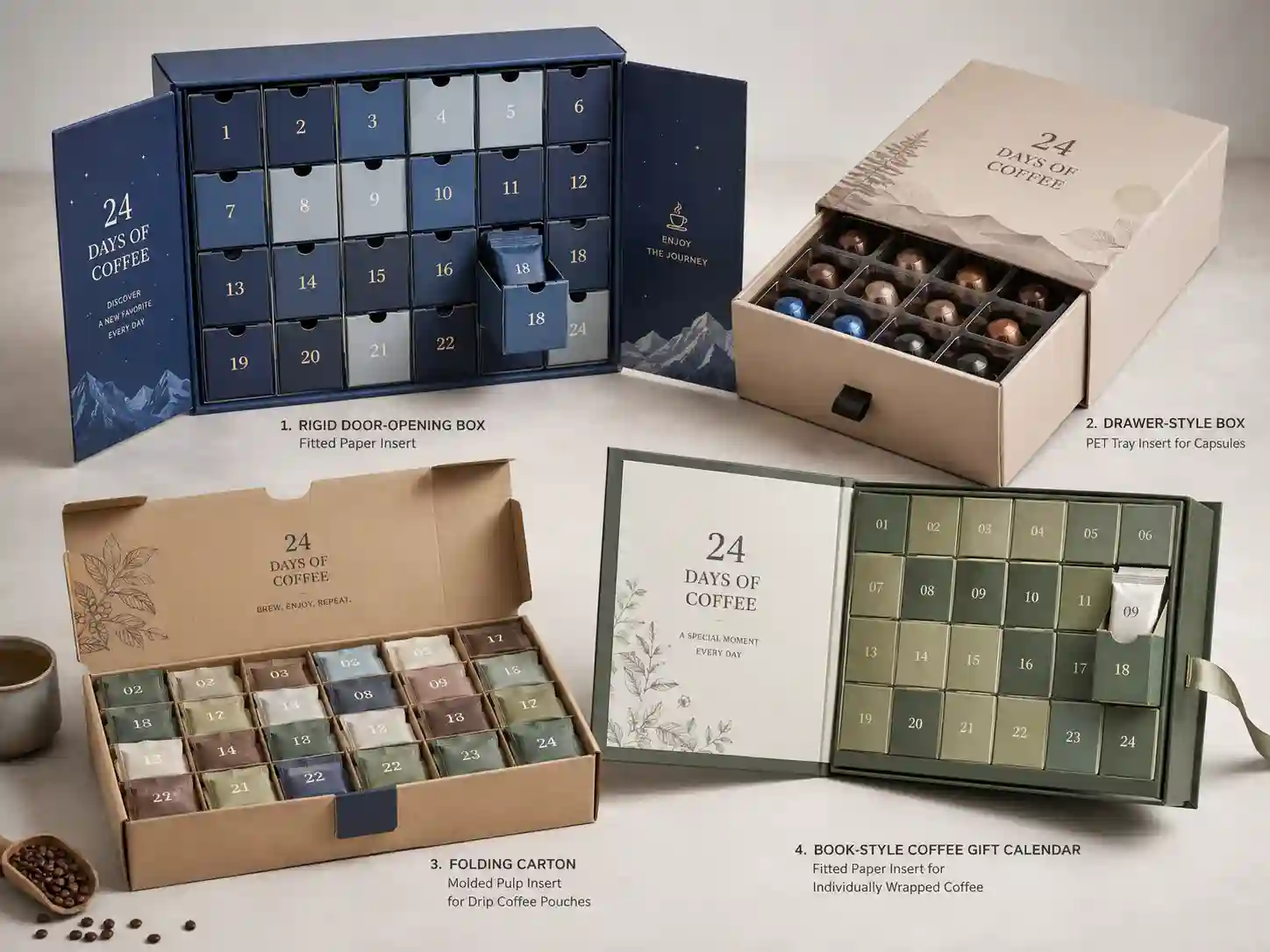
The right structure depends on product weight, target price, retail channel, opening experience, and assembly method. For most coffee advent calendar boxes, common options include rigid door-opening boxes, drawer boxes, folding cartons, book-style boxes, and fold-out calendar boxes.
| Structure option | Best for | Main advantages | Buyer checks before sampling |
|---|---|---|---|
| Rigid door-opening box | Premium coffee gifts, retail campaigns, corporate gifting | Strong presentation, good stiffness, premium feel, suitable for foil stamping or embossing | Check greyboard thickness, door opening strength, magnet or ribbon choice, and filled-box weight |
| Drawer box | Capsule sets, sachet sets, reusable gift formats | Smooth opening, good perceived value, easy product access | Check drawer sliding tolerance, insert height, and whether products shift during transit |
| Folding carton calendar | Cost-sensitive retail programs and larger seasonal runs | Lower unit cost, efficient flat packing, lighter shipping weight | Check paperboard strength, tear-door performance, assembly time, and carton compression |
| Book-style calendar box | Gift boxes with storytelling panels or product information | Large artwork area, good brand presentation, clear labeling space | Check hinge durability, cover alignment, insert position, and barcode location |
| Fold-out calendar box | Retail display and campaign launches with visual impact | Strong display effect, multiple panels, flexible compartment layout | Check opening footprint, panel warping risk, and export carton arrangement |
A rigid box usually costs more than a folding carton because it uses greyboard, wrapped paper, more manual assembly, and more space in export cartons. A folding carton can reduce cost and freight volume, but it may need careful paperboard selection and structural testing if the coffee items are heavy. Drawer boxes and book-style boxes are often chosen when brands want a premium look without making every compartment door too complex.
Factory tip: A coffee calendar with 24 or 25 compartments should be reviewed as a mechanical structure, not only as a graphic design. Door spacing, compartment walls, insert height, and opening direction can affect both assembly speed and final user experience.
How should inserts be designed for sachets, capsules, pouches, or small boxes?
The insert should hold each coffee item securely without damaging sealing edges, capsule rims, or printed pouches. Good insert design starts with actual product samples, not estimated product dimensions from a catalog.
Paper inserts are commonly used for lightweight sachets, drip coffee bags, and small pouches. They are cost-effective, recyclable in many markets depending on local rules, and suitable for projects that need a paper-based structure. PET trays can provide more precise cavities for capsules and small rigid packs. EVA or foam inserts offer stronger cushioning but may not match every brand’s sustainability preference. Molded pulp can be considered for buyers seeking a more paper-based molded solution, but tooling, tolerance, surface texture, and lead time should be reviewed early.
For coffee packaging, the insert must also consider aroma and moisture awareness. The advent calendar box is usually secondary packaging, while the coffee product’s own sachet, capsule, pouch, or inner box provides the primary barrier. Still, buyers should avoid packaging designs that expose primary packs to excess pressure, torn seals, loose dust, or high-humidity storage conditions. If any component may contact food directly, buyers should verify applicable food-contact requirements with official guidance such as the FDA food-contact substance guidance or the rules in their destination market.
What insert information should be checked before sample making?
Before making a prototype, buyers should confirm item size, item thickness, item weight, seal-edge allowance, grip space, compartment sequence, and the opening method. A sachet that fits tightly in a CAD drawing may still be difficult to remove by hand if there is no finger gap.
- Measure the longest, widest, and thickest point of each sachet, capsule, pouch, or small box.
- Check whether all daily items are the same size or whether mixed SKUs need different cavity sizes.
- Allow tolerance for sealing edges, folded corners, capsule rims, or pouch thickness variation.
- Confirm the product sequence before printing numbers on doors or drawer labels.
- Decide whether products should be visible when opened or hidden behind paper doors.
- Check whether the insert should be removable, glued, nested, or locked into the outer box.
QC tip: During insert testing, shake the filled blank sample gently in different orientations. If products jump cavities, twist, or press against door panels, the insert needs revision before printed sampling.
Which materials and finishes affect quality, cost, and lead time?
Material and finishing choices affect the unit price, sample cost, production time, carton volume, and perceived retail value. Buyers should compare paperboard, greyboard, wrapped paper, insert material, lamination, and special finishes as one complete packaging system.
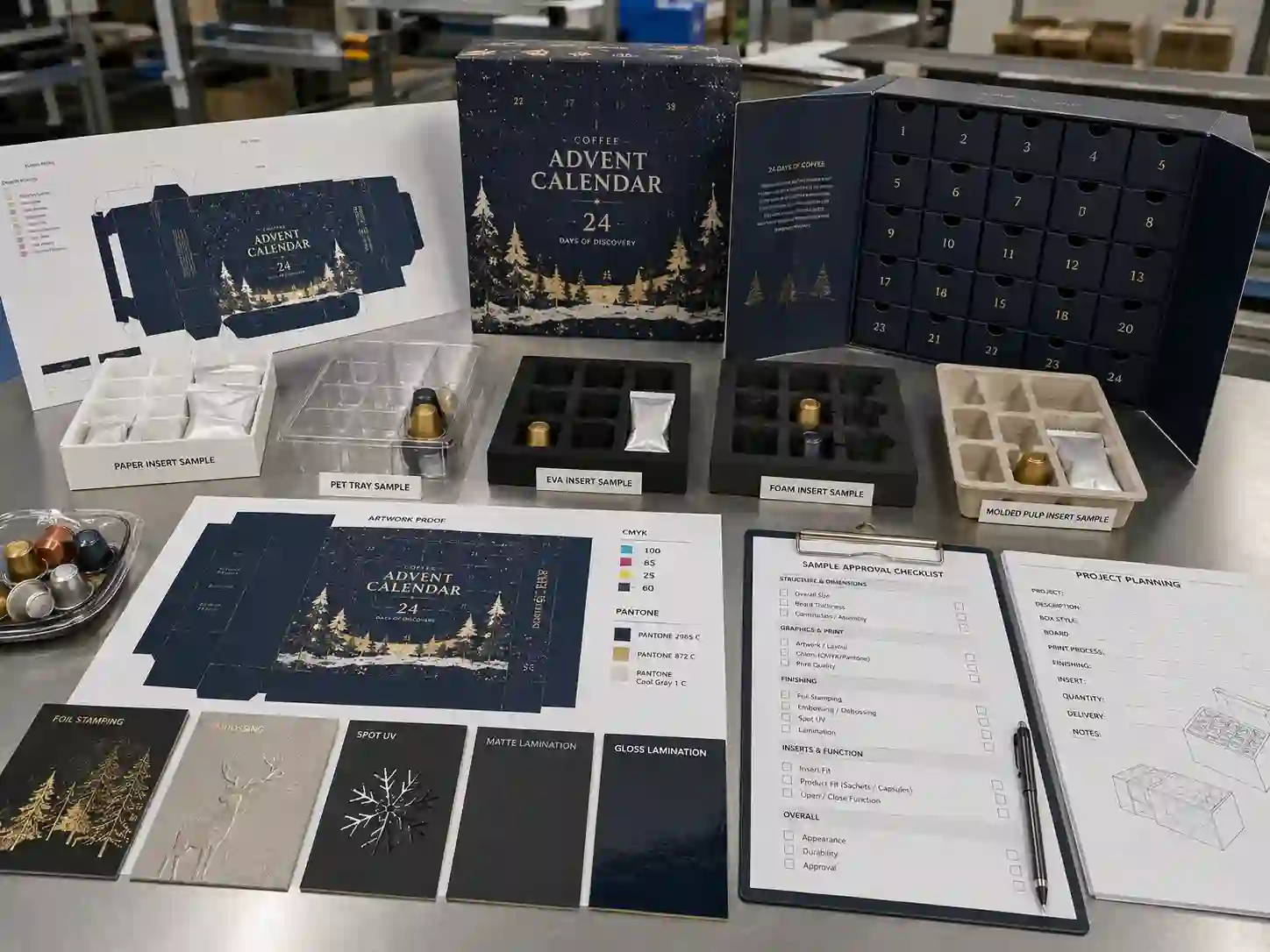
Rigid coffee advent calendar boxes often use greyboard wrapped with printed art paper. Folding carton calendars commonly use paperboard, corrugated backing, or reinforced paper structures depending on product weight. Insert materials may include paper insert, PET tray, EVA insert, foam, or molded pulp. The better choice depends on product format, budget, sustainability goals, and assembly requirements.
Printing normally uses CMYK for full-color artwork and Pantone color matching for brand-critical colors. For premium coffee gifts, buyers may add foil stamping, embossing, debossing, spot UV, matte lamination, or gloss lamination. These finishes can improve shelf appeal, but they also add tooling, proofing, cost, and production checks. A finish that looks good on a flat proof may behave differently across door cuts, folds, corners, or wrapped edges.
Buyer tip: If your brand color is strict, request a printed sample or color proof on the actual substrate. A digital screen approval is not enough for Pantone, matte lamination, foil stamping, or dark coffee-themed artwork.
How does sampling work for custom coffee advent calendar boxes?
Sampling usually moves from a blank structural sample to a printed sample and then to a pre-production sample before mass production. Each stage answers a different buyer question, so skipping steps can create expensive revisions later.
| Sample stage | Main purpose | What the buyer should check | Common revision points |
|---|---|---|---|
| Blank sample | Verify structure, size, insert fit, door opening, drawer sliding, and assembly logic | Product fit, compartment sequence, box strength, insert movement, removal space | Cavity size, door position, insert height, box depth, folding line, glue area |
| Printed sample | Review artwork, color, finish, numbering, labeling space, and overall appearance | CMYK result, Pantone match, barcode area, door numbers, foil/UV position | Color adjustment, text size, varnish area, dieline alignment, finishing pressure |
| Pre-production sample | Confirm the final approved version before mass production | Final materials, approved artwork, insert, packing method, carton quantity | Only minor corrections should remain at this stage |
A blank sample can be made without final printing, making it useful for checking whether coffee sachets, capsules, pouches, or small boxes fit properly. A printed sample is more useful for artwork approval, retail buyer review, sales presentation, and internal sign-off. A pre-production sample should represent the final manufacturing method as closely as possible before bulk production starts.
Factory tip: The best time to change structure is during blank sample review. The best time to adjust color and finishing is during printed sample review. After pre-production approval, changes can affect cost, tooling, schedule, and material purchasing.
What should be included in a sample approval form?
A sample approval form should record the exact version the buyer approved and prevent confusion between old and revised samples. This is especially important when several departments review the same coffee calendar project.
- Project name, SKU, sample date, and version number
- Outer box size, insert size, compartment count, and product format
- Material specification, paper thickness, greyboard thickness, and insert material
- Printing method, CMYK or Pantone references, and finish details
- Door number layout, compartment sequence, barcode, warning text, and labeling space
- Approved packing method, export carton size, carton quantity, and shipping marks
- Required revisions, responsible party, and final approval signature or email confirmation
What MOQ and cost drivers should buyers expect?
MOQ and cost depend on structure, materials, printing, insert type, finishing, assembly time, carton packing, and supplier production setup. There is no universal MOQ or price for coffee advent calendar boxes because a rigid 24-door capsule calendar and a flat-packed folding carton sachet calendar are very different production projects.
Key cost drivers include greyboard thickness, paperboard grade, number of compartments, insert material, tooling, mold cost, printed area, Pantone matching, foil stamping, embossing, spot UV, lamination, manual assembly, product loading requirements, export carton strength, and pallet packing. A design with many small doors may require more cutting accuracy and more inspection time than a simple sleeve box.
Buyers comparing quotations should avoid judging by unit price alone. One supplier may quote a lower price by using thinner board, fewer QC steps, weaker cartons, or a less precise insert. Another may include stronger export packing, clearer sampling, or better pre-production checks. The commercial comparison should include sample cost, tooling cost, MOQ, unit price by quantity tier, lead time, packing method, payment terms, and revision policy.
Decision guide: how should buyers choose the right option?
The best option is the one that balances product protection, retail presentation, cost, assembly efficiency, and shipping reliability. Use the following decision guide before confirming the dieline or requesting a printed sample.
| Buyer priority | Recommended direction | Reason |
|---|---|---|
| Premium gift positioning | Rigid box, drawer box, or book-style box with paper or PET insert | Better structure, stronger shelf appeal, and more room for premium finishes |
| Lower freight volume | Flat-packed folding carton or semi-assembled design | Can reduce carton volume, but may require buyer-side or co-packer assembly |
| Capsule protection | PET tray, molded pulp, or reinforced paper insert | More stable cavity shape and better control of product movement |
| Sachet or drip bag program | Paper insert or folding carton structure | Usually lighter, easier to sequence, and more cost-efficient for large runs |
| Retail shelf clarity | Large front panel with clear labeling space and barcode planning | Helps retail buyers, warehouse teams, and customers identify the SKU quickly |
| E-commerce shipping | Stronger outer box, tighter insert, improved export carton, and drop-test planning | Reduces product movement and damage risk during parcel handling |
For buyers who need supplier support from concept through sampling, custom advent calendar box services can help organize structure planning, dieline review, sample development, and production preparation. Buyers comparing formats can also review custom advent calendar box products for structure ideas before sending an RFQ.
How should artwork and dielines be checked before printed sampling?
Artwork should be checked against the final dieline before a printed sample is produced. Door numbers, cut lines, fold lines, glue areas, barcode position, text safety margins, and finish layers must all align with the real structure.
For coffee advent calendars, artwork often includes daily numbers, flavor names, roast notes, product descriptions, ingredient or compliance text, QR codes, barcodes, and retail labels. If these elements cross cut lines or door openings, the final result may look misaligned. Dark coffee colors, kraft paper textures, metallic finishes, and matte lamination can also change the printed appearance compared with a screen preview.
- Confirm the dieline is the latest approved structural version.
- Keep important text away from cut, crease, and glue areas.
- Check every door number against the product sequence.
- Reserve clear space for barcode, SKU label, shipping label, or importer label if required.
- Separate foil stamping, embossing, spot UV, and white ink layers clearly in the file.
- Confirm CMYK and Pantone settings before proofing.
- Review artwork on both flat dieline and assembled sample photos.
Buyer tip: For multi-market packaging, ask your regulatory or compliance team to confirm labeling text before printed sampling. Reprinting because of late label changes is more expensive than revising a digital artwork file.
What QC checks matter before mass production?
QC should confirm that the approved sample can be repeated consistently during bulk production. The most important checks include structure, dimensions, print accuracy, insert fit, compartment sequence, opening function, assembly quality, and export packing strength.
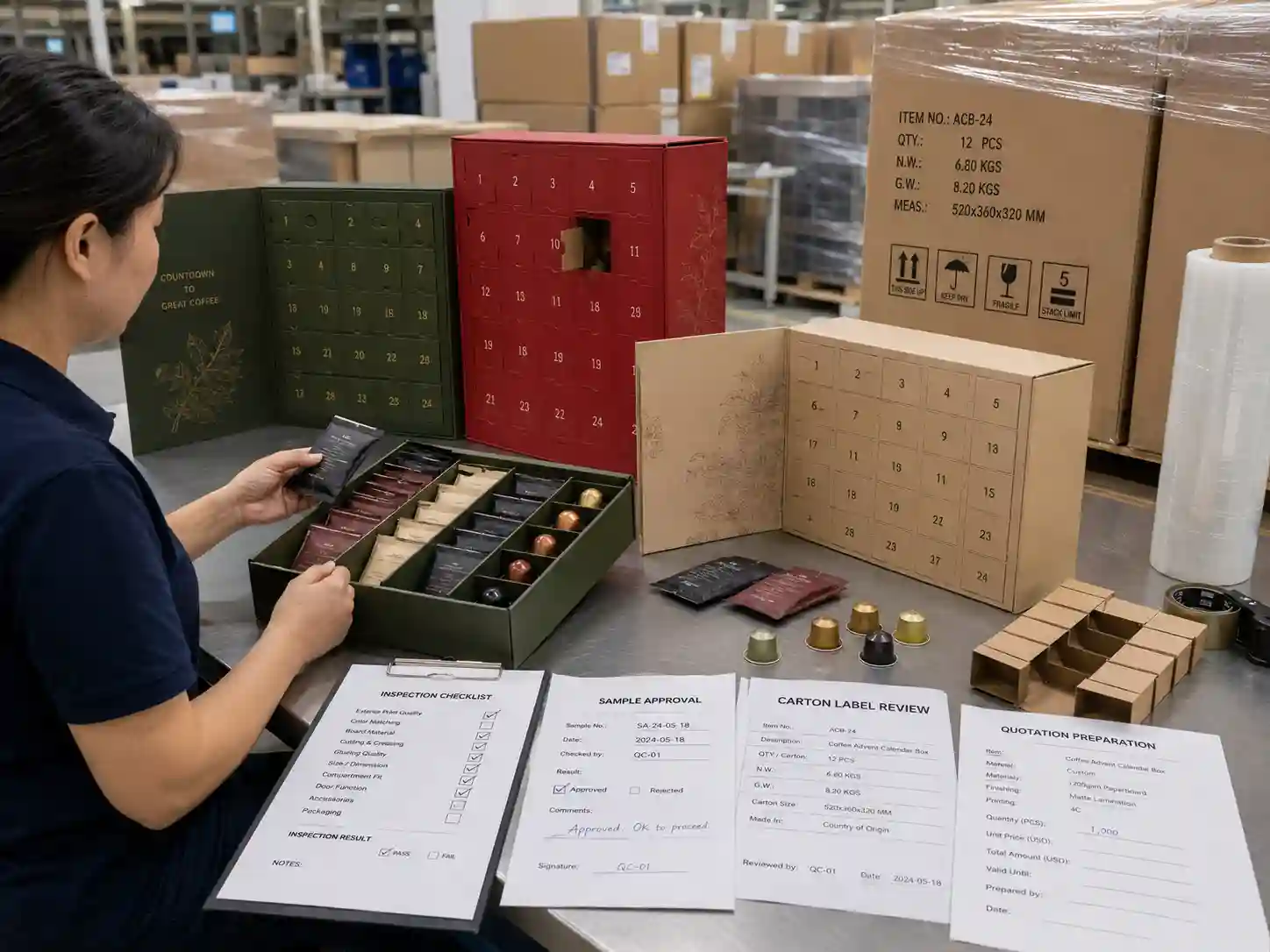
For coffee advent calendar boxes, QC should include both empty-box inspection and filled-fit review using actual or dummy coffee products. Doors should open without tearing too early. Drawer movement should feel smooth but not loose. Inserts should stay in place. Capsules should not rattle heavily. Sachets and pouches should not bend, crush, or catch under door edges.
Inspection should also review glue marks, surface scratches, warped panels, color variation, foil registration, embossing pressure, spot UV position, lamination bubbles, barcode readability, carton labels, and shipping marks. If the project requires pallet packing, confirm pallet height, corner protectors, stretch wrap, carton orientation, and destination labels.
QC tip: A final inspection should compare mass production against the approved pre-production sample, not against a memory of the design. Keep one signed sample at the factory and one with the buyer if possible.
How should export packing be planned for overseas delivery?
Export packing should protect the calendar boxes from compression, moisture exposure, rough handling, and carton confusion during international shipping. Buyers should decide early whether the boxes ship flat, semi-assembled, fully assembled, or filled with coffee products.
Flat packing can reduce freight volume, but it may shift assembly labor to the buyer, co-packer, or fulfillment center. Fully assembled packing saves downstream labor but increases carton volume and may require stronger export cartons. Filled calendars require careful sequence control, carton drop awareness, and clear batch identification. For general transit-test planning, buyers may refer to official resources from the International Safe Transit Association when discussing testing expectations with their logistics or packaging teams.
| Packing decision | When it works well | Risk to check |
|---|---|---|
| Flat packed | Large-volume folding carton calendars with buyer-side assembly | Assembly time, worker error, insert placement, and crease damage |
| Semi-assembled | Projects balancing freight savings and easier final packing | Final assembly instructions and carton organization |
| Fully assembled empty | Premium rigid boxes sent to a co-packer for coffee loading | Higher carton volume and compression protection |
| Filled and packed | Turnkey gift projects with confirmed coffee items and sequence | Product sequence control, batch control, and destination compliance |
Shipping marks should be generic, clear, and consistent with the buyer’s logistics requirements. Export cartons may include item number, carton number, quantity, gross weight, net weight, carton size, country of origin marking if applicable, and destination details. Buyers should confirm whether palletization, corner protectors, moisture protection, or special warehouse labels are needed.
How should buyers compare coffee advent calendar box suppliers?
Buyers should compare suppliers by their ability to control structure, sampling, printing, insert testing, QC, export packing, and communication, not only by the lowest quoted unit price. A good supplier should ask practical questions before quoting and should be able to explain what affects price and lead time.
When reviewing a potential supplier, ask whether they can provide blank samples, printed samples, pre-production samples, dieline support, insert testing, material recommendations, carton packing plans, and revision tracking. Ask how they manage artwork proofing, color confirmation, sample approval, mass production inspection, and export carton labeling. If sustainability or paper sourcing is important, ask the supplier what documentation can be verified; do not assume certification unless it is confirmed by valid documents.
Giftpackpro positions itself as a custom advent calendar boxes manufacturer for B2B seasonal packaging projects, with support for structure development, sampling, bulk production, and export preparation. Buyers can learn more about the Giftpackpro packaging factory when evaluating supplier fit.
What information should be prepared before requesting a quotation?
A complete RFQ helps the supplier provide a realistic quotation, sample plan, MOQ suggestion, and lead-time estimate. Missing product dimensions, artwork status, packing method, or order quantity can delay the quote or lead to inaccurate pricing.
Quotation preparation checklist
- Target box structure: rigid box, folding carton, drawer box, door-opening box, book-style box, or fold-out box
- Product format: sachet, capsule, pouch, drip bag, small coffee box, or mixed format
- Product dimensions and weight for each daily item
- Number of compartments, such as 12, 24, 25, or custom count
- Required compartment sequence and whether numbers must match flavors
- Preferred insert type: paper insert, PET tray, EVA insert, foam, or molded pulp
- Artwork status: ready file, draft design, or need dieline first
- Printing and finishing: CMYK, Pantone, foil stamping, embossing, spot UV, matte lamination, or gloss lamination
- Target quantity and possible reorder quantity
- Sample requirement: blank sample, printed sample, or pre-production sample
- Packing method: flat, semi-assembled, fully assembled, or filled
- Export requirements: carton labels, shipping marks, pallet packing, destination country, and delivery deadline
For more purchasing guidance, buyers can read related advent calendar box buying guides. When the basic project details are ready, the next step is to request a custom quote with product photos, dimensions, quantity, artwork status, and required delivery schedule.
What common mistakes should buyers avoid?
Most problems can be avoided by testing the actual coffee product, approving samples carefully, and confirming packing details before mass production. The most common mistakes happen when buyers approve artwork before structure, estimate product size without samples, or ignore export carton requirements until the end.
- Approving the dieline without real product testing: Coffee pouches and sachets can vary in thickness, especially at sealing edges.
- Ignoring compartment sequence: Flavor order, door numbers, and insert cavities must match before printing begins.
- Using premium finishes without proofing: Foil, embossing, spot UV, and dark matte artwork need physical review.
- Choosing the lowest quote without checking specifications: Thin board, weak inserts, or poor cartons can increase damage risk.
- Skipping the pre-production sample: This can create confusion between approved sample versions and final bulk production.
- Leaving barcode and label space too late: Retail and logistics labels may need clean, flat, scannable areas.
- Forgetting export-packing constraints: Carton size, pallet plan, shipping marks, and moisture protection affect delivery quality.
Factory tip: A calendar box project should not enter mass production until the buyer and factory agree on the approved sample, final artwork, insert specification, packing method, carton details, and inspection standard.
FAQ: Coffee advent calendar boxes for B2B buyers
Can one coffee advent calendar box hold mixed sachets, capsules, and pouches?
Yes, but mixed formats require careful insert design. Each cavity may need a different size or depth, and the door sequence must match the product loading plan. A blank sample with real products is strongly recommended before printed sampling.
Is a rigid box always better than a folding carton?
No. A rigid box is usually better for premium presentation and structural strength, while a folding carton can be better for cost control, lighter weight, and flat packing. The better choice depends on channel, quantity, budget, and product weight.
Do coffee advent calendar boxes need food-contact materials?
Usually the advent calendar is secondary packaging and the coffee is protected by its own sachet, capsule, pouch, or inner box. If any packaging component directly contacts food, buyers should verify destination-market food-contact requirements before production.
What is the difference between a blank sample and a printed sample?
A blank sample checks structure, size, insert fit, compartment layout, and opening function. A printed sample checks artwork, color, finishing, numbering, barcode space, and overall presentation. Both are useful for reducing risk before mass production.
When should the pre-production sample be approved?
The pre-production sample should be approved after the structure, artwork, insert, material, finishing, and packing method are finalized. It should represent the version that the factory will follow during bulk production.
What affects lead time most?
Lead time is affected by structural complexity, sample revisions, material purchasing, printing proof approval, special finishing, insert tooling, manual assembly, QC requirements, and export-packing preparation. Late artwork changes are one of the most common causes of delay.
Can boxes be shipped flat to save freight?
Yes, some folding carton and semi-assembled structures can ship flat or partially flat. However, buyers should calculate assembly labor, co-packer capacity, instruction clarity, and damage risk before choosing flat packing only for freight savings.
How can buyers start a coffee advent calendar box project with Giftpackpro?
To start a coffee advent calendar boxes project, prepare your coffee item dimensions, product format, compartment count, target structure, artwork status, preferred insert, order quantity, sample needs, delivery deadline, and export-packing requirements. Clear information helps Giftpackpro recommend a practical structure, sample route, MOQ plan, and quotation instead of giving a vague estimate.
A strong B2B packaging project moves step by step: confirm product fit, approve the dieline, test a blank sample, review a printed sample, approve a pre-production sample, inspect mass production, and protect the goods with suitable export cartons and shipping marks. This process helps brands reduce revision cost, avoid product-fit problems, and prepare seasonal coffee packaging with better purchasing control.
When you are ready to compare options, send product photos, exact dimensions, quantity, and target schedule through the request a custom quote page. Giftpackpro can review your structure, insert, sample, QC, and export-packing requirements for a custom advent calendar box project.