Quick answer: Candy advent calendar boxes should be planned around candy size, compartment layout, insert fit, retail display, printing method, food-adjacent material requirements, and export packing strength. For B2B buyers, the best solution is not always the most decorative box; it is the structure that protects individually wrapped candies, opens smoothly, supports labeling and barcode space, passes sample approval, and can be produced consistently at the target MOQ. Before requesting a quotation, prepare candy dimensions, quantity per box, preferred box style, artwork expectations, packing method, destination market, and any food-contact or recycling requirements that your importer or retailer must verify.
Candy advent calendar boxes are seasonal products, but the purchasing work is practical: structure selection, insert engineering, artwork proofing, sampling, production tolerance, carton protection, and supplier communication. This guide is written for overseas brands, wholesalers, retail buyers, e-commerce sellers, and packaging purchasing teams comparing custom advent calendar boxes for seasonal candy campaigns.
Giftpackpro works as a custom advent calendar boxes manufacturer for B2B buyers who need packaging that can move from concept to sample, mass production, QC, and export packing without losing control of details.
What should buyers confirm before choosing candy advent calendar boxes?
Buyers should confirm product size, candy count, box structure, insert material, artwork complexity, sales channel, shipping method, and destination-market requirements before choosing the final packaging solution. These details determine the box size, cost, sample timeline, production risk, and carton packing method.
A candy advent calendar box is not only an outer printed package. It is a multi-part packaging system: outer structure, numbered doors or drawers, insert, candy placement, labeling area, finishing, assembly method, and master carton. If one part is ignored, the whole project can suffer from loose candies, damaged doors, crushed corners, poor barcode placement, or delayed quotation.
Buyer tip: Do not start with decoration only. Start with the candy specification. Wrapped candy length, width, height, weight, and shape affect compartment size more than the visual design does.
- Product format: individually wrapped hard candy, gummies, chocolates, lollipops, mints, or mixed gift candy.
- Quantity per calendar: 12, 24, 25, or custom compartment count.
- Sales channel: retail shelf, supermarket display, gift shop, subscription box, Amazon/e-commerce, or promotional campaign.
- Box requirement: rigid box, folding carton, drawer box, book-style box, or door-opening box.
- Insert requirement: paper insert, PET tray, EVA insert, foam insert, molded pulp, or combined solution.
- Branding requirement: CMYK printing, Pantone color, foil stamping, embossing, spot UV, matte lamination, or gloss lamination.
- Export requirement: flat packed or assembled packed, export carton size, pallet plan, shipping marks, and carton label needs.
Which structure is best for candy advent calendar boxes?
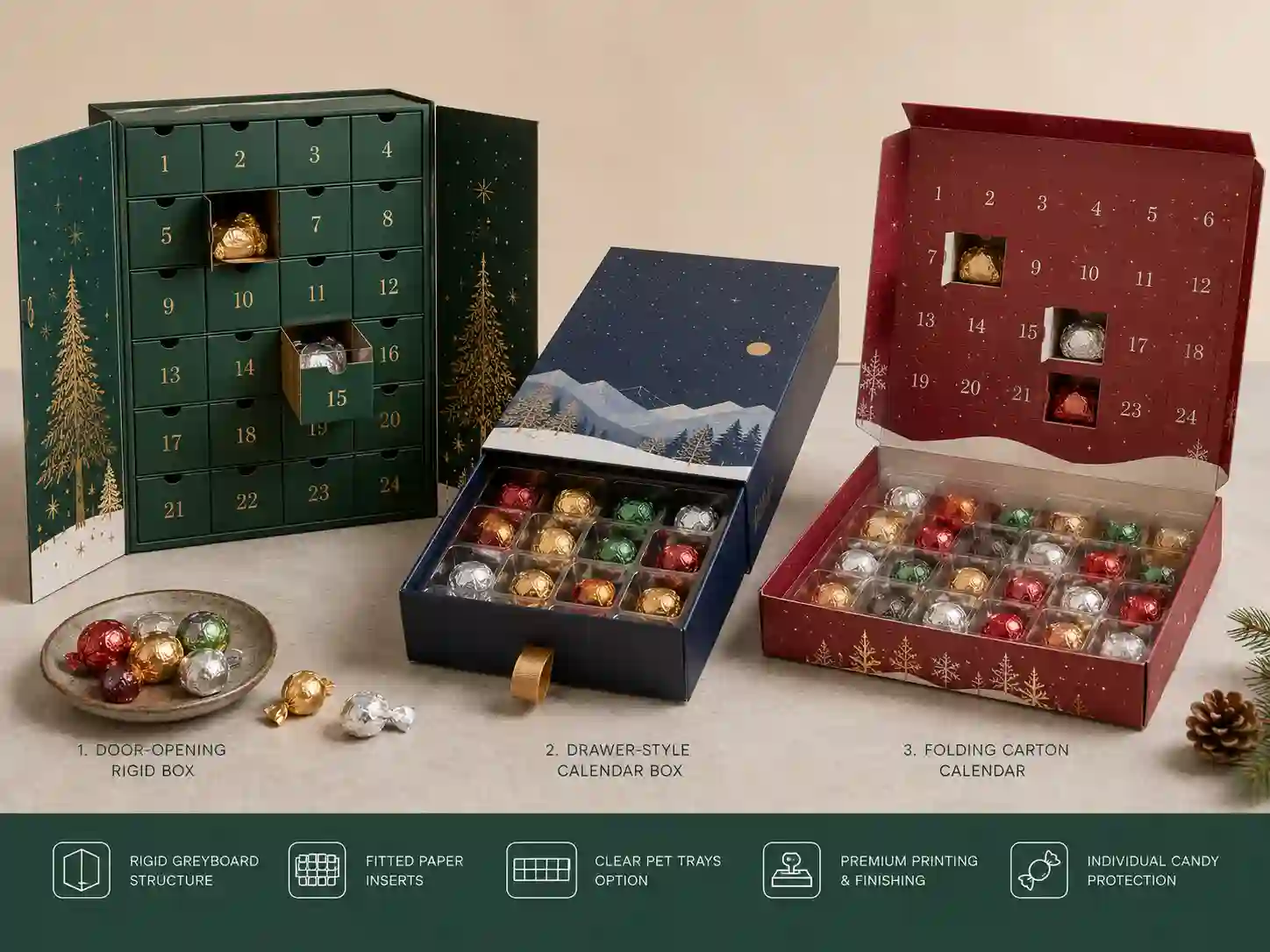
The best structure depends on candy weight, retail positioning, assembly budget, and how the buyer wants each compartment to open. Rigid boxes suit premium gift campaigns, folding cartons suit cost-sensitive volume programs, drawer boxes suit reusable gift presentation, and door-opening boxes suit classic retail advent calendar applications.
For candy products, structure must control both appearance and compartment security. A beautiful box with weak inner support can allow candies to shift during ocean freight or parcel delivery. A strong structure with poor opening design can tear, jam, or frustrate the user. In B2B sourcing, buyers should compare structure by protection, unit cost, display value, packing volume, assembly labor, and insert compatibility.
| Structure Option | Best For | Main Advantages | Buyer Watch Points |
|---|---|---|---|
| Rigid box | Premium candy gift sets, department stores, high-value seasonal campaigns | Strong greyboard structure, high perceived value, good for foil stamping, embossing, and premium finishing | Higher unit cost, larger shipping volume, longer sampling and production time than simple folding carton |
| Folding carton calendar | Large-volume retail candy programs and price-sensitive promotions | Lower material weight, efficient flat packing, suitable for CMYK printing and large retail runs | Needs careful paperboard thickness and insert support to avoid bending or crushed corners |
| Door-opening box | Classic numbered advent calendar format with surprise compartments | Clear seasonal function, strong retail recognition, good front-panel artwork space | Dieline tolerance, perforation strength, and door-opening tests are critical before mass production |
| Drawer box | Gift sets, reusable packaging, premium promotional campaigns | Smooth unboxing experience, strong display value, flexible for different candy shapes | More components, more assembly labor, and higher risk if drawer clearance is not tested |
| Book-style magnetic box | High-end candy assortments and corporate gifting | Premium opening style, strong brand presentation, good for mixed inserts | Magnet placement, board thickness, and shipping weight must be controlled carefully |
Factory tip: A structure that works for empty samples may not work after candy loading. Always test the sample with real wrapped candies or accurate dummy products, not only paper mockups.
How should inserts be selected for candy separation and protection?
Inserts should keep each candy separated, visible where needed, and stable during handling, while matching the product’s food-adjacent packaging requirements. For most candy advent calendar boxes, the insert is the part that decides whether the box feels organized or messy after shipping.
Wrapped candies often vary in size because of twisting, sealing edges, and irregular shapes. A compartment that looks correct in a dieline may become too tight once the real wrapper is included. Buyers should provide the supplier with actual candy samples or exact 3D dimensions, including the wrapper tail and maximum height.
Which insert materials are commonly used?
Paper inserts are widely used for lightweight candy and recyclable-positioned paper packaging. PET trays are useful when candy needs formed cavities and better visibility through compartments. EVA and foam inserts can protect heavier or fragile items but may not match every sustainability or food-adjacent requirement. Molded pulp can support plastic-reduction goals but requires careful tooling and surface review.
- Paper insert: suitable for lightweight wrapped candies, simple compartments, and paper-based packaging direction.
- PET tray: suitable for formed cavities, more accurate candy placement, and stronger shape control.
- EVA insert: suitable for heavier gift items or mixed candy-plus-gift sets, but buyers should verify material expectations for the market.
- Foam insert: useful for cushioning but may be less suitable where buyers want a paper-focused sustainability story.
- Molded pulp: suitable for paper-based positioning, but tooling, color variation, thickness, and surface texture should be approved by sample.
QC tip: Insert testing should include shake testing, door-opening testing, upside-down handling, and loaded-carton checking. If candies move inside the calendar before final delivery, the insert needs adjustment before mass production.
What material and food-packaging issues should buyers discuss?
Buyers should discuss whether the candy is individually wrapped, whether the advent calendar box has direct food contact, and which paperboard, greyboard, ink, coating, adhesive, and insert materials are acceptable for the destination market. A packaging supplier should not make unsupported compliance claims; the buyer should verify required documents with importers, retailers, and local regulations.
Many candy advent calendar boxes are secondary packaging because the candy itself is already wrapped. However, secondary packaging still sits close to food products and may affect odor, moisture, presentation, and consumer confidence. For projects where candy touches the insert or tray directly, food-contact material review becomes more important.
For U.S.-related projects, buyers can review official FDA information about packaging and food contact substances. The practical sourcing point is simple: define the contact condition first, then request material details and supporting documents that match the actual use.
Which material questions should be included in the RFQ?
The RFQ should ask for board type, board thickness, insert material, surface treatment, lamination, adhesive, and any buyer-required documentation. For candy gift packaging, odor and moisture awareness should be discussed early because printing, lamination, glue, and storage conditions can affect the final packed product.
- Is the candy individually wrapped before being placed in the calendar?
- Will candy touch paper, PET, molded pulp, EVA, or foam directly?
- Does the buyer require FSC paper, recycled paperboard, or other material verification?
- Is matte lamination, gloss lamination, varnish, or uncoated paper preferred?
- Are there restrictions on odor, ink, adhesive, or plastic use from the retailer?
- Does the packaging need extra moisture protection during storage or export shipment?
- Will the final product be packed in a polybag, shrink wrap, sleeve, or display carton?
Buyer tip: For candy packaging, a low-odor sample review is more useful than a material name alone. Ask the factory to pack and seal one loaded sample for several days, then check odor transfer, candy movement, and opening performance.
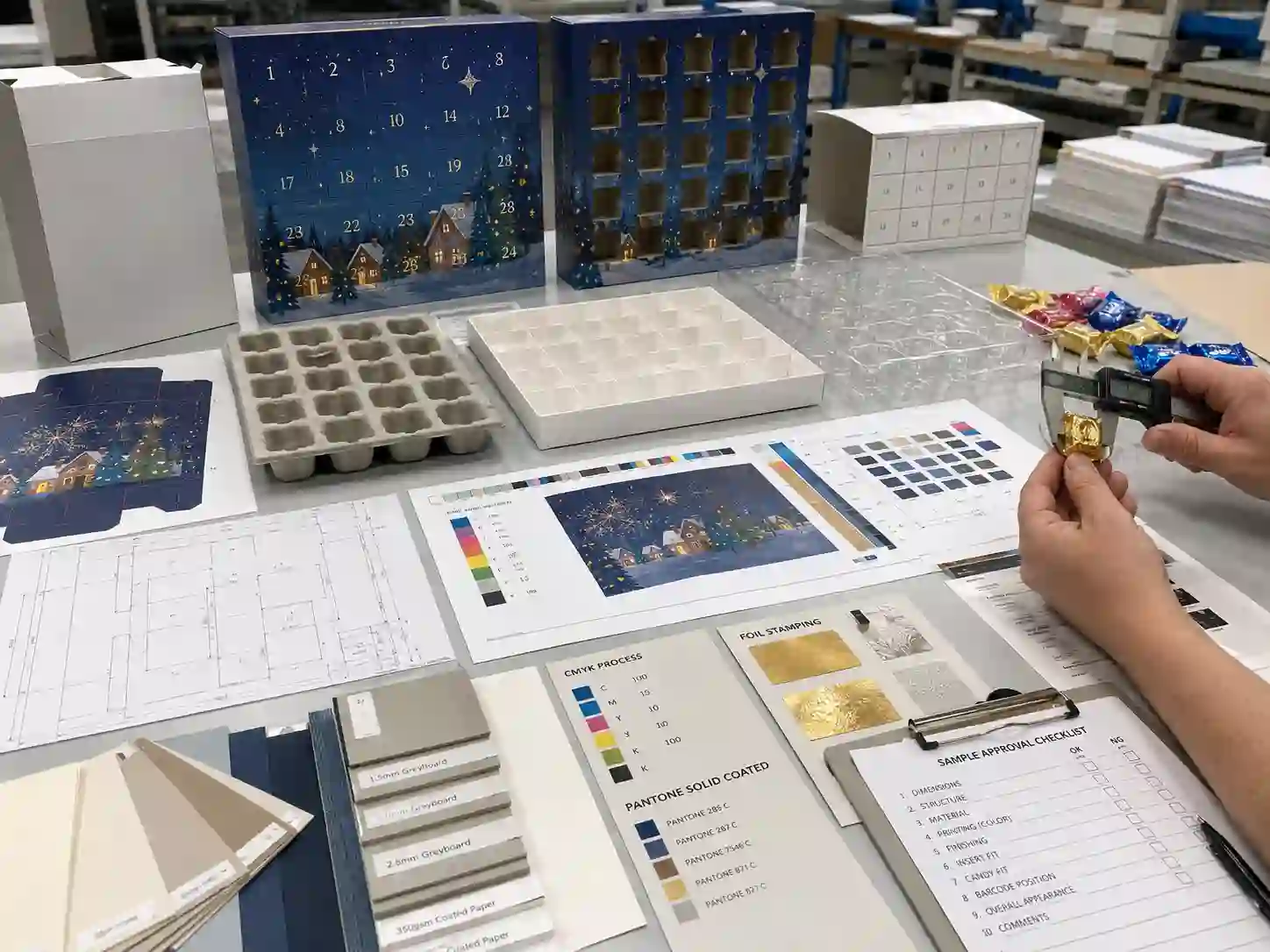
How should artwork, dieline, and printing be prepared?
Artwork should be prepared after the dieline is confirmed, not before. Candy advent calendar boxes often have many doors, numbers, cut lines, glue areas, and insert positions, so artwork must match the approved structure exactly.
For custom printing, buyers should decide whether the project needs CMYK process printing, Pantone spot color control, foil stamping, embossing, debossing, spot UV, matte lamination, gloss lamination, or a combination. Each process affects cost, lead time, sample accuracy, and production risk.
What should buyers check on the dieline?
Buyers should check size, door position, bleed, safety margin, barcode area, warning text area, nutrition or ingredient-label coordination, shipping label needs, and retail-display orientation. A dieline error can cause expensive delays because printing plates, cutting dies, and sample approvals depend on it.
- Confirm final outer box size and loaded candy weight.
- Check every compartment size against the largest wrapped candy dimension.
- Keep important text away from cut lines, folds, perforations, and glue areas.
- Reserve space for barcode, SKU, importer details, recycling marks, and retail labels.
- Confirm number placement for each calendar door or drawer.
- Check whether foil stamping, embossing, or spot UV crosses a fold or cut line.
- Approve the dieline before final artwork is released for sample production.
Factory tip: Foil stamping and embossing look premium, but they require stable board support and accurate registration. Avoid placing fine foil details too close to door perforations or narrow folds.
How do sampling and pre-production approval reduce risk?
Sampling reduces risk by proving structure, insert fit, printing effect, assembly process, and export packing method before mass production. For candy advent calendar boxes, buyers should use samples to test real product loading, not only visual appearance.
A normal project may include a blank sample, printed sample, and pre-production sample. The blank sample checks structure and size. The printed sample checks artwork, color, finishing, and opening experience. The pre-production sample confirms the final materials and manufacturing method before bulk production starts.
Which sample types should buyers request?
Buyers should request the sample type that matches the decision stage. A blank prototype is useful for structure approval, while a printed sample is better for buyer presentation, retail review, and final internal approval.
| Sample Type | Purpose | What to Check |
|---|---|---|
| Blank prototype | Confirms structure, size, door opening, and insert fit before artwork investment | Compartment size, candy loading, box strength, door tear, insert movement |
| Digital printed sample | Shows approximate artwork layout and visual direction | Text placement, image position, numbering, barcode space, general color direction |
| Offset printed sample | Closer to mass production printing and finishing | CMYK color, Pantone match, foil stamping, embossing, lamination, spot UV effect |
| Pre-production sample | Final approval before mass production | Approved material, approved dieline, final insert, final packing method, QC standard |
Use the sample stage to confirm tolerances. Door-opening boxes need perforation testing. Drawer boxes need sliding clearance. Rigid boxes need corner and wrap quality review. Folding cartons need crease strength and board stiffness review.
Buyers who need support from concept to prototype can review Giftpackpro’s custom advent calendar box services and compare available structures through the custom advent calendar box products page before sending a final RFQ.
What cost drivers affect MOQ, quotation, and lead time?
The main cost drivers are box structure, size, material thickness, insert type, printing method, finishing process, sample requirements, assembly labor, order quantity, and export packing method. MOQ and lead time are not fixed for every project because different structures use different materials, dies, tooling, and production steps.
A simple folding carton calendar with paper insert usually has a different MOQ and cost structure from a rigid drawer box with PET tray, foil stamping, embossing, and assembled export packing. Buyers should compare quotations based on the same specification, otherwise the cheapest quote may exclude important details.
How should buyers compare quotations from suppliers?
Buyers should compare quotations line by line, including material, thickness, insert, printing, finishing, sample fee, tooling cost, packing method, carton quantity, payment terms, and lead time. A professional quotation should make the specification clear enough that purchasing, design, and QA teams can review the same assumptions.
- Structure: rigid box, folding carton, drawer box, door-opening box, or custom structure.
- Material: paperboard, greyboard, specialty paper, coated paper, or buyer-specified board.
- Insert: paper insert, PET tray, EVA insert, foam insert, molded pulp, or combined insert.
- Printing: CMYK, Pantone, inside printing, outside printing, or both.
- Finishing: foil stamping, embossing, spot UV, matte lamination, gloss lamination, varnish.
- Assembly: flat packed, semi-assembled, or fully assembled with inserts placed.
- Packing: pieces per export carton, carton size, gross weight, pallet plan, and shipping marks.
- Timeline: sample lead time, tooling time, mass production lead time, inspection time, and export packing time.
Quotable B2B statement: A low unit price is not a complete saving if the quote excludes insert testing, sample approval, carton protection, or the packing method needed for export shipment.
What QC points matter most during mass production?
QC should focus on structural strength, insert accuracy, printing color, finishing registration, door-opening performance, assembly consistency, odor review, carton packing, and shipping mark accuracy. For candy advent calendar boxes, final inspection should use loaded or weight-simulated samples whenever possible.
Mass production problems often come from small details: a door is too tight, a drawer rubs, a PET tray is slightly loose, a barcode is too close to a fold, or the carton label does not match the buyer’s warehouse requirement. A clear inspection checklist helps the supplier and buyer evaluate the same points before shipment.
Practical QC checklist for candy advent calendar boxes
This checklist helps buyers organize pre-shipment inspection points with the factory or third-party inspector. It should be adjusted based on the final structure and sales channel.
- Confirm approved sample is available as the inspection reference.
- Check outer dimensions, compartment count, and insert cavity size.
- Test candy placement with real wrapped candy or accurate dummy products.
- Open random doors or drawers to check tearing, sliding, and user experience.
- Review CMYK and Pantone color against approved proof or sample.
- Check foil stamping, embossing, spot UV, lamination, and surface scratches.
- Check glue areas, corner wrapping, crease lines, and board stiffness.
- Review odor condition after packed samples are closed for a period of time.
- Confirm barcode, SKU, warning text, recycling mark, and labeling space.
- Check export carton strength, carton label, gross weight, and shipping marks.
- Confirm pallet wrap, corner protectors, and moisture-control packing if required.
Buyers can also discuss transport packaging test expectations with logistics teams. For general packaged-product transport testing references, the International Safe Transit Association publishes official ISTA test procedure information that can help buyers understand common shipment-performance discussions.
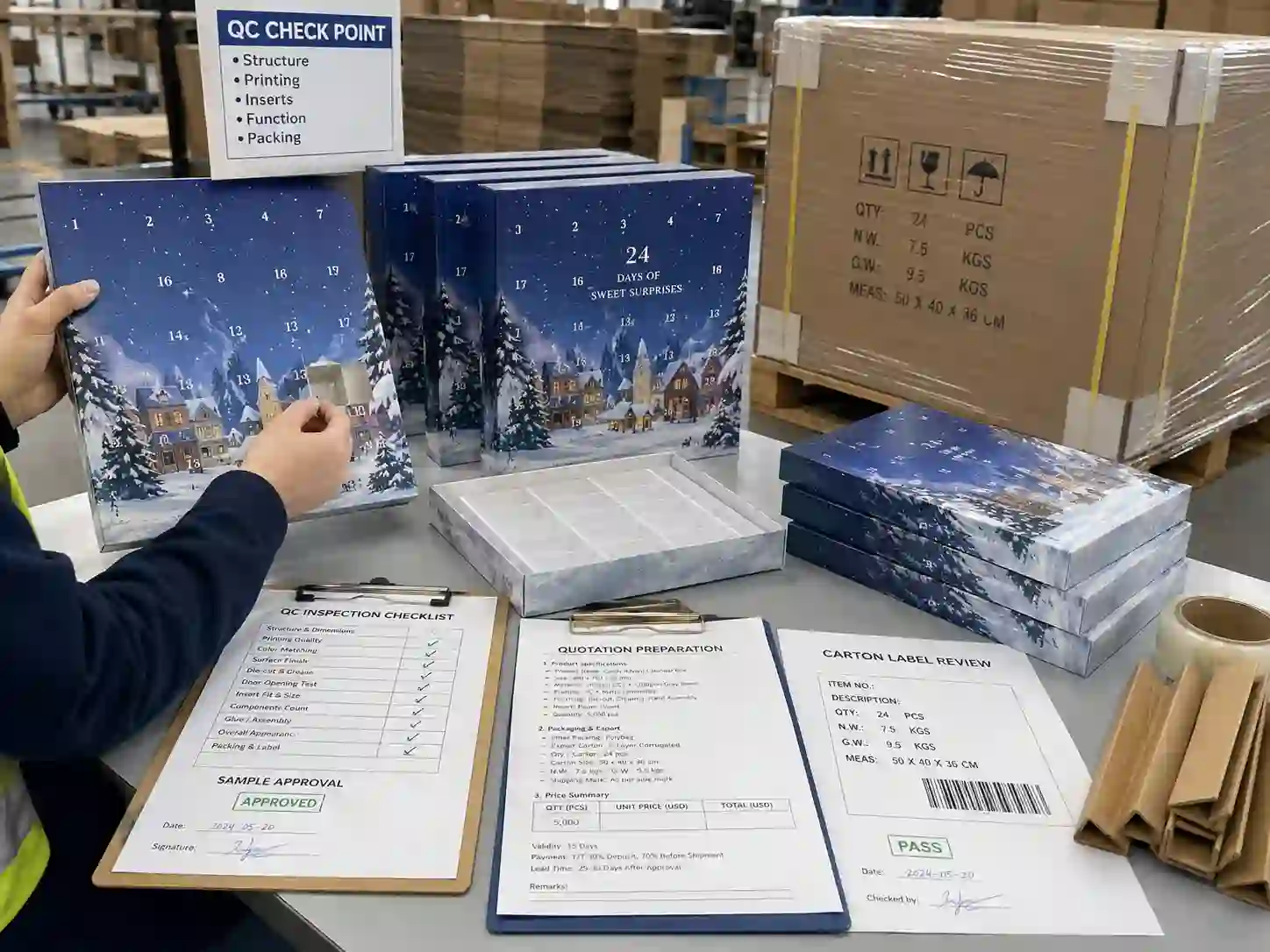
How should export packing be planned for candy calendar boxes?
Export packing should protect the finished calendar from compression, corner damage, moisture exposure, label confusion, and rough handling. The correct method depends on whether the boxes ship flat, semi-assembled, or fully assembled with inserts.
Flat packing can reduce shipping volume for folding carton structures, but it may shift assembly work to the buyer or co-packer. Fully assembled packing protects the retail-ready presentation but increases carton volume and may require stronger export cartons, corner protectors, pallet wrap, and better warehouse handling.
What should be printed on shipping marks and carton labels?
Shipping marks and carton labels should match the buyer’s logistics and warehouse instructions. Typical information includes item number, carton number, quantity, gross weight, net weight, carton size, destination, and handling marks if required.
QC tip: Carton labels should be checked before mass packing starts, not after all cartons are sealed. A label error can delay receiving, Amazon/e-commerce inbound processing, or retailer warehouse acceptance.
- Use strong export cartons sized for the loaded product weight.
- Avoid overpacking cartons so calendar doors and corners are not compressed.
- Use dividers, inner cartons, or protective wrapping when surface finishing is easily scratched.
- Add corner protectors and pallet wrap for palletized shipment where needed.
- Confirm pallet height and carton orientation with the buyer’s forwarder or warehouse.
- Keep shipping marks generic and compliant with the buyer’s routing guide.
Decision guide: how should buyers choose the right option?
Buyers should choose the option that balances brand positioning, candy protection, MOQ, retail channel, and production reliability. A premium structure is suitable when gift value matters, while a simpler structure may be better for high-volume campaigns with tight cost targets.
| Buyer Situation | Recommended Direction | Reason |
|---|---|---|
| Premium retail or corporate gift program | Rigid box or drawer box with paper insert or PET tray | Better presentation, stronger structure, and more space for finishing effects |
| Large-volume supermarket or promotional campaign | Folding carton door-opening calendar | Cost-efficient, retail-friendly, and suitable for large printed runs |
| Mixed candy sizes in one calendar | Custom insert with product-specific cavities | Reduces movement and improves presentation after shipping |
| E-commerce gift set with parcel delivery risk | Stronger outer box, tighter insert, and tested export carton | Improves resistance to compression, vibration, and handling damage |
| Buyer needs fast sample review | Start with blank prototype before printed sample | Confirms structure and insert fit before spending time on full artwork proofing |
Buyer tip: If you are comparing several suppliers, send the same RFQ file to each one. A quotation based on different board thickness, insert type, or packing method cannot be compared fairly.
What information should buyers prepare before requesting a quotation?
Buyers should prepare product dimensions, candy count, box style, insert preference, artwork requirements, order quantity, destination, packing method, timeline, and any retailer or compliance documents required for review. The more complete the RFQ, the more accurate the quotation will be.
Use this RFQ preparation checklist before contacting a factory:
- Outer box size target or product-size-based size requirement.
- Number of candy compartments and whether each compartment uses the same size.
- Real candy samples, photos, or exact dimensions including wrappers.
- Preferred structure: rigid box, folding carton, drawer box, door-opening box, or open to supplier suggestion.
- Insert choice: paper insert, PET tray, EVA, foam, molded pulp, or request factory recommendation.
- Artwork file status: ready dieline artwork, draft design, or need dieline first.
- Printing requirement: CMYK, Pantone, inside/outside printing, varnish, lamination.
- Finishing requirement: foil stamping, embossing, debossing, spot UV, window, ribbon, magnet, sleeve, or none.
- MOQ target and expected annual or seasonal order quantity.
- Sample requirement: blank prototype, printed sample, or pre-production sample.
- Destination country and any retailer, importer, or e-commerce packing requirements.
- Export packing preference: flat packed, semi-assembled, fully assembled, palletized, or carton-only shipment.
- Required quotation terms, payment terms, shipment term, and target delivery date.
You can read more practical packaging topics on the advent calendar box buying guides page, or learn about the Giftpackpro packaging factory before requesting project support.
What common mistakes should buyers avoid?
Buyers should avoid approving artwork before the dieline is final, using candy dimensions without wrapper allowance, comparing incomplete quotations, skipping loaded sample testing, and ignoring export carton strength. These mistakes are common because advent calendar packaging looks simple from the outside but depends on many hidden tolerances.
- Mistake 1: Starting with artwork before structure. The dieline should control artwork placement, not the other way around.
- Mistake 2: Measuring only the candy, not the wrapper. Wrapper tails, seams, and thickness can change the required compartment size.
- Mistake 3: Choosing inserts by appearance only. Insert performance should be tested with real products and handling movement.
- Mistake 4: Ignoring odor and moisture awareness. Candy packaging should be reviewed after being closed and stored, not only when freshly produced.
- Mistake 5: Comparing quotations with different specifications. A cheaper quote may use thinner board, simpler insert, fewer finishing steps, or weaker export packing.
- Mistake 6: Leaving shipping marks until the end. Warehouse labels, carton numbers, and pallet details should be confirmed before packing.
Quotable B2B statement: For seasonal candy packaging, the safest production plan is to approve the structure first, approve the loaded sample second, and approve the final artwork only after the dieline and insert are stable.
FAQ: buyer questions about candy advent calendar boxes
Can one advent calendar box hold different candy sizes?
Yes, but the insert and dieline must be designed around the largest dimensions of each wrapped candy. Mixed candy sizes usually require custom cavity planning, a paper insert with different openings, or a formed PET tray.
Are candy advent calendar boxes considered food-contact packaging?
It depends on whether the candy directly touches the box or insert. If candies are individually wrapped, the calendar may function as secondary packaging, but buyers should still verify material expectations, odor requirements, and any food-contact documentation needed for their market.
What is the best insert for individually wrapped candy?
Paper inserts are common for lightweight wrapped candy, while PET trays give more accurate cavity control. Molded pulp may fit paper-based packaging goals, but it requires sample testing for surface, fit, and product movement.
Can Giftpackpro make a sample before mass production?
Yes, a sample process can start with a blank prototype, printed sample, or pre-production sample depending on the project stage. Buyers should provide candy dimensions, structure preference, insert requirements, and artwork status before sample making.
How early should buyers start a seasonal candy packaging project?
Buyers should start early enough to allow for dieline design, blank sample review, printed sample approval, artwork revision, mass production, QC, export packing, and international shipping. Seasonal projects are less risky when sample approval is completed before the production window becomes tight.
What affects the MOQ for candy advent calendar boxes?
MOQ is affected by structure, material, printing method, finishing process, insert type, tooling, and assembly complexity. A standard folding carton may have a different MOQ from a rigid drawer box with custom tray and premium finishing.
What files are needed for printing?
Buyers usually need final artwork matched to the approved dieline, with bleed, safety margin, color instructions, barcode placement, and finishing layers clearly marked. For Pantone, foil stamping, embossing, or spot UV, separate process layers should be prepared.
How can buyers reduce shipping damage?
Buyers can reduce damage by using stronger export cartons, avoiding overpacked cartons, testing loaded samples, protecting corners, confirming pallet pattern, and checking shipping marks before mass packing. E-commerce projects may need more protective packing than retail pallet shipments.
Ready to plan candy advent calendar boxes for your campaign?
Before you request a custom quote, prepare candy dimensions, compartment count, preferred structure, insert direction, artwork status, order quantity, destination country, and packing requirements. Giftpackpro can then review whether your candy advent calendar boxes are better suited to a rigid box, folding carton, drawer box, or door-opening calendar structure, and help align the sample, MOQ, printing, QC, and export packing plan with your campaign schedule.
For buyers comparing suppliers, the most useful question is not only “What is the unit price?” but “Does this quotation include the structure, insert, sample approval, printing process, inspection standard, and export packing method that my project actually needs?”