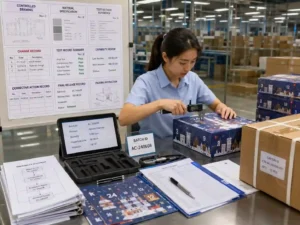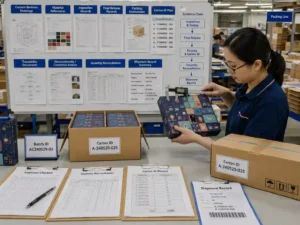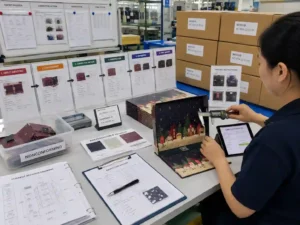
Quick answer: Perfume sample advent calendar boxes need more than attractive seasonal artwork. For B2B buyers, the key decisions are box structure, vial cavity tolerance, insert material, glass protection, printing finish, sample approval, QC standard, and export packing method. A good solution should hold small glass vials, mini atomizers, caps, and sample bottles firmly without crushing them or allowing movement during shipping. Before requesting a quotation, buyers should prepare product dimensions, filled weight, quantity, artwork direction, preferred structure, destination market, and packing requirements. This guide explains how to choose practical structures, inserts, and printing options for safer production and more reliable seasonal campaigns.
What should buyers understand before choosing perfume sample advent calendar boxes?
Buyers should understand that perfume sample advent calendar boxes are precision packaging projects, not standard paper gift boxes. The small size of fragrance vials, the fragility of glass, and the need for premium presentation make insert engineering as important as outer box design.
For brand owners, wholesalers, retail buyers, and packaging distributors, the first decision is not only how the calendar looks. It is whether the structure can protect each sample, support retail display, match the artwork plan, and survive export handling. A rigid box may create a premium unboxing experience, while a folding carton calendar may reduce unit cost and shipping volume. A drawer box can organize samples neatly, but it usually requires stronger insert planning to prevent movement inside each drawer.
Perfume packaging also has practical risks that cosmetics or chocolate calendars may not have. Glass vials can chip, caps can loosen, atomizers can leak, labels can rub against inserts, and small cavities can become too tight after mass production tolerance changes. These details should be reviewed during prototype and pre-production sample stages, not after bulk production has started.
Giftpackpro works as a custom advent calendar boxes manufacturer for B2B seasonal packaging projects, so the best results usually come when buyers share real product samples or exact bottle drawings before the dieline is finalized.
Which box structures work best for perfume sample advent calendars?
The best structure depends on product weight, retail price point, campaign quantity, assembly method, and shipping route. For perfume samples, rigid door-opening boxes, drawer boxes, and reinforced paperboard calendars are the most common B2B options because they can combine display value with controlled compartment design.
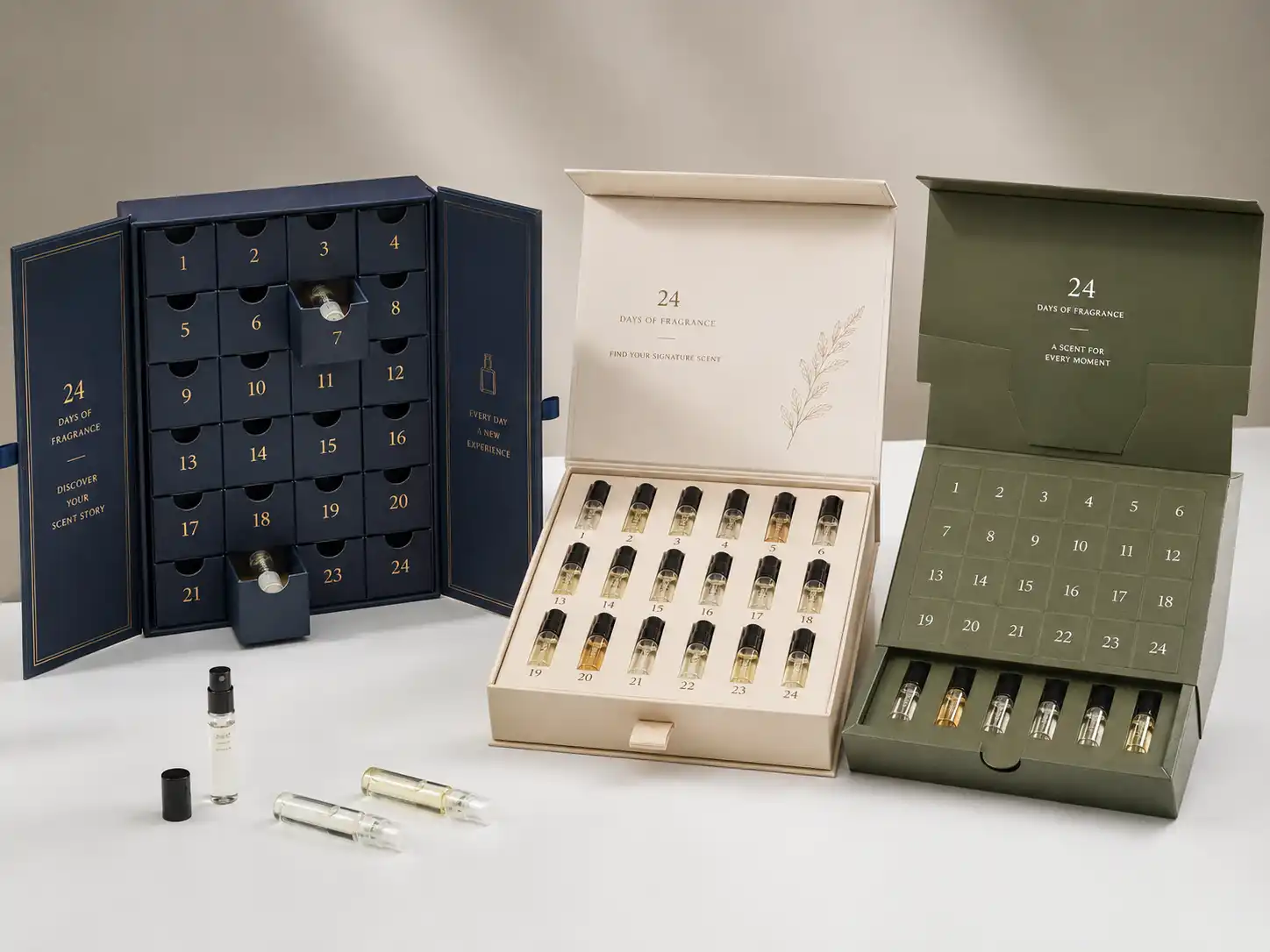
Rigid door-opening box: when premium presentation matters
A rigid door-opening box is often chosen for fragrance campaigns that need a luxury retail impression. The greyboard frame provides strength, and the front doors can create a gift-like opening experience. This structure works well for 12-day, 24-day, or custom-count calendars with small vials placed behind numbered doors or inside a secondary tray.
The buyer should check the hinge area, magnet position if used, door clearance, and insert support. If the box includes glass vials, the insert should prevent the vial from falling forward when a door is opened. A common mistake is designing attractive doors without checking how the sample can be removed by hand.
Drawer box: when organization and refill-style presentation are important
A drawer box is suitable when each perfume sample needs a separate compartment or when buyers want a collectible packaging style. It can use multiple small drawers, one large drawer with inner cavities, or a sleeve-and-drawer design.
For perfume samples, drawer resistance matters. Drawers that are too loose may slide during shipping; drawers that are too tight may damage artwork, foil stamping, or lamination during repeated opening. During sample approval, buyers should test drawer movement with filled vials, not empty mockups only.
Folding carton calendar: when cost and shipping efficiency matter
Folding carton perfume calendars are usually more economical than rigid boxes and can reduce shipping volume. They are useful for larger promotional quantities, e-commerce bundles, or entry-level seasonal campaigns.
The limitation is strength. Small doors, perforation lines, and paperboard panels must be designed carefully so that the box does not collapse when filled with glass vials. If the product is fragile or heavy, a folding carton may still work, but it often needs a strong paper insert, PET tray, or reinforced inner support.
Fold-out calendar: when visual display is part of the campaign
A fold-out structure can display multiple fragrance samples across panels. It is suitable for discovery sets, influencer kits, and retail counters where the open display matters.
The buyer should check panel balance, hinge strength, and whether the filled vials pull one side downward. For export orders, fold-out structures also need carton packing tests because wide panels and corners can be damaged if the master carton is not reinforced.
| Structure option | Best for | Perfume-specific concern | Buyer check before approval |
|---|---|---|---|
| Rigid door-opening box | Premium fragrance launches, luxury gift sets, retail display | Door clearance, glass vial support, magnet or ribbon placement | Open each door with filled samples and confirm vials do not fall out |
| Drawer box | Organized sample sets, refill-style discovery calendars, high perceived value | Drawer friction, insert movement, small cavity accuracy | Test drawer sliding after lamination, foil stamping, and final assembly |
| Folding carton calendar | Higher quantity promotions, cost-sensitive campaigns, lighter sample sets | Panel strength, door tear lines, compression resistance | Confirm paperboard thickness and inner support with product weight |
| Fold-out calendar | Discovery kits, counter display, campaign storytelling with multiple panels | Panel balance, hinge durability, edge protection | Check open display stability and export carton corner protection |
Buyer tip: Choose the structure after confirming product weight and vial size. A design that looks premium in a rendering may fail if the insert cannot hold the glass securely during courier or sea freight handling.
Which insert material should buyers choose for glass vials and mini atomizers?
The insert should hold each fragrance sample securely, protect glass edges, and keep the unboxing experience clean. Paperboard, PET tray, EVA insert, foam, and molded pulp can all work, but each option has different cost, appearance, tolerance, and sustainability considerations.
Paperboard insert: suitable for lightweight samples and recyclable presentation
Paperboard inserts are common for custom advent calendar boxes because they can be printed, folded, and integrated into the box structure. They are useful for lightweight vials, sachets, paper cards, and small sample tubes.
For perfume sample advent calendar boxes, paperboard inserts need accurate die-cut holes and enough friction to hold the vial. If the hole is too large, the vial moves. If it is too tight, the buyer may damage the cap or label when removing the sample. Paper inserts are often best when paired with a supporting base or secondary layer.
PET tray: suitable for accurate cavity shape and clear product positioning
A PET tray can provide more consistent cavities for small bottles, mini atomizers, and mixed-size perfume samples. It is useful when the buyer wants each product to sit in a molded cavity with a clean retail appearance.
The main considerations are tooling, surface scratching, material thickness, and whether the tray aligns with the printed doors. Buyers should request a tray sample with real bottles, because small variations in bottle shoulder, cap diameter, or spray head height can affect fit.
EVA insert: suitable for premium protection and stable product holding
EVA is often used when fragrance samples need stronger cushioning and a premium appearance. It can be cut into precise cavities and is especially useful for glass vials, mini bottles, droppers, or atomizers that should not move during shipping.
However, EVA can increase cost and may not match every brand’s sustainability preference. Buyers should also check odor, surface finish, color consistency, and whether the cavity edge leaves marks on labels or caps.
Foam insert: suitable for cushioning but needs surface review
Foam can protect fragile glass and reduce vibration during transport. It is practical for sampling kits, test shipments, or premium discovery sets that require cushioning.
For retail advent calendars, foam needs careful review because some foam surfaces can look less premium than paperboard or EVA. If foam is used, the buyer should confirm density, color, thickness, and whether the cavity keeps the product upright after repeated handling.
Molded pulp: suitable for sustainability-led projects with enough product tolerance
Molded pulp can be a good option when the buyer wants a fiber-based insert and a more natural packaging message. It works best when the product shape allows slightly larger cavity tolerance.
For very small perfume vials, molded pulp can be challenging because the cavity edge may not be as sharp as PET or EVA. Buyers should check whether the vial sits securely, whether the surface is smooth enough for premium presentation, and whether the pulp color matches the brand direction. For sustainability claims, buyers can review official resources such as FSC and confirm material documentation with the supplier instead of assuming all paper-based materials have the same certification status.
How should buyers compare insert options for perfume sample protection?
Buyers should compare inserts by product fit, protection level, appearance, cost, tooling need, and production tolerance. The lowest-cost insert is not always the lowest-risk option when the product is glass, filled, capped, and shipped internationally.
| Insert type | Protection level | Premium appearance | Typical cost impact | Best buyer use case |
|---|---|---|---|---|
| Paper insert | Medium for lightweight samples | Good when printed or cleanly folded | Low to medium | Promotional calendars with small vials and controlled weight |
| PET tray | Medium to high with accurate cavities | Clean and consistent | Medium, with possible tooling | Mixed perfume sample sizes that need molded positioning |
| EVA insert | High | Premium, especially for rigid boxes | Medium to high | Glass vials, mini atomizers, and high-value discovery sets |
| Foam insert | High cushioning | Depends on surface and density | Medium | Fragile samples or projects requiring extra shock absorption |
| Molded pulp | Medium, depending on cavity design | Natural and sustainable-looking | Medium, often tooling-based | Eco-focused projects with enough cavity tolerance |
Factory tip: For small fragrance vials, ask the supplier to check cavity tolerance using the real filled sample, cap, label, and spray head. Testing only the glass tube body can lead to incorrect fit because the cap is often the widest or tallest part.
What perfume-sample fit issues should be tested before mass production?
Fit testing should confirm that every vial or atomizer stays secure, can be removed by hand, does not leak under normal handling, and does not damage the printed box or insert. This is one of the most important approval steps for perfume sample advent calendar boxes.
Small-cavity tolerance is a major issue. Paperboard thickness, lamination, glue, tray forming, die-cut pressure, and hand assembly can all create small changes between prototype and mass production. A 1 mm difference can be noticeable when the product is a tiny glass vial.
- Vial diameter: Measure the widest point, including label and cap, not only the glass body.
- Vial height: Check whether the bottle sits below the door or panel without pressing against it.
- Cap security: Shake and tilt the sample to confirm the cap does not loosen inside the cavity.
- Leakage concern: Confirm that filled samples are sealed before packing and that the insert does not press on the spray head.
- Removal space: Add finger access or a notch when the cavity is tight.
- Mixed SKU layout: Separate heavier bottles from weaker door areas or unsupported corners.
- Label rubbing: Check whether printed vial labels scratch against PET, EVA, foam, or paper edges.
QC tip: A perfume calendar sample should be tested in several positions: flat, upright, tilted, and inside the export carton. If samples only look good on a factory table, the test is not complete.
How do dieline and compartment layout affect production risk?
The dieline controls box size, door position, insert placement, folding lines, glue areas, and sample access. A good dieline reduces assembly problems and prevents the product from pushing against weak paperboard areas.
For perfume sample calendars, the layout should start with the product map. Buyers should provide the exact number of fragrance samples, each item size, and whether the calendar includes extra items such as scent cards, paper sleeves, blotter strips, or mini brochures. The packaging supplier can then arrange cavity spacing, door size, and internal support.
Door-opening calendars need accurate alignment between the printed door and the insert cavity. If the door is too small, the buyer cannot remove the sample easily. If the door is too large, the structure may lose strength. Drawer calendars need enough clearance for drawer movement after printing, wrapping, and lamination. Rigid boxes need greyboard thickness and wrapping paper allowance included in the final dieline.
Buyers reviewing custom advent calendar box products should compare not only shape and appearance, but also whether the dieline is practical for their specific sample sizes and packing method.
Which printing and finishing choices work best for fragrance campaigns?
Printing and finishing should support the brand’s premium positioning while staying compatible with the selected structure and material. For perfume sample advent calendar boxes, common options include CMYK printing, Pantone color matching, foil stamping, embossing, spot UV, matte lamination, and gloss lamination.
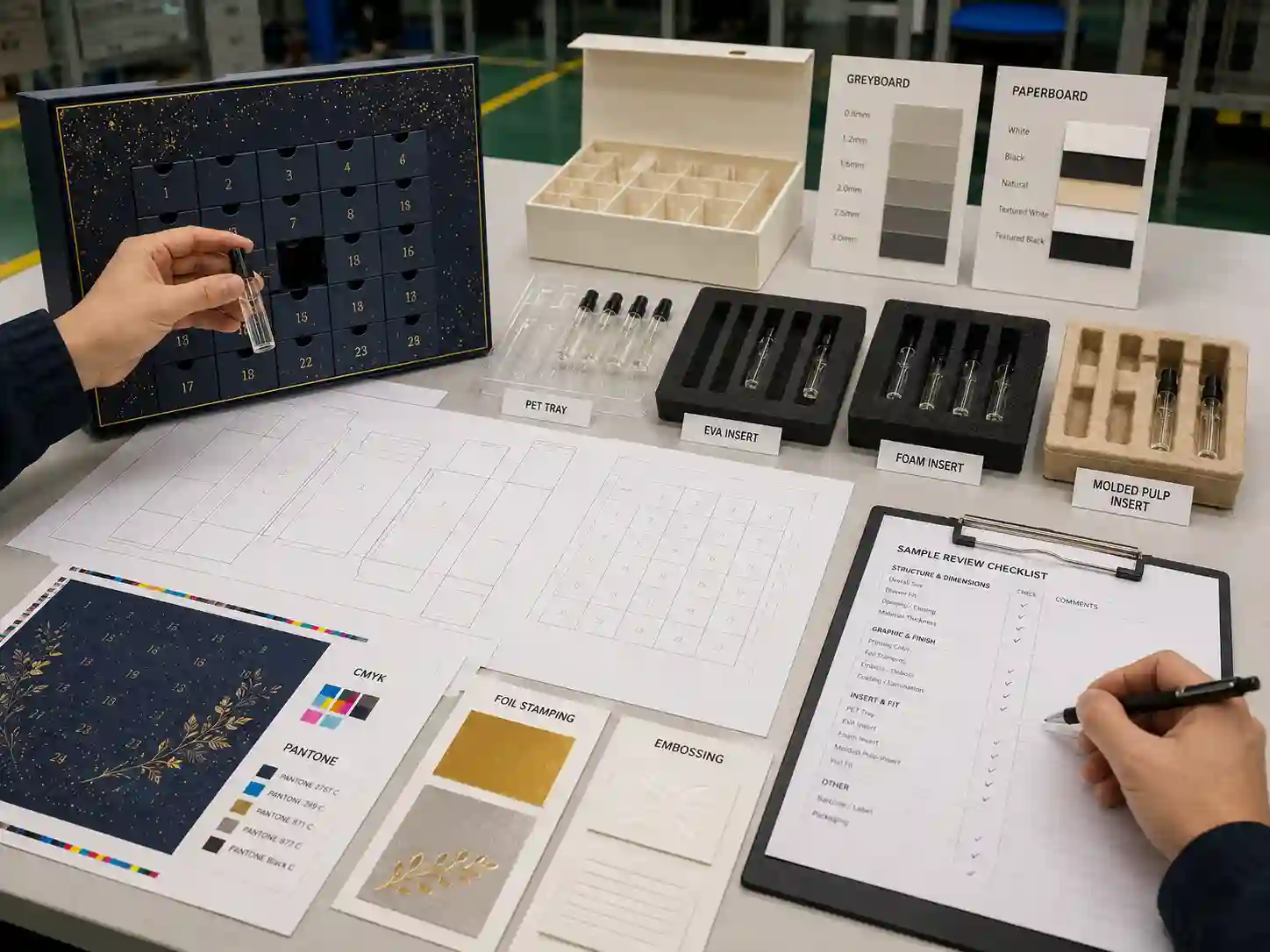
CMYK and Pantone: how should buyers control color?
CMYK is suitable for full-color artwork, gradients, product illustrations, and campaign graphics. Pantone is useful when the brand needs a more controlled solid color, especially for signature tones, seasonal collection colors, or premium minimalist designs.
Buyers should request a digital proof for layout and a printed proof or color reference for important color decisions. Screen color is not enough for final approval. Paper material, lamination, and foil stamping can all change the final visual effect.
Foil stamping, embossing, and spot UV: when should they be used?
Foil stamping works well for fragrance packaging because it creates a premium highlight on logos, numbers, borders, or seasonal details. Embossing can add a tactile effect to doors or cover panels. Spot UV can highlight patterns or product names while keeping the rest of the surface matte.
The buyer should avoid placing delicate foil lines too close to fold lines, door perforations, or drawer edges. During repeated opening, these areas receive more friction. If the project uses small numbered doors, the supplier should check whether foil stamping registration is stable enough for the door layout.
Matte or gloss lamination: which is better?
Matte lamination is often preferred for premium perfume calendars because it reduces glare and gives a soft-touch visual impression. Gloss lamination can make colors brighter and is useful for more vibrant promotional campaigns.
However, lamination affects folding, drawer movement, glue adhesion, and surface scratch resistance. Buyers should approve a sample with the final lamination, not only printed paper. This is especially important for drawer boxes and door-opening boxes where surfaces touch during use.
Buyer tip: When requesting custom advent calendar box services, send the artwork file, Pantone references, finishing expectations, and any brand color tolerance requirements at the beginning. Late finishing changes can affect dieline, sampling time, and quotation accuracy.
What sample approval process should B2B buyers follow?
Buyers should approve perfume calendar packaging in stages: dieline review, white sample, printed sample, insert fit sample, and pre-production sample. This process helps catch structure, artwork, and product-fit issues before mass production.
A white sample checks shape, size, opening method, insert position, and product fit without final printing. A printed sample checks artwork, color, finishing, lamination, numbering, barcode placement, and overall presentation. A pre-production sample should match the final approved material, structure, insert, printing, and packing method as closely as possible.
- Share product details: Provide dimensions, weight, filled sample photos, cap type, and product quantity.
- Review dieline: Check size, door position, drawer clearance, insert cavities, glue areas, and bleed.
- Approve white sample: Test real vials in the cavities and check hand removal.
- Approve artwork proof: Confirm CMYK, Pantone, foil stamping, embossing, spot UV, text, and numbering.
- Approve printed sample: Review color, finishing, structure, and product fit together.
- Confirm packing method: Check inner protection, export carton size, carton label, and shipping marks.
- Release mass production: Only start bulk production after sample approval notes are clear.
Quotable B2B statement: A fragrance advent calendar should not enter mass production until the buyer has tested real filled samples inside the final insert structure, because glass protection and cavity tolerance cannot be confirmed from artwork alone.
How do MOQ, lead time, and cost drivers affect the project?
MOQ, lead time, and cost depend on structure, size, material, insert type, printing finish, tooling, assembly complexity, and order quantity. Perfume sample calendars often need more planning time than simple folding boxes because insert testing and sample approval are more detailed.
Rigid boxes usually have higher unit cost and longer assembly time than folding carton calendars. EVA inserts, PET trays, and molded pulp may require additional tooling or sample adjustment. Foil stamping, embossing, special lamination, and complex door layouts can also affect production schedule.
Buyers should avoid asking for a final price with only a reference photo. A supplier can provide a rough estimate, but an accurate quotation requires dimensions, material preference, insert type, printing requirements, order quantity, and packing method. For seasonal campaigns, the safest approach is to confirm packaging development early enough to allow time for prototype revisions.
| Cost driver | Why it matters | How buyers can control it |
|---|---|---|
| Box structure | Rigid boxes, drawers, and fold-out designs require different material and labor levels | Choose the simplest structure that still protects the product and supports the campaign |
| Insert material | EVA, PET, foam, paperboard, and molded pulp have different tooling and processing needs | Compare fit, protection, and cost with real product samples |
| Printing finish | Foil stamping, embossing, spot UV, and lamination add process steps | Use premium finishes on key visible areas instead of every surface |
| Assembly complexity | Many small doors, drawers, and compartments increase labor and QC time | Confirm layout efficiency during dieline review |
| Export packing | Fragile glass samples require stronger carton and inner protection | Confirm carton size, pallet plan, and shipping marks before production closes |
What QC points matter most for perfume sample advent calendar boxes?
QC should focus on structure accuracy, insert fit, printing quality, assembly consistency, product security, and export carton protection. Because perfume samples are small and fragile, inspection should include both appearance checks and functional fit checks.
During final inspection, the supplier should compare bulk production against the approved sample. Key checks include box dimensions, door opening, drawer movement, glue strength, paper wrapping, color consistency, foil stamping position, embossing effect, spot UV registration, insert cavity accuracy, and carton labeling.
- Check whether each vial cavity matches the approved sample tolerance.
- Confirm that caps, spray heads, and labels are not pressed by doors or inserts.
- Review whether doors open cleanly without tearing the wrong area.
- Test drawer movement after final lamination and assembly.
- Inspect foil stamping, embossing, and spot UV alignment on numbered areas.
- Check glue marks, paper wrinkles, corner damage, and surface scratches.
- Confirm carton label, shipping marks, quantity per carton, and pallet information.
QC tip: For export orders, inspect both the individual calendar box and the master carton. A beautiful retail box can still arrive damaged if the export carton, corner protectors, or pallet wrap are not suitable for the shipping route.
How should export packing be planned for fragile fragrance samples?
Export packing should protect both the outer calendar box and the glass samples inside. Buyers should define carton strength, inner packing, corner protection, pallet method, shipping marks, and carton label information before mass production is completed.
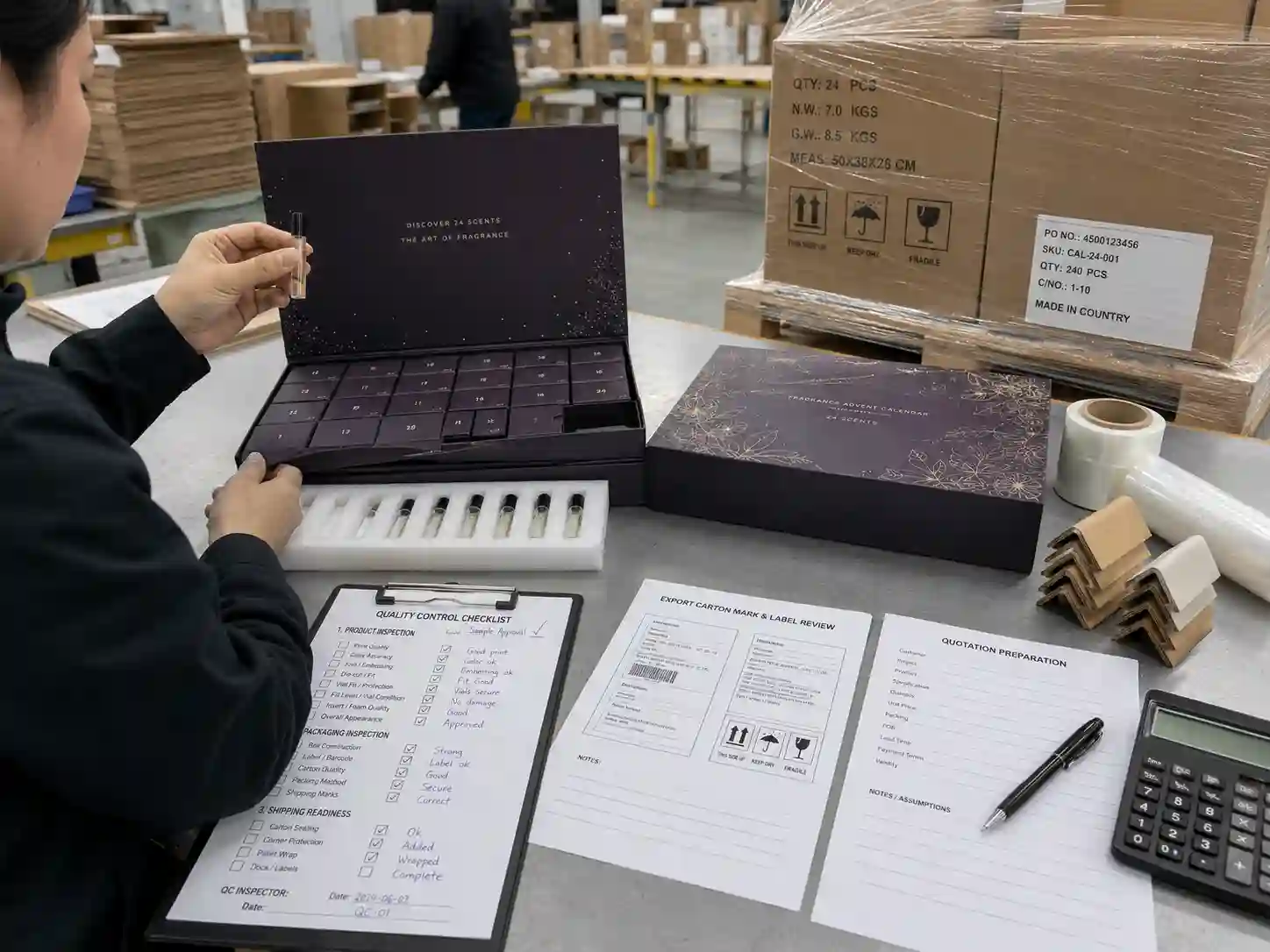
For perfume sample advent calendar boxes, the packaging supplier should consider product weight distribution inside the master carton. If all glass vials are positioned on one side of the calendar, the carton may need extra attention to stacking direction. Inner cartons, poly bags, tissue, corner protectors, or protective paper may be used depending on the surface finish and transport risk.
For larger export shipments, buyers may also review transit testing expectations with their logistics team. Standards and test methods vary by market and shipping route, so buyers can consult official resources such as the International Safe Transit Association when defining testing requirements with suppliers and freight partners.
Shipping marks should be generic, accurate, and aligned with the buyer’s logistics instructions. Carton labels may include item number, PO number, carton quantity, gross weight, net weight, carton size, destination, and handling symbols where required.
How should buyers compare perfume advent calendar suppliers?
Buyers should compare suppliers by packaging engineering ability, sample quality, communication clarity, insert testing method, QC process, export packing experience, and quotation transparency. The lowest unit price is not always the best value if the supplier cannot control small-cavity tolerance or fragile product protection.
A practical supplier should be able to discuss greyboard thickness, paperboard grade, dieline adjustment, insert material options, artwork proofing, sample approval notes, mass production schedule, and final inspection criteria. Buyers should also ask whether the supplier can work from real samples, CAD drawings, or product measurement sheets.
When reviewing the Giftpackpro packaging factory, buyers can evaluate whether the factory-side process matches their purchasing needs: structure development, sampling, printing coordination, insert testing, assembly inspection, and export packing support.
Supplier comparison questions
- Can the supplier recommend insert options based on actual vial size and filled weight?
- Can they provide a white sample before final printed sampling?
- Do they check artwork against dieline, bleed, fold lines, door positions, and finishing areas?
- Can they explain MOQ differences between rigid box, folding carton, drawer box, and molded tray options?
- Do they provide pre-production sample approval before mass production?
- Can they support export carton labeling, pallet packing, and shipping marks?
- Is the quotation clear about material, size, printing, insert, packing, sample cost, and lead time?
What should buyers prepare before requesting a quotation?
Buyers should prepare product, structure, artwork, quantity, market, and packing details before requesting a quotation. The more complete the RFQ information, the more accurate the supplier’s price, sample plan, and lead time estimate will be.
For Giftpackpro, buyers can use the following checklist before they request a custom quote:
- Product details: vial size, cap size, filled weight, sample quantity, bottle photos, and whether real samples can be sent.
- Calendar layout: 7-day, 12-day, 24-day, 25-day, or custom compartment count.
- Preferred structure: rigid box, drawer box, door-opening box, folding carton, or fold-out calendar.
- Insert preference: paper insert, PET tray, EVA insert, foam, molded pulp, or supplier recommendation.
- Artwork requirements: CMYK, Pantone, foil stamping, embossing, spot UV, matte lamination, gloss lamination, and barcode area.
- Order details: target quantity, MOQ expectations, destination country, launch date, and required delivery window.
- Packing requirements: units per export carton, carton marks, pallet requirement, Amazon or retail routing instructions if applicable.
- Approval process: who approves dieline, sample, color, insert fit, pre-production sample, and final packing.
Decision guide: If the project is premium and glass-heavy, start with a rigid box plus EVA or PET insert. If the project is high quantity and cost-sensitive, compare a reinforced folding carton with paperboard or PET insert. If sustainability presentation is central, test paperboard or molded pulp early because small perfume vial tolerance may need more development time.
What common mistakes should buyers avoid?
Buyers should avoid choosing perfume sample calendar packaging based only on appearance, reference photos, or a low quotation. Most problems happen when product fit, insert testing, and export packing are considered too late.
- Approving artwork before product fit: The dieline may change after insert testing, which can affect artwork and numbering.
- Using empty bottles for all tests: Filled samples are heavier and may behave differently during handling.
- Ignoring cap diameter: The cap or spray head may be wider than the vial body.
- Forgetting finger access: A tight cavity can make the sample difficult to remove.
- Overusing premium finishes: Foil, embossing, and spot UV should be planned around fold lines and door openings.
- Comparing quotations without specifications: Two prices may include different greyboard, insert material, printing, carton packing, or sample terms.
- Leaving shipping marks until the end: Carton labels and export marks should be confirmed before packing starts.
FAQ: What do buyers ask about perfume sample advent calendar boxes?
What is the best insert for perfume sample advent calendar boxes?
There is no single best insert for every project. EVA and PET trays usually provide stronger cavity control for glass vials, while paperboard inserts can be cost-effective for lighter samples. Molded pulp may work for sustainability-led projects, but it should be tested carefully for small vial tolerance.
Can one calendar hold different vial and atomizer sizes?
Yes, but the layout must be designed around each product size. Mixed sizes may require different cavity shapes, added finger notches, or separate insert layers to prevent movement and improve presentation.
How early should buyers start sampling?
Buyers should start sampling early enough to allow dieline adjustment, insert testing, artwork proofing, printed sample approval, and pre-production confirmation. Seasonal fragrance campaigns should not leave packaging development until the final purchasing stage.
What affects MOQ for custom perfume calendars?
MOQ is affected by structure, material, printing, finishing, insert type, tooling, and production setup. Rigid boxes, special inserts, molded trays, and complex finishes may have different MOQ requirements from simple folding cartons.
How can buyers reduce leakage risk?
The packaging supplier can reduce pressure on caps and spray heads through better cavity design, but leakage control also depends on the perfume filling and closure quality. Buyers should test filled and sealed samples inside the final insert before mass production.
What files are needed for artwork production?
Buyers usually need editable artwork based on the final dieline, with bleed, CMYK or Pantone information, finishing layers, barcode position, and text converted or packaged correctly. The supplier should check the file before printing proof approval.
How can Giftpackpro support a custom perfume calendar project?
Perfume sample advent calendar boxes require structure planning, insert testing, printing coordination, sample approval, QC, and export packing control. Giftpackpro can help B2B buyers compare structures, develop dielines, test paperboard, PET, EVA, foam, or molded pul