
Quick answer: Beauty advent calendar boxes are custom gift packaging solutions used to organize mixed beauty, skincare, makeup, fragrance, and cosmetic items into a retail-ready seasonal set. For B2B buyers, the most important decisions are structure, insert fit, material strength, printing method, finishing control, sampling process, MOQ, QC, and export packing. A strong project starts with product dimensions, SKU weights, artwork files, retail channel requirements, and target budget. The best supplier should help check the dieline, test inserts, control color proofing, protect fragile palettes or mini bottles, and prepare cartons for international shipment.
What should buyers understand before ordering beauty advent calendar boxes?
Buyers should understand that beauty gift set packaging is not only a printed box; it is a complete structure, insert, decoration, assembly, and export-packing project. The box must display well, hold mixed SKUs securely, protect fragile items, and match the brand’s visual standard across sampling and mass production.
Beauty sets often combine different product shapes: compact palettes, tubes, jars, mini bottles, brushes, sachets, lip products, fragrance samples, and skincare samples. These items do not load into a box evenly. Some are fragile, some are heavy, some are tall and narrow, and some need a smooth reveal when a door or drawer is opened. That is why a buyer should confirm product dimensions and packaging goals before choosing a rigid box, folding carton, drawer box, or door-opening box.
For overseas buyers, the purchasing risk usually appears in four places: poor insert fit, color mismatch, finishing defects, and weak export packing. A good project workflow includes dieline checking, sample approval, artwork proofing, pre-production confirmation, production QC, and carton packing review.
Giftpackpro works as a custom advent calendar boxes manufacturer for B2B buyers that need packaging built around product size, campaign timing, retail presentation, and export shipment requirements.
Which box structures work best for beauty gift sets?
The right structure depends on product count, weight, retail display method, opening experience, assembly cost, and shipping strength. For beauty advent calendar boxes, the most common options are rigid door-opening boxes, rigid drawer boxes, folding carton calendars, book-style boxes, and hybrid paperboard structures.
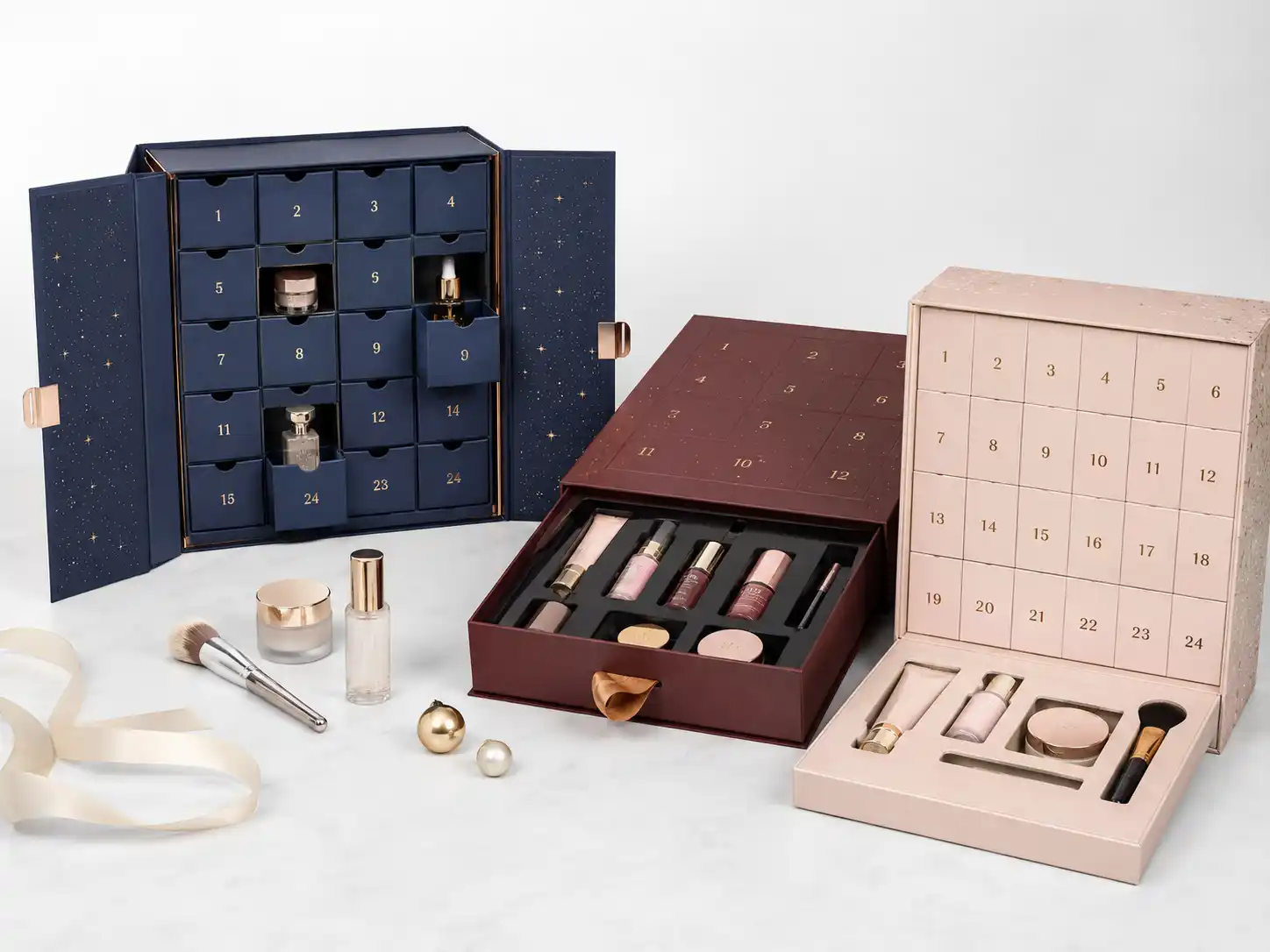
| Structure option | Best for | Buyer advantage | Watch points |
|---|---|---|---|
| Rigid door-opening box | Premium beauty gift sets, influencer kits, retail display campaigns | Strong presentation, good perceived value, supports foil stamping and embossing | Higher material and labor cost; needs accurate door and compartment alignment |
| Rigid drawer box | Makeup, skincare, mini bottle, and mixed sample sets | Smooth unboxing, good protection, suitable for heavier gift sets | Drawer clearance must be tested after lamination and wrapping |
| Folding carton calendar | Lighter beauty samples, promotional sets, larger quantity campaigns | Lower unit cost, efficient flat shipping before assembly, flexible printing | Less premium than rigid boxes; board thickness and lock design matter |
| Book-style box | Retail shelf display, PR presentation, gift-with-purchase campaigns | Clear front-facing story and strong opening experience | Magnet position, hinge strength, and insert height must be controlled |
| Hybrid paperboard structure | Custom promotional sets with unusual product layouts | Can balance budget, display space, and product protection | Requires more early sampling to avoid assembly problems |
Buyer tip: Do not select the structure from appearance only. A beauty calendar with 24 small products may look simple, but mixed SKU depth, bottle weight, palette fragility, and insert tolerance can change the best box structure.
How should inserts be designed for mixed beauty SKU sizes?
Inserts should be designed around real product samples, not only spreadsheet dimensions. Beauty products often have caps, pumps, rounded jars, mirror lids, or fragile pressed-powder palettes that need extra tolerance and support.
Common insert options include paper insert, PET tray, EVA insert, foam, and molded pulp. Paper inserts are cost-effective and recyclable in many markets, but they need good folding and locking design. PET trays offer clear formed cavities for cosmetic bottles and jars. EVA and foam provide better cushioning for fragile palettes or glass mini bottles, but buyers should review material appearance, smell, thickness, and market expectations. Molded pulp can support sustainability positioning, but the texture, color, and precision should be approved by sample.
For beauty gift sets, insert testing should include shake testing, door opening, drawer sliding, repeated product removal, and visual inspection after loading. A product that looks secure when flat may move during air or sea shipment if the insert height is too shallow.
Which insert details should buyers confirm?
Buyers should confirm cavity size, product loading direction, finger notch position, product visibility, insert color, material thickness, and whether products are loaded by hand or machine. If the set includes fragile palettes, the insert should support the corners and avoid pressure on powder pans or mirror areas.
- Confirm exact product size including cap, sleeve, outer carton, or seal label.
- Separate heavy bottles from delicate items where possible.
- Use finger notches for products that buyers must remove easily.
- Check whether the insert hides important product information or shade names.
- Test whether products remain stable when the calendar is tilted or shipped.
Factory tip: For mixed beauty sets, send the supplier physical product samples whenever possible. Digital dimensions are useful for the first dieline, but final insert approval is safer when the factory can test real product fit.
How do printing choices affect the final look of beauty advent calendar boxes?
Printing controls the first visual impression of beauty advent calendar boxes, especially for retail shelves, influencer campaigns, and e-commerce product photos. Buyers should decide early whether the artwork depends on CMYK process printing, Pantone spot colors, metallic effects, or special finishing.
CMYK is suitable for full-color designs, gradients, product illustrations, and seasonal graphics. Pantone is useful when a brand color must remain consistent across the box, insert, sleeve, belly band, and retail display materials. However, Pantone matching can still vary slightly depending on paper, lamination, ink coverage, and production conditions.
Beauty packaging often uses soft neutrals, pastel shades, metallic accents, or high-contrast holiday campaign colors. These colors can shift after matte lamination, gloss lamination, foil stamping, or spot UV. Buyers should not approve final production only from a screen image. A printed proof or physical sample is the safer reference.
When should buyers use CMYK, Pantone, or both?
Use CMYK when the design has many colors or photographic artwork. Use Pantone when brand color consistency is more important than artwork complexity. Use both when the calendar needs full artwork plus one or two controlled brand colors.
| Printing method | Practical use | Buyer check |
|---|---|---|
| CMYK printing | Full-color seasonal artwork, illustrations, gradients, lifestyle graphics | Check image resolution, total ink coverage, and color shift after lamination |
| Pantone spot color | Brand color, solid background, campaign color, logo panel | Approve on the final paper material, not only on a digital screen |
| CMYK plus Pantone | Premium beauty packaging with artwork and controlled brand colors | Confirm color separation, proofing cost, and production tolerance |
For buyers preparing artwork, it is helpful to follow structured barcode and label planning when retail cartons or product labels need scannable codes. Official barcode guidance can be reviewed through GS1 barcode standards.
Which finishing options create a premium beauty gift set presentation?
Finishing should support the brand image and product positioning without creating unnecessary production risk. The most common premium options are matte lamination, gloss lamination, foil stamping, embossing, debossing, spot UV, textured paper, and specialty coating.
Matte lamination gives a soft, premium surface and is common for beauty and skincare packaging. Gloss lamination increases shine and color contrast, which can suit bold promotional designs. Foil stamping is useful for logos, date numbers, borders, icons, and campaign highlights. Embossing or debossing adds tactile detail, but it requires enough paper thickness and accurate tooling. Spot UV can highlight selected artwork areas, but registration must be controlled carefully.
Finishing cost is driven by material area, tooling, registration complexity, number of processes, and production speed. A full foil background, multiple embossing zones, and spot UV on small details can increase cost and defect risk. For many B2B beauty projects, a controlled combination works better: matte lamination plus foil logo, or Pantone background plus embossed date numbers.
How should buyers avoid finishing problems?
Buyers should request a sample or proof that shows the actual finishing combination on the selected material. Finishing defects often appear as foil breaks, uneven embossing, surface scratches, glue marks, or spot UV misregistration.
- Keep very thin foil lines away from deep folds and box edges.
- Allow enough spacing between embossed details and die-cut openings.
- Confirm whether matte lamination may reduce color brightness.
- Use spot UV on clear highlight areas, not overly small text.
- Review finishing under practical retail lighting, not only bright studio light.
QC tip: Premium finishing should be checked at the sample stage and again during mass production. A beautiful prototype does not protect the buyer if the production tolerance is not defined before bulk manufacturing.
What artwork files and dieline checks are needed before sampling?
Before sampling, buyers should prepare editable artwork, dieline requirements, product dimensions, insert layout, printing notes, and finishing instructions. A clear artwork package reduces delays, proofing mistakes, and unexpected sample revisions.
The dieline should show cut lines, crease lines, glue areas, door positions, drawer direction, insert cavities, bleed, safe zones, and any special finishing layer. Artwork should usually include bleed, high-resolution images, outlined fonts, linked images, color references, and separate layers for foil stamping, embossing, spot UV, or die-cut areas.
For multi-door beauty calendars, number placement is especially important. Door numbers should remain readable after cutting and folding. If a door contains a palette or bottle, the opening direction should not force the product to fall out. When the artwork includes a full front pattern, the factory should check whether the pattern continues correctly across doors, drawers, panels, and wrapped edges.
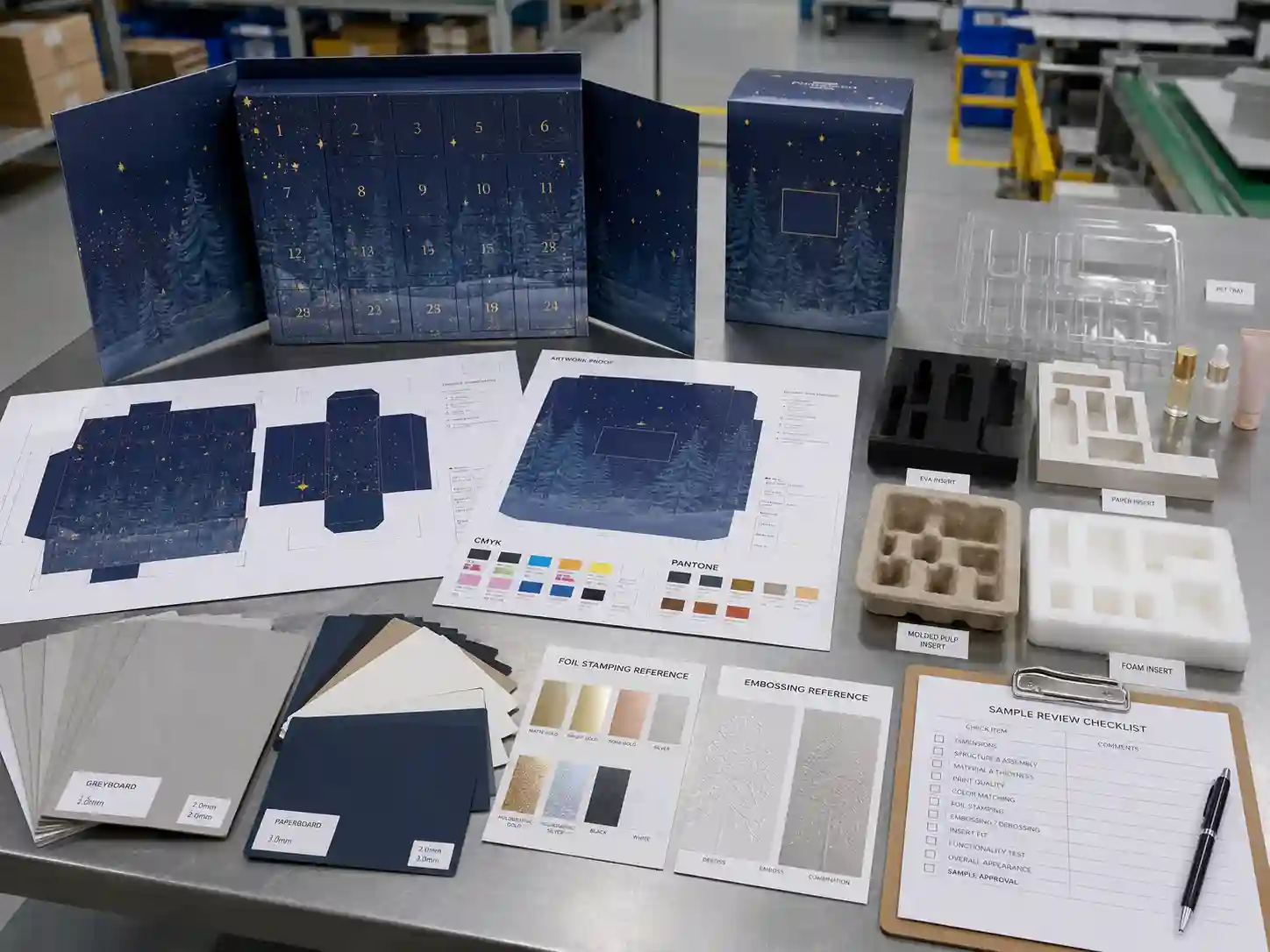
Practical artwork checklist for buyers
- Final box size and structure confirmed.
- All product dimensions checked, including caps and secondary packaging.
- Dieline version number clearly marked.
- Bleed and safe margins added to all panels.
- Fonts outlined or supplied correctly.
- CMYK and Pantone colors labeled clearly.
- Foil stamping, embossing, debossing, and spot UV layers separated.
- Barcode, ingredient label, recycling mark, or shipping mark areas reserved if needed.
- Insert layout checked against product loading order.
- Retail channel or e-commerce photo requirements reviewed.
Giftpackpro’s custom advent calendar box services include structure discussion, material option review, dieline support, sample development, and production coordination for B2B gift packaging projects.
How should buyers compare material options?
Material selection should balance appearance, strength, budget, sustainability goals, and export performance. For beauty gift set advent calendar packaging, the most common materials include paperboard, greyboard, coated paper, specialty paper, PET, EVA, foam, and molded pulp.
Rigid boxes usually use greyboard wrapped with printed paper or specialty paper. Folding carton boxes use paperboard with direct printing and finishing. Inserts can be made from folded paperboard, formed PET, EVA, foam, or molded pulp depending on the product type and presentation requirement. If sustainability claims are important, buyers should verify documentation instead of assuming that one material is always better. FSC-related sourcing information can be checked through the official Forest Stewardship Council website when certified paper is requested.
Material choices affect MOQ and lead time because certain paper colors, board thicknesses, specialty textures, and insert materials may require supplier sourcing or minimum purchasing quantities. Buyers should ask whether the selected material is standard, custom-ordered, or subject to seasonal availability.
What sampling process should brands expect before mass production?
A reliable sampling process usually includes a white sample, printed sample, and sometimes a pre-production sample. Each sample has a different purpose, and skipping the wrong one can increase mass production risk.
A white sample checks structure, size, opening function, insert fit, and product loading. It may not show final printing. A printed sample checks artwork layout, color direction, lamination, foil stamping, embossing, and visual presentation. A pre-production sample is used as the final reference before mass production, especially when the project has strict retail or influencer campaign requirements.
For beauty sets, buyers should load real products into the sample and test basic handling. Open every door, slide every drawer, remove products repeatedly, check whether fragile palettes are under pressure, and confirm whether bottles or tubes shift when the box is tilted.
Sample approval checklist
- Confirm outer box dimensions and weight after product loading.
- Check all insert cavities with real products.
- Review printing color under normal office, warehouse, and retail-style lighting.
- Inspect foil stamping, embossing, spot UV, lamination, and edge wrapping.
- Test opening function for doors, drawers, magnets, ribbons, or locks.
- Confirm carton packing method and estimated units per export carton.
- Approve a signed or clearly documented sample reference before bulk production.
Quotable B2B statement: A beauty advent calendar sample should not be approved only for appearance; it should be approved for loaded product fit, opening function, finishing tolerance, and export-packing logic.
How do MOQ, cost, and lead time change by packaging choice?
MOQ, cost, and lead time depend on structure complexity, material sourcing, insert type, printing process, finishing steps, and assembly labor. A simple folding carton calendar generally has a different cost base from a rigid drawer box with EVA insert, foil stamping, and embossed panels.
Major cost drivers include box size, board thickness, paper type, number of compartments, insert material, printing colors, Pantone use, foil area, embossing tooling, hand assembly, packing method, and order quantity. Lead time may increase when buyers need custom paper, multiple samples, complex tooling, or several rounds of artwork revisions.
Buyers should avoid asking only for the lowest unit price without defining the packaging requirement. A low quotation may exclude insert testing, premium finishing, strong export cartons, or proper sample revision. For retail beauty campaigns, these missing details can become more expensive than the initial saving.
Decision guide: how should buyers choose the right specification?
| Buyer priority | Recommended direction | Reason |
|---|---|---|
| Premium retail presentation | Rigid door-opening box or drawer box with matte lamination and foil stamping | Creates stronger shelf impact and gift value perception |
| Cost-controlled promotional campaign | Folding carton with paper insert and CMYK printing | Balances visual effect, lower material cost, and scalable production |
| Fragile palettes or glass mini bottles | Rigid box with EVA, foam, PET, or reinforced paper insert | Improves product stability and reduces movement during shipment |
| Eco-focused positioning | Paperboard, paper insert, molded pulp, and verified paper sourcing | Supports sustainability messaging when documentation is available |
| Influencer or PR presentation | Book-style or drawer structure with controlled finishing and clean product reveal | Looks better in photos, videos, and unboxing content |
What QC points matter most for beauty advent calendar boxes?
QC should check structure, printing, finishing, insert fit, assembly, cleanliness, product loading, and export packing. Beauty packaging has a low tolerance for visible defects because buyers often use it for retail, social content, and premium gift presentation.
Important inspection points include color consistency, glue marks, scratches, crushed corners, misaligned doors, loose drawers, poor magnet strength, uneven foil stamping, embossing defects, spot UV registration, lamination bubbles, insert deformation, and carton damage. For mixed SKU beauty sets, loaded-product inspection is especially important because empty-box inspection cannot confirm whether the product set will survive handling and shipment.
Final inspection should compare production units with the approved sample. If the buyer has strict color requirements, the approved color proof or signed pre-production sample should be used as the reference. For export orders, carton labels, shipping marks, pallet layout, and packing list details should also be checked before shipment.
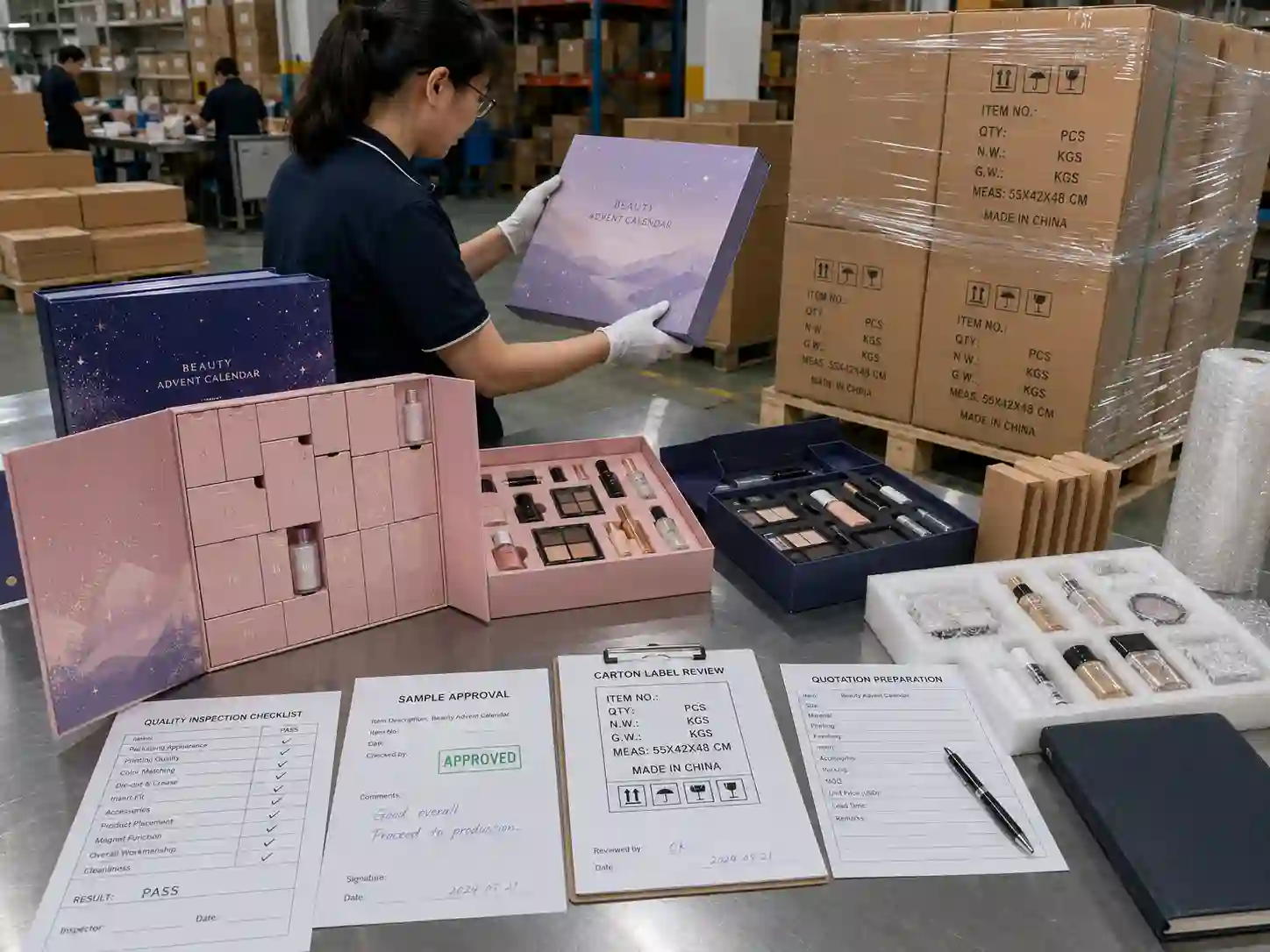
QC checklist for mass production
- Outer dimensions and structure match the approved sample.
- Doors, drawers, ribbons, magnets, and locks function correctly.
- Insert cavities hold products securely without crushing them.
- CMYK and Pantone colors are within approved tolerance.
- Foil stamping, embossing, and spot UV are aligned and clean.
- Matte lamination or gloss lamination has no obvious bubbles or scratches.
- Cartons use correct shipping marks, item numbers, and quantity labels.
- Export cartons and pallets are suitable for the selected shipping method.
How should export packing be planned for overseas shipment?
Export packing should be planned before mass production, not after the finished boxes are assembled. Beauty advent calendar boxes can be large, decorated, and corner-sensitive, so carton strength, corner protection, palletizing, and shipping marks matter.
Common export-packing details include inner protection, polybag or tissue wrapping when required, corner protectors, master export carton size, carton weight control, pallet wrap, shipping marks, and carton label review. Heavy beauty sets should not be packed in cartons that are too large or too weak. Oversized cartons may collapse during stacking, while very heavy cartons increase handling risk.
Buyers selling through retail or e-commerce channels should confirm whether carton labels, barcodes, carton dimensions, pallet height, or routing marks are required. These requirements should be shared before production so the factory can reserve label areas and prepare packing documents correctly.
Factory tip: Export packing is part of the product specification. A premium calendar box with weak cartons, unclear shipping marks, or poor pallet wrapping can still arrive with damaged corners and customer complaints.
How should buyers compare suppliers for custom beauty gift packaging?
Buyers should compare suppliers by project understanding, sampling quality, insert engineering, printing control, finishing capability, QC process, export experience, and communication clarity. The lowest price is not always the best value if the supplier cannot control mixed SKU fit or premium finishing.
A capable supplier should ask practical questions about product size, loading method, campaign deadline, box structure, insert preference, artwork status, retail channel, packing method, and quotation target. If a supplier quotes without these details, the quotation may be incomplete or based on assumptions.
Buyers can review custom advent calendar box products to compare structure possibilities, then discuss project feasibility with the Giftpackpro packaging factory team. For wider planning topics, the advent calendar box buying guides section can help purchasing teams prepare specifications before contacting a supplier.
Supplier comparison checklist
- Can the supplier develop custom structures instead of only standard templates?
- Can they test paper insert, PET tray, EVA insert, foam, or molded pulp options?
- Do they check dieline, bleed, color mode, finishing layers, and barcode areas?
- Can they provide white sample, printed sample, or pre-production sample when needed?
- Do they define QC checkpoints before mass production?
- Can they prepare export cartons, pallet packing, and shipping marks for overseas buyers?
- Do they communicate MOQ, lead time, sample cost, tooling cost, and packing details clearly?
What information should buyers prepare before requesting a quotation?
Buyers should prepare product details, desired structure, box size target, insert preference, artwork requirements, finishing expectations, order quantity, delivery country, and campaign timeline. The more complete the RFQ, the more accurate the quotation will be.
For beauty advent calendar boxes, a strong RFQ should include the number of SKUs, product dimensions, product weight, fragile items, preferred opening style, material direction, printing requirements, finishing details, sample expectation, MOQ target, packing requirements, and shipment deadline. If the buyer has no final structure yet, reference photos or a simple sketch can help the factory suggest options.
RFQ preparation checklist
- Product list with length, width, height, and weight for each item.
- Quantity of compartments and loading sequence.
- Preferred structure: rigid box, folding carton, drawer box, door-opening box, or custom layout.
- Insert preference: paper insert, PET tray, EVA insert, foam, molded pulp, or supplier recommendation.
- Artwork status: finished design, draft concept, or dieline support needed.
- Printing notes: CMYK, Pantone, color proofing, barcode, label, or legal text areas.
- Finishing notes: matte lamination, gloss lamination, foil stamping, embossing, debossing, or spot UV.
- Target order quantity and expected MOQ flexibility.
- Sample deadline, mass production deadline, and delivery destination.
- Export carton, pallet, shipping mark, or retail routing requirements.
What common mistakes should beauty brands avoid?
The most common mistakes are choosing a structure too late, approving artwork without dieline checks, ignoring real product fit, overusing finishing effects, and treating export packing as an afterthought. These mistakes can delay sampling, increase cost, or create quality problems during mass production.
- Mistake 1: Designing before confirming products. Mixed beauty SKUs should be measured before the dieline is finalized.
- Mistake 2: Using screen color as final approval. Printed color can change with paper, ink, and lamination.
- Mistake 3: Selecting inserts only by cost. Fragile palettes, jars, and mini bottles need stability, not only low material cost.
- Mistake 4: Adding too many premium finishes. Too much foil, embossing, and spot UV can raise cost and defect risk.
- Mistake 5: Forgetting carton limits. Large rigid calendars need strong export cartons and sensible carton weight.
- Mistake 6: Requesting a quotation with missing details. Incomplete RFQs lead to estimated pricing and later revisions.
FAQ: Beauty advent calendar boxes for B2B buyers
What are beauty advent calendar boxes used for?
Beauty advent calendar boxes are used for seasonal gift sets, retail promotions, influencer mailers, e-commerce bundles, sample campaigns, and premium brand launches. They organize multiple beauty or cosmetic products into separate compartments with a structured reveal.
Which structure is most premium for beauty gift sets?
Rigid door-opening boxes and rigid drawer boxes usually create the most premium presentation. They support thicker greyboard, wrapped paper, foil stamping, embossing, and better protection for heavier beauty products.
Can one calendar box hold different product sizes?
Yes, but the insert must be custom designed. Mixed SKU sizes require cavity planning, product loading tests, and tolerance checks to prevent movement, crushing, or difficult product removal.
Should buyers choose CMYK or Pantone printing?
CMYK is suitable for full-color artwork, while Pantone is better for controlled brand colors. Many beauty packaging projects use CMYK plus Pantone when both seasonal artwork and brand consistency are important.
Is foil stamping suitable for beauty advent calendar boxes?
Yes. Foil stamping is common for logos, numbers, icons, borders, and premium campaign details. Buyers should check foil area, line thickness, and registration tolerance during sampling.
What is the difference between a prototype and a pre-production sample?
A prototype checks structure, size, insert fit, and general function. A pre-production sample is closer to the final approved production reference, including material, printing, finishing, and assembly details.
What affects MOQ for custom advent calendar boxes?
MOQ is affected by box structure, material sourcing, printing setup, finishing tooling, insert type, assembly labor, and supplier production planning. More customized specifications may require higher starting quantities.
How can buyers reduce production risk?
Buyers can reduce risk by preparing accurate product dimensions, approving a physical sample, checking artwork layers, confirming color proofs, testing insert fit, and agreeing on QC and export-packing standards before mass production.
Ready to develop beauty advent calendar boxes with Giftpackpro?
When requesting beauty advent calendar boxes, prepare your product list, dimensions, target quantity, structure preference, insert expectations, artwork files, finishing notes, sample deadline, and export-packing requirements. These details help Giftpackpro review feasibility, suggest cost-effective options, and prepare a clearer quotation.
If you are planning a retail, wholesale, e-commerce, or seasonal beauty gift set project, you can request a custom quote with your box size, product details, artwork status, and target delivery schedule. A complete RFQ helps the factory recommend the right structure, insert, material, printing, finishing, sample process, MOQ, lead time, QC plan, and export packing for your project.


