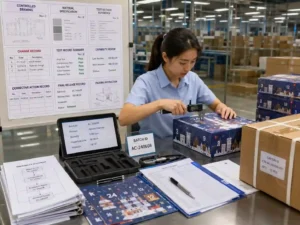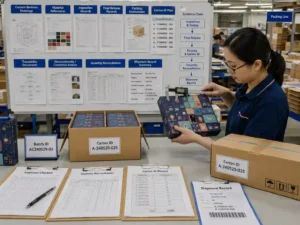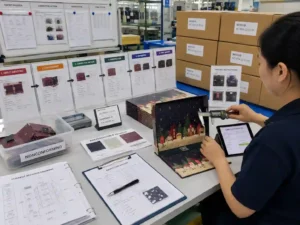
Quick answer: To design makeup advent calendar boxes for seasonal campaigns, buyers should start with the selling channel, product mix, box structure, insert protection, artwork system, sampling plan, MOQ target, QC checklist, and export-packing method. A retail shelf campaign needs strong front-facing display and barcode planning, while an e-commerce gift set needs stronger cartons, tighter insert fit, and better drop-resistance. For mixed makeup SKUs such as palettes, lipsticks, tubes, jars, brushes, and mini bottles, the best result usually comes from confirming product dimensions first, then building the dieline, prototype, printing proof, pre-production sample, mass production checklist, and quotation around real items.
Makeup advent calendar boxes are not only decorative seasonal packaging. For overseas brands, wholesalers, retail buyers, Amazon sellers, and purchasing teams, they are campaign tools that must protect mixed cosmetic SKUs, support premium presentation, survive export shipping, and fit the launch calendar. A good design links structure, insert, printing, packing, and supplier communication before the first sample is made.
Giftpackpro works as a custom advent calendar boxes manufacturer for B2B buyers who need practical packaging development, not consumer holiday storytelling. This guide explains how to connect makeup advent calendar packaging decisions with retail shelf impact, e-commerce gift sets, influencer launch boxes, promotional campaigns, and reliable bulk production.
What should buyers decide before designing makeup advent calendar boxes?
Buyers should decide the sales channel, SKU list, target box style, price position, launch date, and packing method before asking for a design or quotation. These decisions affect box size, material thickness, insert type, artwork layout, MOQ, sample cost, lead time, and export carton strength.
A makeup advent calendar for retail shelves may need a strong front panel, clear product messaging, barcode area, hanging or standing display logic, and consistent shelf-facing graphics. A calendar for e-commerce should focus more on shipping protection, compact master carton design, and unboxing presentation. A PR or influencer campaign box may need premium finishing such as foil stamping, embossing, spot UV, matte lamination, or magnetic closure, but these features must still be checked against budget and production tolerance.
Buyer tip: Do not start with only a visual mood board. Start with a campaign brief that includes product dimensions, sales channel, target order quantity, expected delivery date, and whether the box will be shipped flat, semi-assembled, or fully assembled.
Which box structure works best for retail, e-commerce, and campaign launches?
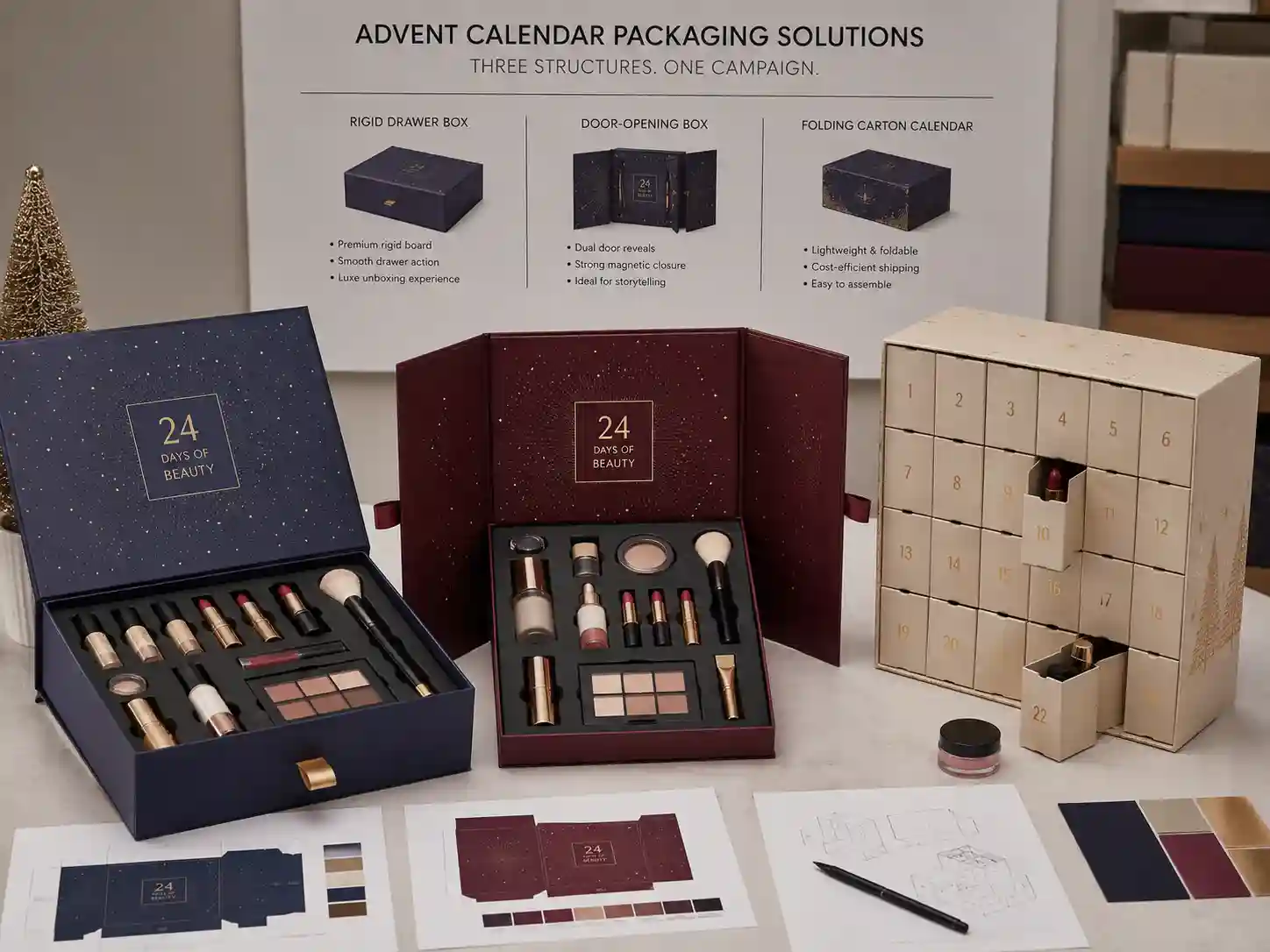
The best structure depends on how the calendar will be displayed, opened, shipped, and priced. For makeup products, the most common options include a rigid box, drawer box, door-opening box, book-style box, folding carton calendar, or hybrid structure with paperboard or PET tray inserts.
| Structure option | Best use case | Advantages | Buyer checks before approval |
|---|---|---|---|
| Rigid box | Premium retail gift sets, influencer kits, luxury campaigns | Strong presentation, good perceived value, suitable for foil stamping, embossing, and premium lamination | Check greyboard thickness, total weight, shipping volume, corner strength, and assembly consistency |
| Drawer box | High-value makeup sets with multiple reveal steps | Good unboxing experience, easy SKU separation, strong display value | Test drawer sliding tolerance, pull-tab strength, insert movement, and carton packing direction |
| Door-opening box | Classic advent calendar campaigns and retail shelf display | Strong front artwork area, familiar opening experience, suitable for numbered doors | Check door perforation, tear resistance, product visibility, and whether fragile palettes are protected |
| Folding carton calendar | Cost-sensitive promotions, large-volume seasonal programs | Lighter weight, lower freight volume, easier flat packing | Confirm board grade, folding accuracy, insert support, and whether the structure can hold heavier cosmetics |
| Book-style box | Gift campaigns, PR boxes, product storytelling | Good opening display, premium feel, useful for printed panels and brand story pages | Check hinge durability, magnet placement, inner tray alignment, and finished box flatness |
For custom advent calendar boxes, structure should not be chosen only by appearance. Heavy compact palettes, glass mini bottles, nail polish bottles, jars, and tubes need different internal support than lightweight sachets or brushes. A rigid drawer box may look premium, but it can increase shipping volume. A folding carton may reduce unit cost, but it may not support fragile cosmetic SKUs without a stronger insert.
Quotable buyer note: The structure of makeup advent calendar boxes should be approved with real product weight, not only artwork renderings, because cosmetic palettes and mini bottles can change insert pressure, box balance, and export-carton performance.
How should inserts be designed for mixed makeup SKU sizes?
Inserts should be designed after all product dimensions and weights are confirmed. Makeup calendars often include fragile palettes, lipstick tubes, mascara tubes, brushes, mini bottles, jars, and sample cards, so one insert material rarely solves every protection and display requirement.
A paper insert is suitable for many lightweight cosmetics and supports paper-based sustainability goals. A PET tray can hold irregular shapes clearly and provide stronger cavity accuracy. EVA insert or foam can improve protection for fragile palettes, glass bottles, or premium gift sets, but buyers should check appearance, recyclability expectations, and market requirements. Molded pulp may be considered when a more paper-based presentation is required, although tooling, surface texture, and cavity precision should be reviewed carefully.
- Paper insert: Good for lightweight SKUs, cost control, and paperboard-based structures.
- PET tray: Useful for accurate cavities, transparent product visibility, and complex shapes.
- EVA insert or foam: Better for fragile or premium products, but needs careful fit and finishing review.
- Molded pulp: Useful for paper-based positioning, but buyers should approve texture, color, and tolerance.
- Hybrid insert: Useful when a box includes palettes, tubes, brushes, and bottles with different risk levels.
Factory tip: For mixed SKU calendars, send the factory product samples or accurate 3D dimensions before the dieline is finalized. A 1 mm to 2 mm insert error can cause lipstick tubes to rattle, jars to lift the lid, or palettes to press against doors during shipment.
What artwork and printing decisions matter for makeup campaigns?
Artwork should be planned around retail visibility, color consistency, finishing control, barcode placement, and seasonal campaign assets. For makeup advent calendar boxes, printing is not only decoration; it affects shelf recognition, influencer photography, e-commerce listing images, and perceived product value.
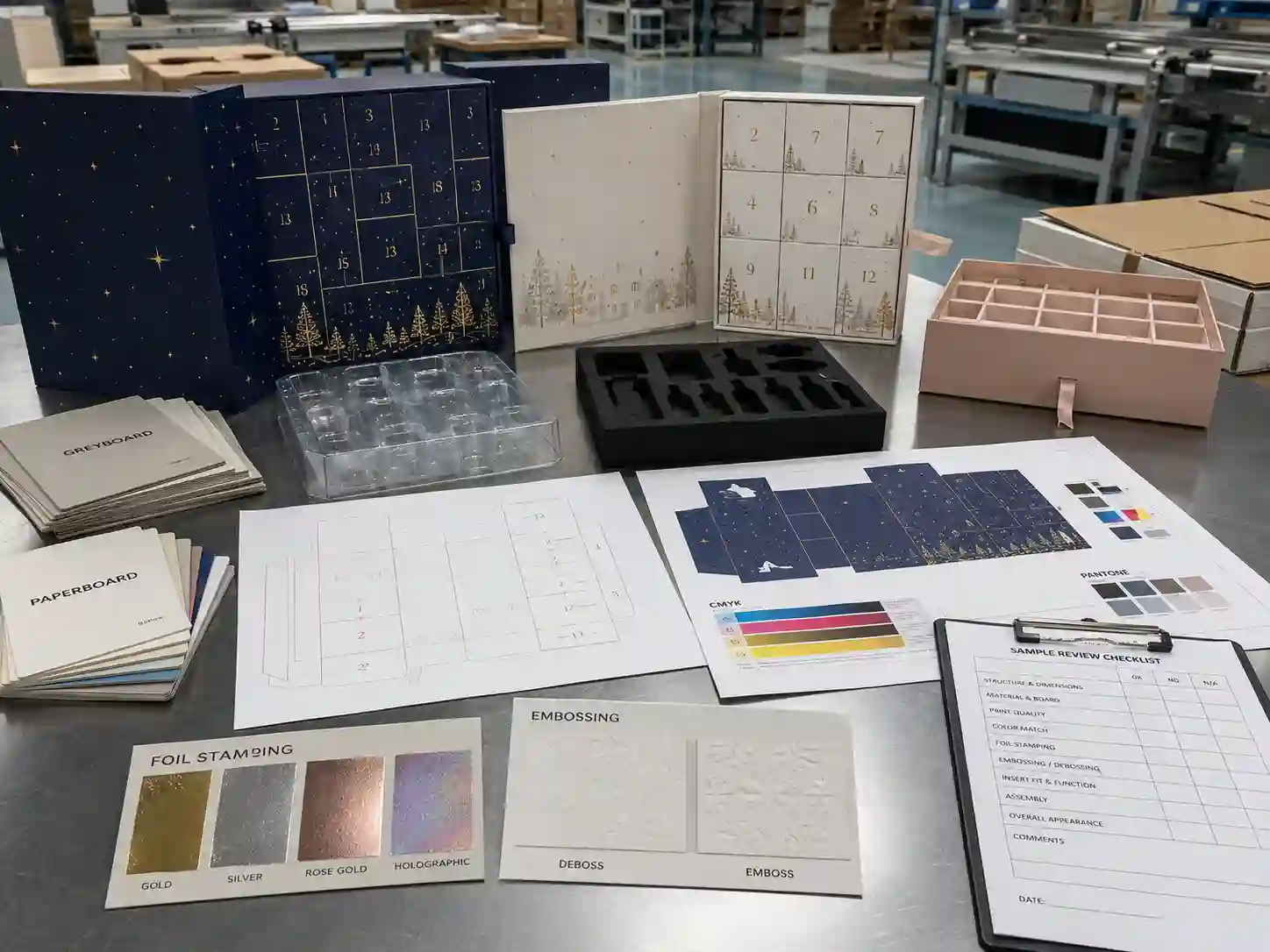
Buyers should confirm whether artwork will be printed in CMYK, matched with Pantone colors, or combined with special finishes. Matte lamination can create a premium soft-touch look, while gloss lamination can make colors appear brighter. Foil stamping is useful for seasonal accents and premium logos, embossing adds texture, and spot UV can highlight selected graphics. Each finish needs a separate production file or layer, and the factory should check registration tolerance before mass production.
Retail and e-commerce calendars also need practical artwork zones. Leave space for barcode, ingredients or product list references when required, recycling icons, shipping marks for cartons, importer information if applicable, and any retailer-specific label area. For barcode and retail data planning, buyers can refer to official GS1 barcode standards when preparing packaging layouts for stores and supply chains.
QC tip: For makeup packaging, color consistency should be checked under controlled lighting with approved printed samples. Metallic foil, dark backgrounds, pastel cosmetic tones, and skin-tone-inspired palettes can shift visually between proof, sample, and mass production if no standard is approved.
How should buyers connect packaging design with retail and e-commerce campaigns?
Buyers should match the box design to the campaign channel before approving the sample. Retail, e-commerce, influencer seeding, and promotional bundles each place different pressure on structure, graphics, packing, and cost.
For retail shelf campaigns
Retail packaging should communicate quickly from the front panel. The box should stand securely, show the campaign theme clearly, and include barcode or label areas required by the retailer. Buyers should check shelf height, case-pack quantity, display orientation, and whether the finished box can resist handling before purchase.
For e-commerce gift sets
E-commerce packaging should survive parcel handling and still look giftable when opened. This may require stronger export cartons, inner protection, corner protectors, tighter inserts, and a box size that reduces empty space. For Amazon or marketplace sellers, outer-carton labeling, SKU identification, and pack-out consistency may be as important as the calendar artwork.
For influencer and PR campaigns
Influencer calendars need camera-friendly opening, clean finishing, and strong insert presentation. However, buyers should avoid over-designing features that cannot be repeated consistently in bulk, such as overly tight drawers, delicate paper doors, or heavy foil coverage on unstable surfaces.
What is the practical design and production process?
A reliable makeup advent calendar project should move from brief to dieline, blank sample, printed sample, pre-production sample, mass production, QC, export packing, and shipment. Skipping sample stages may save time at the beginning but often creates higher risk during assembly or delivery.
- Confirm campaign brief: Define channel, target quantity, product list, launch timing, budget level, and delivery country.
- Prepare product details: Share product dimensions, weights, bottle materials, fragile items, and whether products are filled or empty during packing.
- Choose structure: Compare rigid box, drawer box, door-opening box, folding carton, or book-style format.
- Create dieline: Build the structure and insert layout around actual product sizes and opening logic.
- Make blank sample: Check size, fit, opening, stability, and insert position before color printing.
- Make printed sample: Review CMYK, Pantone, foil stamping, embossing, spot UV, lamination, and barcode area.
- Approve pre-production sample: Freeze structure, material, printing, insert, packing, and QC standards before mass production.
- Run mass production: Control paperboard, greyboard, printing, finishing, die-cutting, gluing, assembly, and packing.
- Inspect and pack: Check finished boxes, export cartons, pallet plan, shipping marks, and carton labels before shipment.
Buyers can review available development support through custom advent calendar box services and compare structure possibilities on custom advent calendar box products before preparing a formal RFQ.
How do MOQ, cost, and lead time affect seasonal campaign planning?
MOQ, cost, and lead time depend on structure complexity, material, insert type, printing method, finishing, order quantity, assembly labor, and packing method. Buyers should ask suppliers to explain cost drivers instead of comparing only the lowest unit price.
Rigid boxes, drawer boxes, EVA inserts, complex PET trays, heavy foil stamping, embossing, and multiple SKUs usually increase cost and sample time. Folding carton structures and paper inserts may reduce cost, but they still require careful testing if the makeup products are heavy or fragile. Lead time should include dieline development, sample making, sample shipping, artwork revision, material purchasing, printing, finishing, assembly, QC, export packing, and vessel or air shipment planning.
Buyer tip: For seasonal campaigns, the most expensive delay is often not production itself. It is late product dimension confirmation, repeated artwork revisions, unclear insert requirements, or slow sample approval.
How should buyers compare suppliers for makeup advent calendar boxes?
Buyers should compare suppliers by packaging engineering ability, sample accuracy, quotation transparency, communication speed, QC process, export-packing experience, and reliability with seasonal deadlines. A low quote is not useful if the supplier cannot control insert fit, printing color, assembly tolerance, or carton protection.
| Supplier comparison point | What to ask | Why it matters |
|---|---|---|
| Structure experience | Have you made similar rigid, drawer, door-opening, or folding carton advent calendars? | Makeup calendars need more engineering than a simple gift box because cavities, doors, and inserts must align. |
| Sample process | Can you provide a blank sample, printed sample, and pre-production sample? | Each sample stage reduces a different risk: size, artwork, finishing, and bulk repeatability. |
| Insert testing | How will you test palettes, tubes, jars, mini bottles, and brushes inside the insert? | Mixed SKU sizes can cause rattling, compression, door bulging, or product movement during export. |
| Printing control | How do you check CMYK, Pantone, foil stamping, embossing, spot UV, and lamination? | Beauty packaging depends heavily on consistent color and premium surface finishing. |
| QC and packing | What final inspection and export carton plan will be used? | Seasonal boxes often ship long distances and must arrive in sellable condition. |
| Quotation detail | Does the quote include material, insert, printing, finishing, sample, packing, carton, and shipping assumptions? | Transparent quotations help buyers compare real project value, not only unit price. |
For supplier background and factory-side packaging capability, buyers can also review the Giftpackpro packaging factory page before starting a sourcing comparison.
What QC checks are important before shipment?
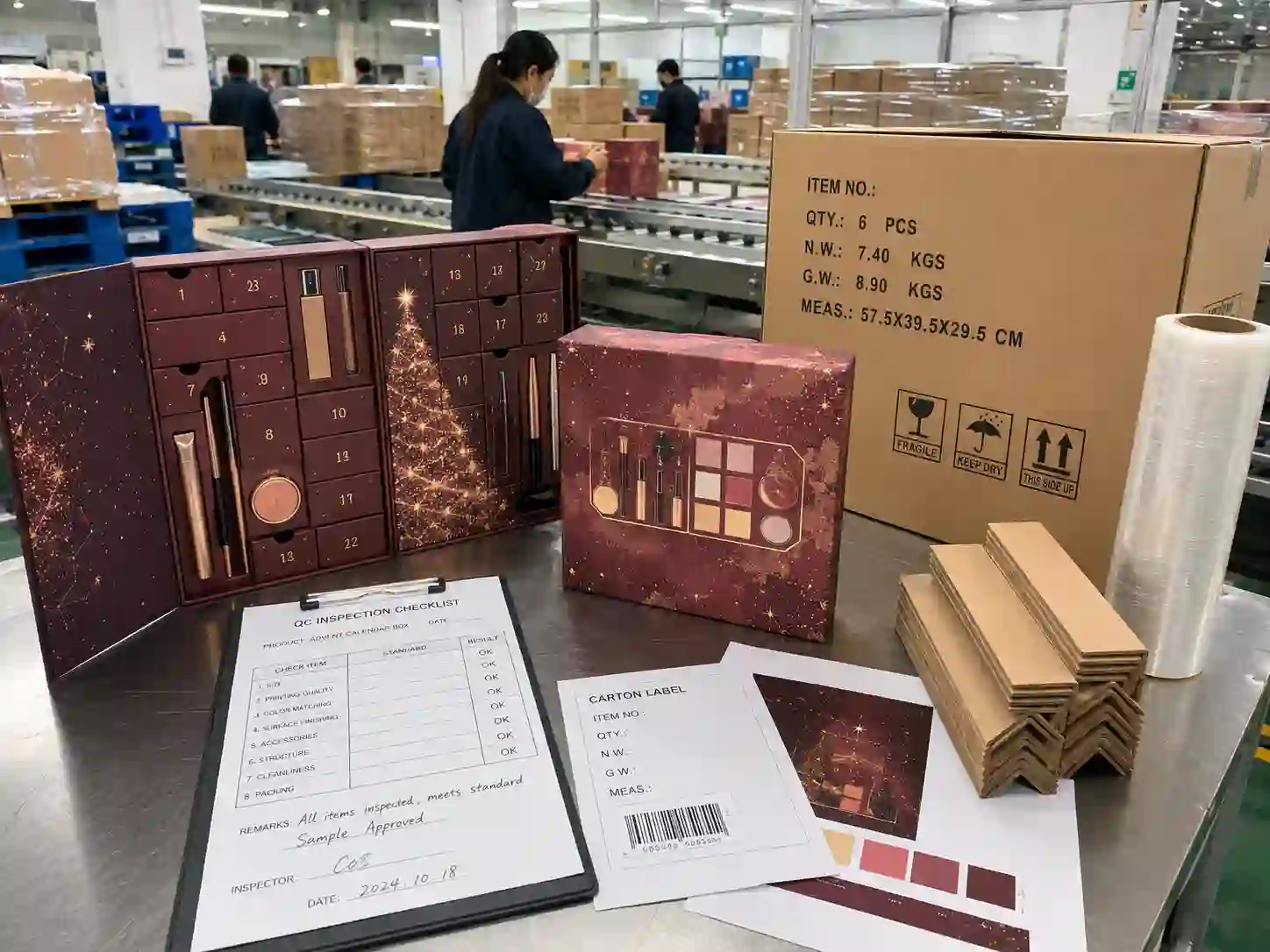
QC should cover structure, insert fit, printing, finishing, assembly, carton packing, and shipping marks. For makeup advent calendar boxes, the final inspection should confirm both appearance and function because retail buyers may reject boxes that arrive damaged, misprinted, difficult to open, or poorly aligned.
- Check finished size against approved dieline and pre-production sample.
- Check paperboard or greyboard thickness, surface paper, lamination, and color consistency.
- Check door-opening, drawer sliding, magnetic closure, ribbon pull, or hinge function.
- Check insert cavities with real products or approved product dummies.
- Check fragile palettes, mini bottles, jars, and tubes for movement after shaking or handling tests.
- Check foil stamping, embossing, spot UV, glue marks, scratches, wrinkles, and corner damage.
- Check barcode area, carton label, shipping marks, SKU references, and retailer packing instructions.
- Check export carton strength, quantity per carton, gross weight, net weight, and pallet plan.
If buyers have retailer or marketplace packaging requirements, those requirements should be shared before the quotation. For transport testing language and distribution simulation, buyers may refer to official resources from ISTA when discussing test expectations with internal logistics or QA teams.
How should export packing be planned for seasonal delivery?
Export packing should be planned at the same time as the box structure, not after mass production. Makeup advent calendar boxes can be damaged by compression, corner impact, rubbing, moisture, and poor pallet loading if carton specifications are not matched to the finished product.
Buyers should confirm whether calendars will be packed fully assembled, flat packed, or semi-assembled. Fully assembled packing protects the finished presentation but increases shipping volume. Flat packing can reduce freight cost but may require local assembly and stricter instructions. Semi-assembled packing can be a compromise when buyers need lower volume but still want reliable structure alignment.
Master cartons should be designed around carton strength, box orientation, corner protectors, inner dividers if needed, carton labels, shipping marks, pallet height, and container loading plan. If the calendar contains fragile makeup products already packed inside, the supplier should check product movement inside the calendar and calendar movement inside the carton.
What should buyers prepare before requesting a quotation?
Buyers should prepare a complete RFQ package so suppliers can quote the same project assumptions. Without clear information, quotations may look cheaper at first but exclude important details such as insert tooling, premium finishing, export cartons, or sample revisions.
Practical RFQ checklist
- Target product name: makeup advent calendar boxes.
- Campaign type: retail shelf, e-commerce gift set, influencer PR box, wholesale program, or promotional bundle.
- Target quantity and expected MOQ flexibility.
- Required structure: rigid box, drawer box, door-opening box, folding carton, book-style box, or open to supplier recommendation.
- Number of days or compartments, such as 12, 24, 25, or a custom layout.
- Product dimensions and weights for each makeup SKU.
- Fragile items, such as palettes, glass mini bottles, mirrors, jars, or pressed powders.
- Preferred insert: paper insert, PET tray, EVA insert, foam, molded pulp, or supplier recommendation.
- Material preference: paperboard, greyboard, specialty paper, recycled paper option, or FSC-related request for verification.
- Printing requirements: CMYK, Pantone, matte lamination, gloss lamination, foil stamping, embossing, spot UV, or other finishing.
- Sample requirement: blank sample, printed sample, pre-production sample, or all stages.
- Export packing method: flat packed, semi-assembled, or fully assembled.
- Delivery country, shipping terms, requested delivery date, and carton-label requirements.
For more purchasing guidance, buyers can read additional advent calendar box buying guides or contact Giftpackpro to request a custom quote with product details, artwork files, and target campaign timing.
Decision guide: which design path should you choose?
The right design path depends on whether the campaign prioritizes premium presentation, cost control, shipping efficiency, or fast launch timing. Buyers should choose the simplest structure that can still protect products, support the brand image, and meet the delivery deadline.
| Buyer priority | Recommended direction | What to avoid |
|---|---|---|
| Premium retail launch | Rigid box or drawer box with strong insert, controlled Pantone color, and selective foil stamping | Too many special finishes without enough sample testing |
| E-commerce shipping | Compact structure, tight insert fit, strong export carton, and clear carton labels | Oversized boxes with empty space and weak corner protection |
| Cost-sensitive promotion | Folding carton or simplified paperboard structure with paper insert | Choosing the cheapest board without testing makeup product weight |
| Influencer campaign | Book-style or drawer structure with clean opening, photo-friendly layout, and premium surface finish | Fragile decorative features that cannot survive courier handling |
| Fast seasonal launch | Use proven structure, limit custom tooling, approve artwork quickly, and keep insert design practical | Late SKU changes after the dieline and sample are approved |
What common mistakes should buyers avoid?
The most common mistakes are approving artwork before product sizes are confirmed, choosing structure only by appearance, ignoring insert tolerance, underestimating sample time, and comparing supplier quotes without checking what is included. These mistakes can create delays, extra costs, or damaged boxes during shipment.
- Do not approve a dieline without real product dimensions and weights.
- Do not use one cavity size for products that vary significantly in height or diameter.
- Do not place fragile palettes near weak doors or unsupported corners without testing.
- Do not rely only on digital renderings for color, foil, embossing, or lamination approval.
- Do not change product SKUs after the insert tooling or cutting die is approved unless the impact is checked.
- Do not compare quotations unless material, size, insert, printing, finishing, packing, and sample terms are the same.
- Do not leave export carton design until the end of production.
FAQ: Makeup advent calendar boxes for B2B seasonal campaigns
What are makeup advent calendar boxes?
Makeup advent calendar boxes are custom seasonal packaging boxes with multiple compartments, doors, drawers, or trays designed to hold cosmetics such as palettes, lipsticks, tubes, mini bottles, brushes, jars, and samples. In B2B projects, they are developed around structure, insert fit, artwork, sampling, QC, export packing, and retail or e-commerce campaign requirements.
Which structure is best for a premium makeup calendar?
A rigid box, drawer box, or book-style box is usually better for a premium makeup calendar because these structures support stronger presentation and premium finishing. The final choice should be checked against product weight, shipping volume, insert design, and budget.
What insert is best for mixed cosmetic products?
There is no single best insert for every mixed makeup set. Paper inserts work well for lightweight items, PET trays provide accurate cavities, EVA or foam supports fragile products, and molded pulp can support paper-based positioning. The insert should be tested with real SKUs before mass production.
How early should buyers start a seasonal calendar project?
Buyers should start as early as possible because the project includes dieline design, sampling, artwork proofing, revisions, material purchasing, printing, finishing, assembly, QC, export packing, and shipping. Seasonal launches become risky when product dimensions or artwork are confirmed late.
What information is needed for an accurate quotation?
An accurate quotation needs box size, structure, order quantity, product dimensions, insert type, material, printing, finishing, sample requirements, packing method, delivery country, and target delivery date. Photos, drawings, product samples, and artwork files help the factory quote more accurately.
Can makeup advent calendar boxes be made for both retail and e-commerce?
Yes, but the design should account for both shelf presentation and shipping protection. Retail needs strong front-facing display and label planning, while e-commerce needs stronger cartons, tighter inserts, and better resistance to parcel handling.
CTA: Prepare your makeup advent calendar box brief before sampling
Before requesting samples or quotations for makeup advent calendar boxes, prepare your SKU list, product dimensions, target quantity, preferred structure, insert requirements, artwork direction, finishing expectations, packing method, and delivery schedule. A clear brief helps Giftpackpro recommend the right structure, create a practical dieline, control sample revisions, and quote the project with fewer hidden assumptions.
For buyers planning retail, e-commerce, wholesale, or promotional seasonal campaigns, Giftpackpro can help review structure options, insert feasibility, printing details, and export-packing requirements before mass production. Share your product list and campaign timeline through the request a custom quote page to begin a practical packaging discussion.