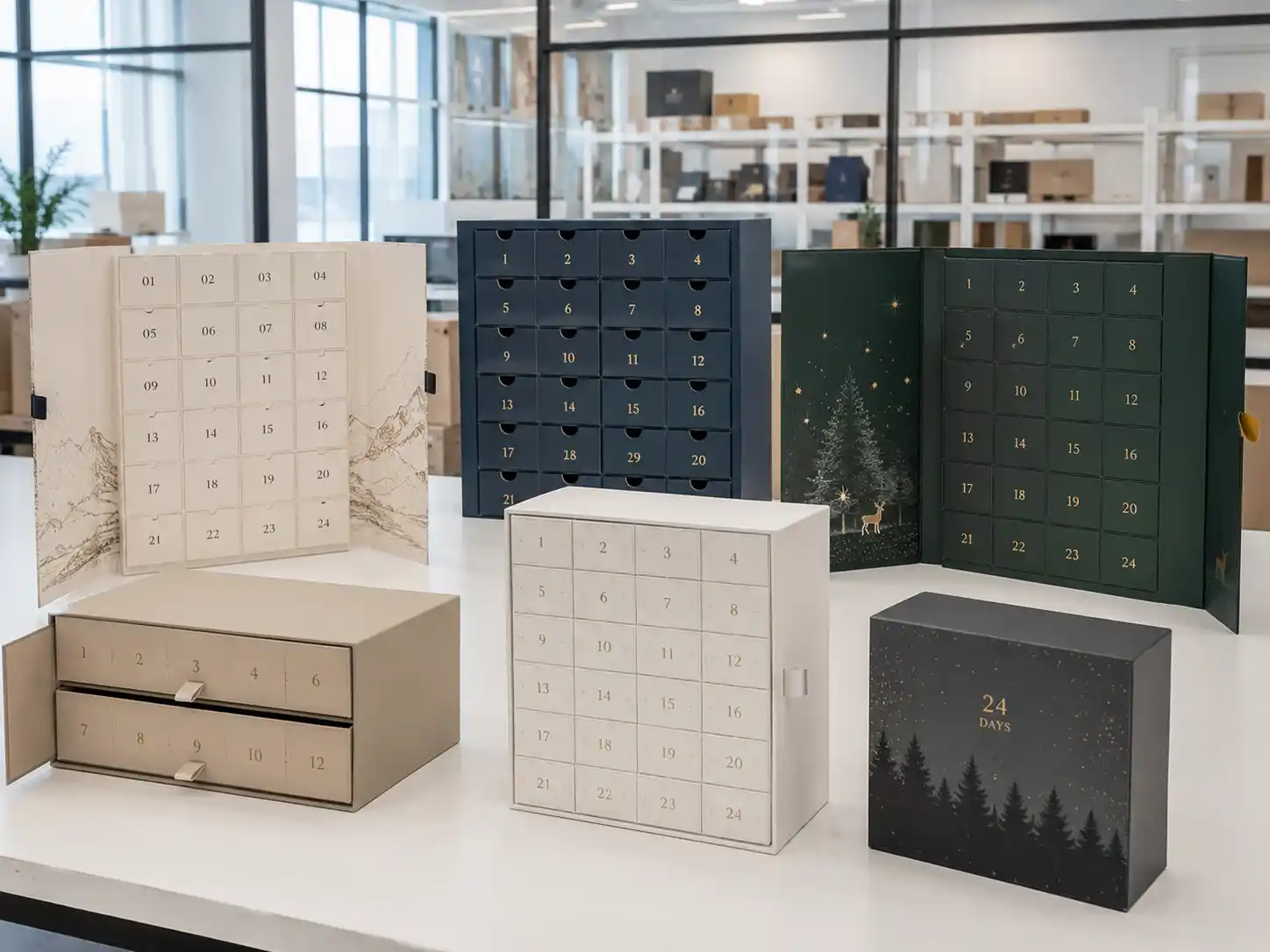
An advent calendar box is a seasonal packaging format with multiple compartments, drawers, doors, or windows that allow customers to open one section at a time. For brands, it is not only a holiday gift box. It is a retail packaging project that combines structure design, insert planning, artwork, sampling, bulk production, quality control, and export packing.
For overseas buyers, the main question is not only “What does it look like?” A better question is: “Which advent calendar box structure can hold my products safely, match my brand artwork, meet my seasonal launch schedule, and stay practical for production?” This guide explains the key buying points brands should review before requesting a quotation from a supplier.
If you are comparing suppliers, start with a custom advent calendar boxes manufacturer that understands paper structure, inserts, printing, and export packing as one project. That helps reduce back-and-forth communication and makes the quotation more useful from the beginning.
What Is an Advent Calendar Box?
An advent calendar box is a multi-compartment packaging box usually designed for seasonal campaigns, Christmas countdown gifts, beauty sets, food promotions, beverage samples, jewelry, toys, lifestyle products, or brand launch kits. Each compartment can hold one product, sample, accessory, voucher, or branded surprise.
From a B2B sourcing perspective, the box is a structured packaging system. It may include an outer rigid box, printed paperboard shell, drawers, die-cut doors, paper inserts, molded trays, ribbons, magnets, sleeves, or inner dividers. The final design depends on product weight, quantity, opening style, retail display needs, and shipping requirements.
A simple advent calendar box can use printed paperboard with numbered windows. A premium version may use a rigid box with pull-out drawers, custom inserts, foil stamping, magnetic closure, and a gift-ready presentation. Neither option is automatically better. The best choice depends on product value, campaign positioning, budget level, production time, and logistics.
Why Brands Use Advent Calendar Boxes
Brands use advent calendar packaging because it turns a set of small products into a complete retail experience. It can help organize multiple SKUs, support seasonal storytelling, increase perceived value, and create a stronger unboxing moment.
For beauty brands, an advent calendar box can present mini skincare, cosmetics, fragrance samples, or influencer gift items in a structured layout. For food and chocolate brands, it can separate flavors or daily treats. For beverage brands, it can hold sachets, small bottles, capsules, or accessories. For promotional campaigns, it can package trial products and coupons in a way that feels planned instead of random.
At the same time, buyers should avoid treating it as a simple printed box. A good advent calendar box requires early decisions about compartment size, product fit, insert material, artwork areas, numbering, barcode placement, outer carton packing, and quality inspection standards.
Main Advent Calendar Box Structures
The structure is the first major decision because it affects tooling, material use, packing method, assembly labor, sample cost, and bulk production stability. Before you ask for a quote, prepare your product list and check whether all items have similar dimensions or mixed sizes.
| Structure Type | Best For | Buyer Notes |
|---|---|---|
| Drawer style advent calendar box | Beauty, jewelry, premium gifts, small accessories | Strong presentation and reusable feel. Drawer fit, pull ribbon strength, and inner box tolerance should be checked during sampling. |
| Door-opening calendar box | Chocolate, food, toys, samples, promotional kits | Good for numbered daily openings. Dieline accuracy and perforation strength are important for a clean opening experience. |
| Rigid advent calendar box | High-value gift sets and premium retail campaigns | Better structure and shelf presence. Usually higher material and assembly requirements than simple paperboard options. |
| Foldable paperboard calendar box | Cost-sensitive seasonal promotions | Efficient for lighter products. Buyers should confirm product weight limits, insert support, and export carton protection. |
| Book-style advent calendar box | Gift sets, PR kits, brand storytelling campaigns | Good front-cover impact. Magnet, hinge, spine width, and product balance should be reviewed carefully. |
If you are not sure which structure fits your project, compare samples from your supplier or ask for a recommendation through custom advent calendar box services. A practical supplier should ask about product size, product weight, quantity per set, artwork status, target market, and shipping method before suggesting a structure.
Inserts and Compartments: The Part Buyers Often Underestimate
The insert is what keeps each product in place. It may be paperboard, corrugated board, molded pulp, EVA, foam, PET, or another material depending on product type and brand requirements. For many B2B projects, the insert is just as important as the outer box because it controls product fit, protection, and presentation.
For light paper items or small cosmetics, a paperboard insert may be enough. For fragile bottles, jars, candles, or glass items, the buyer may need stronger support and a more detailed drop protection discussion. For food products, the buyer should confirm whether the packaging material and inner contact conditions match the product’s own compliance requirements.
When preparing an advent calendar box project, send the product dimensions and weight for each item. If the products are not finalized, send the estimated range and update it before sampling. A small product-size change can affect drawer size, insert cutout, outer box thickness, and final carton packing.
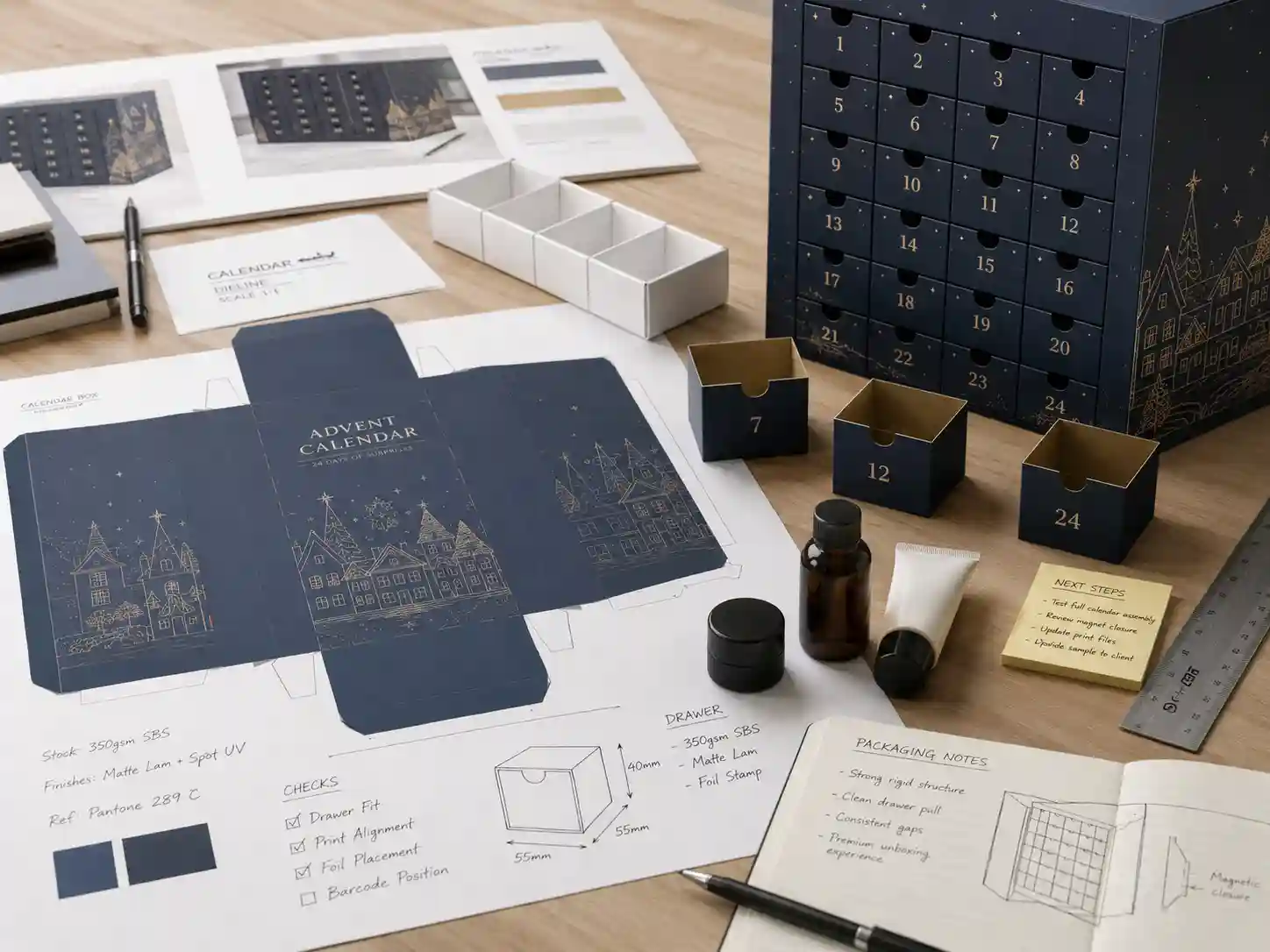
Artwork, Dieline, and Numbering
Artwork should be planned after the structure and dieline are confirmed. A dieline is the technical layout used for printing, cutting, folding, and assembly. It shows where artwork can be placed, where folds occur, and where doors, windows, drawers, or insert openings will sit.
For an advent calendar box, artwork usually includes front cover graphics, product numbering, brand logo, seasonal elements, product information, barcode areas, warning text if required, and sometimes inner printing. Buyers should avoid finalizing visual artwork before confirming the dieline because the structure may change printable areas.
Retail brands should also consider supply-chain labeling. If barcodes, carton labels, or product identification codes are needed, buyers can review general retail labeling principles through GS1 standards. This does not replace your market-specific compliance review, but it helps teams understand why barcode and label space should be planned early.
Materials and Finishing Options
Common advent calendar box materials include rigid greyboard wrapped with printed paper, SBS paperboard, CCNB, kraft paperboard, corrugated paperboard, and specialty paper. The choice depends on product weight, box size, presentation level, and target retail price.
Finishing options can include matte lamination, gloss lamination, soft-touch finish, hot stamping, embossing, debossing, spot UV, ribbon pulls, magnetic closure, window patching, and custom handles. These details can improve shelf appeal, but they also affect sample cost, production steps, and quality checks.
For responsible paper sourcing discussions, buyers may refer to FSC as a recognized external reference. Do not assume a supplier has a specific certification unless they provide valid documents for your order. If certification is important for your market or retailer, ask for proof before mass production.
MOQ, Sampling, and Production Planning
MOQ for an advent calendar box depends on structure, material, printing method, finishing, and assembly complexity. For some custom paper packaging projects, MOQ is usually around 300-500 pcs depending on structure, but buyers should confirm case by case. A larger rigid drawer calendar usually has different requirements from a flat paperboard calendar.
Sampling is important because the buyer needs to check product fit, opening experience, insert support, color direction, finishing effect, barcode location, and shipping protection before bulk production. A photo confirmation alone is not always enough for complex structures. If timing allows, request a physical sample and test it with the actual products.
Lead time should also be confirmed based on order quantity, sample revisions, artwork readiness, material availability, finishing complexity, and seasonal factory capacity. Advent calendar packaging is time-sensitive, so buyers should avoid starting too close to the holiday retail window. Seasonal retail planning should include design approval, sampling, revision time, production, inspection, export packing, shipping, and final distribution.
What to Prepare Before Requesting a Quotation
A useful quotation depends on complete project information. If the supplier only receives a general request such as “Please quote an advent calendar box,” the price may be too rough to support real purchasing decisions. A better inquiry includes structure preference, product details, material expectations, artwork status, order quantity range, destination country, and packing needs.
| Information to Provide | Why It Matters | Example Buyer Note |
|---|---|---|
| Product dimensions and weight | Controls compartment size, insert design, and box strength | Send length, width, height, and weight for each item if possible. |
| Number of compartments | Affects structure, dieline, assembly, and material use | 12-day, 24-day, or custom product-count layouts are common options. |
| Preferred structure | Helps the supplier estimate tooling, material, and assembly process | Drawer style, door-opening, rigid box, foldable box, or book-style design. |
| Artwork readiness | Determines whether dieline support or design adjustment is needed | Confirm whether you have final AI/PDF artwork or need layout guidance. |
| Order quantity range | Helps estimate unit cost and production method | Give a realistic range instead of asking for one price without quantity. |
| Export packing requirements | Protects the finished boxes during shipment | Ask about master carton size, carton strength, and pallet packing if needed. |
You can also review more advent calendar box buying guides before building your quotation request. The more accurate your information is, the easier it is for a packaging factory to recommend a practical structure instead of guessing.
Quality Control Points for Advent Calendar Boxes
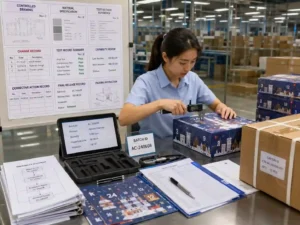
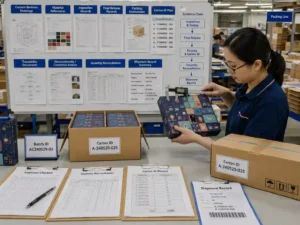
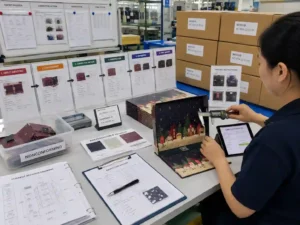
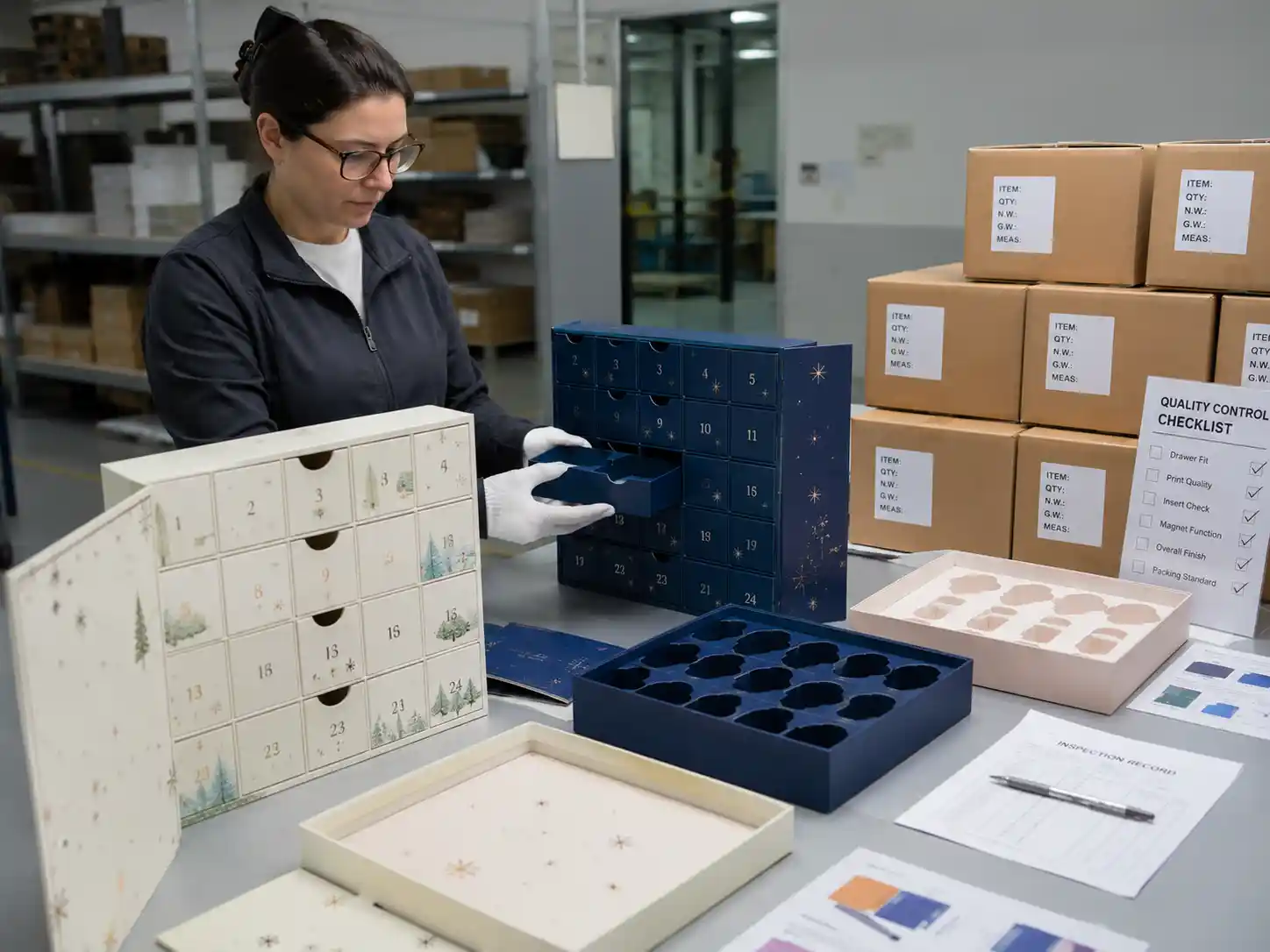
Quality control should cover both appearance and function. A calendar box may look attractive in photos, but buyers also need to check whether drawers slide smoothly, doors open without tearing too early, inserts hold products firmly, and the outer box remains stable after packing.
Key QC Checks
- Check color consistency against approved artwork or sample.
- Inspect lamination, hot stamping, embossing, spot UV, and surface finish.
- Test drawer movement, door perforation, magnet position, ribbon strength, and hinge durability where applicable.
- Confirm insert fit with real products or accurate product dummies.
- Review numbering accuracy and compartment sequence.
- Check barcode area, retail text, and carton label placement if required.
- Confirm export carton packing protects the box corners, surface, and structure.
For overseas buyers, it is also useful to ask the supplier how they handle pre-production confirmation, in-process checks, and final inspection. A packaging project with multiple compartments has more details than a standard folding carton, so clear QC communication reduces surprises before shipment.
How to Compare Advent Calendar Box Suppliers
When comparing suppliers, do not choose only by the lowest unit price. A very low quotation may exclude important items such as insert design, sample revision, special finishing, stronger export cartons, or assembly labor. Ask what is included and what is not included.
A practical supplier should be able to discuss structure options, suggest material choices, provide dieline support, guide artwork placement, produce samples, communicate MOQ factors, and explain export packing. You can also check the Giftpackpro packaging factory page to understand factory background before starting a project discussion.
For a serious project, send the same project brief to each supplier. Then compare quotation details, response quality, technical questions, sample approach, and risk warnings. A supplier who asks useful questions early may help prevent expensive changes later.
FAQ: Advent Calendar Box Buying Questions
1. What products can be packed in an advent calendar box?
An advent calendar box can be used for cosmetics, skincare, chocolate, tea, coffee, small beverages, jewelry, toys, stationery, candles, promotional gifts, and other small products. The key is to match the structure and insert to the product size, weight, and fragility.
2. Do I need a custom dieline before designing the artwork?
Yes, for most custom projects. The dieline tells your designer where the folds, cut lines, windows, drawers, doors, and printable areas are located. Final artwork should follow the confirmed dieline to avoid misalignment during production.
3. Can one advent calendar box hold products in different sizes?
Yes, but the structure becomes more detailed. Mixed-size products require different compartment dimensions or custom inserts. Buyers should provide product size and weight information early so the supplier can design a stable layout.
4. What affects the price of an advent calendar box?
Price is affected by size, structure, material, insert type, printing, finishing, order quantity, assembly difficulty, sampling, and export packing. A drawer-style rigid box with special finishing usually costs more than a simple paperboard door-opening structure.
5. How early should brands start an advent calendar packaging project?
Brands should start early enough to allow time for structure selection, dieline creation, artwork preparation, sampling, revisions, bulk production, quality control, and shipping. Seasonal packaging should not be left until the final retail window.
6. Can I request a custom quote without final artwork?
Yes. You can request an initial estimate with product size, box structure preference, order quantity range, and packaging goals. However, the final quotation may need adjustment after the dieline, artwork, finishing, and sample details are confirmed.
Need Custom Advent Calendar Boxes?
If your brand is planning a seasonal gift set, retail countdown campaign, or promotional packaging project, prepare your product list, quantity range, preferred structure, artwork status, and target delivery plan. Giftpackpro can help discuss structure, inserts, printing, sampling, and export packing for custom paper packaging projects.
To start your project, request a custom quote and share your product dimensions, box idea, and buying requirements. A clear brief helps the packaging team recommend a practical advent calendar box solution for sampling and bulk production.