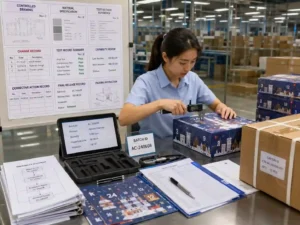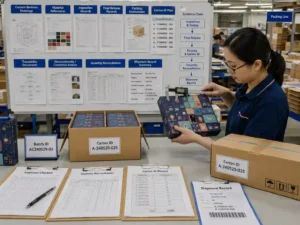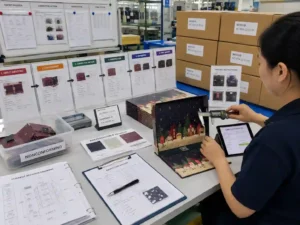
Quick answer: Rigid advent calendar boxes are more expensive because they require heavier materials, more production steps, more precise assembly, and more engineering control than standard folding cartons. A rigid box usually uses greyboard wrapped with printed paper, customized inserts, complex opening structures, premium finishing, and additional quality checks. For brands planning retail launches, e-commerce gift sets, or seasonal campaigns, the higher cost is mainly related to structure, durability, presentation, sampling, labor, and production risk rather than only the paper material itself.
For buyers comparing custom advent calendar boxes, understanding these cost drivers helps avoid unrealistic quotations and makes supplier evaluation easier. Giftpackpro works with brands, wholesalers, and purchasing teams that need packaging decisions connected to retail requirements, product protection, and reliable bulk production.
Why are rigid advent calendar boxes more expensive than folding cartons?
Rigid advent calendar boxes cost more because they are built as premium packaging structures instead of simple folded paper products. The manufacturing process normally involves rigid board cutting, wrapping, component assembly, insert fitting, and multiple inspection stages.
A folding carton is usually produced from printed paperboard that is die-cut and folded into shape. A rigid box uses thicker greyboard panels that create stronger walls, better shelf presence, and a more premium opening experience. This additional structure increases material usage and factory labor.
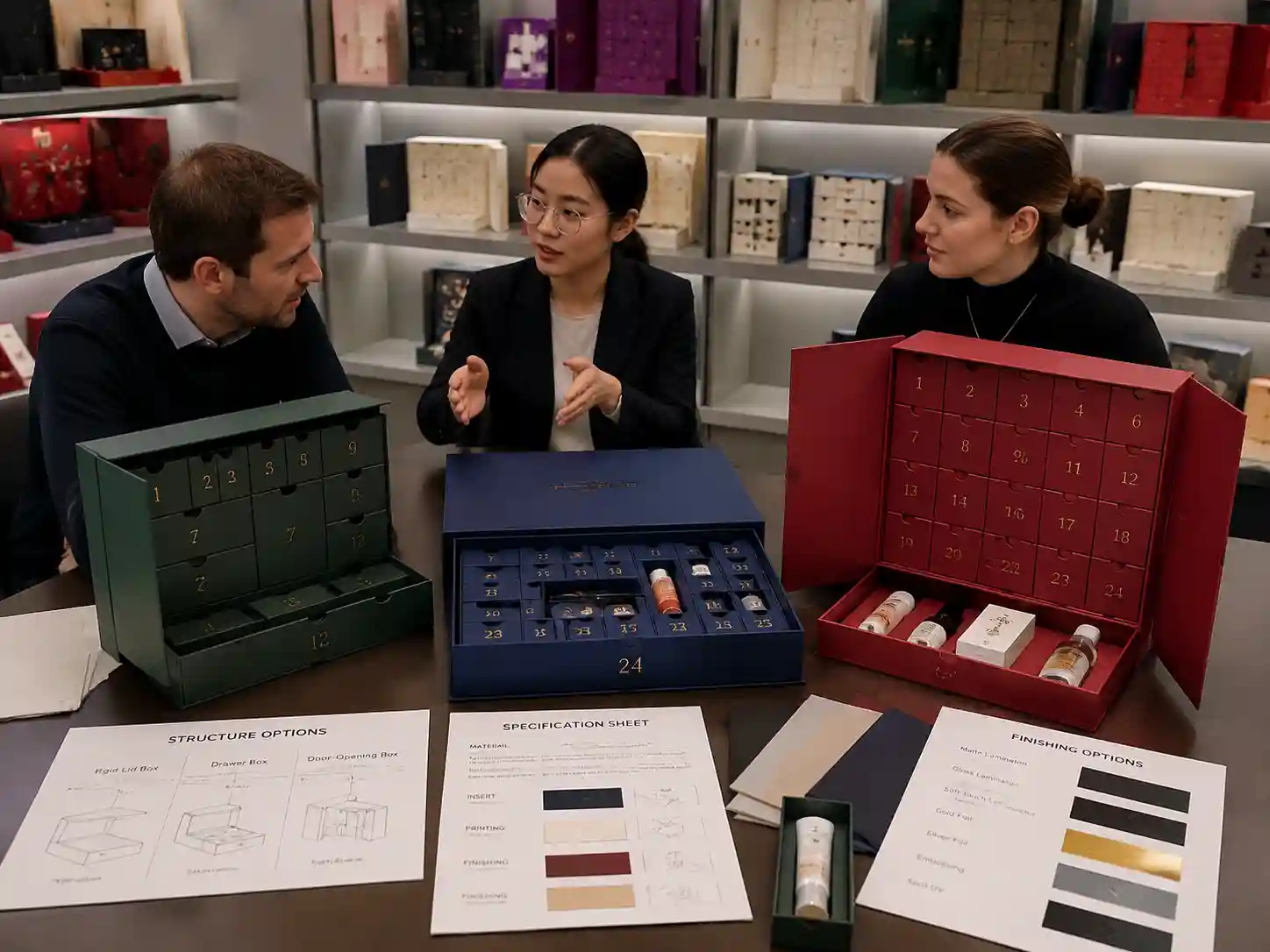
| Packaging Option | Main Materials | Production Complexity | Typical Buyer Application |
|---|---|---|---|
| Folding carton advent calendar | Paperboard with folding structure | Lower assembly complexity | Retail promotions, lightweight gift sets |
| Rigid advent calendar box | Greyboard, wrapped paper, inserts, special components | Higher engineering and manual assembly | Premium seasonal launches, luxury gift programs, e-commerce collections |
| Drawer or door-opening rigid box | Rigid board structure with moving parts | High tolerance requirements | High-value gift sets requiring strong presentation |
Factory tip: When comparing quotations, buyers should confirm whether the supplier is pricing the same structure. A rigid drawer box with custom inserts cannot be compared directly with a basic folding carton because the production processes are different.
Which rigid advent calendar box structures increase the cost?
The structure has one of the biggest impacts on the final quotation. More moving parts, compartments, and opening mechanisms require more development work and assembly control.
Does a drawer advent calendar box cost more?
Yes. Drawer-style rigid advent calendar boxes usually cost more because they require accurate drawer sizing, smooth sliding performance, reinforced panels, and clearance testing. The factory must control tolerances so drawers open correctly without being too loose or too tight.
Are door-opening advent calendar boxes more expensive?
Door-opening structures often have higher production requirements because hinges, panels, magnets, closures, and door alignment must be checked during sampling and mass production. Poor alignment can affect both appearance and user experience.
Do multi-compartment layouts increase cost?
Yes. More compartments require more internal engineering. A 24-door or 25-compartment advent calendar needs accurate spacing, insert design, and product-fit testing to ensure each section functions correctly.
- Rigid lid boxes: simpler structure but still require wrapping and assembly.
- Drawer boxes: higher cost due to moving components and tolerance control.
- Door-opening boxes: higher cost due to hinges, alignment, and opening performance.
- Multi-layer boxes: higher cost due to additional boards and assembly steps.
What materials make rigid advent calendar boxes more expensive?
The material selection directly affects both cost and packaging performance. Premium rigid advent calendar boxes typically combine several materials instead of using one paper sheet.
- Greyboard: Provides the rigid structure and determines wall strength.
- Paperboard: Used for printed wrapping, internal components, or folding elements.
- Paper insert: A cost-effective solution for lightweight products.
- PET tray: Provides accurate product positioning and a clean display.
- EVA insert: Adds premium protection for fragile or valuable items.
- Foam insert: Supports products requiring cushioning.
- Molded pulp: Provides an eco-oriented option with protective performance.
The correct insert depends on the product being packed. Cosmetic minis, fragrance samples, jewelry cards, beverage samples, pet products, and promotional gifts all require different cavity sizes and protection methods.
Buyer tip: Prepare product dimensions, weight, quantity per compartment, and opening requirements before requesting a quotation. Insert design cannot be accurately priced without product-fit information.
How do printing and finishing affect rigid advent calendar box costs?
Printing and finishing increase cost because rigid packaging usually requires more surface treatment and stricter appearance control. Buyers often select premium finishes to improve shelf visibility and brand presentation.
Common customization options include:
- CMYK printing for full-color artwork.
- Pantone matching for specific brand colors.
- Matte lamination or gloss lamination for surface protection.
- Foil stamping for metallic effects.
- Embossing for raised texture.
- Spot UV for selective glossy highlights.
Each additional process requires production planning and quality inspection. For example, foil stamping on multiple panels requires registration control, while color-sensitive projects may require approved printing proofs before bulk production.
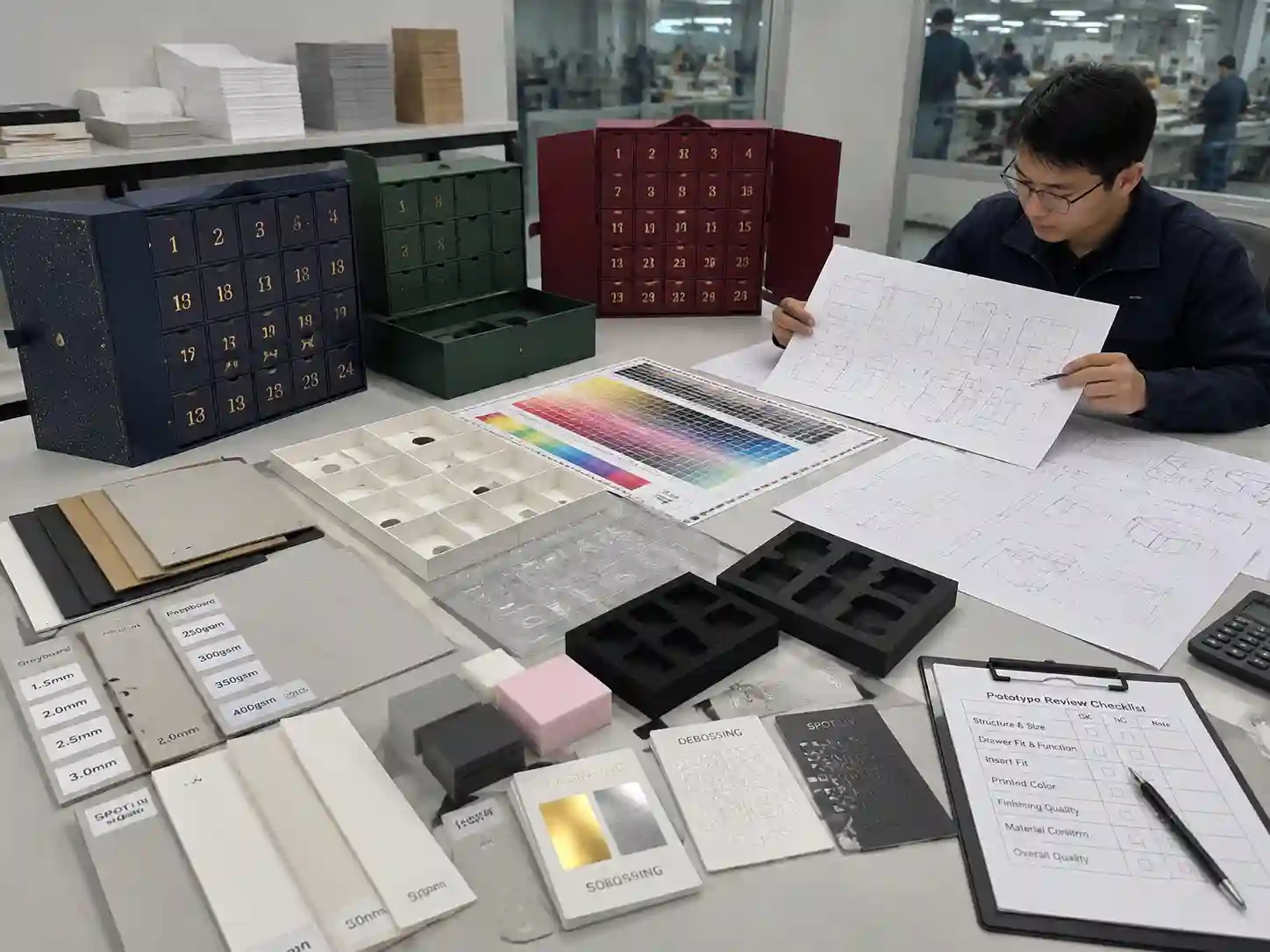
What sampling and prototype work makes rigid boxes more expensive?
Sampling is a major cost factor because rigid advent calendar boxes often need engineering validation before mass production. A professional supplier normally checks the structure, materials, artwork, inserts, and opening functions through prototype stages.
What should buyers check during sampling?
- Dieline accuracy: Confirm all panels, folds, doors, and compartments match the intended structure.
- Material selection: Verify greyboard thickness, wrapping paper, and insert materials.
- Product fit: Test whether products fit securely without damaging packaging components.
- Artwork approval: Check CMYK output, Pantone colors, finishing effects, and positioning.
- Assembly tolerance: Test drawer movement, door opening, magnetic closure, and panel alignment.
A pre-production sample reduces production risk because it allows buyers and factories to confirm expectations before committing to mass production.
QC tip: A sample is not only a visual reference. It is a production agreement covering structure, materials, finishing, and assembly standards.
How do MOQ and production planning influence rigid advent calendar box prices?
MOQ affects rigid advent calendar box pricing because tooling, setup, material purchasing, and production preparation costs are distributed across the order quantity. Larger quantities usually improve unit economics, while smaller projects may carry higher setup costs.
Buyers should discuss:
- Target order quantity and repeat order plans.
- Seasonal launch deadlines.
- Sample approval timing.
- Material availability.
- Bulk production schedule.
For seasonal retail campaigns, early planning is important because rigid boxes require more production stages than standard packaging. Late approvals can create pressure on manufacturing schedules and export arrangements.
How should buyers compare suppliers for rigid advent calendar boxes?
Buyers should compare suppliers based on engineering ability, communication, sample quality, production control, and export experience instead of only comparing unit prices.
| Supplier Evaluation Area | Buyer Questions |
|---|---|
| Structure capability | Can the supplier produce drawer boxes, door-opening boxes, and complex compartment layouts? |
| Sampling process | Does the supplier provide prototype review and pre-production approval? |
| Material knowledge | Can they recommend suitable board, insert, and finishing options? |
| QC process | Do they check dimensions, assembly, printing, and packaging before shipment? |
| Export preparation | Can they manage export cartons, pallet requirements, and shipping marks? |
Giftpackpro provides custom advent calendar boxes manufacturer solutions for international buyers who need support from structure development through bulk production.
What information should buyers prepare before requesting a rigid advent calendar box quotation?
A complete RFQ helps suppliers provide more accurate pricing and production recommendations. Buyers should prepare the following information:
- Box structure preference: rigid box, drawer box, door-opening box, or another design.
- Outer dimensions and product compartment requirements.
- Product samples, drawings, or detailed measurements.
- Insert preference: paper insert, PET tray, EVA, foam, or molded pulp.
- Artwork files or design references.
- Printing and finishing requirements.
- Expected MOQ and delivery schedule.
- Destination country and export packing requirements.
Buyers can review more packaging planning resources through advent calendar box buying guides and learn about available custom advent calendar box services before starting a project.
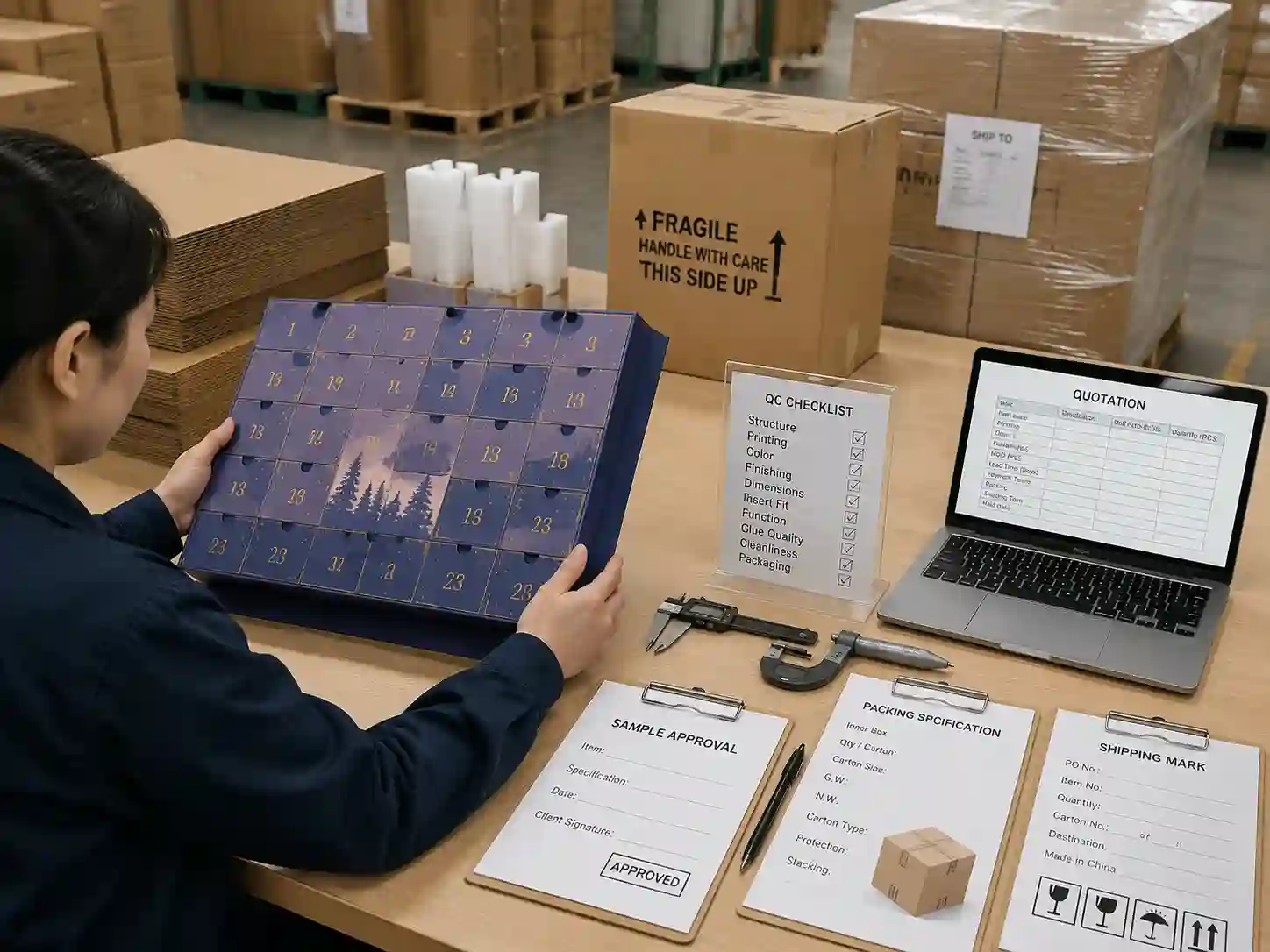
How do QC and export packing affect rigid advent calendar box costs?
Quality control and export packing add cost because rigid boxes must arrive without crushed corners, warped panels, damaged finishes, or displaced inserts. A premium structure requires protection throughout transportation.
Common QC checkpoints include:
- Board thickness and panel strength.
- Drawer movement and door-opening performance.
- Insert alignment and product fit.
- Color consistency against approved samples.
- Foil stamping, embossing, and coating quality.
- Carton protection and pallet stability.
Export packing may include reinforced export cartons, corner protection, separators, pallet wrapping, and clear shipping marks. Buyers should confirm packing standards during quotation instead of treating shipping protection as an afterthought.
For supply chain verification, buyers may also review official packaging and logistics guidance from organizations such as GS1 identification standards and FSC responsible forest management information when applicable to their packaging requirements.
Decision guide: Should you choose rigid advent calendar boxes?
Rigid advent calendar boxes are usually the better choice when presentation, durability, and premium positioning are more important than the lowest packaging cost.
- Choose rigid boxes if: the product is premium, the retail display matters, or the unboxing experience supports the campaign.
- Choose folding cartons if: the project requires lower cost, lighter weight, or large-volume promotional distribution.
- Choose drawer or door-opening structures if: the packaging design itself is part of the customer experience.
FAQ: Why are rigid advent calendar boxes expensive?
Are rigid advent calendar boxes always more expensive?
Generally yes, because they require stronger materials, more assembly steps, and more quality control than simple folding cartons. However, final pricing depends on structure, quantity, materials, and customization.
What is the biggest cost driver in a rigid advent calendar box?
The biggest cost drivers are usually structural complexity, insert requirements, material selection, finishing options, labor-intensive assembly, and order quantity.
Can rigid advent calendar boxes be produced with lower costs?
Yes. Buyers can reduce costs by simplifying the structure, optimizing insert materials, selecting practical finishes, increasing order quantity, and confirming specifications early.
How early should buyers start a rigid advent calendar box project?
Seasonal projects should begin early enough for design confirmation, prototype approval, production, QC, and export shipping planning. The exact timeline depends on structure and order requirements.
Prepare your rigid advent calendar box project before requesting a quotation
Understanding why rigid advent calendar boxes are expensive helps buyers make better packaging decisions. The higher cost comes from engineering, materials, customization, quality control, and production management required for premium seasonal packaging.
Before contacting a supplier, prepare your product dimensions, target quantity, structure preference, artwork status, insert requirements, and delivery expectations. Giftpackpro can help buyers evaluate options, develop samples, and prepare production plans through its custom advent calendar box products and factory experience.
Ready to discuss your packaging requirements? Prepare your project details and request a custom quote for a rigid advent calendar box solution.
You can also learn more about the company background through Giftpackpro packaging factory.