
Quick answer: The right number of compartments for an advent calendar box depends on the product size, retail positioning, insert design, shipping requirements, and target price. Many commercial custom advent calendar boxes use 12, 24, or 25 compartments, but B2B buyers should select the layout based on product fit rather than a fixed number. A 24-compartment structure may work for small cosmetics, chocolates, or promotional items, while premium gift sets may require fewer larger compartments with stronger inserts. The compartment count affects the dieline, material usage, assembly time, MOQ, sampling cost, and export packing method.
For brands, wholesalers, and retail buyers sourcing custom advent calendar boxes manufacturer solutions, compartment planning is a packaging engineering decision. The number of sections inside the box influences the customer experience, product protection, factory production process, and final quotation.
How many compartments should an advent calendar box have for commercial production?
The best compartment number is usually determined by product dimensions, sales channel, and packaging budget. Buyers should confirm the product assortment before selecting a box structure because changing compartment quantity after sampling can affect the entire packaging design.
Common commercial options include:
| Compartment Quantity | Typical Application | Packaging Considerations |
|---|---|---|
| 12 compartments | Half-month campaigns, premium gift collections, larger products | Allows larger product cavities and stronger inserts with less internal complexity |
| 24 compartments | Traditional seasonal retail programs, cosmetics, chocolates, beauty sets | Requires accurate insert design and tighter production tolerance |
| 25 compartments | Extended holiday campaigns and premium countdown products | Needs careful layout planning because one additional compartment can affect box size |
| Custom quantity | Brand campaigns, promotional kits, subscription gifts | Designed around product count, dimensions, and marketing requirements |
Buyer tip: Do not decide compartment quantity first and force the products into the box later. Professional suppliers normally review the product dimensions, weight, protection needs, and opening experience before recommending the structure.
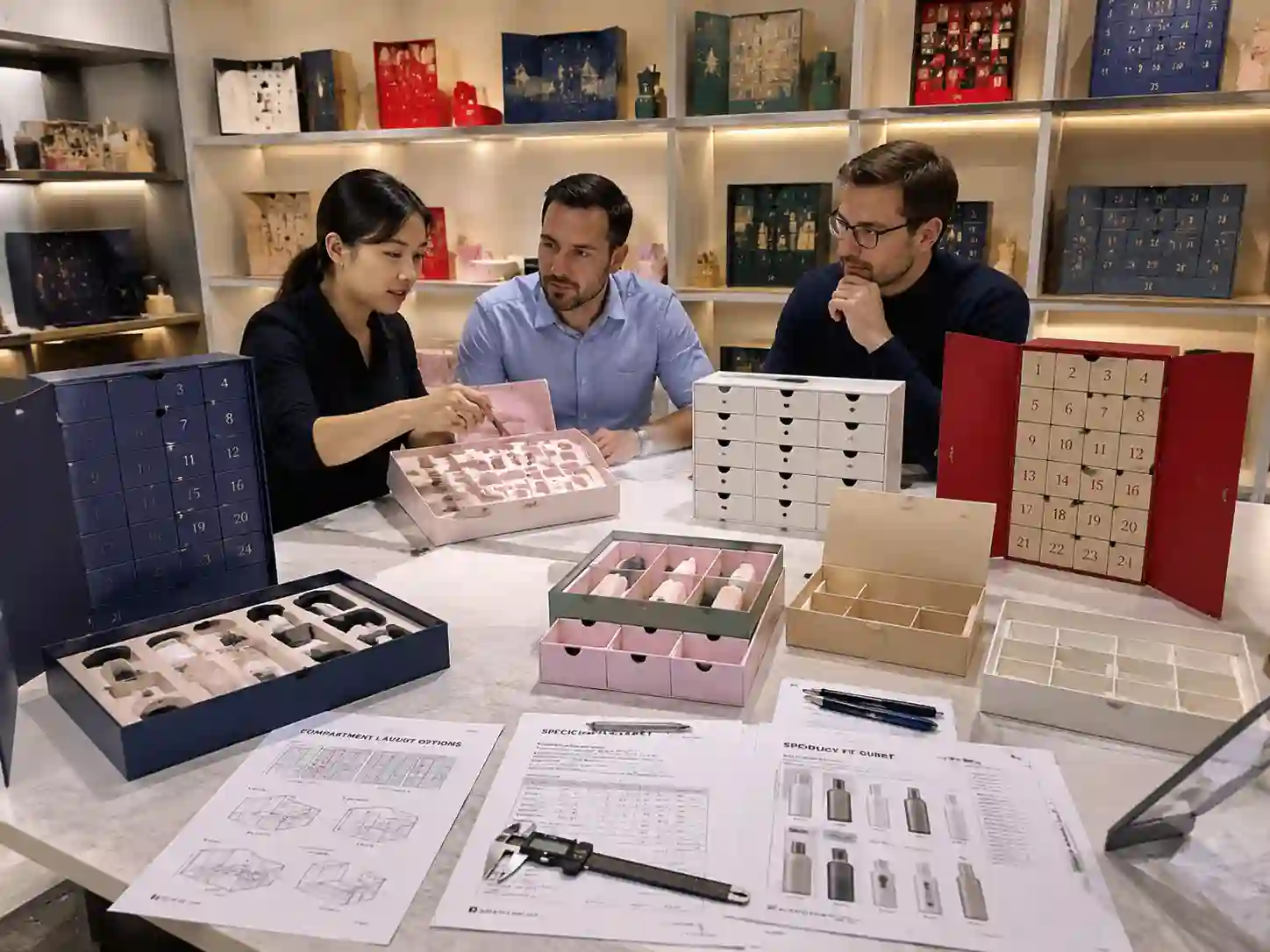
What should buyers consider before choosing the number of compartments?
Before deciding how many compartments an advent calendar box needs, buyers should evaluate the products, insert system, and shipping conditions. The compartment count is only one part of the packaging design.
Does product size affect compartment quantity?
Yes. Product dimensions are one of the biggest factors. Small items can fit into more compartments, while larger bottles, jars, gift items, or premium products may require fewer sections.
For example:
- Small cosmetic samples may use 24 narrow compartments with a paper insert or PET tray.
- Chocolate collections may require food-safe material selection and accurate cavity sizing.
- Beauty gift sets with bottles may need EVA, foam, or molded pulp inserts for protection.
- Premium promotional items may use fewer compartments with larger drawer-style sections.
How does the box structure change with compartment numbers?
The structure of the advent calendar box must support the internal layout. Common structures include rigid box, folding carton, drawer box, and door-opening box designs.
- Rigid box: Suitable for premium retail positioning because greyboard construction provides strength and a luxury feel. More compartments require precise insert fitting.
- Folding carton: A cost-effective choice for larger quantities where weight and shipping efficiency are important.
- Drawer box: Works well for layered compartments and premium unboxing experiences.
- Door-opening box: Creates a display-style experience but requires careful hinge, panel, and compartment alignment.
Buyers can review different structures through custom advent calendar box products before selecting a final compartment layout.
Which insert is best for different advent calendar compartment designs?
The insert determines whether each compartment protects the product properly. A higher compartment count usually requires more precise insert engineering because each cavity has less tolerance for error.
| Insert Type | Best For | Buyer Considerations |
|---|---|---|
| Paper insert | Lightweight products and economical projects | Lower cost but requires accurate folding and assembly control |
| PET tray | Cosmetics, small bottles, retail display products | Provides clean product positioning and repeatable sizing |
| EVA insert | Premium products requiring cushioning | Improves protection but increases material and processing cost |
| Foam insert | Fragile or luxury items | Requires careful cutting tolerance and appearance control |
| Molded pulp | Eco-focused packaging programs | Requires product compatibility testing and design review |
Factory tip: A supplier should check the insert fit during the prototype stage, not only after mass production begins. Incorrect cavity size can create loose products, damaged items, or assembly delays.
How does compartment quantity affect artwork and printing?
Compartment design affects the outer box dimensions, printable area, and artwork layout. Buyers should finalize the structure before preparing final artwork because the dieline controls where graphics, text, and finishing effects appear.
Important artwork considerations include:
- Dieline approval before graphic production.
- CMYK or Pantone color confirmation before printing.
- Testing foil stamping, embossing, spot UV, matte lamination, or gloss lamination positions.
- Checking whether numbers, doors, drawers, or opening panels align correctly.
For example, a 24-compartment door-opening advent calendar box may require careful numbering alignment across multiple panels. A drawer box with layered sections may require different artwork placement because the front panel and internal trays move separately.

What sampling process should buyers follow before bulk production?
Buyers should approve a physical sample before mass production. A correct sample confirms compartment size, insert fit, structure performance, artwork placement, and assembly requirements.
Recommended sample approval checklist
- Confirm the final product dimensions and number of compartments.
- Review the dieline and structural drawings.
- Check insert cavity size using real products or accurate dummy samples.
- Approve printing proof, CMYK/Pantone references, and finishing details.
- Test opening, closing, drawer movement, and door alignment.
- Review packing method and shipping protection before production release.
A pre-production sample helps buyers avoid expensive corrections during mass production. Professional suppliers normally use the approved sample as the reference standard for bulk QC inspection.
How do MOQ, lead time, and cost change with compartment numbers?
More compartments generally increase production complexity because they require more cutting, folding, assembly, and insert operations. However, the final impact depends on the structure, materials, quantity, and production method.
| Cost Factor | Impact of More Compartments |
|---|---|
| Material usage | Larger internal layouts may require more board, inserts, and packaging components |
| Assembly labor | More sections usually increase folding, gluing, and inspection time |
| Sampling | Complex structures may require more prototype adjustments |
| MOQ planning | Factories may recommend quantities based on tooling, setup, and production efficiency |
| Lead time | More complicated structures may require longer engineering and assembly preparation |
Buyer tip: When requesting pricing, provide the compartment quantity, product size, preferred structure, insert requirement, artwork status, quantity forecast, and delivery destination. This allows factories to prepare a more accurate quotation.
How should buyers compare suppliers for compartment-based advent calendar boxes?
The best supplier is not only the one offering the lowest unit price. Buyers should compare engineering ability, sample accuracy, communication, QC process, and export experience.
Supplier comparison checklist
- Can the supplier recommend suitable compartment layouts?
- Can they provide structural drawings and prototype samples?
- Do they understand rigid box, folding carton, drawer box, and door-opening box production?
- Can they manage insert development and product-fit testing?
- Do they have clear QC procedures before shipment?
- Can they provide export carton, pallet, and shipping mark requirements?
Working with an experienced packaging partner reduces production risks from design changes, incorrect inserts, color differences, and shipping damage. Buyers can learn more about supplier capabilities through Giftpackpro packaging factory.
What information should buyers prepare before requesting a quotation?
A complete RFQ helps suppliers calculate structure, materials, production steps, and shipping requirements accurately.
Quotation preparation checklist
- Required compartment quantity.
- Product dimensions, weight, and quantity per compartment.
- Preferred box structure.
- Material preference such as paperboard or greyboard.
- Insert type requirement.
- Artwork files or design status.
- Printing and finishing requirements.
- Sample requirements.
- Target order quantity and MOQ expectations.
- Shipping destination and required delivery date.
Buyers preparing these details can usually receive faster and more accurate feedback through professional custom advent calendar box services.
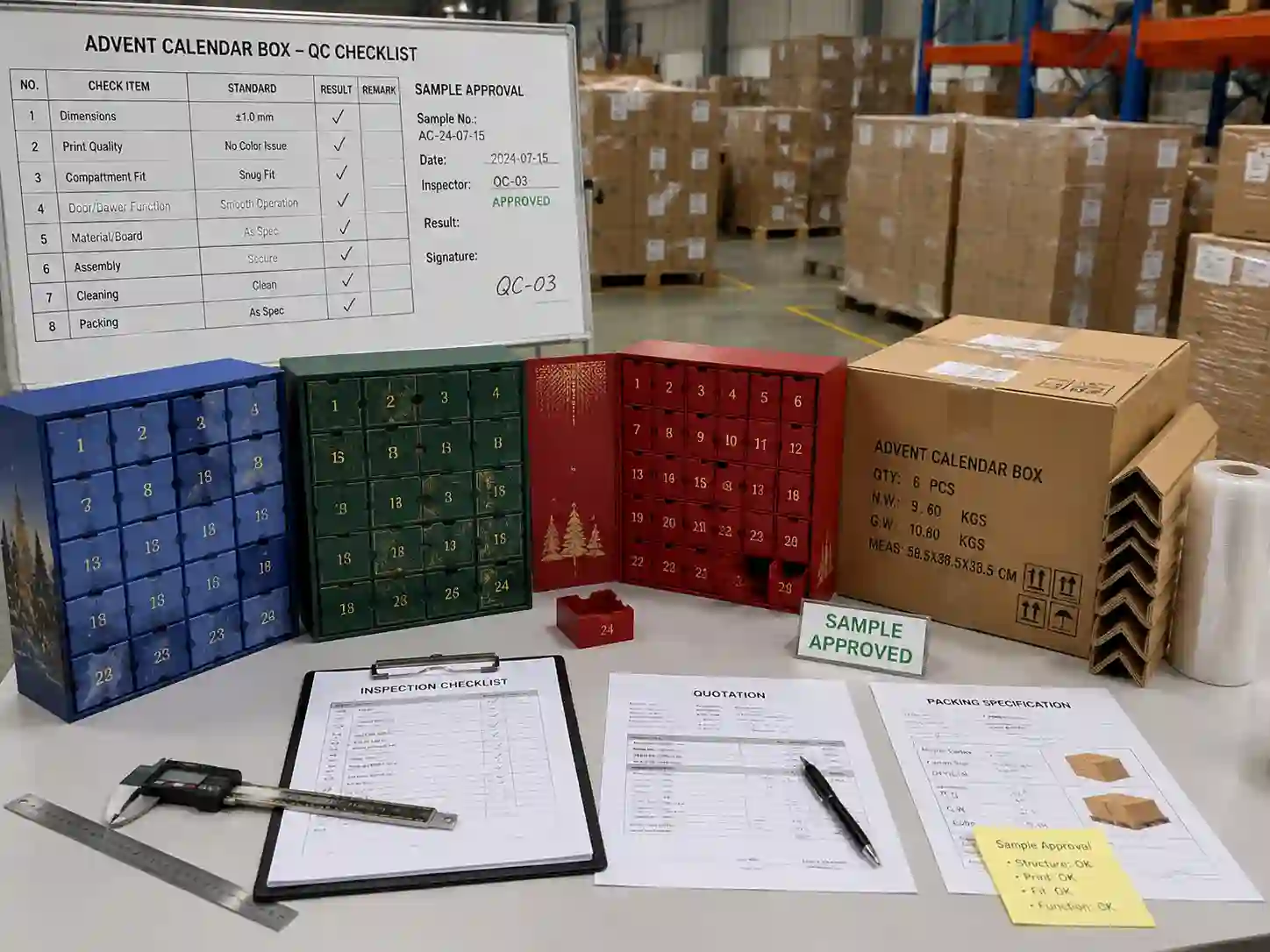
What QC checks are important for advent calendar boxes with multiple compartments?
Multi-compartment boxes require more inspection points because small errors can affect the entire opening experience.
QC checkpoints for production
- Compartment dimensions match approved specifications.
- Insert cavities hold products securely.
- Doors, drawers, and panels operate smoothly.
- Printing colors match approved samples.
- Foil stamping, embossing, and coating quality are consistent.
- Outer box strength meets shipping requirements.
- Export cartons protect finished products during transportation.
- Shipping marks and pallet preparation follow buyer requirements.
QC tip: Buyers should request inspection photos, sample approval records, and packing confirmation before shipment when managing overseas production.
FAQ: How many compartments should an advent calendar box have?
Is 24 compartments the standard for advent calendar boxes?
Twenty-four compartments are common for seasonal retail programs, but they are not always the best choice. The correct number depends on product size, customer experience, and production requirements.
Can I customize the number of compartments?
Yes. Custom advent calendar boxes can be designed with different compartment quantities based on product dimensions, campaign goals, and packaging structure.
Do more compartments always increase the price?
Not always. Cost depends on materials, structure, insert type, quantity, assembly process, and shipping requirements. A simple folding carton with many compartments may cost differently from a premium rigid box with fewer sections.
When should buyers decide the compartment layout?
The compartment layout should be confirmed before final artwork and production approval because it affects the dieline, insert design, and sample development.
How should buyers plan the right compartment design for their next project?
The answer to “how many compartments advent calendar box” buyers need is based on product fit, packaging structure, insert protection, production budget, and retail requirements. A successful project starts with accurate product information, prototype testing, and supplier communication.
Before contacting Giftpackpro, prepare your product dimensions, preferred compartment quantity, structure preference, artwork status, quantity estimate, and delivery requirements. Buyers can also explore more advent calendar box buying guides or request a custom quote for project-specific recommendations.


