Quick answer: Craft kit advent calendar boxes are custom multi-compartment packaging solutions designed to hold small creative items such as beads, yarn, stickers, washi tape, clay packs, brushes, buttons, charms, and paper shapes in a controlled seasonal presentation. For B2B buyers, the best solution depends on product weight, compartment count, insert accuracy, artwork complexity, MOQ, sampling method, export packing, and factory communication. A reliable China supplier should help check the dieline, test item fit, confirm material strength, review color proofing, and quote clearly for structure, insert, printing, finishing, assembly, and shipping preparation.
What should buyers understand before sourcing craft kit advent calendar boxes?
Buyers should understand that craft kit advent calendar boxes are not just printed gift boxes; they are packaging-engineered kits with many small items, separate compartments, door or drawer access, insert tolerance, and repeated opening actions. The structure must protect different shapes while keeping the retail display neat and easy to pack in bulk.
Craft items create special packaging challenges. Beads can shift, stickers can bend, yarn can compress, small charms can slide under dividers, and clay packs may need more space than expected after sealing. Before asking a factory for a quotation, the buyer should decide whether the calendar will be sold as a premium rigid gift set, a lightweight folding carton calendar, an e-commerce kit, or a retail shelf display.
For brands comparing China factories, the most important question is not only “What is the price?” A better question is: “Can this supplier control insert fit, door opening strength, color accuracy, assembly quality, and export packing at the target order quantity?” Giftpackpro works as a custom advent calendar boxes manufacturer for B2B buyers who need these details checked before mass production.
Which box structure is best for craft kit advent calendar boxes?
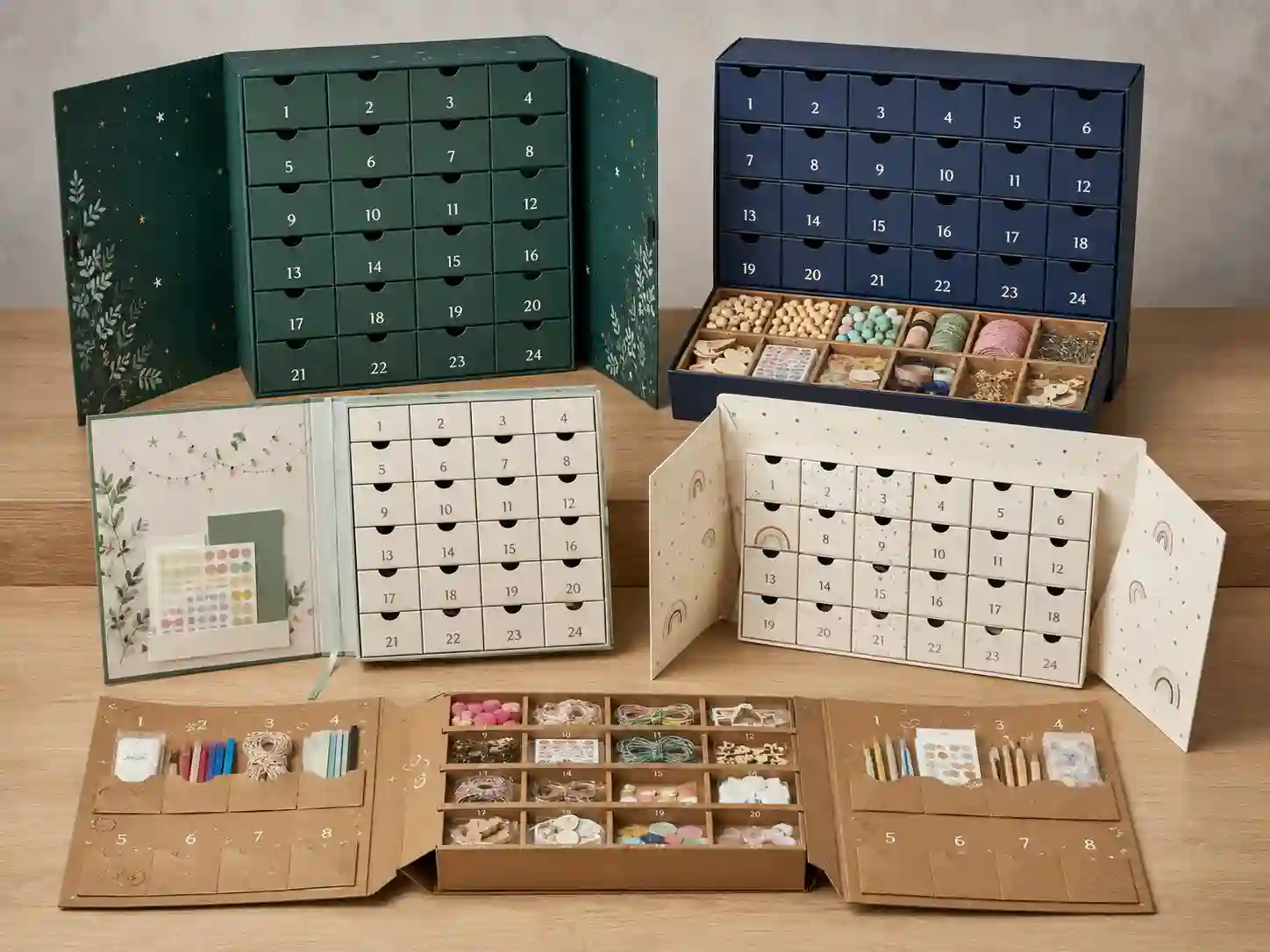
The best structure depends on the number of craft items, target retail price, item weight, shelf presentation, and shipping method. Door-opening calendars are popular for daily reveal concepts, drawer boxes feel more premium, folding cartons help control cost, and book-style boxes are useful when the brand wants a higher-value gift set appearance.
| Structure option | Best use case | Buyer advantages | Points to confirm with supplier |
|---|---|---|---|
| Door-opening box | Small craft items with numbered daily access | Strong advent calendar recognition, clear retail display, good for stickers, charms, beads, paper shapes, and mini brushes | Door perforation, finger notch size, insert alignment, paperboard thickness, and whether items push against doors during transit |
| Rigid drawer box | Premium craft kit gift sets with higher perceived value | Durable greyboard structure, reusable feeling, smooth drawer experience, strong presentation for retail and gifting | Drawer sliding tolerance, ribbon pull strength, inner tray fit, outer sleeve clearance, and assembled packing volume |
| Book-style craft activity calendar | Kits that need a storytelling panel, instruction area, or large front display | Premium opening experience, useful for brand copy, instruction cards, and mixed craft materials | Magnet or ribbon closure strength, spine width, insert height, and whether the lid closes flat after product loading |
| Folding carton calendar | Cost-sensitive campaigns, large-volume retail programs, lighter craft items | Lower unit cost, efficient flat packing, easier freight planning, suitable for paper stickers and lightweight accessories | Board stiffness, crease durability, door tearing control, loading method, and whether the carton can support stacked master cartons |
| Fold-out activity calendar | Interactive kits with activities, instruction panels, or craft steps | More space for instructions, strong campaign value, suitable for educational or DIY craft themes | Fold sequence, hinge durability, panel warping, and packed size after assembly |
Buyer tip: Ask the supplier to show the same item set in two or three structures during sample planning. A rigid drawer calendar may look premium, but a door-opening paperboard calendar may display better in retail if the front artwork and numbering system are more important than the unboxing mechanism.
How should inserts be designed for mixed craft items?
Inserts should be designed around the actual item dimensions, not only the outside box size. For craft kit advent calendar boxes, the insert is often the main factor that decides whether the product feels organized, survives shipping, and looks professional when opened.
Common craft kits include mixed items with very different behavior. Beads and buttons need small compartments that prevent movement. Yarn bundles need soft space without over-compression. Mini brushes and thread cards need length control. Clay packs need depth. Stickers and paper shapes need flat areas to avoid bending. A factory should request item samples or accurate product drawings before finalizing the insert.
Which insert material should buyers compare?
Paper inserts are suitable for many lightweight craft items and support paper-based packaging goals. PET trays provide clear cavity definition and are useful when items have irregular shapes. EVA and foam inserts hold delicate or premium accessories tightly, but they can increase cost and may not match all sustainability goals. Molded pulp can be considered when buyers want a paper-based molded structure, but tooling, cavity detail, and surface appearance should be reviewed early.
- Paper insert: Good for stickers, paper shapes, thread cards, mini envelopes, washi tape, and light accessories.
- PET tray: Good for mixed small items that need visible cavities and stable positioning.
- EVA insert: Useful for higher-value tools, brushes, metal charms, or delicate accessories that require tight holding.
- Foam insert: Useful for cushioning but should be checked for odor, compression marks, and product contact suitability.
- Molded pulp insert: Suitable for paper-based positioning when the cavity shapes are not too small or too complex.
Factory tip: A 1 mm insert tolerance issue can become visible when 24 or 25 compartments are repeated across a calendar. Buyers should approve the insert only after real product fit testing, not from a flat dieline screenshot.
What materials work best for craft kit advent calendar packaging?
The material choice should match the calendar structure, item weight, retail positioning, and export route. For most custom advent calendar boxes, paperboard is used for folding structures, while greyboard is used for rigid boxes that need stronger shape retention and premium shelf presence.
For lightweight craft kits, a folding carton with suitable paperboard may be enough. For heavier kits containing clay packs, mini tools, larger yarn rolls, or many small containers, a rigid box made with greyboard and wrapped printed paper can improve durability. Buyers should ask the factory whether the quoted material thickness is for the outer shell, inner tray, divider, or wrap paper, because these are often different components.
Brands with responsible sourcing requirements can ask suppliers to discuss paper sourcing and chain-of-custody documentation. Buyers can review official information from the Forest Stewardship Council when building their own paper sourcing policy, but they should verify any certification claim directly with the supplier and documents instead of assuming every paper option is certified.
How should artwork, numbering, and finishing be prepared?
Artwork should be prepared after the structure and insert layout are confirmed, because door positions, drawer fronts, fold lines, and compartment numbers must match the final dieline. A craft kit calendar usually needs clear numbering, practical item identification, and enough unprinted safety area around perforations, creases, and glue zones.
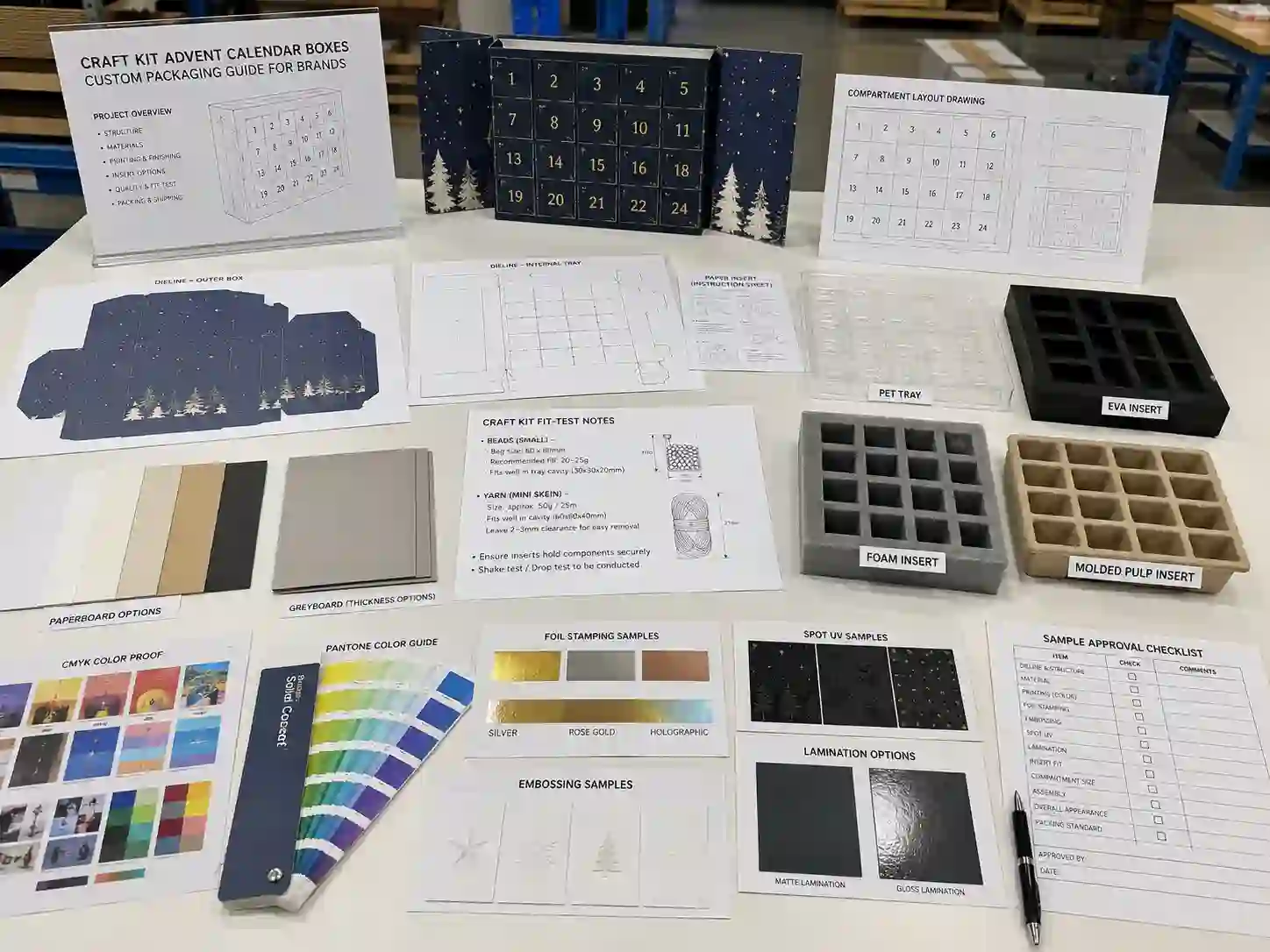
The most common artwork checks include CMYK setup, Pantone color references, barcode area, warning text area if needed, retail display panel, and printing tolerance around numbered doors. Buyers should ask for a dieline with bleed, safe area, crease lines, cut lines, and glue zones clearly marked. If the box includes foil stamping, embossing, spot UV, matte lamination, or gloss lamination, each finishing layer should be provided as a separate artwork file or clearly separated layer.
For craft kits, artwork should also consider product identification. If a buyer wants the calendar to include activity steps, QR codes, instruction cards, or age-related caution text, these areas should be planned before sample printing. Adding them after the sample stage can cause dieline changes, delay approval, and increase prepress cost.
Which finishing options make sense for B2B craft kit calendars?
Finishing should support the retail position without making production unstable. Matte lamination can give a clean modern appearance and reduce scuffing. Gloss lamination can make colors brighter but may show scratches more easily. Foil stamping works well for logos, numbers, or campaign titles. Embossing and spot UV can create a premium feel, but the factory should check registration accuracy when these effects are close to small numbered doors.
Buyer tip: Keep small numbers readable. A beautiful foil number that cannot be read under retail lighting is a packaging problem, not a design success.
How do MOQ, cost, and quotation details differ by structure?
MOQ and cost depend on structure complexity, material usage, insert type, printing, finishing, assembly labor, and packing method. Buyers comparing China suppliers should request itemized quotations instead of only comparing one total unit price.
A rigid drawer craft calendar usually costs more than a folding carton because it uses greyboard, wrap paper, more hand assembly, and larger export volume. A PET tray may require tooling or mold setup depending on complexity. EVA and foam inserts may increase material and cutting cost. Foil stamping, embossing, spot UV, and special lamination each add setup steps and production risk if artwork is not prepared correctly.
Quotation comparison should include these details:
- Box structure and open size
- Closed box size and compartment count
- Paperboard or greyboard thickness
- Insert material, thickness, and tooling needs
- Printing method, CMYK or Pantone references
- Finishing options such as foil stamping, embossing, spot UV, matte lamination, or gloss lamination
- Sample type and sample fee
- Estimated MOQ and price breaks
- Assembly method and whether product loading is included
- Export carton size, quantity per carton, gross weight, and pallet option
- Lead time for sample, pre-production sample, and mass production
How should importers compare China suppliers for craft kit advent calendar boxes?
Importers should compare suppliers by engineering support, quotation clarity, sampling discipline, communication speed, production control, and export packing experience. The lowest quote is not always the safest option if the supplier has not checked insert fit, loading method, or carton strength.
When sourcing from China, ask each factory the same RFQ questions and compare the quality of their answers. A serious supplier should ask about product dimensions, weight, target structure, artwork status, order quantity, delivery schedule, packing preference, and shipping destination. If a supplier quotes quickly without asking about compartment layout or insert material, the quotation may be too general for decision-making.
Decision guide: how to shortlist suppliers
- Choose a structure-capable supplier if your calendar needs rigid drawers, book-style opening, or complex door perforations.
- Choose an insert-capable supplier if your kit includes many small loose items such as beads, buttons, charms, or paper shapes.
- Choose a printing-detail supplier if your artwork includes Pantone color, foil stamping, embossing, spot UV, or tight numbering alignment.
- Choose an export-experienced supplier if your order will ship assembled, has fragile retail corners, or requires pallet planning.
- Choose a communication-reliable supplier if your launch date is fixed and sample revisions must be handled quickly.
Buyers can review custom advent calendar box services to understand the type of structural, sampling, printing, and production support that should be discussed before placing an order. They can also compare finished styles from custom advent calendar box products when preparing internal purchasing discussions.
What sampling process should buyers expect before mass production?
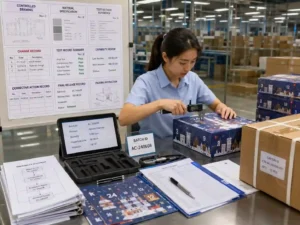
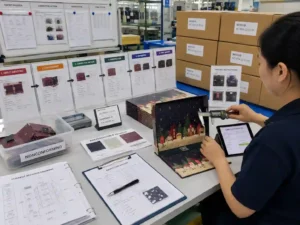
Buyers should expect sampling to move from structure confirmation to printed sample approval and then pre-production sample confirmation. For craft kit advent calendar boxes, sample approval should include real product fit testing, door or drawer function testing, color proof review, and packing simulation.
A blank sample can confirm size, structure, compartment layout, and insert fit before artwork is printed. A printed sample checks color, finishing, numbering, barcode position, and overall retail appearance. A pre-production sample should represent the final approved material, printing, finishing, insert, and assembly method before mass production starts.
Quotable B2B statement: “For craft kit advent calendar boxes, the sample is not only a visual approval tool; it is the buyer’s first test of insert tolerance, product loading efficiency, door-opening strength, and export packing risk.”
Practical sample approval checklist
- Confirm closed box size and open display size.
- Place every craft item into the correct compartment and shake the sample gently to check movement.
- Test door opening, drawer sliding, book-style hinge, or fold-out panels repeatedly.
- Check whether stickers, paper shapes, or instruction cards bend inside the compartment.
- Check if beads, buttons, charms, or small packs can escape from the cavity.
- Review CMYK color, Pantone matching, foil stamping, embossing, spot UV, and lamination surface.
- Confirm barcode area, numbering sequence, warning text, and retail display copy.
- Check glue areas, edge wrapping, crease lines, and corner quality.
- Confirm master carton packing direction and whether the sample corners need extra protection.
- Record all changes in one approval document before authorizing mass production.
Which QC points matter most during mass production?
QC should focus on repeated structure accuracy, insert fit, printing consistency, assembly strength, and export packing. Because advent calendar packaging has many repeated doors, drawers, or compartments, small production variations can create large visible problems across the order.
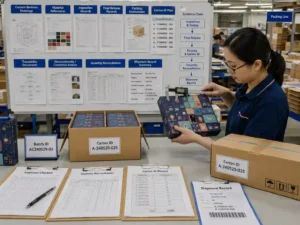
Important inspection points include material thickness, dieline cutting accuracy, door perforation strength, drawer sliding tolerance, insert cavity alignment, glue bonding, color consistency, finishing registration, numbering sequence, and carton packing method. Buyers should ask whether the supplier performs in-process checks before final inspection, because catching alignment problems after full assembly is expensive and slow.
For international orders, buyers may also request inspection criteria based on their own quality level. When packaging must pass transport simulation, buyers can review official resources from the International Safe Transit Association and discuss suitable test expectations with their logistics or quality team.
QC tip: For craft kit calendars, inspect a loaded sample, not only an empty box. Empty packaging can look perfect while loaded compartments reveal pressure marks, bulging doors, loose cavities, or uneven drawer movement.
How should export packing be planned for craft kit advent calendar boxes?
Export packing should be planned according to whether the calendars ship flat, semi-assembled, or fully assembled. Fully assembled rigid boxes protect presentation but increase carton volume; flat packed folding cartons reduce freight volume but require clear assembly control at the loading site.
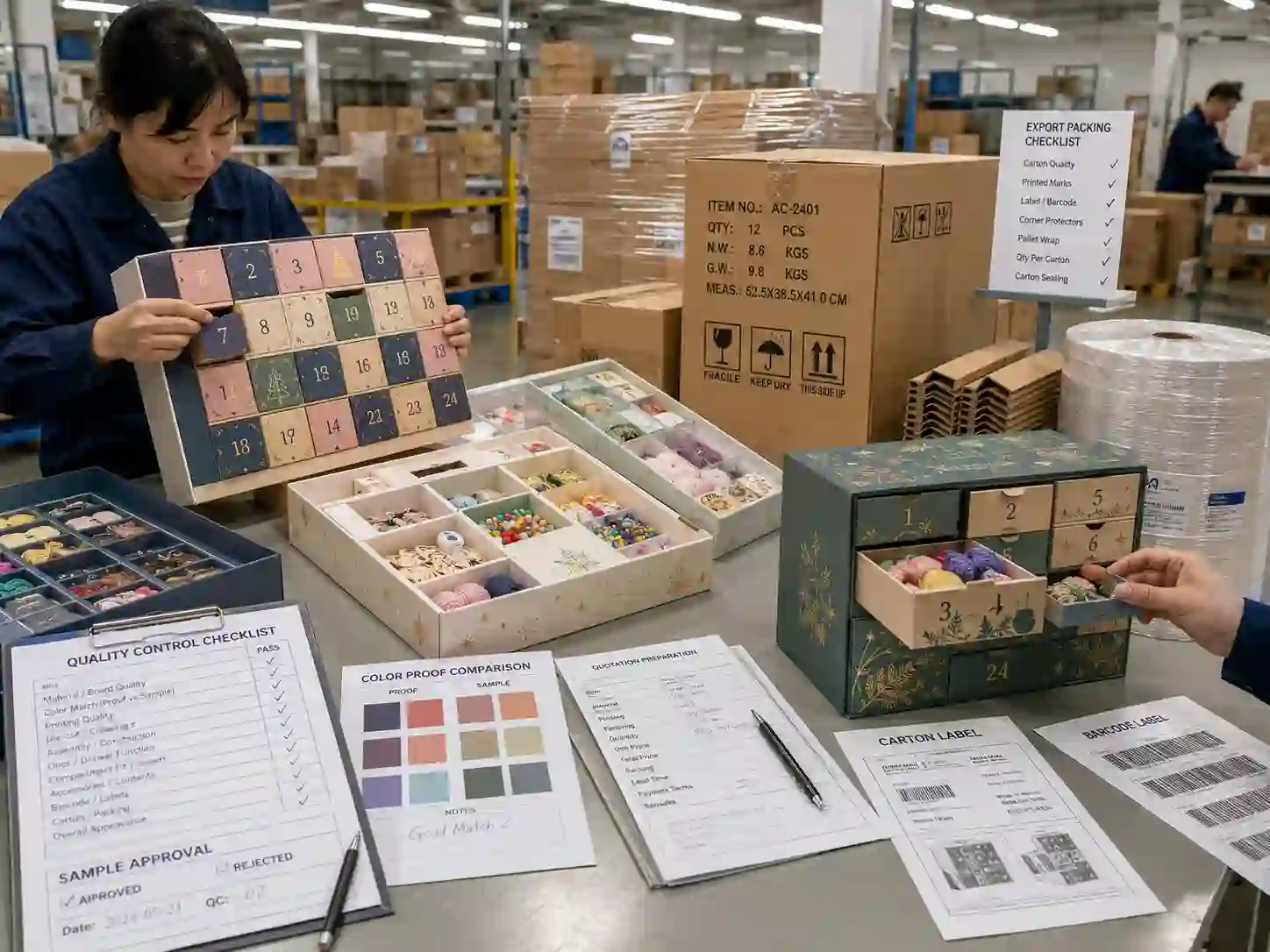
For craft kits, export carton planning should consider corner protection, carton stacking strength, moisture control, pallet layout, shipping marks, barcode labels, and carton drop risk. If items are loaded into the calendar before export, the master carton must prevent movement and crushing. If products are loaded after arrival, the buyer needs assembly instructions and packing sequence guidance.
Shipping marks should be generic but clear, including item code, carton number, quantity, gross weight, net weight, carton dimensions, and destination information when required by the buyer’s logistics process. Pallet wrapping, corner boards, and carton orientation marks can help reduce damage during long-distance shipping.
What information should buyers prepare before requesting a quotation?
Buyers should prepare product dimensions, item weights, compartment count, target structure, artwork status, order quantity, destination, and required delivery date before requesting a quotation. The more complete the RFQ, the easier it is for a supplier to provide a useful price and lead time.
Before contacting Giftpackpro, buyers can prepare the following information:
- Target box type: door-opening, rigid drawer, book-style, folding carton, or fold-out calendar
- Number of compartments and item list for each compartment
- Product dimensions, weights, photos, or physical samples
- Preferred insert type: paper insert, PET tray, EVA insert, foam, or molded pulp
- Artwork files, dieline status, logo files, and color references
- Printing and finishing preferences, including CMYK, Pantone, foil stamping, embossing, spot UV, matte lamination, or gloss lamination
- Expected MOQ, test order quantity, and annual forecast if available
- Sample requirement: blank sample, printed sample, or pre-production sample
- Export packing preference: flat, assembled, palletized, or special carton marking
- Target delivery schedule and shipping destination
Buyers who are still defining the project can read more advent calendar box buying guides or contact the Giftpackpro packaging factory team to discuss feasible options before finalizing the RFQ.
What common mistakes should buyers avoid?
The most common mistakes are quoting too early, choosing structure by appearance only, ignoring insert tolerance, approving artwork before the dieline is final, and comparing suppliers without matching specifications. These mistakes can cause sample revisions, delayed production, higher freight cost, or packaging that does not fit the craft items correctly.
- Mistake 1: Sending only a reference photo. A photo is useful for style direction, but the supplier still needs size, item list, quantity, material expectations, and packing method.
- Mistake 2: Ignoring item movement. Small beads, buttons, charms, and paper shapes need cavity control, not just visual compartments.
- Mistake 3: Choosing premium finishing too late. Foil stamping, embossing, and spot UV affect artwork layers, sample time, and production alignment.
- Mistake 4: Approving an empty sample only. Loaded samples reveal pressure, bulging, movement, and opening problems.
- Mistake 5: Comparing quotations with different assumptions. One quote may include assembled packing and a PET tray, while another may assume flat packing and a paper insert.
- Mistake 6: Forgetting export carton design. A beautiful retail box still needs suitable master cartons, corner protection, shipping marks, and pallet planning.
FAQ: Craft kit advent calendar boxes for B2B buyers
What are craft kit advent calendar boxes used for?
Craft kit advent calendar boxes are used to package multiple small creative products in numbered compartments for retail campaigns, e-commerce gift sets, promotional kits, and seasonal brand launches. They can hold items such as beads, yarn, stickers, washi tape, mini brushes, clay packs, paper shapes, buttons, charms, and thread cards.
Which structure is most cost-effective?
A folding carton calendar is usually more cost-efficient than a rigid drawer or book-style rigid box because it uses lighter paperboard and can often be packed flat. However, the best value depends on item weight, retail price point, assembly method, and shipping volume.
When should buyers choose a rigid box?
Buyers should choose a rigid box when the craft kit needs premium presentation, stronger shape retention, heavier product loading, or a gift-set feel. Rigid drawer boxes and book-style calendars are often selected for higher-value campaigns.
Can one calendar include different insert materials?
Yes. Some projects combine paperboard dividers with PET trays, EVA pads, or foam blocks for specific items. The buyer should confirm assembly complexity and cost before mixing too many insert types.
How long does sampling take?
Sampling time depends on structure, artwork readiness, insert complexity, and finishing. A blank structural sample is usually faster than a printed sample with foil stamping, embossing, spot UV, or special insert tooling. Buyers should confirm lead time with the supplier based on the final specification.
What makes a quotation reliable?
A reliable quotation clearly states structure, size, material, insert, printing, finishing, MOQ, sample cost, production lead time, packing method, export carton details, and payment terms. If these details are missing, the price may not be comparable.
CTA: How to prepare your project for Giftpackpro
To develop craft kit advent calendar boxes efficiently, prepare your item list, product sizes, target structure, compartment count, artwork files, preferred insert type, MOQ estimate, delivery schedule, and export packing requirements. Giftpackpro can then review structure feasibility, dieline planning, insert fit, sample options, printing details, QC points, and quotation requirements for your project.
For a practical supplier comparison, send the same complete RFQ to each factory and check who responds with clear engineering questions, realistic lead time, and itemized pricing. When you are ready to compare options or request a sample, you can request a custom quote for craft kit advent calendar boxes from Giftpackpro.