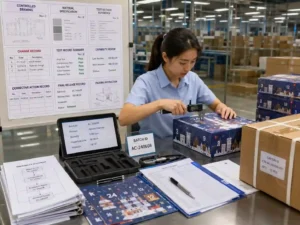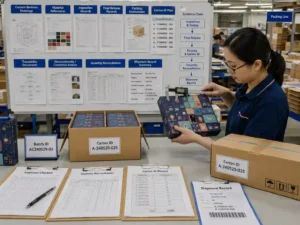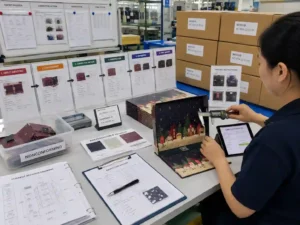
Quick answer: China advent calendar box lead time is mainly affected by box structure, material availability, insert design, artwork approval, printing and finishing processes, sampling speed, production quantity, quality control requirements, and export packing preparation. Buyers ordering custom advent calendar boxes should confirm the dieline, insert fit, printing specifications, finishing details, and approval timeline before production begins. A clear RFQ package and fast sample feedback can reduce delays and help suppliers plan mass production more accurately.

What should buyers know about China advent calendar box lead time before ordering?
The main factor affecting China advent calendar box lead time is the level of customization required. A simple folding carton with standard printing usually moves faster than a complex rigid box with multiple compartments, specialty inserts, and premium finishing.
For B2B buyers, lead time should be viewed as a complete project timeline, not only the factory production period. The schedule normally includes:
- Structure confirmation and dieline development
- Material selection and purchasing
- Artwork checking and printing proof approval
- Prototype or pre-production sample creation
- Mass production and assembly
- Quality control inspection
- Export packing and shipment preparation
A reliable supplier should explain which stages affect timing and which buyer decisions can create delays. Giftpackpro supports overseas buyers through custom advent calendar box services covering structure development, sampling, production coordination, and quality checks.
Which advent calendar box structures have different production timelines?
The box structure directly affects manufacturing complexity. Rigid boxes, drawer boxes, and door-opening designs usually require more processing steps than standard folding cartons because they involve additional assembly, components, and tolerance checks.
| Box structure | Lead time impact | Buyer considerations |
|---|---|---|
| Folding carton | Usually shorter production preparation | Suitable for lightweight products and higher-volume campaigns. Requires accurate paperboard selection and crease-line checking. |
| Rigid box | Longer due to wrapping and manual assembly | Common for premium gifts. Greyboard thickness, wrapping paper quality, and corner accuracy affect final appearance. |
| Drawer box | Requires additional fitting checks | Drawer movement, clearance, pull tab strength, and insert placement must be tested before bulk production. |
| Door-opening box | More engineering review needed | Hinge direction, opening performance, door alignment, and magnetic or locking functions require sampling. |
Factory tip: Buyers often focus on printing speed but overlook structure approval. A delayed dieline approval can affect the entire production schedule because printing plates, cutting tools, and materials cannot be finalized before the structure is confirmed.
How do inserts affect advent calendar box production time?
Insert design is one of the most underestimated lead-time factors. Advent calendar boxes often contain multiple compartments, meaning every cavity must match the product size and opening method.
Common insert options include:
- Paper inserts: Cost-effective and suitable for lightweight products such as cards, samples, and small accessories.
- PET trays: Provide accurate product positioning and a cleaner retail presentation.
- EVA inserts: Used for premium products requiring cushioning and a secure fit.
- Foam inserts: Suitable for delicate items requiring protection.
- Molded pulp inserts: Used when buyers need a paper-based protective solution.
Each insert type requires fit testing. A product that is too loose may move during shipping, while an insert cavity that is too tight may slow assembly or damage the product during packing.
How do printing and finishing choices change China advent calendar box lead time?
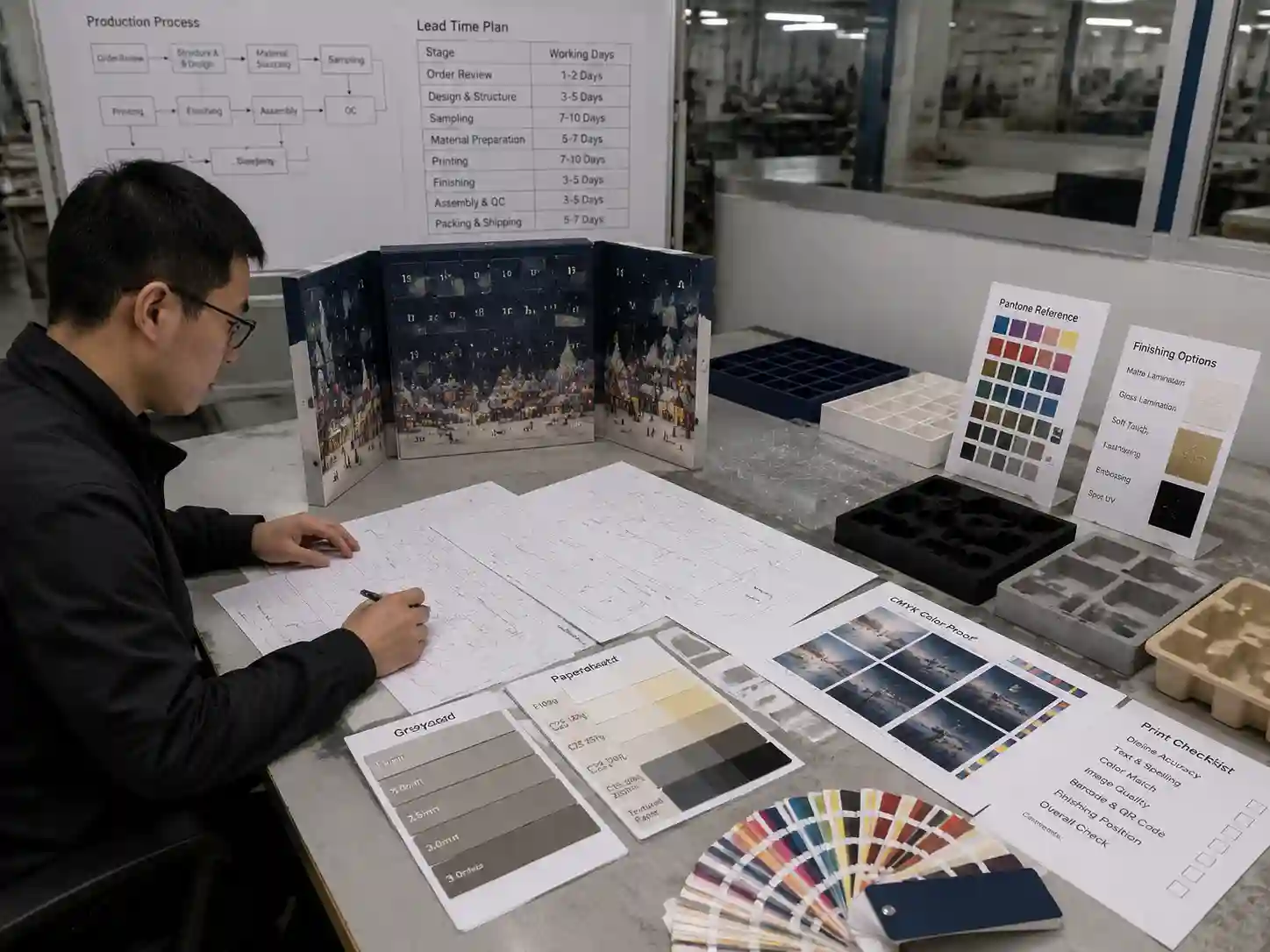
Printing and finishing requirements can significantly influence production schedules because premium effects require additional preparation, approval, and processing steps.
Standard CMYK printing is generally easier to schedule, while Pantone matching, foil stamping, embossing, spot UV, and specialty coatings require more detailed confirmation.
| Printing or finishing option | Lead time consideration | Buyer approval requirement |
|---|---|---|
| CMYK printing | Standard workflow after artwork approval | Confirm color expectations using printed proofs when accuracy matters. |
| Pantone color matching | May require additional color adjustment | Approve color references before bulk printing. |
| Matte lamination | Usually follows standard finishing workflow | Check surface appearance and compatibility with artwork. |
| Gloss lamination | Requires finishing scheduling | Confirm reflection and color appearance. |
| Foil stamping | Requires tooling and placement confirmation | Approve foil position and artwork separation. |
| Embossing | Requires mold preparation | Check depth, alignment, and surface effect. |
| Spot UV | Requires separate coating setup | Confirm highlighted areas on artwork files. |
Why are artwork checks important before production?
Artwork approval is a common cause of delay because packaging errors are expensive to correct after printing begins. Buyers should confirm:
- Correct dieline placement and folding direction
- Text position and barcode readability
- Color references and print expectations
- Finishing locations such as foil, embossing, and spot UV areas
- Panel alignment after assembly
Buyer tip: A signed artwork approval and production sample approval reduce the risk of reprinting, which can create much longer delays than the original approval process.
How do MOQ and order quantity affect production scheduling?
MOQ affects production planning because suppliers need to arrange materials, machine scheduling, labor allocation, and packing requirements based on order volume.
Larger quantities may require longer production time but can improve efficiency because setup costs are spread across more units. Smaller orders may require more careful scheduling, especially when they include complex structures or multiple finishing processes.
When comparing suppliers, buyers should ask:
- What MOQ applies to this structure and material combination?
- Is the MOQ different for custom inserts or special finishing?
- Does the supplier separate sample timing from bulk production timing?
- How is production capacity allocated during seasonal demand periods?
What sample and approval steps should buyers include in the timeline?
Sampling is a critical checkpoint before mass production. A professional packaging supplier should confirm the prototype structure, printing quality, insert fit, and finishing appearance before bulk manufacturing.
A typical approval process includes:
- Review initial design requirements and product dimensions.
- Create dieline and structural proposal.
- Produce prototype sample.
- Check box opening, insert fitting, and appearance.
- Approve printing proof or pre-production sample.
- Start mass production after confirmation.
For custom advent calendar boxes, sampling is especially important because the package combines multiple components. A drawer box may need movement testing, while a door-opening box may require hinge and alignment checks.
Buyers can review more practical sourcing topics through our advent calendar box buying guides before preparing a supplier comparison.
How should buyers compare suppliers for faster and more reliable delivery?
The fastest supplier is not always the one with the shortest quoted production time. Buyers should compare supplier capability, communication speed, engineering experience, and quality control systems.
| Supplier comparison point | Why it matters |
|---|---|
| Engineering support | Experienced suppliers identify structural problems before production. |
| Sample process | Clear approval steps reduce production mistakes. |
| Printing control | Proofing prevents color and finishing disputes. |
| QC process | Inspection catches assembly, alignment, and material issues. |
| Export experience | Proper cartons and packing reduce shipping damage. |
Giftpackpro provides buyers with information about its custom advent calendar box products and manufacturing capabilities so purchasing teams can compare suitable structures before requesting samples.
What quality checks should happen before export shipment?
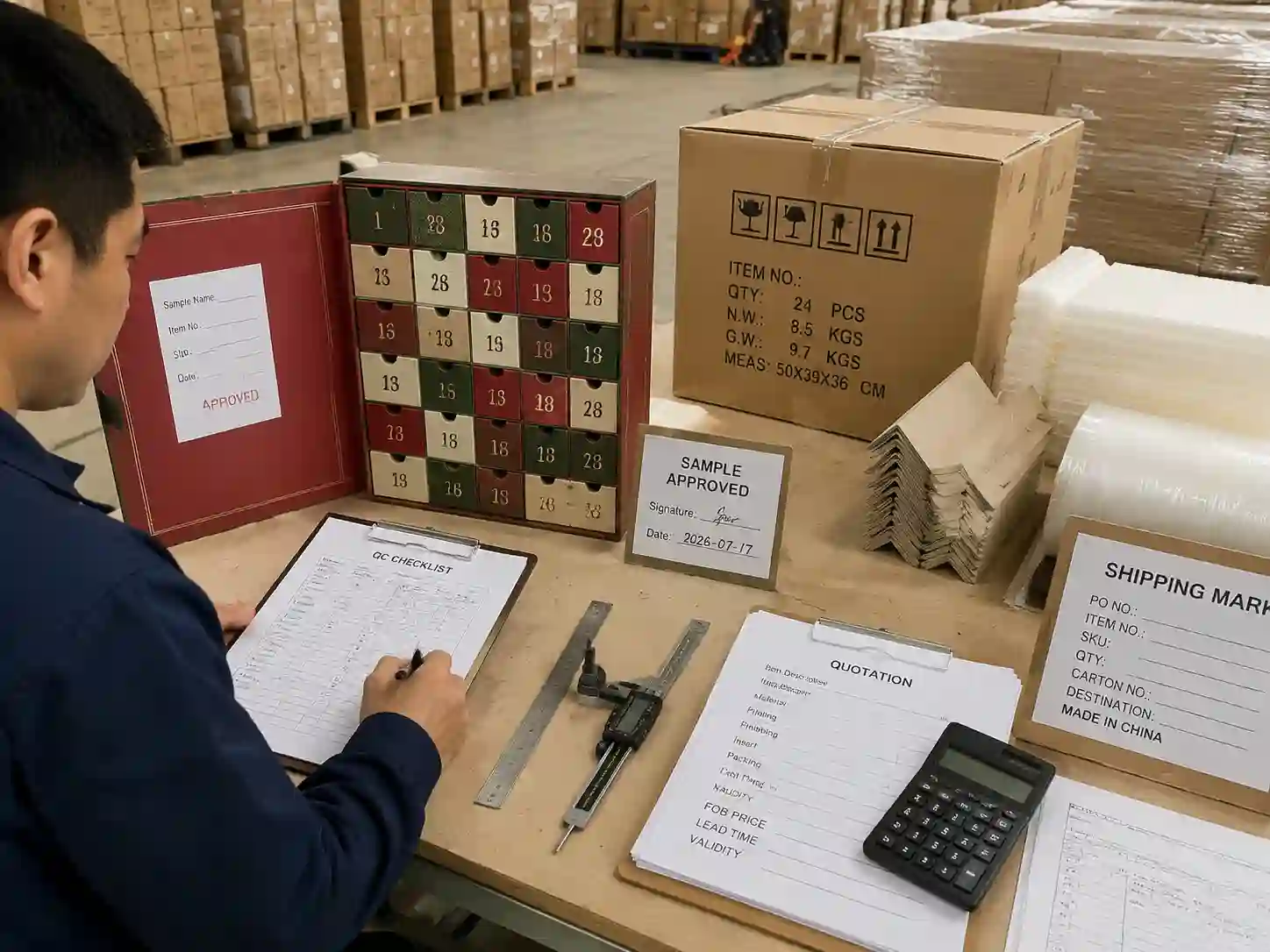
Quality control should happen before shipment, not after goods arrive. Final inspection normally covers appearance, dimensions, assembly performance, printing quality, and export packing condition.
A practical QC checklist includes:
- Box dimensions match approved specifications
- Panels are square and correctly aligned
- Drawer movement or door opening works correctly
- Insert cavities match approved product samples
- CMYK or Pantone colors match approved references
- Foil, embossing, and spot UV effects are correctly positioned
- Cartons protect finished boxes during transportation
- Shipping marks and carton information are correct
QC tip: Export packing decisions influence lead time because cartons, corner protection, pallet planning, and shipping marks should be prepared before the shipment date rather than after production completion.
What information should buyers prepare before requesting a quotation?
A complete RFQ package helps suppliers provide a more accurate quotation and realistic production timeline.
Before contacting a factory, prepare:
- Box structure preference: rigid box, folding carton, drawer box, or door-opening box
- Finished box dimensions and product measurements
- Number of compartments required
- Insert material preference
- Printing requirements such as CMYK or Pantone colors
- Finishing requirements including lamination, foil stamping, embossing, or spot UV
- Target quantity and expected delivery date
- Shipping destination and export packing requirements
Buyers can request a custom quote from Giftpackpro with these details to help the factory evaluate structure, materials, sampling requirements, and production planning.
China Advent Calendar Box Lead Time: Frequently Asked Questions
How long does China advent calendar box production usually take?
Production time varies depending on structure, quantity, materials, finishing, sampling requirements, and approval speed. Custom rigid boxes with complex inserts and specialty finishing usually require more planning than standard paperboard cartons.
Does adding foil stamping or embossing increase lead time?
Yes. Foil stamping and embossing require additional preparation, tooling, and approval checks. Buyers should confirm these effects during the sample stage to avoid production changes.
Can buyers reduce lead time for custom advent calendar boxes?
Buyers can reduce delays by preparing complete artwork, confirming product dimensions early, approving samples quickly, and avoiding late structure or finishing changes after production begins.
Why is insert testing important for lead time?
Insert testing prevents assembly problems and product-fit issues. Correcting insert problems after mass production starts can create major delays and additional costs.
Final buyer checklist for planning China advent calendar box lead time
The most effective way to control lead time is to make packaging decisions early. Buyers should confirm structure, inserts, artwork, finishing, sampling, QC, and export requirements before placing bulk orders.
- Confirm structure and product fit before quotation.
- Prepare complete artwork and finishing instructions.
- Approve samples before mass production.
- Check printing, assembly, and insert quality during QC.
- Confirm export carton and shipping requirements before shipment.
For buyers sourcing seasonal packaging, working with an experienced custom advent calendar boxes manufacturer helps reduce communication gaps and production risks. Learn more about the Giftpackpro packaging factory approach or contact the team for project evaluation.