Quick answer: Yes, advent calendar boxes can be used for food packaging when the structure, inserts, materials, and production controls are designed for the specific food product. For B2B buyers, the key considerations are not only the appearance of the box but also product separation, moisture and odor awareness, insert fit, labeling space, sampling accuracy, quality inspection, and export protection. Custom advent calendar boxes for food applications are commonly developed for chocolates, snacks, tea, coffee, confectionery, and gift food sets, but suppliers should confirm suitable materials and buyer compliance requirements before mass production.
For brands, wholesalers, and retail buyers evaluating advent calendar boxes food packaging, the right supplier should help control the complete process from dieline development and prototype testing to bulk production and final shipment inspection.
Can advent calendar boxes be used for food packaging applications?
Yes, they can be used for many food gift applications, especially when the packaging structure protects individual products and supports retail presentation. The box itself usually functions as the outer gift package, while inserts or trays organize each food item inside.
Common food applications include:
- Chocolate and confectionery advent calendar boxes with individual compartments.
- Tea or coffee sampler boxes with separated sachets or small containers.
- Snack gift sets requiring multiple product spaces.
- Premium food gift packaging for seasonal retail campaigns.
- Mixed product calendars combining different food formats.
Buyers should define the product size, weight, packaging environment, and handling requirements before selecting a structure. A box designed for lightweight chocolate pieces may not be suitable for heavier glass jars, tins, or moisture-sensitive products without structural adjustments.
What should buyers understand before choosing food advent calendar boxes?
The most important decision is matching the box structure and internal protection system with the actual food product. A visually attractive box can still fail if compartments are too loose, inserts deform, or products move during transportation.
Before requesting a quotation, buyers should prepare:
- Product dimensions and quantity per compartment.
- Individual product packaging information.
- Total box weight and expected shipping conditions.
- Retail display requirements.
- Artwork requirements and branding guidelines.
- Target market requirements for labeling and packaging information.
Buyer tip: Send physical samples or detailed product drawings whenever possible. Packaging factories can create more accurate dielines and inserts when product tolerance information is available.
Which advent calendar box structures work best for food products?
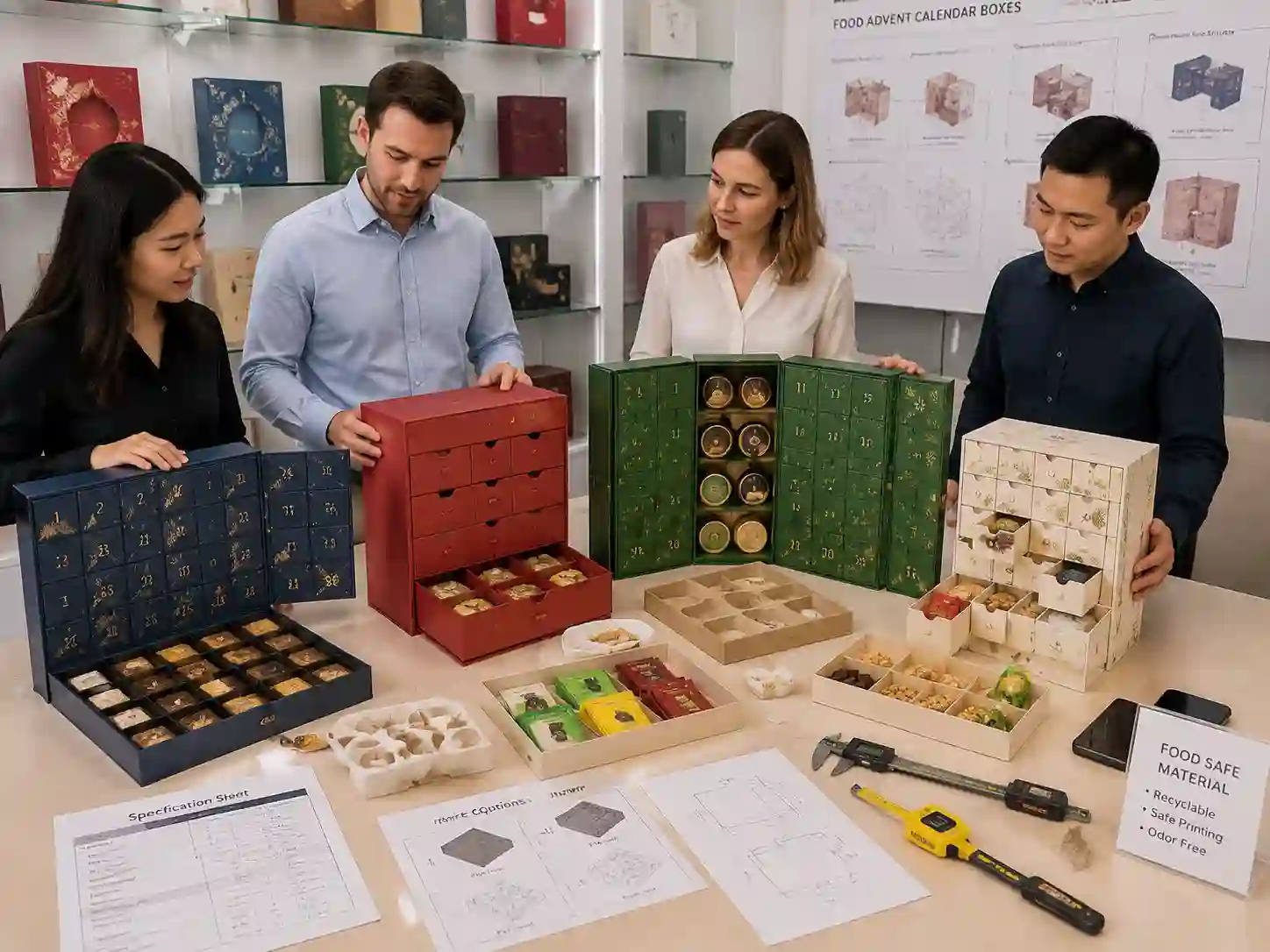
The best structure depends on product weight, opening experience, budget, and shipping requirements. Buyers usually compare rigid boxes, folding cartons, drawer boxes, and door-opening boxes.
| Structure | Best For | Advantages | Buyer Considerations |
|---|---|---|---|
| Rigid box | Premium chocolate, luxury food gifts, seasonal collections | High perceived value, strong protection, premium finishing options | Higher material and labor cost, larger shipping volume |
| Folding carton | Mass retail food calendars, lightweight products | Lower cost, efficient shipping, easy printing | Requires accurate folding and insert design |
| Drawer box | Premium sampler sets and gift collections | Smooth opening experience and strong presentation | Drawer movement needs production testing |
| Door-opening box | Retail displays requiring visible compartments | Good product visibility and storytelling layout | Hinges, doors, and locking points need inspection |
Many food brands choose custom advent calendar box products based on product positioning. Premium brands often select rigid box structures, while high-volume campaigns may prefer folding carton solutions for cost control.
How do inserts protect food products inside advent calendar boxes?
Inserts are one of the most important components because they control product movement, separation, and presentation. A suitable insert keeps products organized while reducing damage during handling and shipping.
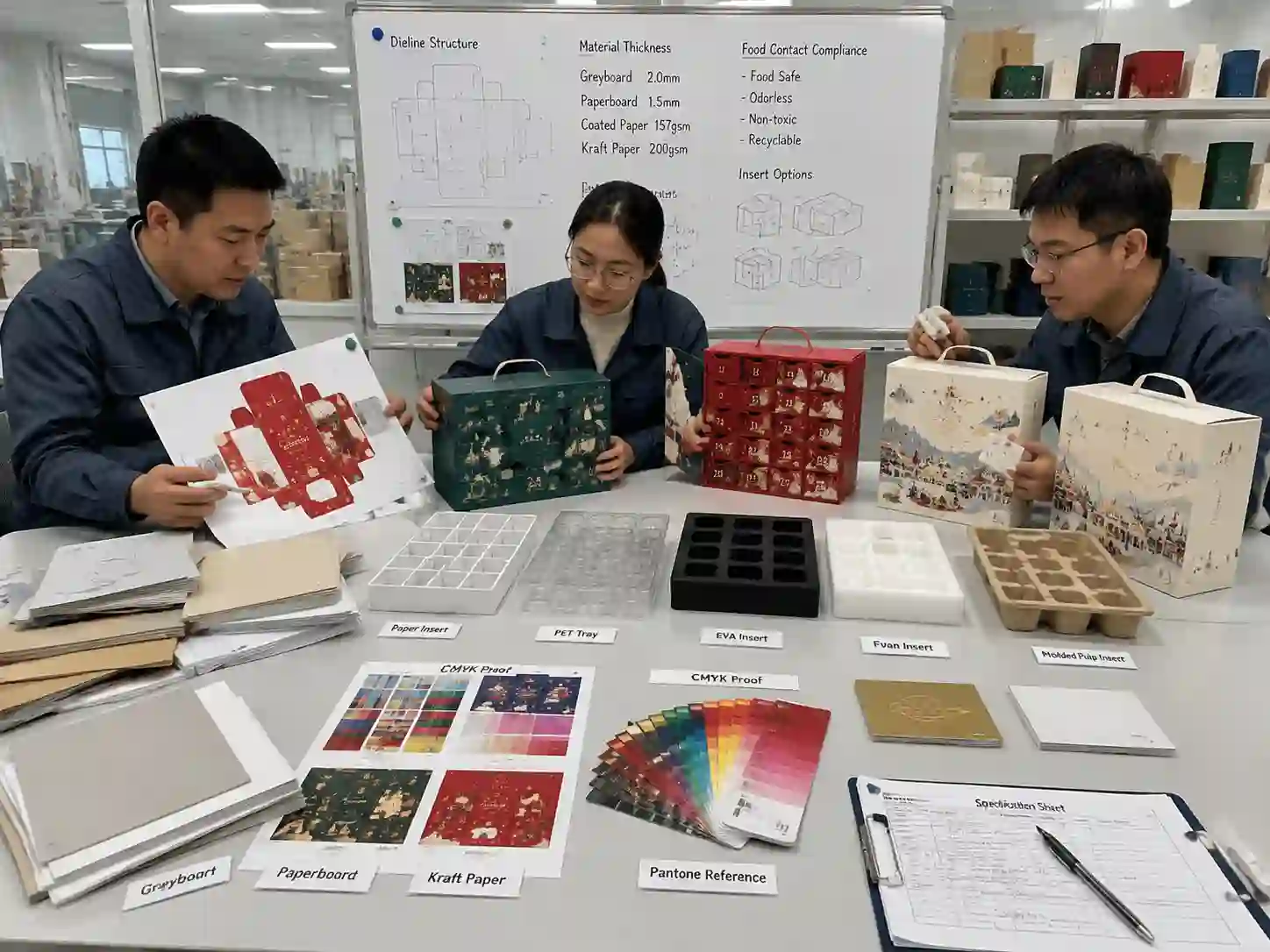
Common insert options include:
- Paper insert: Cost-effective and recyclable option for lightweight products.
- PET tray: Provides accurate product positioning and clear compartment visibility.
- EVA insert: Used when cushioning and premium presentation are important.
- Foam insert: Suitable for products requiring additional protection.
- Molded pulp insert: A paper-based alternative for brands seeking renewable material options.
For food packaging projects, buyers should discuss odor awareness, moisture sensitivity, product contact requirements, and whether the insert needs additional protection layers. Suppliers should not assume one insert material works for every food category.
What materials are commonly used for food advent calendar packaging?
Most custom food advent calendar boxes combine printed paper materials with structural boards. Material selection affects strength, appearance, cost, and shipping performance.
- Paperboard: Common for folding cartons and lightweight packaging.
- Greyboard: Used as the rigid structure inside premium boxes.
- Specialty papers: Used for texture and premium appearance.
- Protective coatings: Such as matte lamination or gloss lamination depending on design needs.
Buyers discussing food applications should verify material suitability with suppliers and confirm any required market regulations. For example, companies selling products in different regions may need to review official food-contact guidance, such as the information provided by the FDA food contact substances guidance.
How does customization work for food advent calendar boxes?
Customization normally starts with product measurements and a packaging brief. The factory creates a dieline, develops the structure, prepares artwork, and produces a sample before mass production.
The typical development process includes:
- Review product dimensions and packaging requirements.
- Create structural drawings and dieline proposals.
- Select materials and insert solutions.
- Prepare artwork files and printing specifications.
- Produce prototype or pre-production samples.
- Complete buyer approval before bulk manufacturing.
Printing and finishing choices can include CMYK printing, Pantone color matching, foil stamping, embossing, spot UV, matte lamination, or gloss lamination. For food gift packaging, buyers should pay special attention to color consistency because seasonal retail campaigns often require multiple production batches to match approved samples.
What quality control checks are important for food advent calendar boxes?
Quality control should cover structure, printing, assembly, inserts, and final packing. Food packaging projects require consistent production because even small assembly differences can affect product placement and retail appearance.
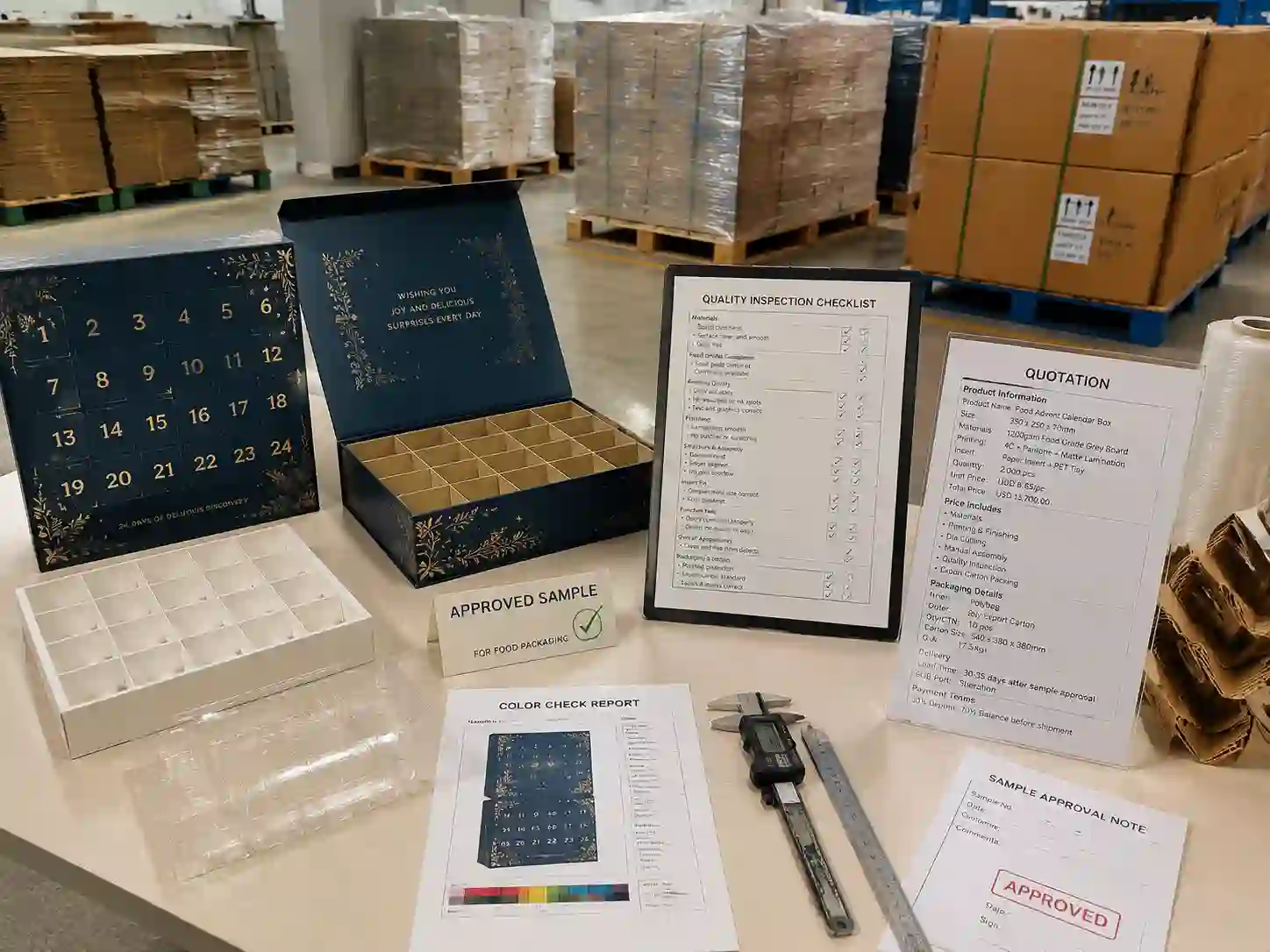
Production QC checklist for buyers
- Confirm material specifications match the approved sample.
- Check dieline dimensions and compartment accuracy.
- Test insert fitting with actual products.
- Review printing color against approved CMYK or Pantone references.
- Inspect foil stamping, embossing, and surface finishing quality.
- Check box opening performance and assembly strength.
- Inspect final packed cartons before shipment.
QC tip: A successful pre-production sample approval process reduces the risk of large-scale corrections after mass production begins.
How should buyers compare suppliers for custom food advent calendar boxes?
The best supplier is not always the one offering the lowest unit price. Buyers should compare manufacturing capability, communication, sampling process, QC methods, and export experience.
| Supplier Evaluation Area | Questions Buyers Should Ask |
|---|---|
| Structure capability | Can the factory develop rigid box, drawer box, folding carton, and custom insert solutions? |
| Sampling process | Does the supplier provide prototype and pre-production sample approval? |
| Quality control | Are printing, assembly, insert fit, and packing inspections included? |
| Export experience | Can the supplier prepare export cartons, pallet packing, and shipping marks? |
| Communication | Can the supplier clearly explain materials, lead time, MOQ, and quotation details? |
Working with an experienced Giftpackpro packaging factory helps buyers coordinate design, production planning, and quality checks from one source.
What MOQ, lead time, and quotation details should food packaging buyers prepare?
MOQ and lead time depend on box structure, materials, finishing, inserts, and production requirements. Buyers should provide enough information for an accurate quotation instead of requesting a price with only a box size.
A professional RFQ should include:
- Box structure preference.
- Finished size and compartment quantity.
- Product dimensions and weight.
- Material preference.
- Printing and finishing requirements.
- Insert requirements.
- Estimated order quantity or MOQ target.
- Destination country and export packing requirements.
- Required sample timeline and production deadline.
Factory tip: The more complete the RFQ information, the easier it is for suppliers to calculate material usage, labor requirements, sampling costs, and production lead time accurately.
How should food advent calendar boxes be packed for international shipping?
Export packing protects finished boxes from compression, moisture exposure, and handling damage during transportation. Buyers should discuss carton strength, pallet arrangement, corner protection, and shipping marks before production completion.
Typical export packing considerations include:
- Strong export cartons matched to box dimensions.
- Protection between stacked products.
- Corner protectors for pallet stability.
- Stretch wrapping for pallet shipments.
- Clear shipping marks and carton identification.
For larger retail programs, buyers may also review logistics requirements with reference organizations such as GS1 SSCC identification standards when carton tracking is needed.
Common mistakes when ordering advent calendar boxes for food packaging
Many packaging problems happen because buyers confirm appearance before confirming production details.
- Choosing a structure without testing real product fit.
- Approving artwork before checking dieline alignment.
- Ignoring insert tolerance differences.
- Requesting quotations without product specifications.
- Skipping sample approval before bulk production.
- Not considering export protection requirements.
FAQ: Advent calendar boxes food packaging questions from buyers
Can custom advent calendar boxes hold chocolate products?
Yes. Chocolate products are a common application, but the compartment size, insert material, and protection method should be designed according to product dimensions and handling requirements.
Are rigid boxes better than folding cartons for food gift packaging?
Rigid boxes usually provide a more premium presentation and stronger structure, while folding cartons can offer better cost efficiency for larger retail quantities.
Do suppliers provide samples before bulk production?
Professional suppliers usually recommend prototype or pre-production samples so buyers can confirm structure, printing, inserts, and assembly performance before placing large orders.
What information is needed to request a quotation?
Buyers should prepare product details, box size, structure preference, materials, finishing requirements, quantity, destination, and timeline. Buyers can use request a custom quote to provide project details for evaluation.
Final guide: How to choose the right advent calendar boxes food packaging solution
Advent calendar boxes can be effective food gift packaging when structure, inserts, materials, printing, QC, and export packing are planned together. The best results come from treating the box as a complete packaging system rather than only a printed outer shell.
Before starting a project, buyers should review supplier capabilities, approve samples carefully, and compare quotations based on total value including production control and reliability. Explore more advent calendar box buying guides or contact Giftpackpro for custom advent calendar box services and packaging development support.