
Quick answer: Yes, recyclable advent calendar boxes can be produced for cosmetics, chocolate, candles, jewelry, toys, tea, coffee, beverages, and gift products by selecting suitable paper-based structures, recyclable board materials, and compatible inserts. For B2B buyers, the key is not only choosing recyclable materials but also balancing product protection, premium appearance, printing quality, assembly performance, MOQ, sampling accuracy, and export durability. A reliable packaging supplier should help evaluate structure, dieline, inserts, artwork, prototype testing, QC requirements, and quotation details before mass production.

Can custom advent calendar boxes be made with recyclable materials?
Yes. Most custom advent calendar boxes can be developed with recyclable paper-based materials, especially when buyers select the right combination of paperboard, greyboard, paper inserts, and suitable surface finishing options.
For overseas brands and retailers, recyclable packaging decisions usually depend on the product category, required protection level, shelf presentation, and target market requirements. A luxury cosmetics calendar may need a rigid box structure with carefully engineered inserts, while a lightweight tea or coffee calendar may use a folding carton structure with paperboard compartments.
Recyclable advent calendar boxes are commonly developed using:
- Paperboard: suitable for folding carton structures and lightweight retail packaging.
- Greyboard: commonly used for rigid boxes requiring strength and premium presentation.
- Paper inserts: useful for compartments and products with moderate protection needs.
- Molded pulp inserts: a paper-based option for products requiring cushioning and shape support.
- Recyclable paper wrapping materials: used for certain box coverings and finishing applications.
Buyers should confirm material composition with suppliers and verify whether the selected materials meet their market requirements. For example, buyers selling in markets with sustainability claims may need supporting documentation from material suppliers rather than relying only on general “eco-friendly” descriptions.
Which advent calendar box structures work best with recyclable materials?
The best structure depends on the product size, weight, protection requirements, and brand positioning. Recyclable materials can be applied to different structures, but each option has different engineering considerations.
| Box Structure | Typical Application | Recyclable Material Considerations | Buyer Decision Point |
|---|---|---|---|
| Folding carton | Tea, coffee, chocolate, small gifts | Paperboard construction with paper compartments or inserts | Best for lighter products and efficient shipping |
| Rigid box | Luxury cosmetics, jewelry, premium gifts | Greyboard with paper wrapping materials | Requires strength testing and precise assembly |
| Drawer box | Beauty sets, gift collections | Paper-based outer structure with engineered trays | Sliding performance and insert fit must be checked |
| Door-opening box | Premium seasonal collections | Rigid or paperboard structures with compartment layouts | Opening experience and product visibility are critical |
Buyer tip: A recyclable structure should still protect the product throughout storage, transportation, and retail handling. A weaker box that causes product damage can create more waste and higher replacement costs.
How do recyclable advent calendar boxes work for different product categories?
Recyclable packaging solutions need to match the product category because each product creates different packaging challenges.
- Cosmetics: Small bottles, tubes, and jars often require accurate inserts to prevent movement. Paper inserts, molded pulp, or carefully designed compartments may be considered depending on product weight.
- Chocolate: Food products require careful consideration of material suitability, hygiene requirements, and product-contact components. Buyers should confirm any food-contact requirements with qualified suppliers.
- Candles: Heavier items need stronger structures, reinforced corners, and reliable internal support.
- Jewelry: Premium presentation may require precise slots, cushions, or protective inserts while maintaining a recyclable packaging goal.
- Toys: Larger compartments and stronger paperboard structures may be needed to prevent deformation.
- Tea and coffee: Lightweight products often work well with folding cartons and paper-based divider systems.
- Beverages: Bottle size, weight, and shipping stress usually require stronger testing before bulk production.
- Gift products: Structure selection depends on whether the priority is appearance, protection, or shipping efficiency.
Before requesting a quote, buyers should provide product dimensions, weight, quantity per calendar, and packaging requirements. This allows the supplier to recommend a realistic structure instead of quoting based only on box size.
What materials and finishes should buyers consider for recyclable packaging?
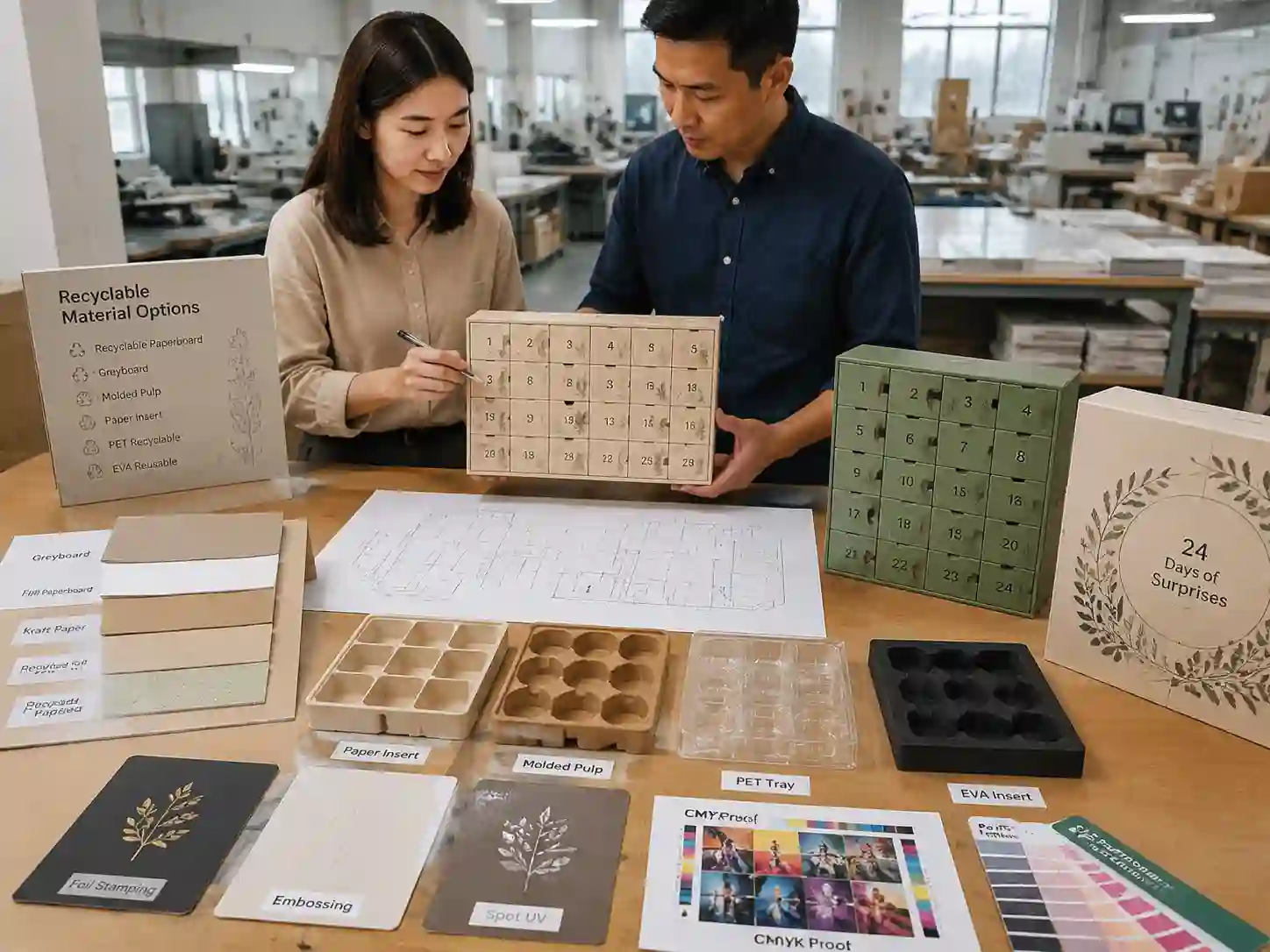
Material selection affects recyclability, appearance, durability, and production cost. Buyers should evaluate the complete packaging system rather than one material alone.
What recyclable material options are commonly reviewed?
- Paperboard thickness and stiffness
- Greyboard thickness for rigid structures
- Paper insert designs for compartments
- Molded pulp solutions for cushioning
- Alternative inserts compared with PET tray or EVA insert options
Can premium printing and finishing still be used?
Yes. Recyclable advent calendar boxes can still use professional printing and finishing processes. Buyers commonly review:
- CMYK printing for full-color artwork
- Pantone color matching for brand consistency
- Matte lamination for a soft premium appearance
- Gloss lamination for stronger visual impact
- Foil stamping for decorative highlights
- Embossing for texture and premium positioning
- Spot UV for selected design areas
However, buyers should discuss finishing combinations during the design stage because some coatings or mixed-material combinations may affect recycling considerations in certain markets.
Factory tip: A supplier should check the dieline before artwork approval. Incorrect dieline placement can cause printing, folding, and assembly problems even when the material selection is correct.
What should buyers check before ordering recyclable advent calendar boxes?
Buyers should evaluate the complete production process, from prototype development to final export packing. Choosing recyclable materials is only one part of successful packaging sourcing.
Buyer checklist before production
- Confirm the box structure: rigid box, folding carton, drawer box, or door-opening box.
- Confirm product dimensions, weight, and compartment layout.
- Review insert options including paper insert, PET tray, EVA insert, foam, or molded pulp.
- Approve dieline and artwork placement before printing.
- Check CMYK or Pantone color proofing requirements.
- Review sample construction and product fitting results.
- Confirm MOQ and production timeline.
- Define QC inspection points before mass production.
- Confirm export carton requirements and shipping protection.
How should buyers compare suppliers for recyclable advent calendar boxes?
The best supplier comparison should focus on manufacturing capability, communication quality, and quality-control systems rather than only unit price.
| Supplier Evaluation Area | Questions Buyers Should Ask |
|---|---|
| Material knowledge | Can the supplier recommend suitable recyclable board and insert options? |
| Structure engineering | Can the factory review dielines and test assembly performance? |
| Sampling | Does the supplier provide prototype and pre-production sample approval? |
| Production control | Are printing, finishing, assembly, and inspection processes monitored? |
| Export experience | Can the supplier provide suitable export carton, pallet, and shipping mark preparation? |
Giftpackpro provides custom advent calendar boxes manufacturer support for buyers needing customized seasonal packaging solutions. The company also offers custom advent calendar box services covering structure development, sampling, production coordination, and packaging customization.
What sampling and QC steps are important for recyclable calendar packaging?
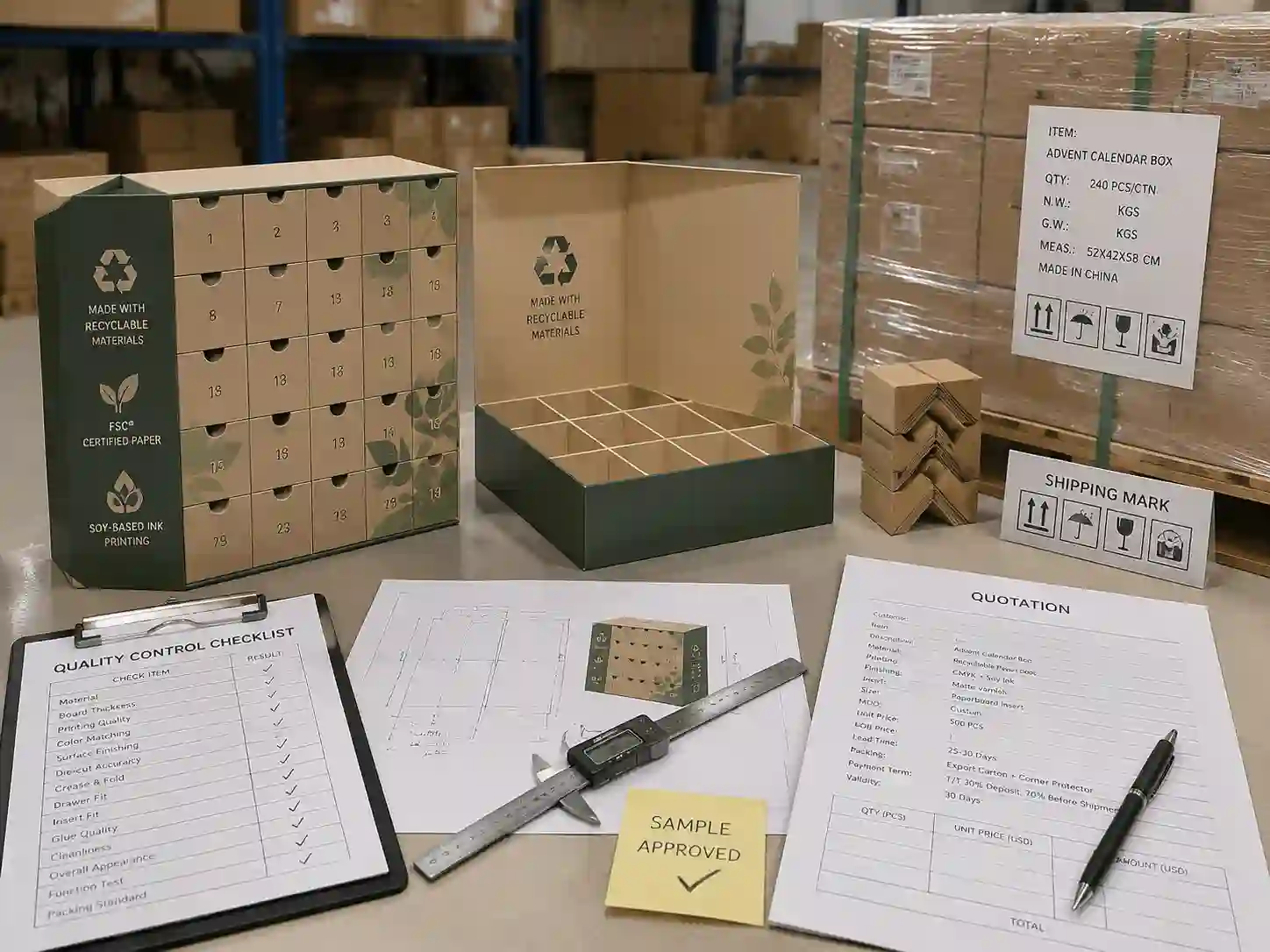
Sampling is the stage where buyers confirm whether recyclable packaging concepts work in real production conditions. A professional supplier should test more than appearance.
Important sample approval checks include:
- Material thickness and surface quality
- Compartment size accuracy
- Product fit and removal experience
- Drawer movement or door-opening performance
- Printing color consistency
- Finishing quality
- Assembly tolerance
- Packaging strength before shipment
QC tip: Buyers should approve a production sample before mass production whenever possible. Small changes in board thickness, insert tolerance, or finishing application can affect the final bulk order.
For international shipments, QC should also include export packing checks such as:
- Export carton strength
- Corner protection
- Pallet stability
- Shipping marks
- Protection against compression and transportation damage
What information should buyers prepare for a recyclable advent calendar box quotation?
A complete RFQ helps suppliers provide more accurate pricing, production schedules, and material recommendations.
- Product category and intended market
- Box structure preference
- Box dimensions or product dimensions
- Number of compartments
- Insert requirements
- Material preference and sustainability goals
- Printing and finishing requirements
- Required quantity and estimated MOQ
- Sample requirements
- Shipping destination and export packing expectations
Buyers can review additional custom advent calendar box products options to understand different structures and applications before preparing an RFQ.
What common mistakes should buyers avoid when sourcing recyclable advent calendar boxes?
- Choosing materials before confirming product requirements: A recyclable material is not suitable if it cannot protect the product.
- Ignoring insert engineering: Poor fit can damage products during transportation.
- Approving artwork before dieline review: This can create printing and assembly errors.
- Comparing suppliers only by price: Low quotations may exclude sampling, QC, or export preparation.
- Skipping prototype testing: Packaging performance should be verified before bulk production.
FAQ: Recyclable advent calendar boxes for B2B buyers
Are recyclable advent calendar boxes suitable for luxury brands?
Yes. Luxury brands can use recyclable packaging structures with premium printing, finishing, and carefully engineered rigid box designs. The challenge is balancing sustainability goals with premium appearance and product protection.
Are recyclable inserts strong enough for cosmetics and gifts?
They can be suitable when correctly designed. Paper inserts and molded pulp options may work for many products, while heavier or fragile items may require additional engineering evaluation.
Do recyclable advent calendar boxes cost more?
Cost depends on material choice, structure complexity, insert design, printing, finishing, order quantity, and production requirements. A recyclable solution is not automatically cheaper or more expensive.
How early should buyers start production?
Buyers should allow time for design confirmation, sample approval, material preparation, production, QC, and international shipping. Seasonal packaging projects benefit from early planning because production schedules become tighter during peak periods.
How can buyers start a recyclable advent calendar box project?
Before contacting a supplier, prepare product details, target quantity, structure preference, insert requirements, artwork status, sustainability expectations, and delivery timeline.
Giftpackpro helps overseas brands, retailers, wholesalers, and packaging buyers develop recyclable advent calendar boxes through material evaluation, structure planning, sampling, bulk production coordination, and quality control support. Buyers can visit the Giftpackpro packaging factory page to learn more about the supplier background or explore more advent calendar box buying guides before starting a project.
When your packaging requirements are ready, you can request a custom quote with your product details, quantity, and design expectations for a more accurate evaluation.


