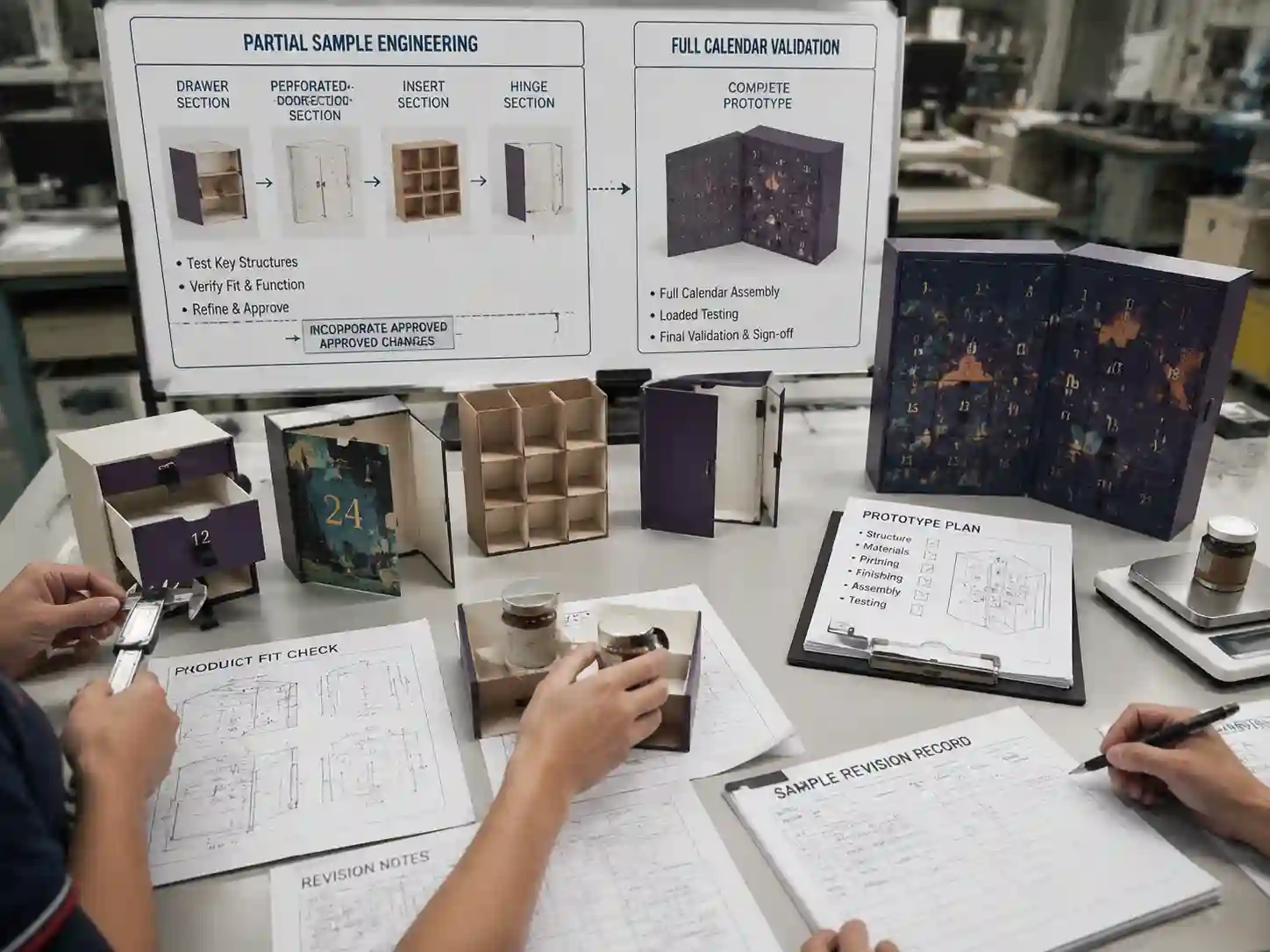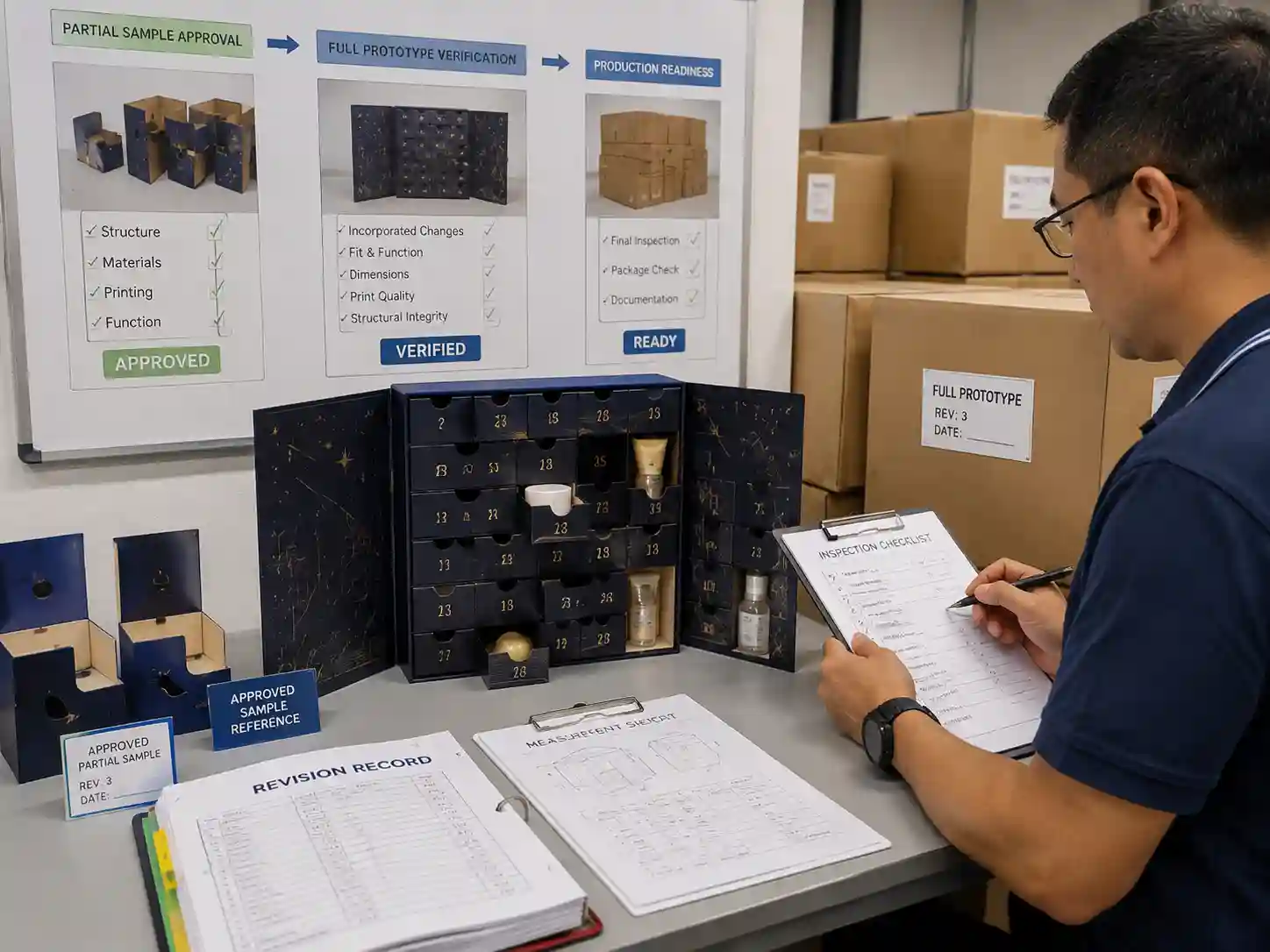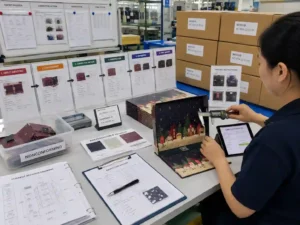
Quick answer: In partial sample vs full prototype planning, a supplier should make a partial sample when the decision concerns one localized feature that can be tested independently, such as a drawer, hinge, perforated door, insert cavity, wrapped edge, or finishing detail. A full calendar is more appropriate when interactions between components, loaded performance, overall alignment, opening sequence, appearance, or final production approval must be evaluated. The sample format should follow the question being tested.
When is a partial sample enough?
A partial sample is usually enough when one defined construction or process question can be isolated without changing the behavior of the complete calendar. The sample should reproduce the materials, dimensions, interfaces, and manufacturing method relevant to that question.
For example, an engineer may not need a complete 24-drawer calendar to determine whether one drawer has sufficient clearance. A representative drawer, sleeve section, and surrounding structure may provide the necessary evidence if they reproduce the actual board thickness, wrapping method, tolerances, and contact surfaces.
Typical reasons for requesting a partial sample include:
- checking a drawer-to-sleeve clearance;
- testing a perforated door and its tie points;
- confirming a ribbon, magnet, hinge, or pull-tab detail;
- evaluating one insert cavity against the actual product;
- reviewing foil, embossing, lamination, or another localized finish;
- checking a wrapped corner or edge construction;
- confirming a corrected feature after a previous sample revision.
The important distinction is that “partial” should describe the physical scope, not the quality of the evidence. A small sample still needs enough production-relevant detail to support the decision being made.
When should the supplier make a full calendar prototype?
A full prototype is needed when the approval depends on interactions across the complete structure. If changing one area can affect alignment, loading, opening, balance, appearance, or assembly elsewhere, an isolated sample may hide important problems.
A complete calendar becomes especially useful once the project moves from solving individual engineering questions to confirming that approved components work together.
| Decision to verify | Partial sample | Full prototype | Evidence to record |
|---|---|---|---|
| Single drawer clearance | Usually suitable | Not normally required for this question alone | Drawing revision, measured clearance, materials |
| One perforated door geometry | Usually suitable | Needed later for overall door layout | Cut geometry, opening result, revision |
| Localized foil or emboss detail | Often suitable | Useful if alignment spans multiple panels | Approved artwork layer and process sample |
| Multiple drawer alignment | Limited value | Preferred | Gap consistency, front alignment, photographs |
| Loaded product fit across all compartments | Useful for early cavity development | Required for system-level evaluation | Product matrix, compartment positions, fit observations |
| Opening sequence and complete appearance | Insufficient | Preferred | Approved artwork, structure and opening checks |
| Golden-sample or final approval candidate | Normally insufficient | Normally required | Signed revision, specifications and approval record |
How should you decide between a partial sample vs full prototype?
Start by writing down the exact approval question. If that question can be answered without depending on the rest of the calendar, a partial sample may be efficient; if the answer depends on multiple components working together, move to a full prototype.
Can the feature be isolated realistically?
The partial sample must preserve the conditions that influence the feature. A drawer-clearance sample, for example, becomes misleading if it uses different board thicknesses or omits wrapped surfaces that reduce the available gap.
Check the structural drawing and identify which dimensions, materials, finishes, adhesives, folds, and neighboring components influence the result. Those elements should be represented even if the rest of the calendar is omitted.
Could another component change the result?
If the answer is yes, the project is approaching the point where a full prototype is safer. Calendar structures contain accumulated tolerances, and individual parts that work separately may behave differently after assembly.
Drawer stacks are a simple example. One drawer may operate correctly in isolation, while multiple drawers, dividers, wrapped panels, and assembly variation can affect the overall fit and visual alignment.
Is the sample being used for final approval?
Final approval generally requires broader evidence than a localized engineering sample can provide. Before design freeze or a golden-sample decision, the buyer and supplier should be able to identify exactly what complete configuration has been approved.
The required level varies by project, but approval should not silently expand from “this hinge works” to “the entire calendar is approved.” Those are different decisions and should have different records.
How should loaded testing affect the sample choice?
Use partial loaded samples for early product-fit questions, but use a complete loaded prototype when product weight, distribution, access, retention, or structural interaction must be assessed across the calendar.
A representative cavity can establish whether a jar, tube, bottle, sachet, or accessory fits its intended retention geometry. However, it cannot automatically demonstrate how a complete calendar behaves when every compartment is loaded.
For full loaded testing, the project team should confirm that the products or approved weight-and-dimension substitutes correspond to the current product matrix. Record which item was placed in each compartment and which sample revision was tested.
This prevents an important evidence gap: a calendar may appear approved while the tested products actually belong to an earlier dimensional set.
What should be recorded when approving a partial sample?
A partial sample should have its own revision and approval scope. The record needs to make clear exactly what was accepted and, equally importantly, what was not evaluated.
| Record field | Example of useful information |
|---|---|
| Sample ID | Project reference plus sample revision |
| Purpose | Verify drawer clearance after structural revision |
| Components represented | Drawer, sleeve section and wrapped divider |
| Drawing/artwork revision | Current controlled file revision |
| Materials/process | Materials and production method relevant to the test |
| Checks performed | Measurements, fit, opening or visual inspection |
| Result | Approved, revise, or retest |
| Approval limitation | Does not approve complete loaded calendar |
Photographs can support the record, but photographs alone are weak revision control. Link them to the sample ID, drawing revision, measurements, test notes, and approval status so the supplier can reproduce the approved condition later.
What should be checked before moving to a full prototype?
Before investing effort in a complete prototype, close the major localized questions that could force structural rework. The objective is not to eliminate every possible revision but to avoid building a full calendar around unresolved critical details.
- Confirm the current structural drawing and revision number.
- Verify critical product dimensions against the latest product matrix.
- Close significant drawer, door, hinge, insert, or retention issues identified in partial samples.
- Record accepted changes instead of relying on marked physical samples alone.
- Identify which production-method features still need verification in the complete prototype.
- Define whether the next full sample is for engineering review, buyer sign-off, loaded testing, or golden-sample approval.
For projects requiring broader custom structural development, the custom advent calendar box services page provides context on Giftpackpro’s packaging capabilities, while representative formats can be reviewed under custom advent calendar box products.
What are the risks of using partial samples for too long?
The main risk is approving individual features without proving that they work as a system. Partial samples reduce unnecessary full builds, but they should not become a substitute for complete validation when component interactions matter.
Problems that may remain hidden include cumulative drawer misalignment, overall panel bowing, conflicts between inserts and structure, inconsistent opening behavior, artwork discontinuity, loaded balance, and assembly effects.
There is also a documentation risk. Several approved partial samples can represent different revision stages. Unless those decisions are consolidated into one controlled drawing and specification set, the supplier may not have a single unambiguous configuration from which to make the next prototype.
How should partial samples feed into design freeze and the golden sample?
Approved partial-sample decisions should be transferred into controlled project documents before design freeze. The final full prototype should then confirm that those decisions coexist correctly in the complete calendar.
A practical sequence is: isolate a problem, make the minimum representative sample, test it, record the decision, update the controlled files, and incorporate the change into the next relevant complete sample.
The golden sample, where used, should represent the agreed complete configuration rather than a collection of unrelated partial approvals. Buyer sign-off should identify the sample revision and the supporting drawing, artwork, material, product-fit, and change records applicable to that approval.
FAQs about partial and full advent calendar samples
Can one drawer represent every drawer in an advent calendar?
Only when the drawers share the same relevant geometry, materials, loading conditions, and interfaces. Different sizes, product weights, inserts, finishes, or positions may require additional representative samples or complete-calendar verification.
Does a digitally printed full mockup replace a production-method sample?
Not automatically. A full mockup can show overall structure, graphics, sequence, and appearance, but a feature whose performance depends on the intended manufacturing process may need separate production-method evidence.
Should every revision require another full calendar?
No. A localized correction can often be verified with a controlled partial sample when it does not affect other approved areas. A new full prototype becomes appropriate when the revision changes system-level performance or when the project reaches complete approval.
Who should approve the move from partial samples to a full prototype?
This is project-dependent. Typically, the responsible engineering, product, purchasing, quality, or project owner should confirm that critical open issues have been resolved and define what the full prototype must prove. The approval responsibility should be recorded rather than assumed.
For a project-specific sampling plan, drawings, or prototype review, request a custom quote and provide the current calendar structure, product information, unresolved sample questions, and latest revision files.