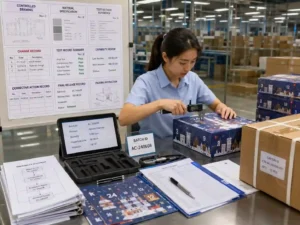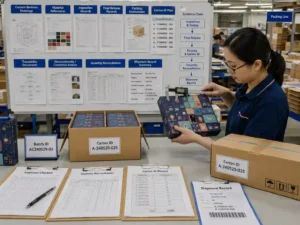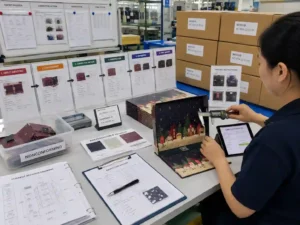
Quick answer: Retail labels and factory shipping marks serve different purposes and should be controlled separately during export packing. Retail labels identify the finished product for sales channels, while shipping marks identify cartons during factory handling, freight movement, customs processing, and warehouse receiving. For advent calendar export cartons, separation is usually managed through approved carton artwork, packing specifications, carton markings, and pre-shipment verification records.
What is the difference between retail labels and factory shipping marks?
Retail labels communicate product information for the selling environment, while factory shipping marks support logistics identification and carton handling. Keeping them separate reduces the risk of incorrect labels, blocked carton identification, or confusion during export operations.
For custom advent calendar packaging, the retail label may appear on the individual product box, inner packaging, or retail-ready unit. Factory shipping marks normally appear on master cartons, pallet documents, or logistics records used by factories, freight providers, and receiving teams.
| Item | Main Purpose | Typical Location | Verification Method |
|---|---|---|---|
| Retail label | Product identification and market presentation | Individual calendar box or retail packaging | Approved artwork review and sample approval |
| Factory shipping mark | Carton tracking and shipment handling | Master carton exterior and shipping documents | Carton inspection and packing record check |
| Internal production code | Factory traceability | Production records or controlled labels | Lot and packing record review |
Why should retail labels and shipping marks be controlled separately?
Separating these marking systems helps prevent operational mistakes during export preparation. A retail label designed for consumers may not provide the information needed for warehouse handling, while a factory shipping mark may not be suitable for a retail-facing product surface.
Common risks when the two are mixed include:
- Master cartons becoming difficult to identify during receiving.
- Incorrect product versions being shipped together.
- Retail packaging being covered by unnecessary logistics information.
- Warehouse teams relying on incomplete carton identification.
- Destination assembly teams receiving unclear product grouping information.
The exact separation method depends on the destination market, retailer requirements, logistics process, and approved packaging specifications.
How should factories decide where shipping marks appear on advent calendar cartons?
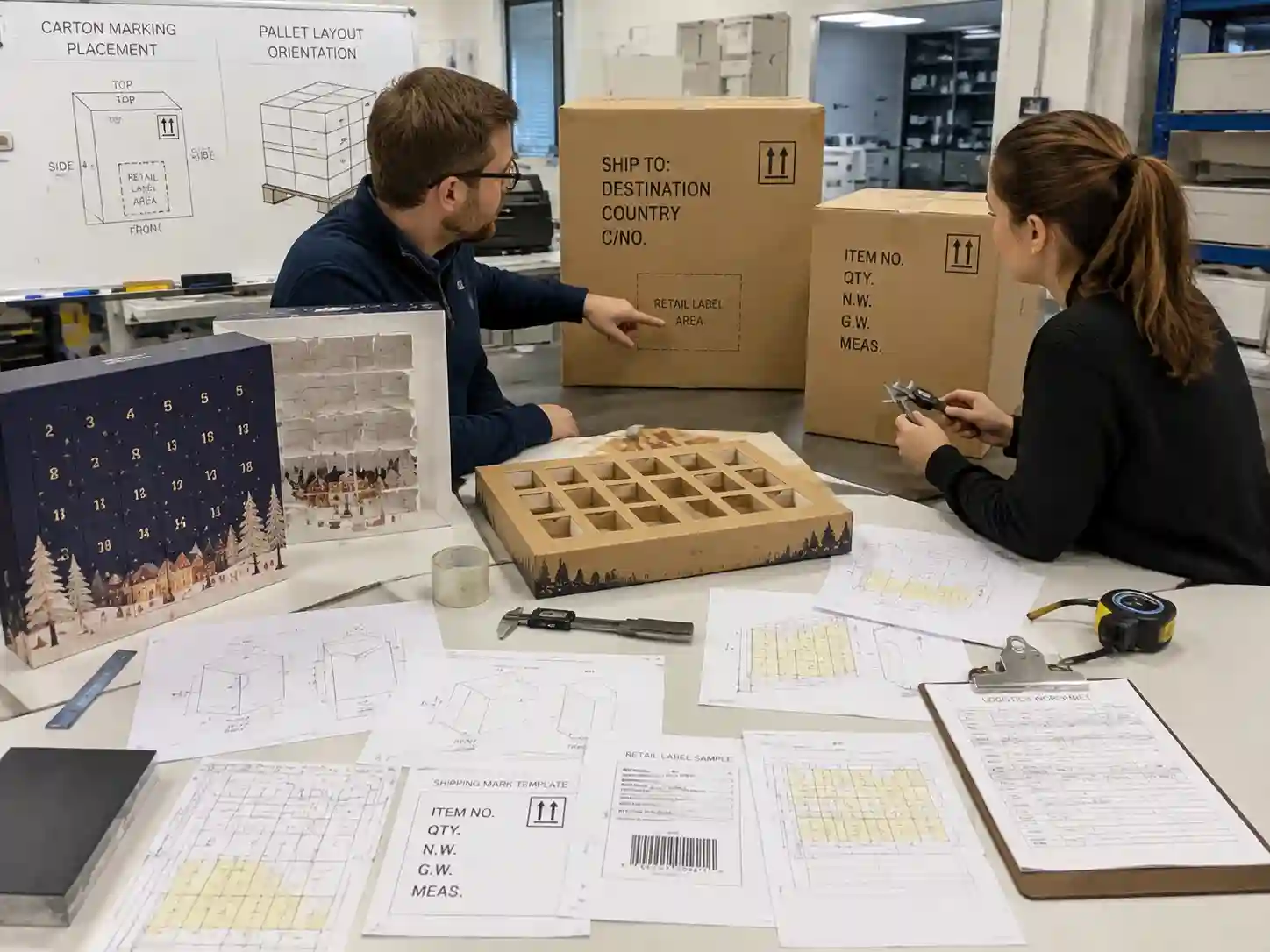
Shipping mark placement should be decided during packaging planning, before bulk production. The goal is to keep carton identification visible after pallet loading, wrapping, and normal transport handling.
Typical review points include:
- Confirm the master carton identification area from the approved packing specification.
- Check that marks remain visible when cartons are stacked in the approved pallet pattern.
- Review whether stretch wrap, corner protection, or pallet straps could hide important information.
- Verify that carton markings match packing records before shipment release.
Packaging drawings, carton samples, and pallet layout sketches are useful evidence because they show whether the marks remain practical after loading conditions change.

Which information normally belongs on factory shipping marks?
Factory shipping marks should contain information needed for logistics control rather than retail presentation. The exact content varies by project, but commercial shipments commonly use approved carton identification details such as product reference, carton quantity, handling information, and destination-related instructions when required.
Project-dependent decisions may include:
- Whether purchase order references are required.
- Whether destination warehouse codes must be shown.
- Whether carton numbers are needed for receiving control.
- Whether handling symbols are appropriate for the product structure.
Buyers should approve the final shipping mark format before production because incorrect carton markings can create receiving delays even when the products themselves are correct.
How can buyers verify that shipping marks are separated correctly?
Verification should combine document review and physical carton inspection. Buyers can confirm separation by comparing approved artwork, carton specifications, and finished production samples.
Useful evidence includes:
- Approved retail packaging artwork.
- Master carton drawings showing marking locations.
- Packing specifications with carton identification requirements.
- Pre-shipment inspection records.
- Photos of finished pallets before dispatch.
| Pre-shipment check | What to confirm |
|---|---|
| Retail unit inspection | Retail labels match the approved product version. |
| Master carton inspection | Shipping marks are visible and correctly positioned. |
| Pallet inspection | Carton identification remains readable after wrapping. |
| Document review | Packing records match carton markings and shipment details. |
What happens if retail labels and shipping marks are mixed?
Mixing the two marking systems can increase handling risk throughout the supply chain. A carton may arrive physically intact but still require additional checking if warehouse teams cannot quickly confirm carton identity.
For example, if a master carton only displays a retail-facing product name but does not include approved shipment identification, receiving staff may need to open cartons or compare multiple documents manually. This creates additional handling and increases the chance of sorting errors.
A controlled marking system supports smoother movement from factory packing to freight loading, destination receiving, and final assembly processes.
How do pallet patterns affect shipping mark visibility?
Pallet configuration can change whether shipping marks remain usable. A carton marking position that works on a single carton may become hidden when cartons are rotated, stacked, or covered with stretch wrap.
Packaging engineers and logistics teams should review:
- Carton orientation within each pallet layer.
- Available marking surfaces after corner protection is added.
- Visibility from warehouse inspection positions.
- Potential damage from vibration, compression, or moisture exposure.
This review is especially important for larger advent calendar cartons where pallet efficiency and carton stability must be balanced with identification access.

What should buyers approve before shipment?
Buyer approval should focus on the final production condition rather than only reviewing a digital artwork file. The approved reference should show how retail packaging, master cartons, and shipping marks work together.
- Approved retail label artwork.
- Approved master carton marking layout.
- Final packing configuration.
- Carton and pallet identification method.
- Inspection records confirming the production shipment matches the approved requirements.
FAQs About Retail Labels vs Shipping Marks
Can the same label be used as both a retail label and a shipping mark?
Usually they should remain separate because their purposes are different. A combined approach is only suitable when the project requirements specifically allow it and all logistics information remains clear.
Who approves factory shipping marks?
Approval responsibility depends on the project structure. It may involve purchasing teams, logistics teams, retailers, or other parties responsible for receiving requirements.
Should shipping marks be printed directly on cartons or added separately?
The method depends on carton design, production requirements, and handling needs. The important point is that the final marking must remain accurate, visible, and consistent with approved records.
Giftpackpro supports commercial buyers with custom advent calendar packaging development, including packaging specifications and production coordination. For export carton marking requirements, review your carton identification needs early and request a custom quote for your packaging project.