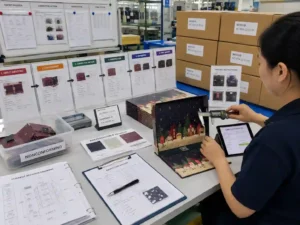
Quick answer: Cosmetic tube insert clearance should be based on the tube’s measured dimensions, material tolerance, loading method, and whether the product must slide, press-fit, or lock into position. A common approach is to add only enough space to prevent friction, deformation, and loading difficulty while keeping the tube stable during handling. The final clearance should be confirmed through cavity drawings, physical samples, and loaded-product checks.
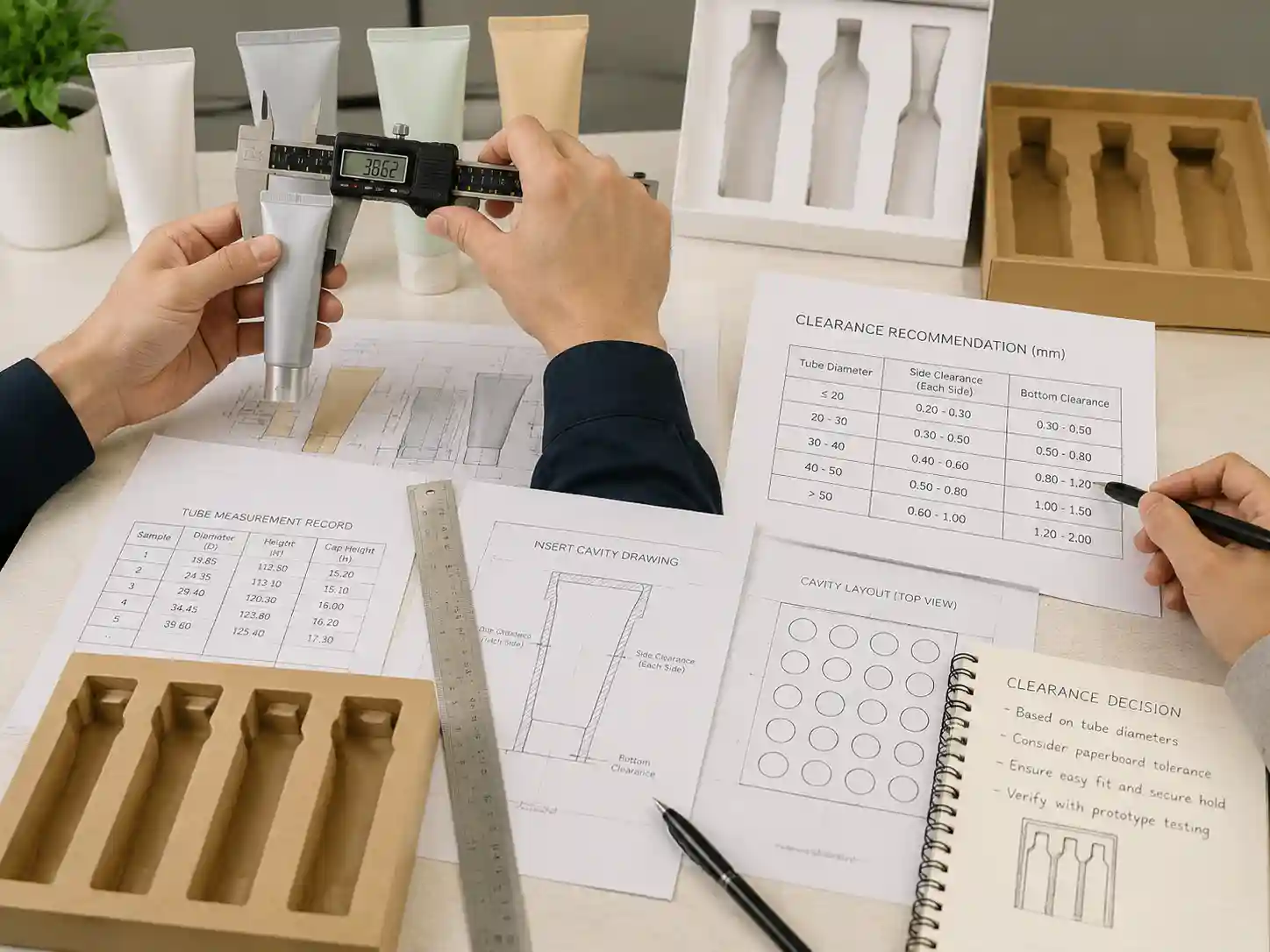
How Much Cosmetic Tube Insert Clearance Is Usually Needed?
The correct cosmetic tube insert clearance is not a fixed number for every project. It depends on tube material, cap shape, filling level, weight distribution, insert material, and how the product is loaded into the cavity.
For paper inserts used in custom advent calendar boxes, the cavity normally needs enough tolerance to allow smooth insertion and removal while preventing excessive movement. A cavity that is too tight may damage printed surfaces or deform soft tubes, while a cavity that is too loose can cause products to shift during transport and presentation.
As a practical engineering reference, designers usually evaluate:
- Outer tube diameter or width at the widest point
- Tube height and cap extension
- Tube body flexibility and compression resistance
- Insert material thickness and spring-back behavior
- Product orientation inside the compartment
What Measurements Should Be Taken Before Designing the Insert?
The insert design should begin with actual product measurements rather than packaging assumptions. Cosmetic tubes often vary slightly because of filling conditions, cap assembly, and manufacturing tolerances.
Which tube dimensions affect cavity clearance?
The most important dimensions include the maximum body width, thickness, height, cap diameter, and any protruding features such as flip caps or pumps.
| Measurement | Why It Matters | Verification Method |
|---|---|---|
| Maximum tube width | Defines cavity opening size and side clearance | Digital caliper measurement |
| Tube thickness | Controls front-to-back cavity tolerance | Dimensional inspection record |
| Total height | Determines support depth and top clearance | Product sample measurement |
| Cap or pump projection | Prevents pressure on protruding parts | Loaded sample check |
Measurement records, product drawings, and approved samples should be kept together so the insert cavity is based on confirmed dimensions rather than estimates.
How Do Material and Tolerance Affect Paper Insert Clearance?
Paper inserts are not completely rigid. Folded paperboard, corrugated structures, and molded paper components can compress, flex, or recover slightly during production and handling.
The required clearance may increase when:
- The cosmetic tube has a soft or squeezable body.
- The insert material has thicker folds or reinforced structures.
- The product must be loaded manually at production speed.
- The tube has irregular shapes or multiple contact points.
The clearance may decrease when:
- The product requires a premium fixed-position display effect.
- The tube shape is rigid and dimensionally stable.
- The insert uses a precision-cut cavity with controlled support areas.
These recommendations are project-dependent. The final value should be confirmed by testing actual products with the selected insert structure.
How Should Suppliers Validate Cosmetic Tube Insert Fit?
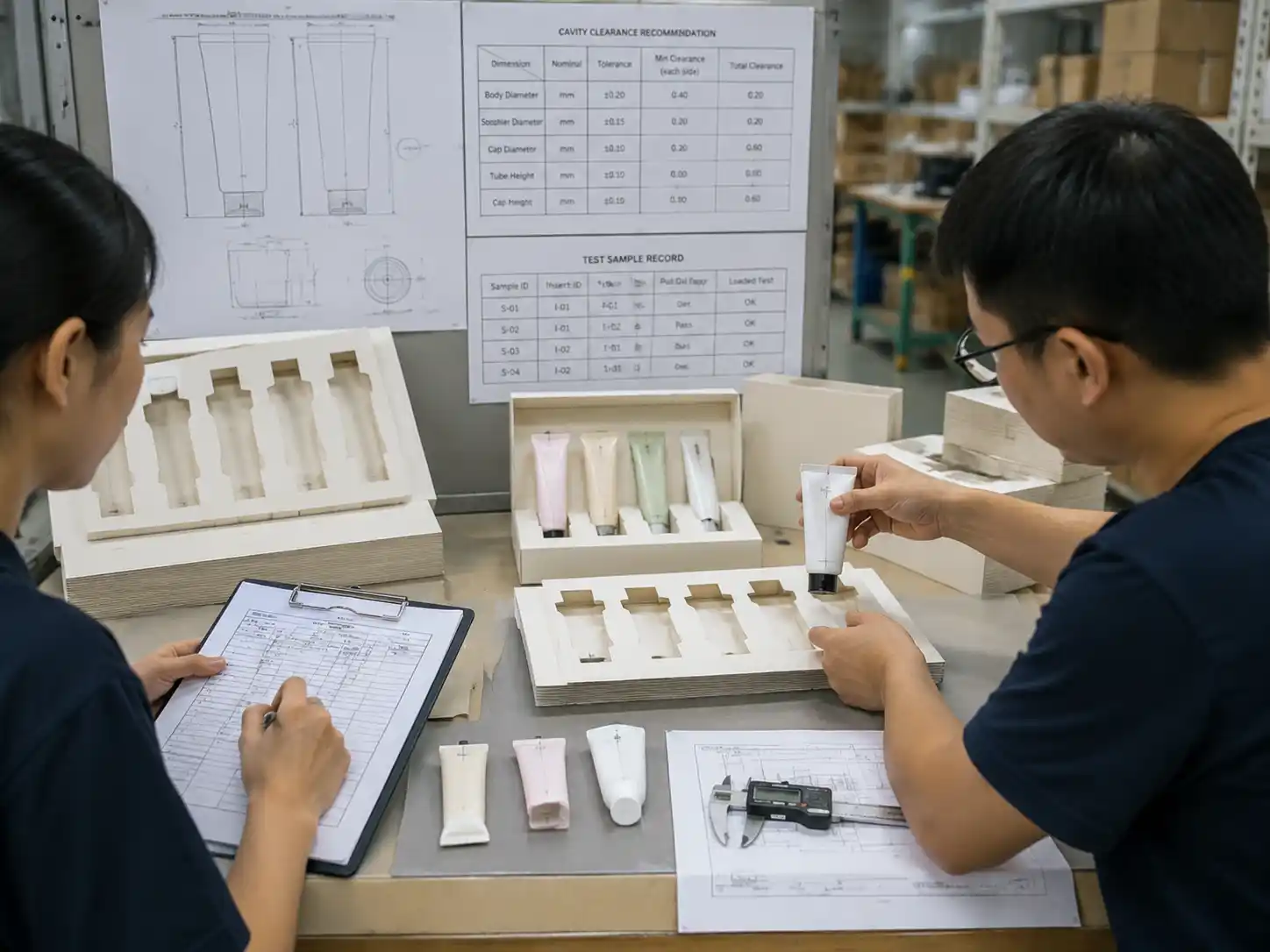
Insert validation should combine drawings, prototypes, and loaded-product inspection. A dimensionally correct cavity on paper may still fail if the product cannot be inserted smoothly or moves after assembly.
What checks should be completed during sample validation?
- Confirm product dimensions: Compare received product samples with the approved measurement sheet.
- Review cavity drawings: Check opening size, support points, and clearance zones.
- Load actual tubes: Insert real products using the intended production method.
- Check movement: Verify that tubes remain positioned without excessive looseness.
- Inspect appearance: Confirm there is no tube deformation, surface damage, or visible stress.
| Loaded Sample Check | Acceptance Focus |
|---|---|
| Insertion force | Product loads without excessive resistance |
| Product retention | Tube stays positioned during handling |
| Visual condition | No scratches, dents, or deformation |
| Repeat loading | Cavity remains functional after multiple checks |
Approval records should include cavity drawings, measured samples, prototype photos, and comments from engineering or quality teams. These documents help prevent changes being made after production starts.
What Problems Happen When Clearance Is Incorrect?
Incorrect clearance can create quality problems throughout production, packing, and customer handling.
- Too little clearance: tubes may become difficult to load, surfaces may be damaged, and soft packaging may deform.
- Too much clearance: products may shift, reducing presentation quality and increasing movement inside the box.
- Uneven clearance: tubes may lean or create inconsistent alignment between compartments.
These risks are especially important when multiple cosmetic tube sizes are packed in the same calendar or gift set because each cavity may require separate dimensional validation.

Should Buyers Approve Clearance Before Mass Production?
Yes. Clearance approval should be completed before production because insert dimensions directly affect product protection, loading efficiency, and final appearance.
Buyers should review:
- Final product measurement sheets
- Approved insert drawings
- Physical cavity samples
- Loaded-product photographs or inspection records
- Any agreed dimensional tolerances
Giftpackpro supports custom advent calendar box development with measurement review, structural evaluation, and sample verification through its custom advent calendar box services. Related packaging structures can also be reviewed through custom advent calendar box products.
FAQs About Cosmetic Tube Insert Clearance
Can one clearance standard work for all cosmetic tubes?
No. Tube materials, shapes, caps, and loading methods vary. Each product size should be evaluated separately during insert design.
Is a tighter cavity always better for premium packaging?
No. A tighter cavity can improve positioning, but insufficient tolerance may create loading problems or damage the product. Balance is required.
What documents help confirm insert clearance?
Useful evidence includes product measurement sheets, cavity drawings, prototype samples, inspection records, and approval notes.
For custom cosmetic tube packaging projects, clear product dimensions and validated insert fit are the foundation for reliable production. Contact Giftpackpro through request a custom quote to discuss your packaging requirements.