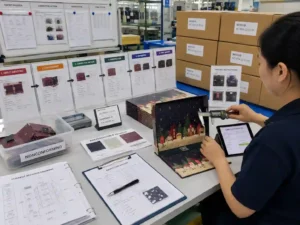
Preventing tall products from touching or pressing against the lid requires accurate height measurement, internal clearance planning, and loaded sample validation. Buyers should confirm the product’s maximum height, orientation, insert position, compression allowance, and lid structure before production approval. The key is not only measuring the product itself, but verifying the complete assembled package with the product, insert, tray, and closed lid together.
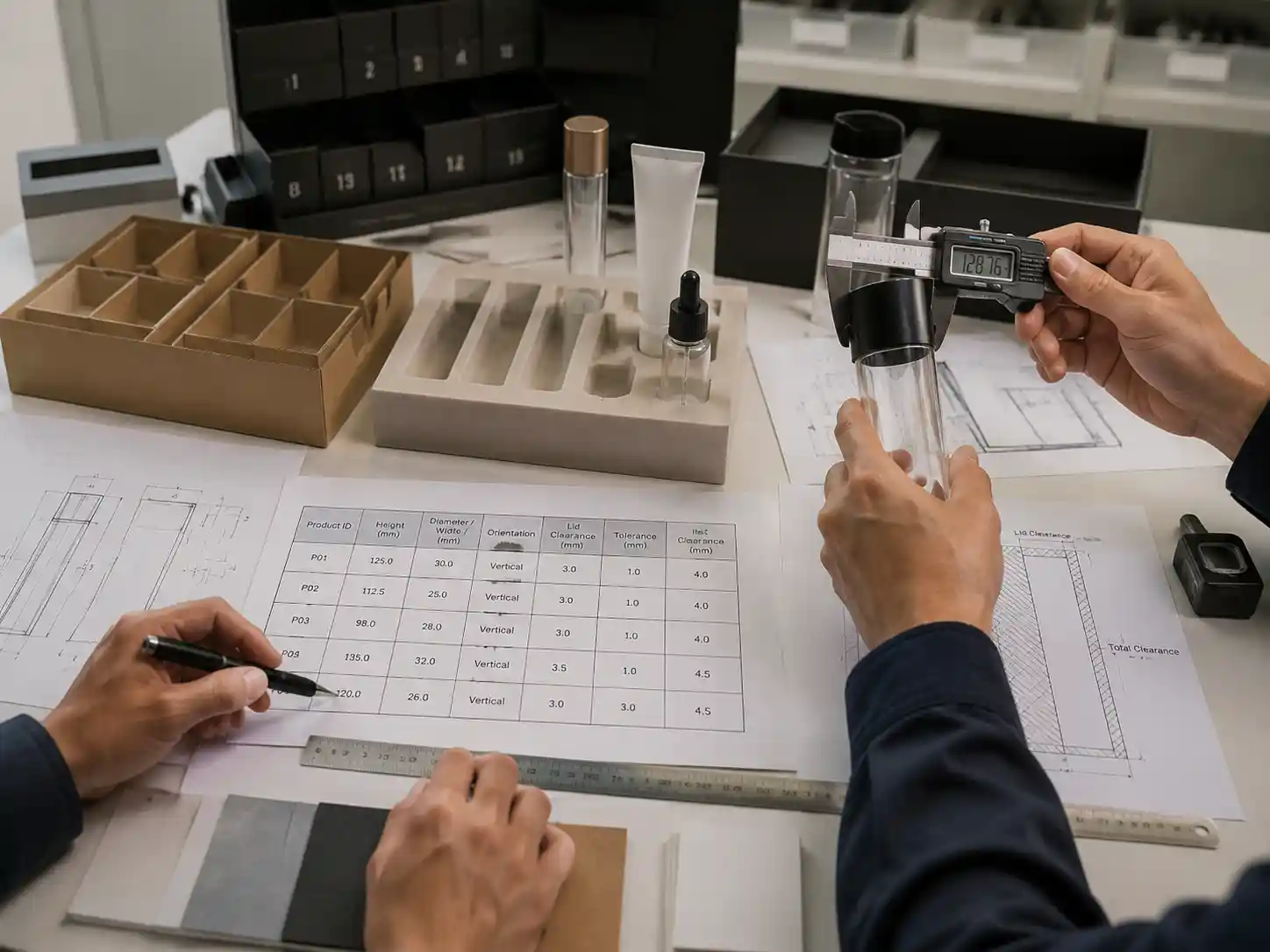
Why is tall product lid clearance important in advent calendar packaging?
Tall product lid clearance is important because insufficient internal height can cause lid collision, product damage, deformation of inserts, or difficulty closing the finished box. The final package height depends on several layers, including the product dimension, cavity depth, insert thickness, protective space, and lid construction.
A product that fits into an open tray may still create problems after the lid is closed. Buyers should evaluate the complete assembled condition rather than relying only on product measurements.
How should buyers measure products before designing lid clearance?
Buyers should measure the actual product dimensions that affect the closed package, including maximum height, width, depth, cap or protrusion height, and any unstable parts that may shift during packing.
- Measure the highest point: Record the maximum product height from the bottom contact point to the highest external feature.
- Confirm product orientation: Check whether the product stands upright, lies flat, or requires angled placement inside the cavity.
- Measure with packaging conditions: Include caps, closures, protective sleeves, and other components that remain inside the calendar.
- Record variation: Identify normal size differences between samples or production batches.
| Measurement Item | Purpose | Buyer Verification Method |
|---|---|---|
| Maximum product height | Defines minimum cavity and lid space | Digital caliper or height gauge measurement |
| Product orientation | Prevents unexpected height increase | Approved placement drawing or sample review |
| Insert thickness | Affects available internal space | Insert specification measurement |
| Closed box height | Confirms final clearance | Assembled sample inspection |
How much clearance should be added above tall products?
The required clearance depends on the product shape, insert design, lid structure, and handling requirements. There is no universal clearance value because different products react differently to movement, pressure, and manufacturing variation.
In practice, buyers should define a clearance allowance between the product’s highest point and the inside surface of the closed lid. This allowance should consider:
- Product dimension tolerance from manufacturing variation.
- Insert compression or movement during assembly.
- Product orientation changes during packing.
- Lid stiffness and structural deformation.
- Protection requirements for sensitive products.
Recommended clearance values should be treated as project-specific engineering decisions and confirmed through samples rather than assumed from drawings alone.

How can buyers validate clearance using samples?
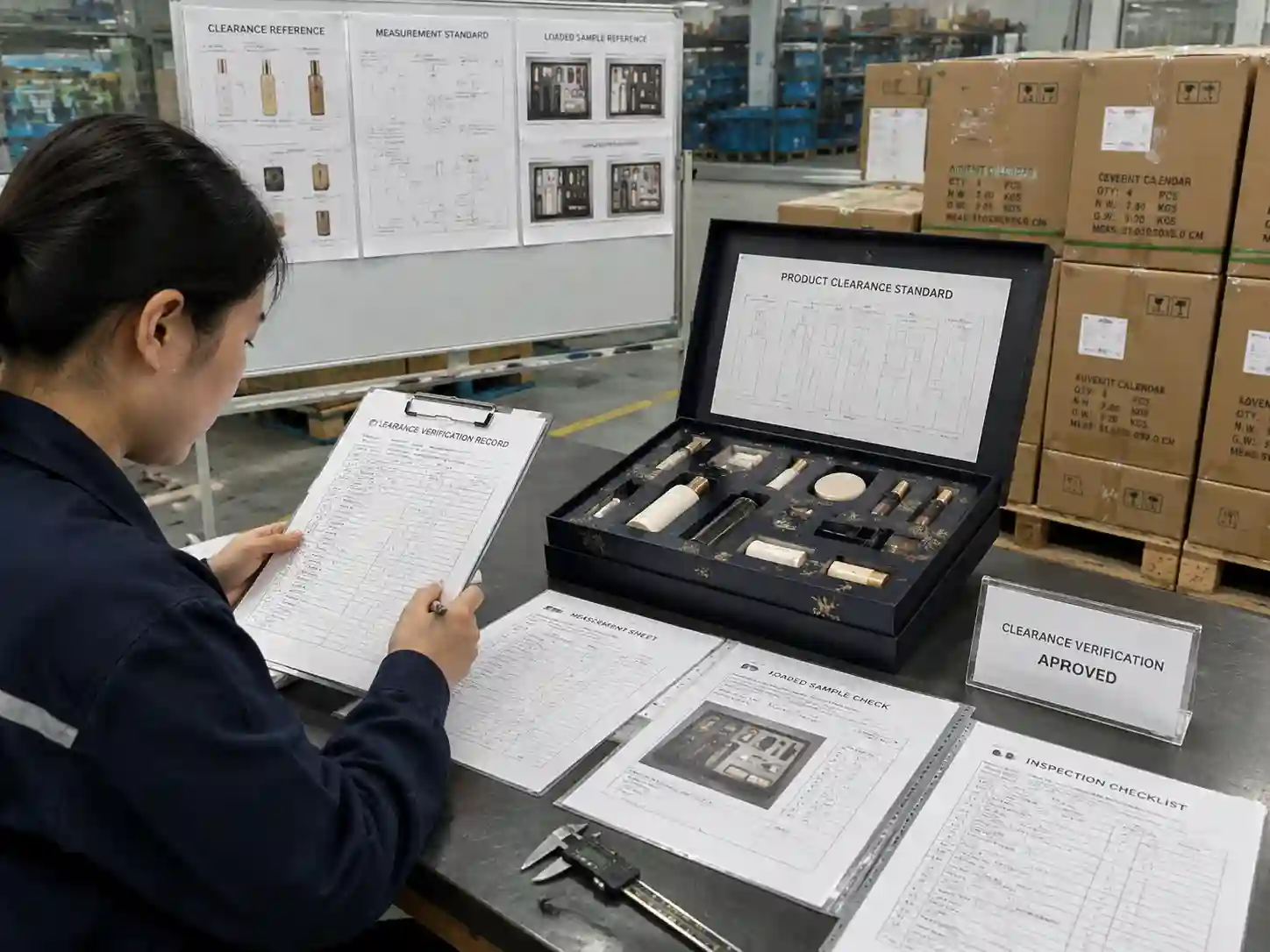
The most reliable method is a loaded sample check using the real product or representative samples inside the final insert and box structure. This confirms whether the lid closes correctly under actual conditions.
A practical loaded-sample checklist includes:
- Product samples installed in every relevant cavity position.
- Insert positioned exactly as designed.
- Lid fully closed without forced pressure.
- Visible gap confirmed between product and lid interior.
- Product movement checked after closing and handling.
- Measurements recorded for approval reference.
Buyers should keep approval records such as dimension sheets, cavity drawings, sample photos, and inspection notes. These documents help ensure that production follows the approved packaging configuration.
What packaging design factors affect tall product clearance?
Tall product clearance is influenced by more than the product height. The complete packaging structure must be reviewed because each component changes the available internal space.
How does insert design affect clearance?
Insert thickness, cavity depth, and product positioning directly affect the remaining space above the product. A thicker insert may improve protection but reduce available lid clearance.
How does product orientation affect lid collision risk?
Incorrect orientation can increase the effective height of a product. A product placed vertically may require significantly more internal height than the same product placed horizontally.
How does lid structure affect the final clearance?
The inner lid surface, rigid board thickness, and folding structure all influence the actual closing space. Buyers should confirm internal dimensions rather than relying only on external box dimensions.
What records should buyers approve before production?
Before production approval, buyers should confirm the final measurements and packaging configuration through controlled documents. Useful records include:
- Approved product dimension sheet.
- Final cavity layout drawing.
- Insert specification and thickness details.
- Loaded sample inspection record.
- Closed-box clearance verification notes.
These records provide traceability between product specifications and the finished advent calendar box. Giftpackpro supports custom packaging development through custom advent calendar box services and can help buyers evaluate structural requirements before manufacturing.
What are common mistakes when checking tall product clearance?
The most common mistake is checking only the empty box or insert without testing the loaded condition. A cavity that looks correct in a drawing may fail when the actual product height, tolerance, and assembly conditions are introduced.
- Using nominal product dimensions without considering variation.
- Ignoring caps, lids, or product protrusions.
- Approving drawings without a closed-box sample check.
- Measuring external box height instead of internal clearance.
Separating confirmed measurements from project assumptions helps reduce avoidable packaging revisions.
Frequently asked questions about tall product lid clearance
Can buyers calculate lid clearance only from product height?
No. Product height is only one input. The insert, orientation, cavity depth, and lid structure must also be considered.
Should clearance be checked before or after insert production?
Clearance should be reviewed during insert development and confirmed with a finished loaded sample before production approval.
Does a taller box always solve lid collision problems?
Not always. Increasing height may affect structure, appearance, and logistics. Improving product orientation or insert design may provide a better solution.
How can buyers start a tall product clearance review?
Buyers should prepare product dimensions, orientation requirements, and sample details before requesting packaging development support. For custom solutions, contact Giftpackpro through request a custom quote and provide the product measurements needed for clearance evaluation.