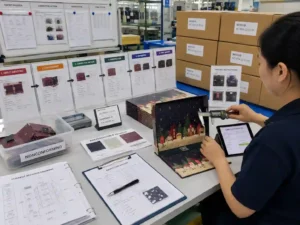
Quick answer: There is no single packaging capability record review frequency that fits every project. Buyers should require records to be reviewed at defined intervals and whenever a meaningful change occurs. Specifications and drawings should be checked against the current approved revision before production; test evidence should remain applicable to the actual material, structure, process, and intended use; and capability records should be reconsidered when equipment, processes, subcontractors, materials, product requirements, or quality performance change.

How often should packaging capability, test, and specification records be reviewed?
The practical approach is to combine periodic review with event-triggered review. A calendar date alone cannot establish whether evidence is still valid: buyers also need to ask whether the conditions represented by the record still match the current packaging project.
For example, an older test report may still describe an unchanged material and test method, while a recently issued capability presentation may already be misleading if an important process has been moved to another facility. Record age is therefore one check, not the complete decision.
Buyers should separate three questions:
- Is the document current? Check its date, revision, approval status, and superseded versions.
- Is the evidence still applicable? Confirm that materials, construction, equipment, process conditions, test methods, and production sources remain relevant.
- Does the buyer need to approve a change? Some changes can be controlled internally by the supplier, while others require written buyer review before production proceeds.
What review frequency is appropriate for different packaging records?
Different records should not automatically share one review cycle. Controlled specifications may need confirmation at every production release, while broader supplier-capability information can be reviewed periodically and whenever operational changes occur.
| Record type | Practical review point | What should trigger earlier review? | Evidence to check |
|---|---|---|---|
| Structural drawings and specifications | Before sampling, approval, and production release | Dimension, construction, artwork, insert, material, or product change | Revision number, approval date, dimensional requirements, material references |
| Material specifications | At project approval and before use of the applicable material specification | Grade, thickness, finish, adhesive, source, or performance requirement changes | Controlled specification, material identity, purchase or receiving references where relevant |
| Test reports | When establishing whether evidence supports the current project | Material, construction, method, acceptance criterion, process, or intended-use change | Sample identity, test method, date, conditions, results, applicable specification |
| Supplier capability records | At supplier qualification and at a defined periodic review | New equipment, process relocation, subcontracting, capacity change, repeated quality problems | Process records, equipment evidence, production examples, QC controls, responsible facility |
| Inspection and QC records | For each applicable production batch or inspection stage | Nonconformity, process adjustment, rework, or corrective action | Batch identity, inspection method, measurements, disposition, release status |
| Traceability and packing records | During production and final release as required by the project | Batch split, rework, mixed production, packing change, quantity discrepancy | Production identity, carton identity, quantities, release and packing references |
These are practical review points rather than universal mandatory intervals. The applicable contract, buyer quality requirements, product risk, destination requirements, and agreed quality plan can require different controls.
When should records be reviewed even if the scheduled review date has not arrived?
Records should be reconsidered whenever a change could make previous evidence unrepresentative of current production. This event-based review is especially important for multi-component packaging, where one apparently small change can affect several controlled documents.
Typical triggers include:
- a different paper, board, adhesive, coating, magnet, ribbon, insert material, or other specified component;
- a structural drawing or dimensional tolerance revision;
- a change in the products that must fit inside the packaging;
- new tooling, equipment, assembly methods, or production locations;
- introduction or replacement of a subcontracted process;
- a changed test method, sample preparation method, or acceptance criterion;
- repeated inspection failures or a significant nonconformity;
- corrective action that modifies material, tooling, process settings, inspection, or handling;
- a packing configuration change that affects the evidence used for shipment release.
The important principle is applicability. If a change breaks the connection between an existing record and current production, the supplier should determine what needs revision, re-verification, re-testing, or renewed approval rather than simply leaving the document active because its scheduled review date has not arrived.

How should buyers verify whether an older test report is still useful?
Do not accept or reject a test report based on its date alone. Trace the tested sample back to the current specification and determine whether the variables relevant to the result remain substantially the same.
For an advent calendar structure, that may require checking the identified board or paper, thickness or construction, component dimensions, adhesive or assembly method, test conditions, and sample identity. The exact variables depend on what the test is intended to demonstrate.
What evidence should connect the report to current production?
A useful report should make its scope identifiable enough for the buyer or quality team to compare it with the current project. Supporting records may include the applicable drawing revision, material specification, sample or batch identity, test method, dated results, and production records.
A report becomes weaker evidence when the tested sample cannot be identified, the relevant construction is unclear, or nobody can establish whether current production still matches what was tested.
Does every packaging change require new testing?
No. The need for re-testing depends on whether the change could materially affect the characteristic being verified and on any applicable customer, contractual, or regulatory requirement.
The supplier should document the change and its assessment. Where re-testing is not considered necessary, the reasoning should be technically defensible rather than assumed. Where buyer approval is required, that assessment should not replace the buyer’s decision.
How should packaging specifications be kept under review?
Specifications should operate as controlled requirements, not static files stored in an old project folder. Before relevant work proceeds, the supplier should be able to identify which revision governs the material, component, sample, inspection, and production activity.
For complex seasonal paper packaging, this may involve structural drawings, component dimensions, board or paper requirements, surface-finish references, assembly requirements, tolerances, approved samples, and packing instructions.
A practical verification sequence is:
- Identify the current approved specification or drawing revision.
- Confirm that obsolete revisions have not been released to production.
- Connect physical samples and materials to the applicable requirements.
- Check whether measurement and inspection records use the same requirements.
- Record approved changes and their effective point in production.
- Confirm whether any changed requirement requires buyer re-approval.
Buyers evaluating a new project can also discuss document control and engineering support when reviewing custom advent calendar box services rather than treating specification control as a final-inspection issue.
How often should supplier capability evidence be refreshed?
Capability evidence should be refreshed often enough to represent how the supplier currently performs the work, with additional review after material operational changes. A fixed annual or other periodic review can provide administrative discipline, but it should not postpone review after a significant change.
Capability claims are stronger when supported by identifiable evidence: relevant equipment and processes, dated production examples, inspection methods, engineering records, traceability systems, corrective-action records, and clear disclosure of externally performed operations where relevant.
What does strong versus weak capability documentation look like?
| Weak documentation | Stronger documentation |
|---|---|
| Undated factory photographs | Dated evidence connected to an identifiable facility or process |
| General statement that a process is available | Process evidence showing where and how the relevant operation is controlled |
| Test report with unclear sample identity | Report linked to an identified sample, method, specification, and result |
| Material description without revision control | Controlled specification linked to the applicable material or component |
| QC photographs with no production identity | Dated inspection evidence linked to batch, measurement, and disposition records |
| Old case study with no connection to current capability | Relevant production example supported by records that show the demonstrated process |
The purpose is not to accumulate more documents. It is to maintain an evidence chain that allows a buyer to determine what capability was demonstrated, under what conditions, and whether it remains relevant today.

What should a buyer’s record-review checklist contain?
A concise checklist should test currency, applicability, traceability, change control, and approval status. It should make missing evidence visible before a project reaches final release.
- Is each controlled document dated and revision identified?
- Is the current approved version clearly distinguishable from obsolete versions?
- Can test results be traced to an identifiable sample, material, or construction?
- Do current production materials and processes still match the evidence being relied upon?
- Have significant material, structural, process, tooling, facility, or subcontracting changes been recorded?
- Were nonconformities and corrective actions evaluated for their effect on existing evidence?
- Do inspection records identify the applicable batch and requirement?
- Can released production be connected to traceability and packing records where required?
- Are project-dependent re-testing requirements documented?
- Are changes requiring buyer approval clearly separated from supplier internal approvals?
For a wider view of supplier evaluation topics, buyers can use the advent calendar box buying guides. The review-frequency decision itself should remain tied to the evidence and risks of the specific project.
Who should decide whether a record needs updating or re-approval?
The supplier should control its own technical and quality documents, but that does not automatically give it authority to approve every project change. Responsibilities should distinguish supplier document control from buyer approval requirements.
Verifiable facts include revision dates, measured dimensions, identified materials, recorded test methods, batch numbers, inspection results, and documented changes. These can be checked against records and physical production.
Project-dependent recommendations include periodic capability-review intervals, the extent of repeat testing, additional inspection frequency, and which changes justify new verification. These depend on packaging construction, product risk, prior performance, contractual requirements, and intended use.
Buyer approvals can include acceptance of specification changes, deviations, revised samples, changed materials, or other items specifically reserved for customer approval. Suppliers should not present an internal sign-off as buyer approval where buyer authorization is required.
What is the main risk of reviewing records only by date?
The main risk is relying on evidence that looks administratively current but no longer represents the product being manufactured. Conversely, automatically discarding evidence solely because it is old can create unnecessary work when its applicability has been properly established.
A better system asks both when was this reviewed? and what has changed since the evidence was created or last verified? That combination makes capability, testing, specification, QC, and traceability records more useful for purchasing decisions.
FAQs about packaging record review
Should every specification have an expiry date?
Not necessarily. Document-control systems vary. What matters is that the supplier can identify the approved revision, control changes, prevent unintended use of obsolete requirements, and perform any periodic review required by its system or the project.
Should capability records be reviewed before placing every order?
Not every unchanged capability claim needs a complete investigation for every repeat order. Buyers should, however, verify critical capability when project requirements change, meaningful supplier changes occur, previous performance creates concern, or the evidence available no longer demonstrates the required process.
Can a corrective action trigger a specification or test-record review?
Yes. If corrective action changes a material, dimension, tooling condition, process, inspection method, or other variable relevant to existing evidence, affected specifications and test records should be evaluated for continued applicability.
What should buyers request when the review status is unclear?
Ask for the current controlled document, its revision or approval information, the evidence connecting it to the relevant sample or production, and records of significant changes since the supporting evidence was generated. This is usually more informative than requesting a newer date alone.
For a custom seasonal packaging project, request a custom quote and include the drawings, product information, material requirements, test expectations, and approval requirements that need to be controlled during supplier review.