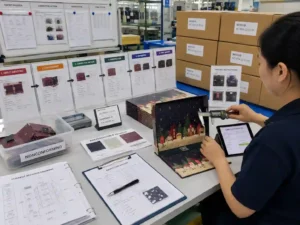
Quick answer: Before final payment, buyers should request pre shipment packing photo records that connect approved production to identifiable packed cartons and the shipment quantity. Useful evidence normally includes dated packing photos, carton identification, quantity reconciliation, packing lists, final inspection or release records, and relevant traceability references. The objective is not to collect attractive warehouse photos. It is to verify that the goods being paid for are the accepted production, packed in the agreed configuration, in quantities that reconcile with shipment records.

What pre shipment packing photo records should buyers request?
Buyers should request a photo set that identifies the order, shows the actual packing condition, and can be cross-checked against inspection and shipment records. A few unlabelled photos of closed cartons provide weak evidence because they do not establish what is inside, when the photos were taken, or which production batch they represent.
For a multi-component advent calendar order, a practical photo set may include:
- finished calendars or packaging components before secondary packing;
- representative open cartons showing the actual unit arrangement;
- protective materials, dividers, sleeves, bags, corner protection, or other specified packing components where applicable;
- closed cartons showing carton identification or shipping marks;
- multiple cartons or the packed production area to provide reasonable evidence of production scale;
- palletized or consolidated goods when this is part of the agreed shipment configuration; and
- dated or otherwise traceable photo references connected to the order, batch, inspection, or packing record.
The exact photo set is project-dependent. A buyer should define important views before packing is completed if certain internal details will become impossible to verify once cartons are sealed.
Which shipment records should accompany the packing photos?
The most useful shipment records allow the buyer to reconcile what was approved, what was packed, and what is scheduled for dispatch. Document names vary between suppliers, so buyers should focus on the information and traceability rather than a particular form title.
| Evidence | What it should help verify | Useful cross-check |
|---|---|---|
| Dated packing photos | Actual packing configuration and identifiable goods | Order, batch, carton or packing references |
| Final inspection or release record | Whether the relevant production quantity passed the defined release process | Inspection date, quantity, product identity and disposition |
| Packing list | Carton count, unit quantity and shipment composition | Accepted production quantity and carton records |
| Carton identification record | Which cartons belong to the shipment | Carton numbers, SKU references or batch identifiers |
| Quantity reconciliation | Whether accepted, packed, rejected, reworked and outstanding quantities make sense | Final inspection and packing totals |
| Traceability reference | Connection between packed goods and relevant production or QC records | Batch, lot, work-order or equivalent internal reference |
| Shipment or dispatch record | Planned shipment identity and dispatch status | Packing list and carton count |
Some transport documents may not exist before final payment or before cargo is handed to the carrier. Buyers should therefore distinguish documents that can reasonably be verified before release from documents generated only after dispatch.
How should buyers verify that the photos belong to the actual order?
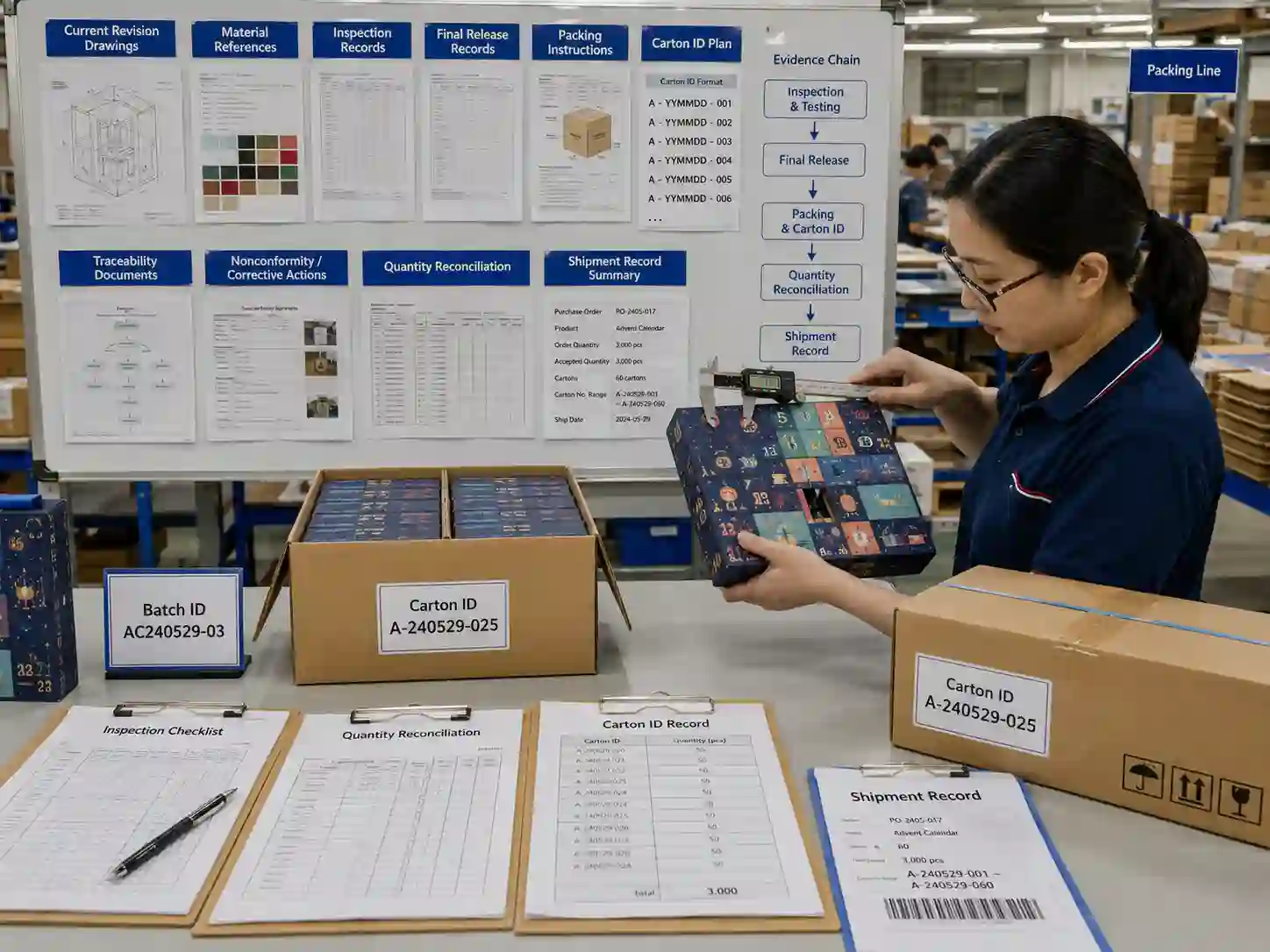
Look for identifiers that connect the photographs to controlled records. The strongest evidence chain moves from the approved requirement to inspected production, then from released production to identifiable cartons and shipment quantities.
For example, a photograph may show a carton number or order reference that appears in the packing record. That record can then be reconciled with a packing list, while the packed quantity can be compared with the quantity accepted by final inspection.
Where practical, buyers can ask for photo filenames, captions, worksheets, or another simple index that records the date and relevant order, batch, SKU, carton, or inspection reference. The method does not need to be elaborate; it needs to make the evidence auditable.
What makes packing-photo documentation strong or weak?
| Weak documentation | Stronger documentation |
|---|---|
| Several unlabelled warehouse photos | Dated photos tied to an identifiable order or packing record |
| Only closed cartons are photographed | Representative internal packing plus sealed-carton condition is documented |
| One carton is presented as proof of the whole shipment | Representative cartons and broader packed quantity are documented |
| Carton labels cannot be connected to records | Carton identifiers reconcile with carton and packing records |
| Packing list quantity is accepted without comparison | Packing quantity is reconciled with inspection and release quantities |
| Photos are treated as proof that quality passed | Photos support, but do not replace, applicable inspection and release records |
How should packed quantities be reconciled before payment?
Buyers should compare the quantity accepted by QC with the quantity reported as packed. Significant differences should be explained before payment approval rather than assumed to be normal.
A useful reconciliation can distinguish total production, inspected quantity, accepted quantity, rejected or segregated quantity, reworked quantity where applicable, packed quantity, and any balance not yet packed. The categories needed depend on the project’s inspection and production controls.
For example, if an inspection record identifies 9,800 accepted units but the packing list shows 10,000 packed units, the additional 200 units require explanation. Conversely, if fewer units are packed than were accepted, the buyer should understand whether the difference represents spares, shortages, split shipments, unfinished packing, or another documented disposition.
This is particularly important for multi-component packaging because an apparently complete finished quantity can hide missing drawers, inserts, sleeves, accessories, or other components unless the supplier’s production and packing records control the complete assembly.
Which quality records should be checked with shipment evidence?
Packing evidence should be connected to the applicable final inspection or release decision. It should not be used as a substitute for dimensional, functional, appearance, material, or other quality checks required by the project.
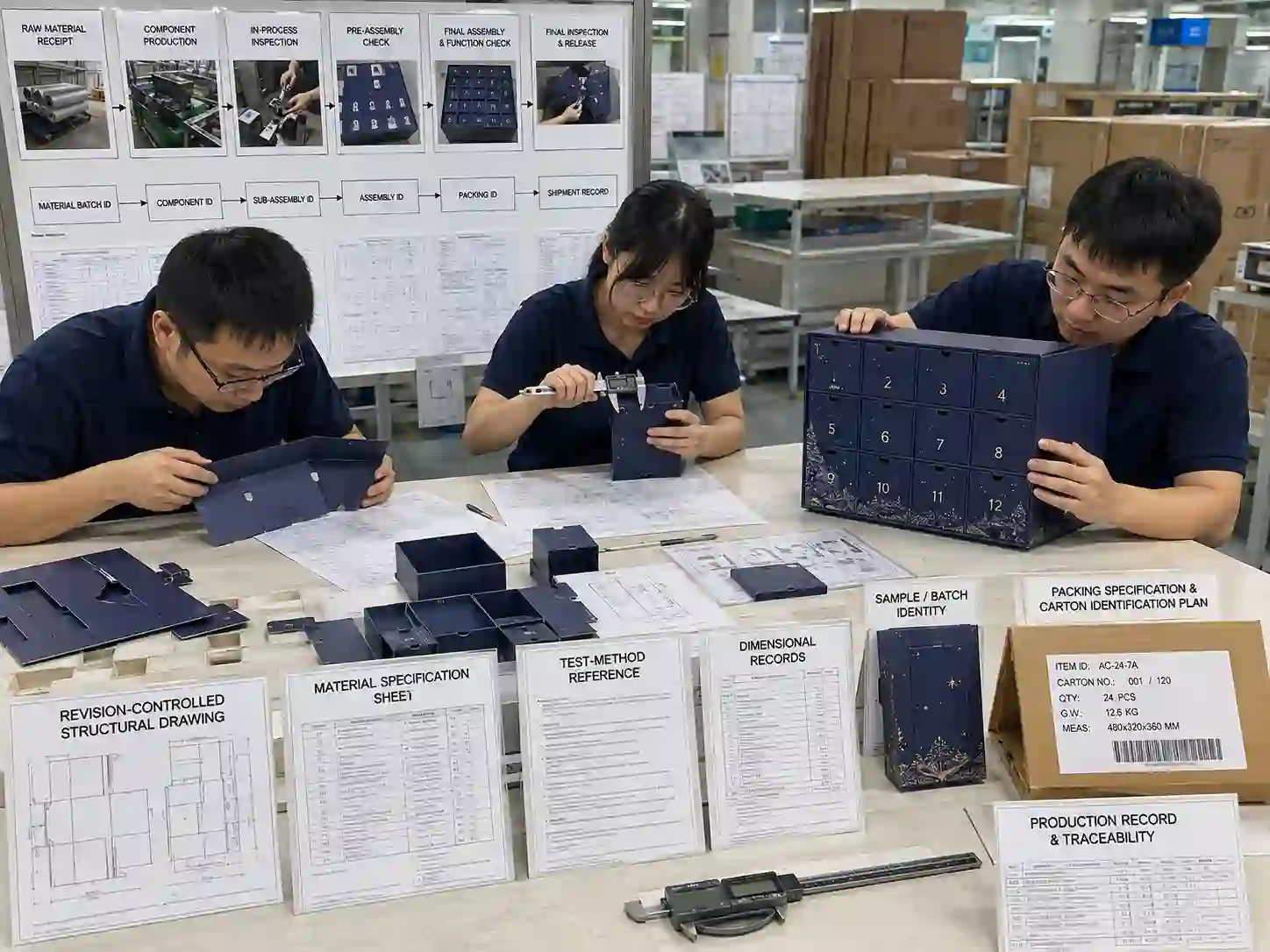
Where relevant, the buyer may cross-check the shipment against current-revision drawings, approved samples, material specifications, inspection records, test-method references, nonconformity records, and corrective-action verification. Not every document needs to be resent with every payment request if it has already been reviewed and remains applicable.
The key question is whether unresolved quality issues affect the production being packed. If a previous defect required corrective action, the buyer should be able to identify the affected production, the disposition, the verification of the correction, and the quantity ultimately released.
What should buyers check before approving final payment?
A short verification checklist helps prevent payment approval from becoming a simple response to a supplier’s invoice. The buyer should confirm that documentary gaps affecting shipment identity, quantity, or release have been resolved or consciously accepted.
- Confirm that the photos can be associated with the correct purchase order or project.
- Check that representative internal packing matches the approved or specified packing configuration.
- Confirm that carton identification is visible and consistent with the packing records.
- Reconcile packed quantities with accepted production quantities.
- Review the applicable final inspection or release status.
- Check whether any rejected, reworked, held, or outstanding goods remain unresolved.
- Verify that relevant corrective actions have been closed when they affect the shipment.
- Identify shipment documents that cannot legitimately exist until after carrier handover rather than treating them as missing evidence.
- Record any buyer-specific approval, waiver, deviation, or remaining condition before authorizing payment.
Which evidence is verifiable, project-dependent, or a buyer approval?
Keeping these categories separate prevents supplier documents from being interpreted as guarantees they cannot provide. Some facts can be checked directly, while other requirements depend on the purchase specification or the buyer’s commercial controls.
Verifiable facts include visible carton identifiers, documented packing quantities, inspection dates, recorded release status, traceability references, and whether figures reconcile across supplied records.
Project-dependent recommendations include how many cartons should be photographed, which internal packing stages need evidence, whether pallet photos are necessary, and which QC or test records should accompany the payment package. These should reflect product complexity, shipment configuration, identified risks, and contractual requirements.
Buyer approvals include accepting a documented deviation, approving a quantity difference, waiving a requested record, accepting an open commercial condition, or authorizing payment despite evidence that is not yet available. A supplier should not silently make these decisions on the buyer’s behalf.
What risks can packing photos reveal before final payment?
Good packing evidence can reveal mismatched carton identities, incomplete packing, unexpected packing methods, visible carton damage, inconsistent protective materials, or quantities that do not reconcile. It can also reveal when the evidence itself is too weak to support a payment decision.
However, photos have limits. They normally cannot establish every dimensional tolerance, material property, concealed assembly detail, or functional result. Those claims require the appropriate drawing, specification, measurement, inspection, sample, or test record.
This distinction is important when reviewing a supplier’s broader evidence package. Buyers evaluating custom advent calendar box services should define which records support each critical requirement instead of expecting a single photograph or certificate to prove the complete order.
When should the evidence package be agreed with the supplier?
The required evidence should ideally be defined before the relevant production or packing stage begins. Requesting internal packing photographs only after every carton has been sealed may make meaningful verification impossible without reopening goods.
Buyers can specify required photo stages, identifiers, quantity records, inspection references, and approval responsibilities in purchasing or quality documentation. This gives the supplier a clear record-retention target and gives the buyer a defined basis for reviewing final-payment evidence.
For additional supplier-verification topics, see the advent calendar box buying guides or review the capabilities of the Giftpackpro packaging factory.
FAQs about packing and shipment evidence
Are packing photos enough to approve final payment?
Not by themselves for most controlled packaging projects. Photos are strongest when they can be reconciled with quantity, inspection, release, carton identification, and traceability records applicable to the shipment.
Should buyers require every carton to be photographed?
Not automatically. The appropriate photo coverage depends on shipment size, risk, carton-identification method, contractual requirements, and whether other records provide reliable traceability. High-risk exceptions may justify more extensive documentation.
What if a shipment document is unavailable before payment?
First determine when that document is actually generated. Carrier-dependent documents may only become available after cargo handover, so the buyer should distinguish a legitimately future document from evidence that the supplier should already possess.
Should corrected goods have separate packing evidence?
When a correction affects shipment release, the evidence should make the disposition traceable. The buyer should be able to connect the affected production to corrective-action verification, reinspection or release status, and the packed goods where applicable.
If you need to define the packing, inspection, traceability, and final-payment evidence required for a custom packaging project, request a custom quote and include your product configuration and documentation requirements.