
First-article inspection is used to verify that an advent calendar box design can be produced correctly before full production begins. It confirms structural dimensions, assembly functions, artwork accuracy, component fit, and quality requirements using an approved first production article. The process helps identify risks early, document acceptance criteria, and prevent repeated defects during manufacturing.
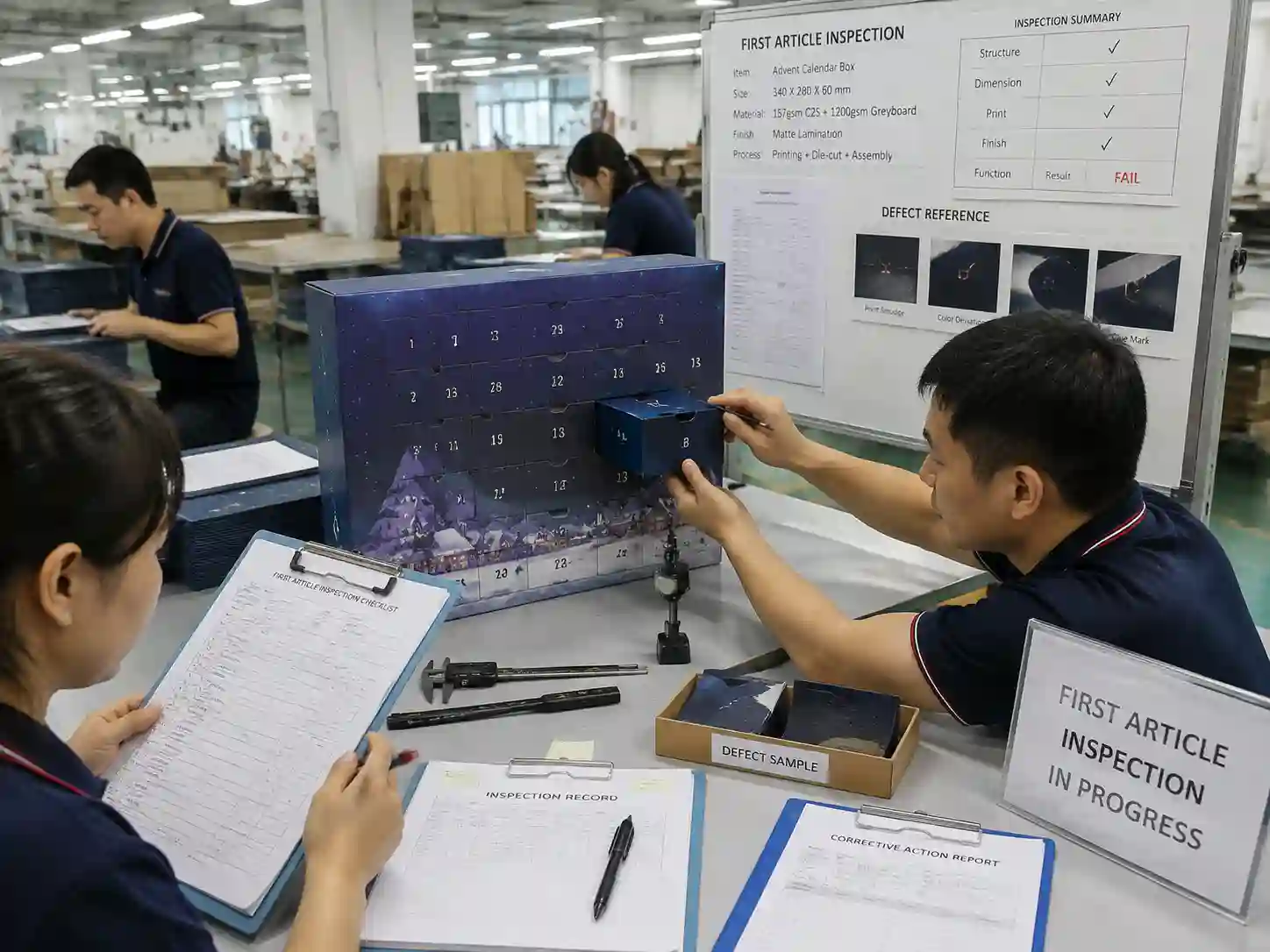
What is advent calendar first article inspection and why is it important?
Advent calendar first article inspection is the formal review of the first completed production unit or production sample against approved specifications before normal production continues. It connects engineering requirements, production methods, and quality expectations into one verification step.
Unlike a visual check of finished boxes, first-article inspection evaluates whether the manufacturing process is capable of producing the required structure consistently. For complex advent calendar formats, this is especially important because multiple drawers, doors, folds, inserts, and decorative elements must work together.
How should factories prepare for first-article inspection?
The inspection should begin with clear reference information. Inspectors need the latest approved drawings, specifications, sample references, artwork files, and inspection criteria before checking the first article.
A practical preparation process usually includes:
- Confirming the approved structural drawing and dimensional requirements.
- Reviewing material specifications and component identification.
- Checking the latest artwork revision and decoration requirements.
- Preparing measurement tools and inspection records.
- Defining acceptable defects and rejection criteria before inspection.
For custom advent calendar boxes, the first article should represent the actual production method as closely as possible. A handmade prototype or early concept model may not show the same risks as a production-made article.
Which parts of an advent calendar box should be checked during first-article inspection?
The inspection should cover functional performance, dimensional accuracy, appearance, and assembly quality. The exact checkpoints vary by structure, product weight, finishing requirements, and intended use.
| Inspection Area | Typical Checks | Evidence to Record |
|---|---|---|
| Structure and dimensions | Overall size, drawer clearance, panel alignment, folding accuracy | Measurement records and approved drawings |
| Opening and closing functions | Drawer movement, door operation, hinge performance, retention features | Functional inspection notes and photos |
| Component assembly | Correct positioning of inserts, dividers, magnets, ribbons, or supports | Assembly checklist and component references |
| Surface quality | Printing alignment, finishing consistency, visible defects | Defect classification record |
| Packaging performance | Stability during handling and product loading conditions | Loaded sample evaluation |
How are tolerances and functional requirements verified?
Tolerances should be checked against approved engineering requirements rather than personal judgment. Measurements provide objective evidence that the first article matches the intended design.
Common verification methods include:
- Using rulers, calipers, gauges, or templates for critical dimensions.
- Comparing the first article with an approved reference sample.
- Checking repeated functions such as drawer opening and closing cycles.
- Confirming that assembled components remain positioned correctly.
Some requirements depend on the project. For example, a calendar designed for lightweight items may require different functional checks from one holding heavier packaged products. The inspection plan should reflect the final application.
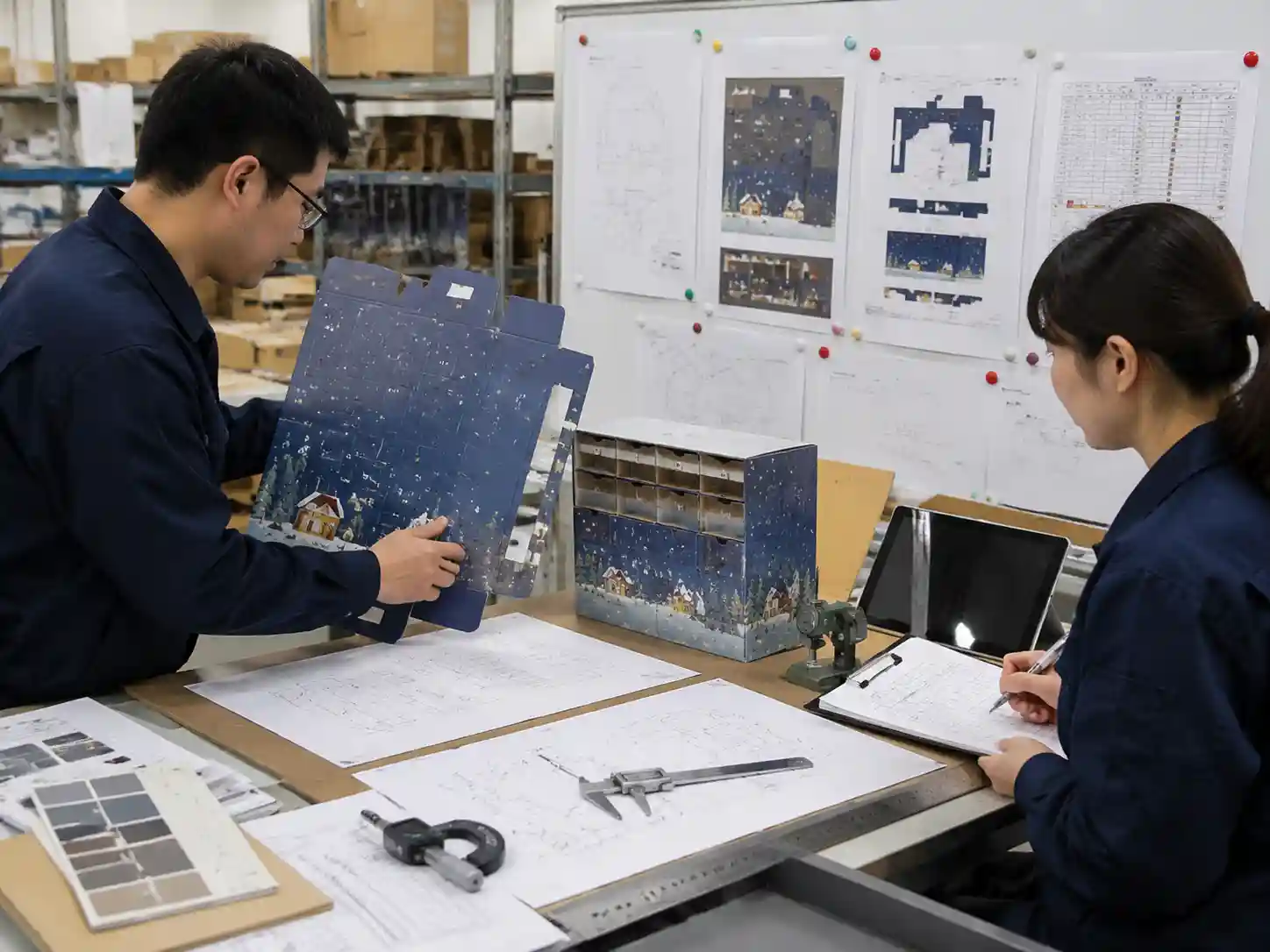
What defect criteria should be defined before first-article approval?
Defect criteria should be agreed before production approval so that inspectors, suppliers, and buyers use the same acceptance standard.
What defects are commonly reviewed during first-article inspection?
- Structural defects: incorrect dimensions, poor folding, weak connections, or misaligned components.
- Functional defects: drawers that stick, doors that do not open correctly, or retention parts that fail.
- Appearance defects: visible scratches, printing issues, finishing problems, or surface damage.
- Assembly defects: missing parts, incorrect placement, or mixed components.
| Defect Type | Inspection Question | Required Action |
|---|---|---|
| Critical issue | Does the defect affect safety, function, or required use? | Correct before production approval |
| Major issue | Does the defect affect customer acceptance or product performance? | Review and correct before continuation |
| Minor issue | Is the defect cosmetic and within agreed limits? | Record and monitor during production |
How should first-article inspection results be documented?
Inspection records should provide traceability from approval decisions back to the production article. A complete record allows teams to understand what was approved and why production was released.
Useful documentation may include:
- Inspected sample identification information.
- Measurement results and inspection checklists.
- Photos of approved and rejected conditions.
- Corrective-action records for identified problems.
- Approval signatures or confirmation records from responsible teams.
A traceability example:
- First article sample: production version A.
- Issue identified: drawer clearance outside approved requirement.
- Correction: structural adjustment completed.
- Verification: updated first article inspected and approved.
- Production status: released only after approval record completion.
What happens if the first article fails inspection?
If the first article does not meet requirements, production should not continue with the same conditions. The failed item should be reviewed to identify whether the issue comes from design, material, tooling, assembly method, or process control.
The corrective action process normally includes:
- Recording the non-conformance and affected requirement.
- Identifying the root cause.
- Adjusting the process or component.
- Producing a revised first article.
- Repeating inspection before approval.
This approach prevents the same issue from being repeated across a full production run.
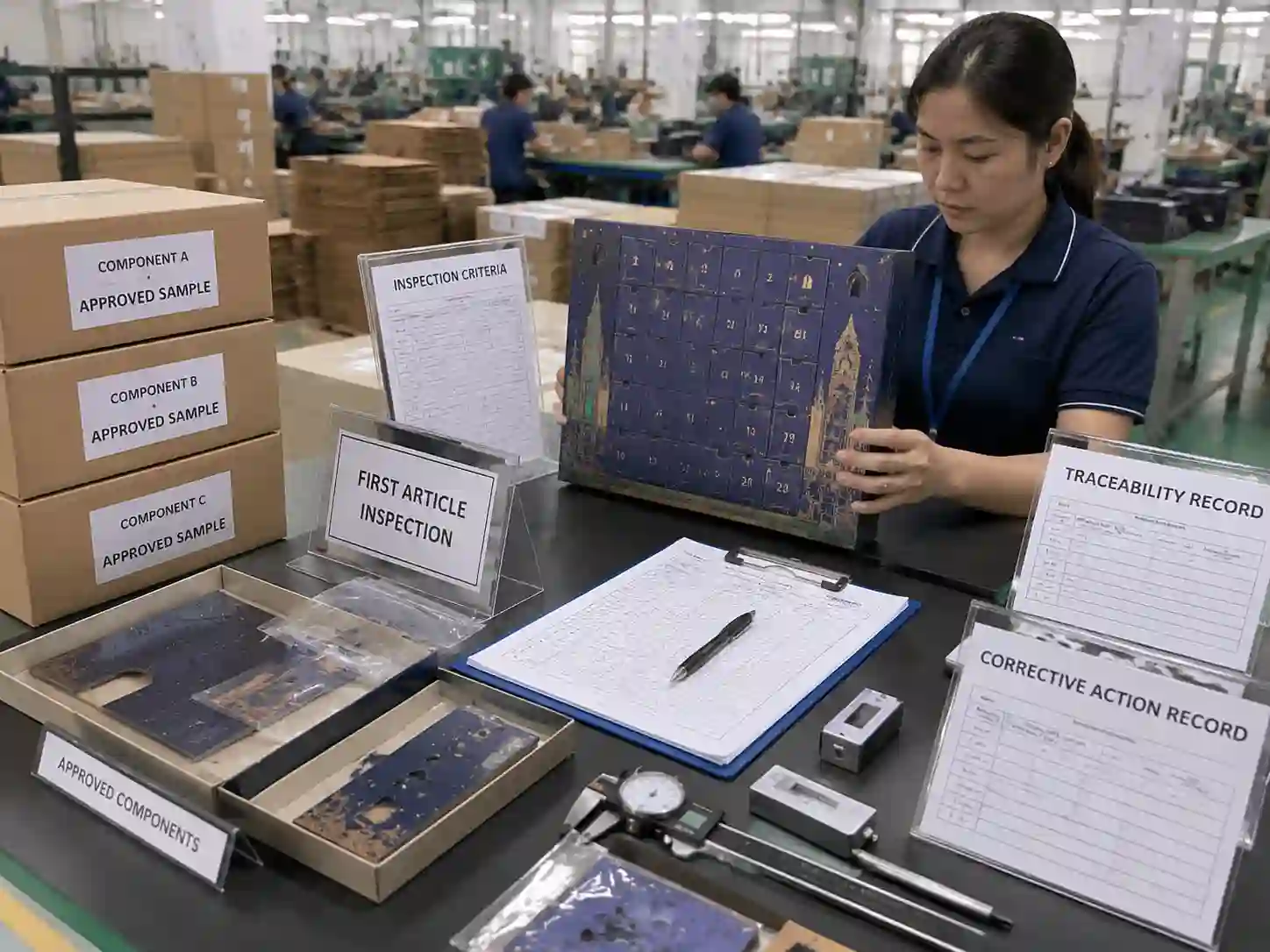
How does first-article inspection support production quality control?
First-article inspection creates the quality baseline for later production checks. Once the first article is approved, inspectors can compare ongoing production against the confirmed standard.
For custom advent calendar packaging, this baseline is useful because production involves multiple variables, including structure, components, finishing, and manual assembly steps. Clear first-article approval reduces uncertainty between engineering, purchasing, production, and quality teams.
Giftpackpro applies structured production review methods for custom packaging projects. Learn more about custom advent calendar box services, explore available custom advent calendar box products, or contact the team through request a custom quote for project-specific requirements.
FAQs about advent calendar first article inspection
Is first-article inspection the same as final quality inspection?
No. First-article inspection happens before regular production approval and confirms that the manufacturing process can meet requirements. Final quality inspection checks completed production output against the approved standard.
Who should review the first article?
The review may involve quality teams, packaging engineers, purchasing representatives, and project stakeholders depending on the project requirements and approval process.
Can first-article inspection requirements vary between advent calendar projects?
Yes. The inspection scope depends on the box structure, number of components, product loading requirements, finishing complexity, and functional expectations.


