
Quick answer: Effective 24 drawer assembly sequence control relies on making each drawer position identifiable and difficult to mix up. A controlled process typically combines numbered work instructions, fixed assembly locations, staged drawer sets, visual references, in-process checks, batch traceability, and defined action for sequence errors. The exact method depends on whether drawers differ by artwork, dimensions, products, inserts, or orientation, but the finished calendar should be verified against an approved sequence reference before release.
Why is drawer sequence difficult to control during manual assembly?
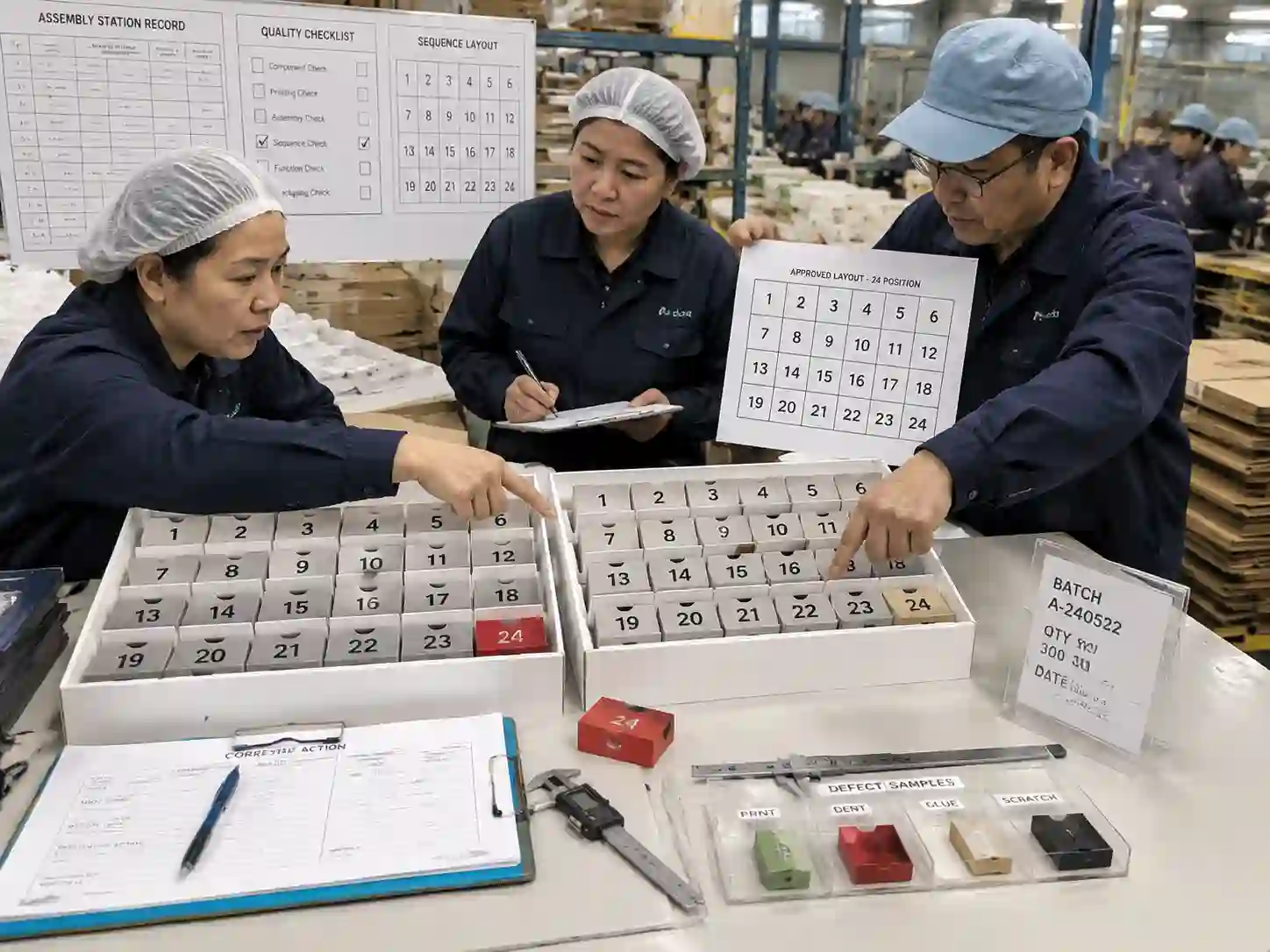
A 24-drawer calendar creates multiple opportunities for substitution, rotation, duplication, omission, or position errors because operators handle many visually similar components. The risk increases when drawer differences are subtle or when several assembly operations occur at separate stations.
A drawer may have the correct dimensions and acceptable printing but still become a functional or visual defect when installed in the wrong cavity. Sequence control therefore needs to be treated as an in-process assembly requirement rather than relying only on a final appearance check.
Before production, the supplier should identify what makes each position unique. Depending on the project, this may include the drawer number, printed artwork, cavity dimensions, insert configuration, product SKU, opening orientation, or a combination of these characteristics.
What should the approved 24-drawer sequence reference contain?
The production team should work from one controlled reference showing the intended position and orientation of all 24 drawers. It should match the buyer-approved artwork, structural information, and production revision.
A practical sequence reference can include:
- drawer positions 1 through 24;
- a front-view layout showing the location of each numbered drawer;
- drawer dimensions where multiple sizes are used;
- artwork or color identification where drawer graphics differ;
- orientation marks for directional graphics;
- insert or product references when contents vary by position;
- drawing or document revision identification;
- approved sample or visual reference identification; and
- date or production release status where required by the control system.
The critical point is document consistency. A correct assembly instruction paired with an obsolete artwork layout can still produce a complete but incorrectly sequenced calendar. Revision status should therefore be checked when production documents are issued to the line.
How does 24 drawer assembly sequence control work at the assembly station?
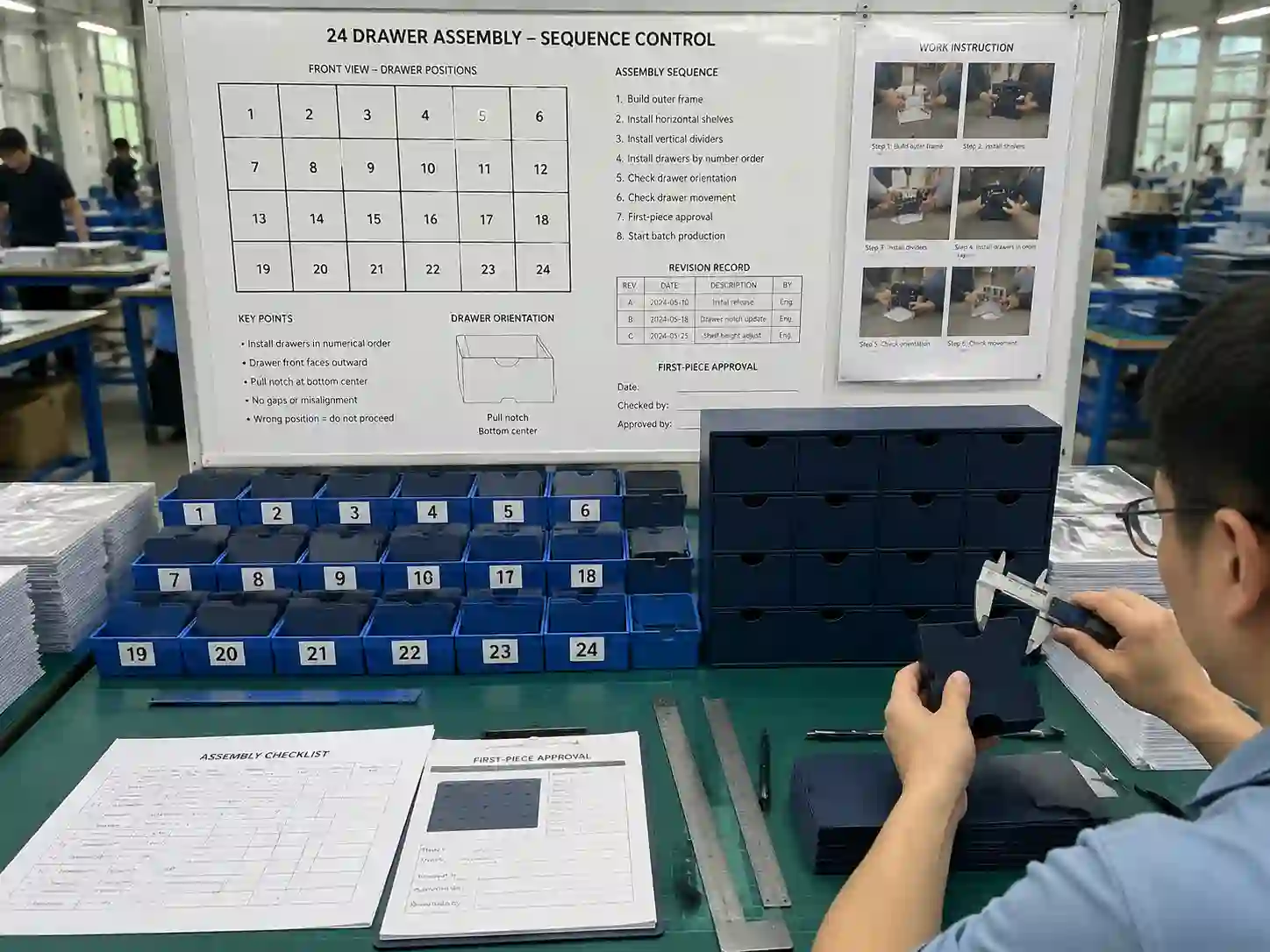
The strongest manual controls reduce the amount of remembering and interpretation required from operators. Instead of asking an assembler to memorize 24 positions, the workstation should make the next correct component visually and physically clear.
How should the 24 drawers be staged?
Drawers can be staged in controlled sets corresponding to their required positions. Separate trays, bins, racks, or clearly defined work areas can prevent loose components from different positions from becoming mixed.
For example, a work tray may provide 24 identified locations corresponding to the approved layout. An operator removes each drawer from its designated location and places it into the matching calendar position. An empty staging location then provides a simple visual indication that the component has been used.
The exact fixture is project-dependent. A calendar containing several drawer sizes may benefit from physical segregation, while identical-size drawers with unique printing may depend more heavily on visual identification.
Should drawers carry temporary sequence identification?
Temporary identification can be useful when permanent artwork is not sufficiently clear for assembly control. The marking method must not damage the visible surface or remain on the finished product unintentionally.
Possible controls include removable labels on protected areas, identification on intermediate packaging, marked staging trays, batch cards, or component bundles identified by position range. The selected method should be validated against the actual surface material and finishing requirements.
How can assembly direction reduce sequence errors?
A fixed assembly direction makes the process more repeatable. Work instructions can define a consistent progression such as left-to-right and top-to-bottom according to the approved structural layout.
Operators should not independently choose where to start when drawer positions are sequence-critical. A standardized route makes skipped positions, duplicated drawers, and orientation errors easier to identify during in-process inspection.
Which in-process inspections catch sequence mistakes early?
Inspection should occur before a large quantity of incorrectly assembled calendars accumulates. Checks can be placed at first-piece approval, during assembly, after a defined assembly stage, and at finished-unit inspection according to the project’s control plan.
| Inspection point | What to check | Evidence or reference | Typical issue detected |
|---|---|---|---|
| Material release | Correct drawer components and revision | Production order, approved artwork or drawing | Wrong or obsolete component entering assembly |
| First assembled unit | All 24 positions, orientation and drawer type | Approved sequence layout or reference sample | Systematic setup error |
| In-process check | Selected or complete position sequence as specified | QC checklist and workstation reference | Operator mix-up or replenishment error |
| Functional check | Drawer location, fit, opening and closing | Approved drawing, sample and defined criteria | Wrong-size drawer or incorrect orientation |
| Finished-unit inspection | Completeness and final sequence | Approved master layout and inspection record | Missing, duplicate or transposed drawer |
Inspection frequency and sample quantity are project-dependent and should be defined in the applicable quality plan or buyer requirement rather than assumed to be universal.
What defects should inspectors classify during sequence checks?
Sequence inspection should use defined defect descriptions rather than vague instructions such as “check drawers.” Clear classifications make inspection results easier to record, investigate, and communicate.
A focused defect checklist may include:
- drawer installed in the wrong numbered position;
- two positions containing the same drawer or artwork;
- required drawer missing;
- drawer rotated or reversed relative to the approved orientation;
- wrong drawer size installed in a cavity;
- drawer artwork inconsistent with the approved sequence;
- wrong insert or internal configuration associated with a drawer;
- drawer unable to open or close correctly because of incorrect placement;
- component from another revision or batch mixed into the set; and
- temporary identification remaining on the finished visible surface.
Whether a particular defect is classified as critical, major, minor, or under another buyer-defined system should come from the approved inspection criteria. The supplier should not substitute an assumed severity classification for a buyer’s documented requirement.
How should dimensional tolerances be separated from sequence control?
Sequence and dimensional conformity should be checked separately even though they can interact. A drawer in the correct numbered location can still be defective if its dimensions cause excessive friction, poor alignment, or an unacceptable gap.
Conversely, a dimensionally correct drawer can be a sequence defect if it carries the artwork intended for another position.
Packaging engineers can verify dimensional requirements using the released drawing and suitable measurement equipment. Functional inspection can then confirm that representative drawers open, close, align, and remain in their intended positions as required by the approved specification.
This separation helps root-cause analysis. It prevents an assembly-position problem from being incorrectly recorded as a dimensional defect and vice versa.
How is drawer sequence traceability maintained?
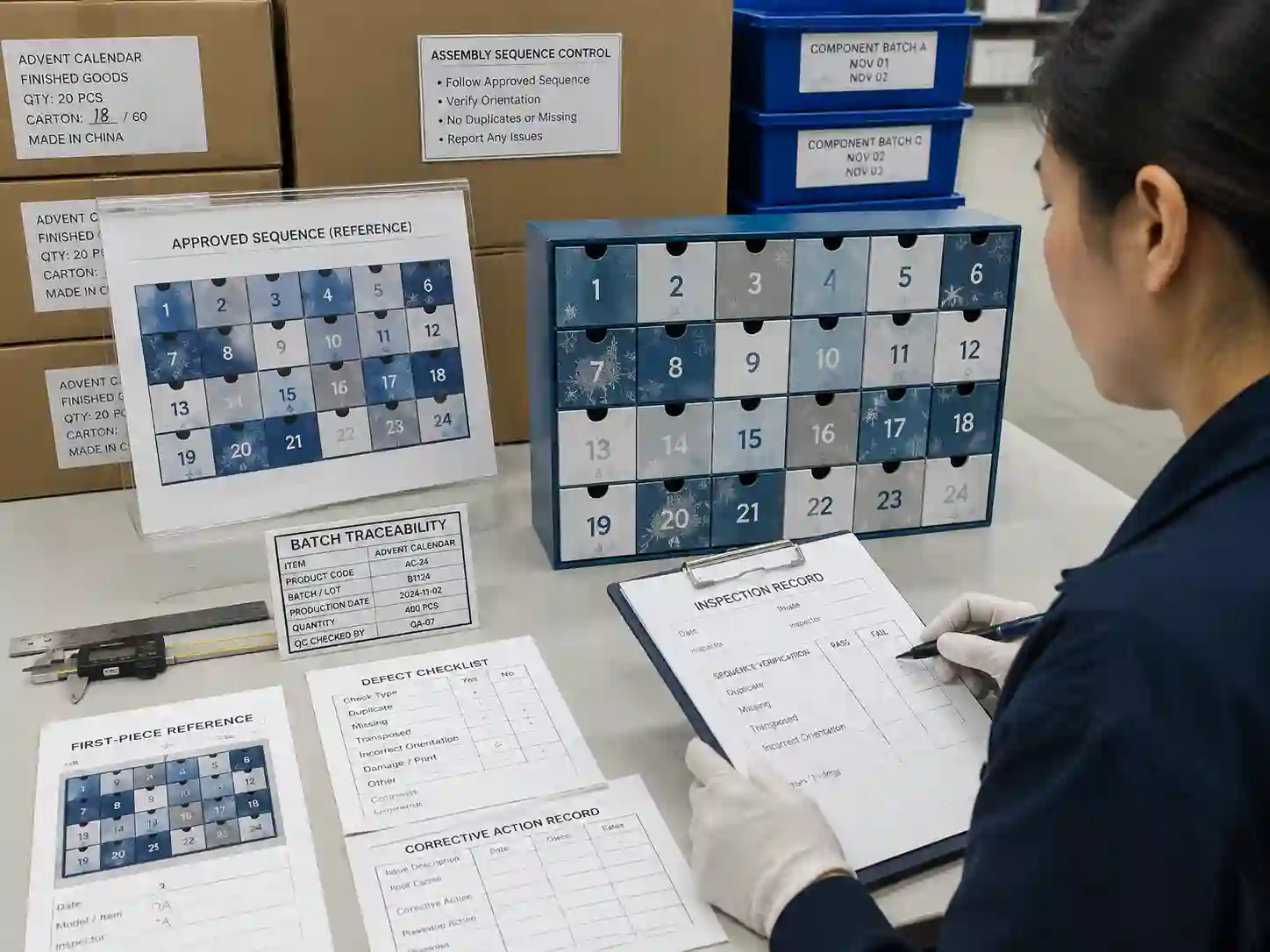
Traceability should make it possible to connect an inspected calendar or production lot with the relevant assembly period, component revision, and inspection records. The required depth depends on the project and production control system.
What can a practical traceability record look like?
A simplified record might show:
| Record field | Example of information recorded |
|---|---|
| Production order | Internal job or order reference |
| Calendar version | Released structural/artwork revision |
| Drawer component set | Component batch or issue reference |
| Assembly station | Line or workstation identifier |
| Assembly period | Date and shift or defined production period |
| Inspection | First-piece and in-process check status |
| Nonconformity | Defect record number when applicable |
| Disposition | Rework, segregation, acceptance under authorized criteria, or other approved action |
The purpose is not paperwork for its own sake. If an inspector discovers drawers 11 and 12 have been transposed, traceability should help determine which production units may have been assembled under the same conditions.
What should happen when a sequence error is found?
A detected sequence error should trigger containment before normal production continues when there is a risk that the same error affects other units. The affected scope should then be determined using production and inspection records.
A practical corrective process can include:
- Identify and segregate the known nonconforming unit or lot.
- Compare the unit against the current approved 24-position reference.
- Check whether the error is isolated or repeated.
- Review material staging, replenishment, workstation layout, instructions, and revision status.
- Define the affected production period using available traceability records.
- Reinspect or rework affected units according to approved instructions.
- Correct the workstation condition that allowed the mix-up.
- Verify the next production units before returning to normal inspection frequency.
Corrective action should address the mechanism that created the error. Simply telling an operator to “be more careful” provides weak control if two almost identical drawer stacks remain side by side without identification.
Which sequence-control details should buyers approve?
Buyers normally need to approve the product requirements rather than every movement made by an assembly operator. However, sequence-critical references should be unambiguous before bulk assembly begins.
Depending on the project, buyer-controlled information may include the final 24-position layout, artwork revision, drawer orientation, product-to-drawer allocation, dimensional requirements, approved sample, functional expectations, and defect criteria.
The manufacturing team can then translate those approved requirements into workstation instructions, staging methods, inspection records, and traceability controls.
For custom projects, reviewing these requirements early with custom advent calendar box services can help align structural, artwork, assembly, and QC references before production release. Existing constructions can also be reviewed through custom advent calendar box products when assessing how different drawer formats affect manual assembly.
How can a buyer verify that sequence control is actually working?
Ask for objective evidence from the production process rather than relying only on a statement that the drawers are checked. Useful evidence can include the released sequence drawing, workstation instruction, first-piece record, in-process inspection sheet, nonconformity record, and photographs of controlled staging where appropriate.
A production visit or inspection can also compare the documented process with the actual workstation. Inspectors can verify whether components are segregated, references are current, operators follow the specified assembly direction, and completed calendars match the approved 24-position layout.
For information about manufacturing and quality-control capabilities, buyers can review the Giftpackpro packaging factory.
What is the most reliable way to prevent 24-drawer mix-ups?
The most reliable approach is layered control: an approved master sequence defines what is correct, controlled staging makes the correct assembly easier, standardized work reduces variation, in-process inspection detects deviations, and traceability limits the scope when something goes wrong.
No single label, checklist, or final inspection replaces that system. The exact controls should reflect the actual drawer differences and the consequences of a mix-up.
FAQs
Do all 24 drawers need individual identification during assembly?
Not necessarily. Individual identification is most useful when drawers are visually similar but position-specific. Where dimensions, colors, or other features already make positions unmistakable, controlled trays or grouped staging may provide sufficient identification. The method should be selected from the actual mix-up risk.
Can final inspection alone control drawer sequence?
Final inspection can detect sequence defects, but relying on it alone allows errors to accumulate before discovery. In-process controls are more effective for identifying systematic setup, replenishment, or assembly mistakes while the affected production scope is still limited.
What happens if artwork revisions change several drawer numbers?
The revised artwork and sequence reference should be formally released, and obsolete instructions or component references should be removed from the workstation. Existing components should be identified and segregated as necessary so that previous and current revisions cannot be mixed unintentionally.
If your project uses 24 position-specific drawers, provide the structural layout, artwork sequence, and product allocation when you request a custom quote so the assembly and inspection requirements can be reviewed against the actual calendar design.


