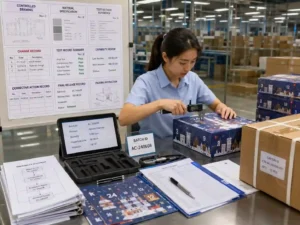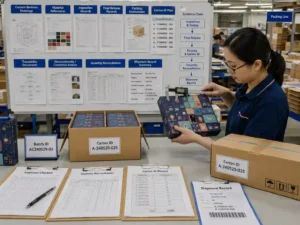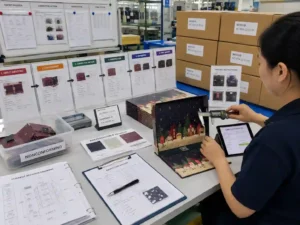
Quick answer: Export packing for advent calendar boxes from China should be planned before mass production, not after the boxes are finished. Buyers should confirm whether boxes will ship flat or assembled, select the correct export carton size, test inserts and product fit, define pallet requirements, prepare shipping marks, and approve packing samples before bulk shipment. For custom advent calendar boxes, the best export packing solution depends on box structure, insert design, material thickness, destination requirements, and handling risks during international transportation.
For overseas brands, wholesalers, and retail buyers, export packing is not only about putting finished boxes into cartons. It affects product protection, container efficiency, freight cost, assembly labor, and customer experience after delivery. A reliable supplier should connect packaging engineering, production planning, QC inspection, and logistics preparation into one process.
What should buyers understand before arranging export packing for advent calendar boxes from China?
Before choosing an export packing method, buyers should understand the relationship between box structure, product weight, insert protection, and shipping conditions. The same packing method does not work equally well for every custom advent calendar box design.
Custom advent calendar boxes are usually more complex than standard folding cartons because they may include multiple compartments, doors, drawers, internal trays, or rigid structures. Export packing must protect these functional parts while controlling shipping volume.
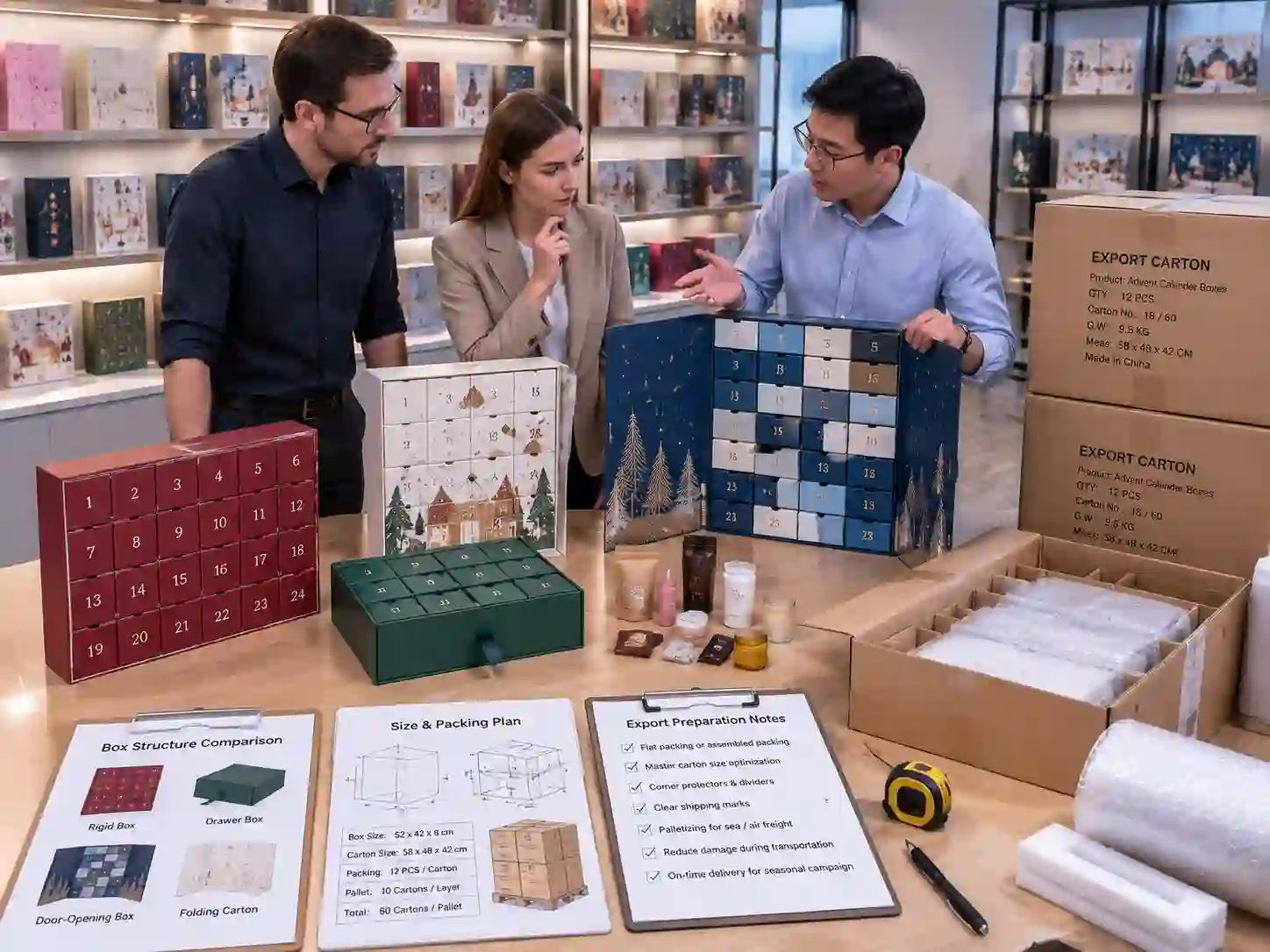
Common structures include:
- Rigid box: Strong premium structure made with greyboard and wrapped paper, often requiring careful corner protection because finished boxes are heavier and less flexible.
- Folding carton: Efficient for larger quantities because flat packing reduces shipping volume and storage space.
- Drawer box: Requires accurate clearance control because excessive pressure during shipping can affect drawer movement.
- Door-opening box: Needs protection around hinges, doors, magnets, and opening panels to avoid deformation.
Should advent calendar boxes be shipped flat packed or assembled?
The correct choice depends on the box structure, customer requirements, labor costs, and transportation efficiency. Flat packing usually reduces freight volume, while assembled packing provides better presentation control but requires more space.
| Packing Option | Best Application | Advantages | Buyer Considerations |
|---|---|---|---|
| Flat packing | Folding cartons and some collapsible structures | Lower shipping volume, lower freight cost, easier warehouse storage | Requires accurate folding, crease quality, and assembly testing |
| Assembled packing | Rigid boxes, premium gift packaging, retail-ready displays | Ready for product filling and store presentation | Higher carton volume and stronger protection requirements |
| Partial assembly | Boxes with complex inserts or multiple components | Balances protection and shipping efficiency | Requires clear assembly instructions and QC control |
Buyer tip: Ask the supplier to provide both packed dimensions and assembled dimensions before approving the order. A small difference in carton size can significantly affect international freight calculations.
How do inserts affect export packing for advent calendar boxes?
Insert design directly influences shipping stability because inserts prevent movement, impact damage, and product shifting inside the box. Buyers should test the insert together with the final box structure before bulk production.
Common insert options include:
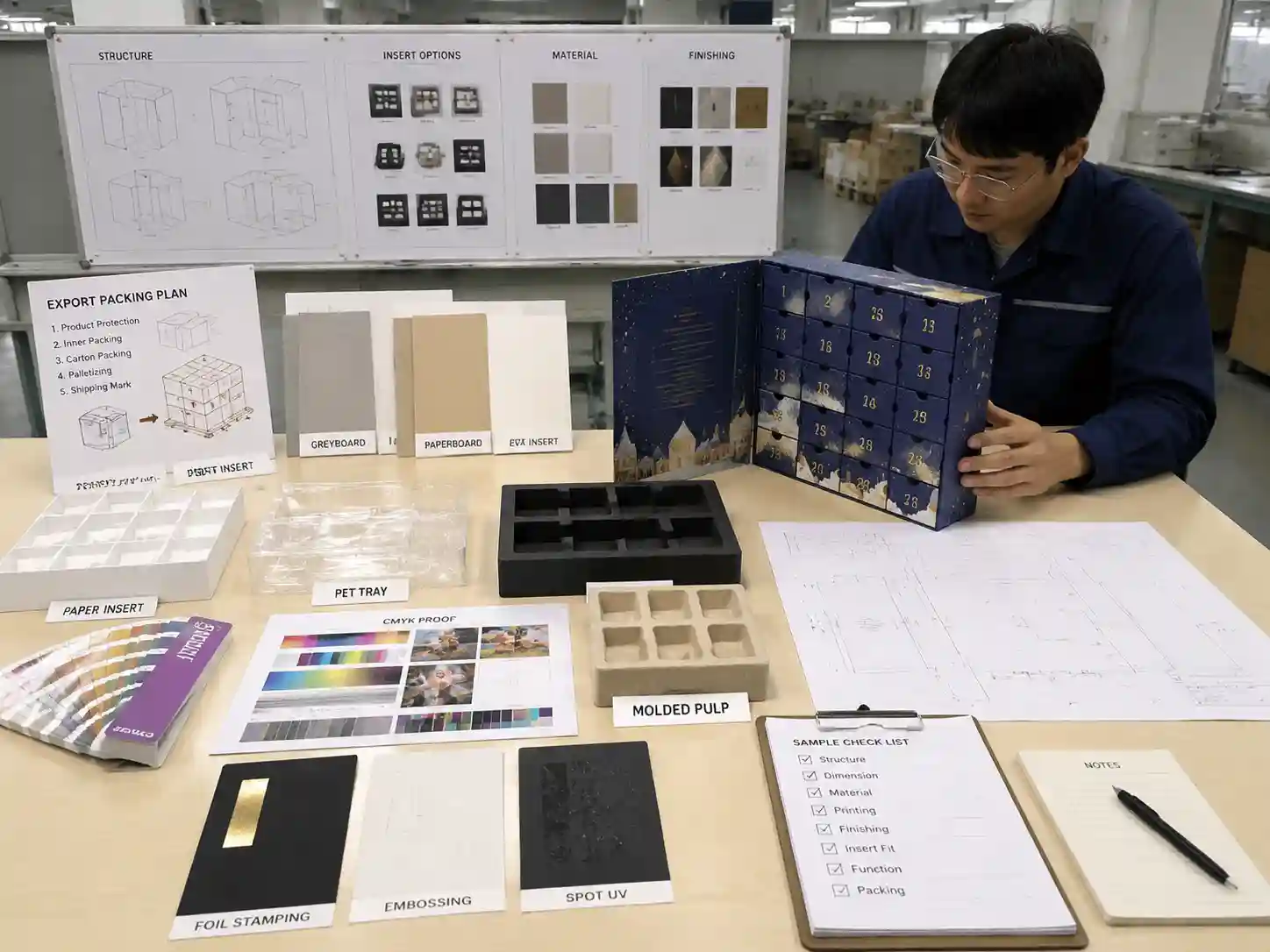
- Paper insert: Cost-efficient and suitable for lightweight products such as cards, samples, tea sachets, or small gifts.
- PET tray: Provides accurate cavities and visibility for products that require individual positioning.
- EVA insert: Suitable for premium products requiring soft protection and precise fitting.
- Foam insert: Helps absorb impact for fragile items.
- Molded pulp insert: Useful when buyers need recyclable protection solutions.
For example, an advent calendar box containing cosmetics may require individual cavities for tubes or bottles, while a chocolate application may need food-contact suitability review and stronger temperature considerations. Buyers should confirm product dimensions, weight distribution, and cavity tolerance before requesting a quotation.
Which materials and customization details affect export packing decisions?
Material selection affects box strength, carton weight, protection level, and shipping cost. Buyers should finalize materials before export packing design because changing board thickness or finishing methods can change the final carton dimensions.
Important production details include:
- Paperboard and greyboard thickness for structural strength
- Dieline accuracy for folding and assembly performance
- CMYK printing proof and Pantone color confirmation
- Foil stamping, embossing, spot UV, matte lamination, or gloss lamination testing
- Insert material thickness and product clearance
- Finished box stacking strength during carton packing
Factory tip: Export packing should be reviewed during the prototype stage. A box that passes visual approval may still need adjustments if it cannot maintain shape inside export cartons.
How should buyers compare suppliers for export packing advent calendar boxes China orders?
Buyers should compare suppliers based on their complete packaging process rather than only unit price. A capable supplier should explain how sampling, production, QC, and export packing connect together.
| Supplier Evaluation Point | Questions Buyers Should Ask |
|---|---|
| Structure capability | Can the factory produce rigid boxes, drawer boxes, folding cartons, and door-opening structures? |
| Sample process | Will the supplier provide a prototype and pre-production sample for approval? |
| Insert testing | Can the factory check product fit, movement, and protection before bulk production? |
| QC system | Are printing, assembly, dimensions, and packing inspected before shipment? |
| Export experience | Can the supplier recommend carton sizes, pallet methods, and shipping marks? |
Giftpackpro supports buyers looking for custom advent calendar boxes manufacturer solutions with attention to structure, production control, and export preparation.
What sampling and QC checks should be completed before export packing?
Before shipment, buyers should approve a production sample that represents the final mass-production standard. Export packing should only begin after the product structure, printing, finishing, and insert fit are confirmed.
Pre-export QC checklist for advent calendar boxes
- Confirm box dimensions match approved drawings and dielines
- Check drawer movement, door opening, and locking functions
- Verify insert cavities fit the actual product size
- Compare printing color with approved CMYK proof or Pantone reference
- Inspect foil stamping, embossing, and surface finishing quality
- Check corner strength and panel flatness
- Confirm carton quantity and packing method
- Verify shipping marks before container loading
A buyer should also request clear photos or inspection records before shipment. Some companies use third-party inspection providers or internal quality teams to verify shipment conditions.
For sustainability-related packaging decisions, buyers can review official information from FSC certification resources when evaluating responsible paper sourcing requirements.
How should export cartons and pallets be arranged for international shipping?
Export cartons should be designed around product protection, carton strength, and transportation efficiency. The goal is to prevent crushing, moisture exposure, movement, and corner damage during handling.
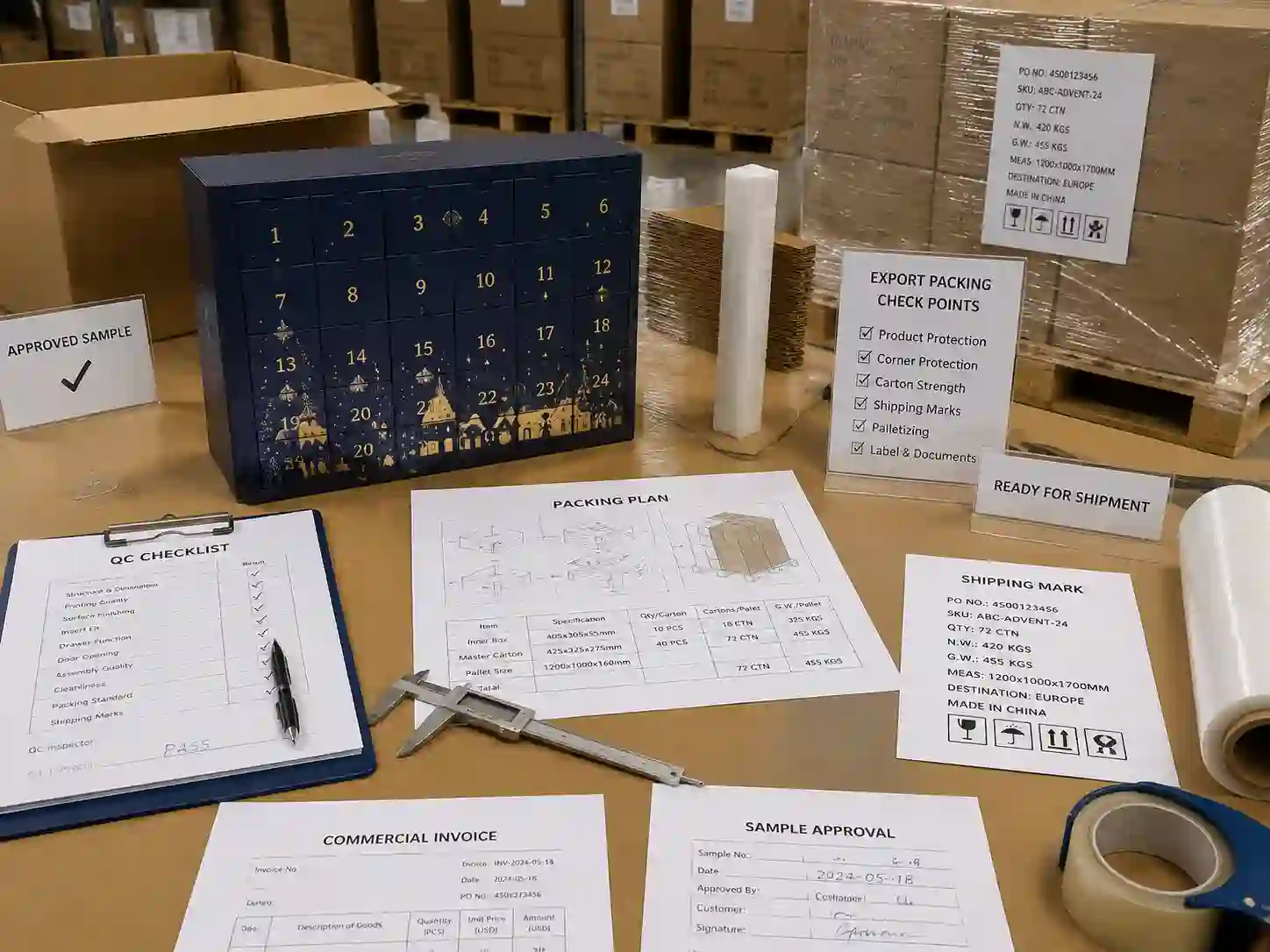
Typical export packing steps include:
- Protect finished boxes with inner wrapping, separators, or protective materials where required.
- Arrange products evenly inside master cartons to avoid pressure points.
- Add corner protection or dividers for rigid and premium structures.
- Seal cartons according to shipping requirements.
- Add shipping marks, carton numbers, weight information, and handling information.
- Stack cartons securely on pallets if required.
- Apply pallet wrap and confirm loading stability.
QC tip: The strongest-looking box is not always the safest shipping box. Export packing should be tested based on the complete logistics journey, including factory handling, container loading, unloading, and warehouse storage.
What information should buyers prepare before requesting a quotation?
A complete RFQ helps suppliers provide more accurate pricing, lead time, and export packing recommendations. Buyers should prepare technical information before contacting a factory.
Quotation preparation checklist
- Box structure preference: rigid box, folding carton, drawer box, or door-opening box
- Finished box size and product dimensions
- Number of compartments required
- Insert type and material preference
- Paperboard or greyboard requirements
- Artwork files and printing requirements
- Finishing requirements such as foil stamping or embossing
- Estimated order quantity and target MOQ
- Destination country and shipping requirements
- Expected delivery timeline
Buyers can review more sourcing guidance through advent calendar box buying guides and explore available custom advent calendar box products before preparing a project brief.
How do MOQ and lead time influence export packing planning?
MOQ and lead time affect material purchasing, production scheduling, and packing preparation. Larger orders may require earlier carton planning because packaging materials, inserts, and shipping arrangements must be coordinated.
Typical project stages include:
- Artwork and specification confirmation
- Dieline review and prototype production
- Sample approval
- Material purchasing
- Printing and finishing
- Box assembly
- Final QC inspection
- Export packing and shipment preparation
Buyers should discuss the complete timeline with suppliers instead of only asking for production days. Packaging complexity, insert testing, and approval speed can influence the final delivery schedule.
What are common export packing mistakes buyers should avoid?
The most common mistakes happen when export packing is treated as a final shipping step instead of part of packaging engineering.
- Choosing carton sizes without considering finished box dimensions
- Approving samples without testing insert fit
- Ignoring drawer and door-opening functions during transportation testing
- Changing materials after carton planning is completed
- Failing to confirm shipping marks before loading
- Using insufficient protection for rigid or premium boxes
- Comparing suppliers only by quotation price
Decision guide: Which export packing method is right for your advent calendar box project?
| Project Situation | Recommended Packing Approach |
|---|---|
| High-volume retail order | Consider flat packing or optimized carton packing to reduce freight cost |
| Luxury gift packaging | Consider assembled packing with stronger protection |
| Products with fragile contents | Prioritize tested inserts and impact protection |
| Complex multi-door or drawer designs | Require prototype testing before mass production |
FAQ: Export packing advent calendar boxes China buyers often ask
Can advent calendar boxes be shipped flat from China?
Yes, some structures can be shipped flat to reduce freight volume, especially folding cartons and selected collapsible designs. The supplier should confirm whether flat packing affects assembly quality or product presentation.
Should buyers approve export packing samples?
Yes. A packing sample or production sample helps confirm carton size, product protection, insert stability, and handling requirements before bulk shipment.
What increases export packing costs?
Common cost drivers include larger carton dimensions, heavier rigid structures, protective materials, special inserts, pallet requirements, and additional inspection requirements.
How early should buyers discuss export packing with a factory?
Export packing should be discussed during quotation and sampling stages, because structure, materials, and insert design directly affect shipping plans.
How to arrange export packing with Giftpackpro
Successful export packing starts with accurate project information. Before requesting a sample or quotation, buyers should prepare box structure requirements, product dimensions, insert expectations, artwork details, quantity, destination, and shipping preferences.
Giftpackpro provides custom advent calendar box services for buyers who need support with structure development, sampling, production preparation, QC coordination, and export packing planning. You can also learn more about our process through the Giftpackpro packaging factory page.
When your specifications are ready, prepare your packaging brief and request a custom quote to discuss suitable materials, packing methods, lead time, and production options for your advent calendar box project.