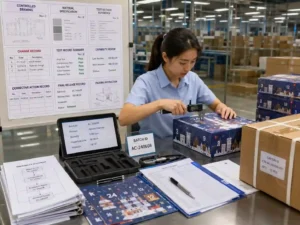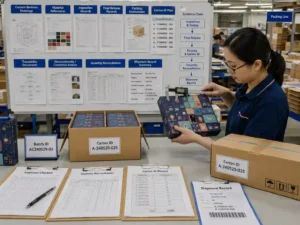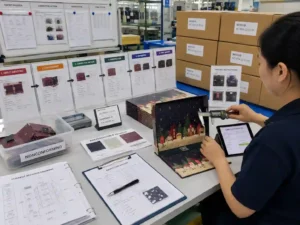
Quick answer: To avoid low quality advent calendar box suppliers, buyers should evaluate more than price. A reliable supplier must demonstrate control over box structure, insert fitting, material selection, artwork accuracy, sampling, production quality, and export packing. Before placing a bulk order, compare suppliers by reviewing prototypes, checking dielines, confirming printing standards, testing product fit, understanding MOQ and lead time, and requesting clear quotation details. The right supplier should provide evidence of manufacturing capability rather than only attractive samples or low initial pricing.
For overseas brands, wholesalers, retail buyers, and purchasing teams, custom advent calendar boxes are seasonal packaging projects with strict deadlines. A supplier mistake in structure, printing, inserts, or shipping preparation can affect the entire launch schedule. Choosing the right packaging partner early reduces production risk and improves consistency during mass production.
Why do buyers need to identify low quality advent calendar box suppliers before ordering?
Buyers should identify weak suppliers before sampling or bulk production because advent calendar boxes combine multiple packaging processes that must work together. Unlike standard cartons, these products often include multiple compartments, opening mechanisms, decorative finishing, and custom inserts that require accurate engineering.
Common warning signs of unreliable suppliers include:
- Only providing product photos without explaining materials or construction methods.
- Giving unclear quotations without separating box, insert, printing, finishing, and packing costs.
- Avoiding prototype development or sample approval before mass production.
- Not confirming product dimensions and insert tolerance.
- Offering extremely low prices without explaining material thickness, finishing, or production limits.
Buyer tip: A professional supplier should be able to explain why a specific structure, board thickness, insert material, or finishing method is recommended for your product weight, retail channel, and shipping requirements.
Which advent calendar box structures should buyers compare before choosing a supplier?
The best supplier should understand different custom advent calendar box structures and recommend the right solution based on product size, opening experience, cost target, and logistics requirements. A supplier that only pushes one box style may not have enough engineering flexibility.
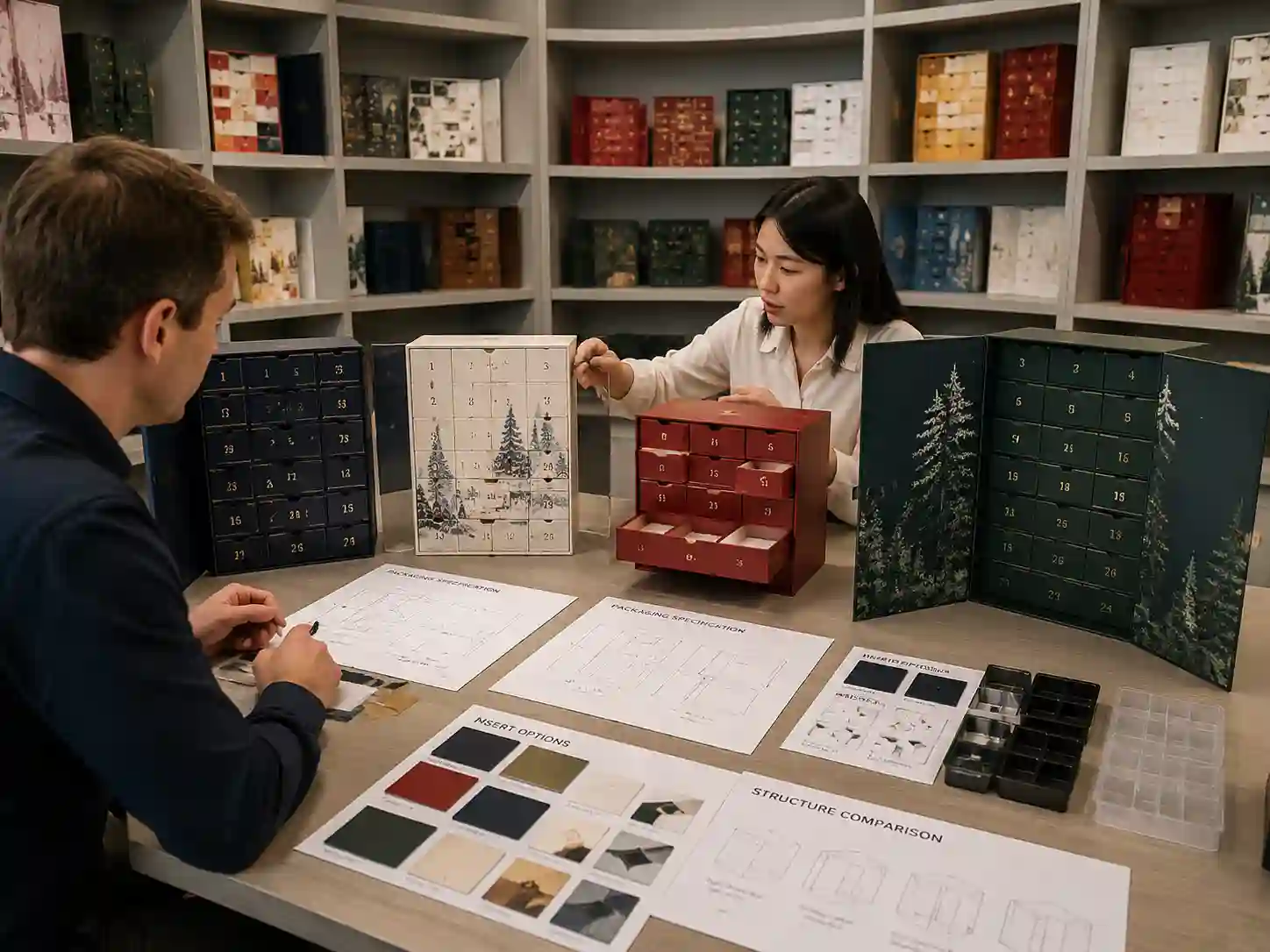
| Box Structure | Best Application | Buyer Evaluation Points |
|---|---|---|
| Rigid box | Premium retail gifts, luxury seasonal campaigns, corporate gifts | Check greyboard thickness, wrapping quality, corner finishing, and overall rigidity. |
| Folding carton | Higher volume projects with cost-sensitive requirements | Review paperboard quality, locking design, crease accuracy, and print registration. |
| Drawer box | Products requiring repeated opening and premium unboxing | Test drawer movement, clearance tolerance, pull strength, and insert positioning. |
| Door-opening box | Interactive seasonal displays and retail presentation | Check hinge strength, door alignment, opening angle, and internal support. |
Reliable suppliers should provide structural recommendations based on the product inside the calendar. For example, cosmetics, tea sachets, small accessories, pet products, and gift items may require different compartment sizes and insert systems.
How can buyers check whether the supplier understands inserts and product fit?
A qualified advent calendar box supplier should treat inserts as an engineering component, not a simple accessory. Poor insert design can cause products to move, damage the box, block doors or drawers, or create inconsistent customer experiences.
Important insert considerations include:
- Paper insert: Suitable for lightweight products and organized compartment layouts.
- PET tray: Useful when clear product visibility and precise cavity positioning are required.
- EVA insert: Suitable for products requiring cushioning and premium presentation.
- Foam inserts: Often used when protection and product stability are priorities.
- Molded pulp inserts: Considered for projects requiring shaped protection and environmentally focused options.
QC tip: Always request an insert fit test using the real product or accurate product dimensions. A sample that looks correct externally may still fail when compartments are too tight, too loose, or difficult to access.
What materials and printing details separate reliable suppliers from low-quality suppliers?
Material selection and printing control are major differences between professional packaging factories and low quality advent calendar box suppliers. Buyers should ask suppliers to confirm paperboard, greyboard, wrapping paper, coating, and finishing specifications before approval.
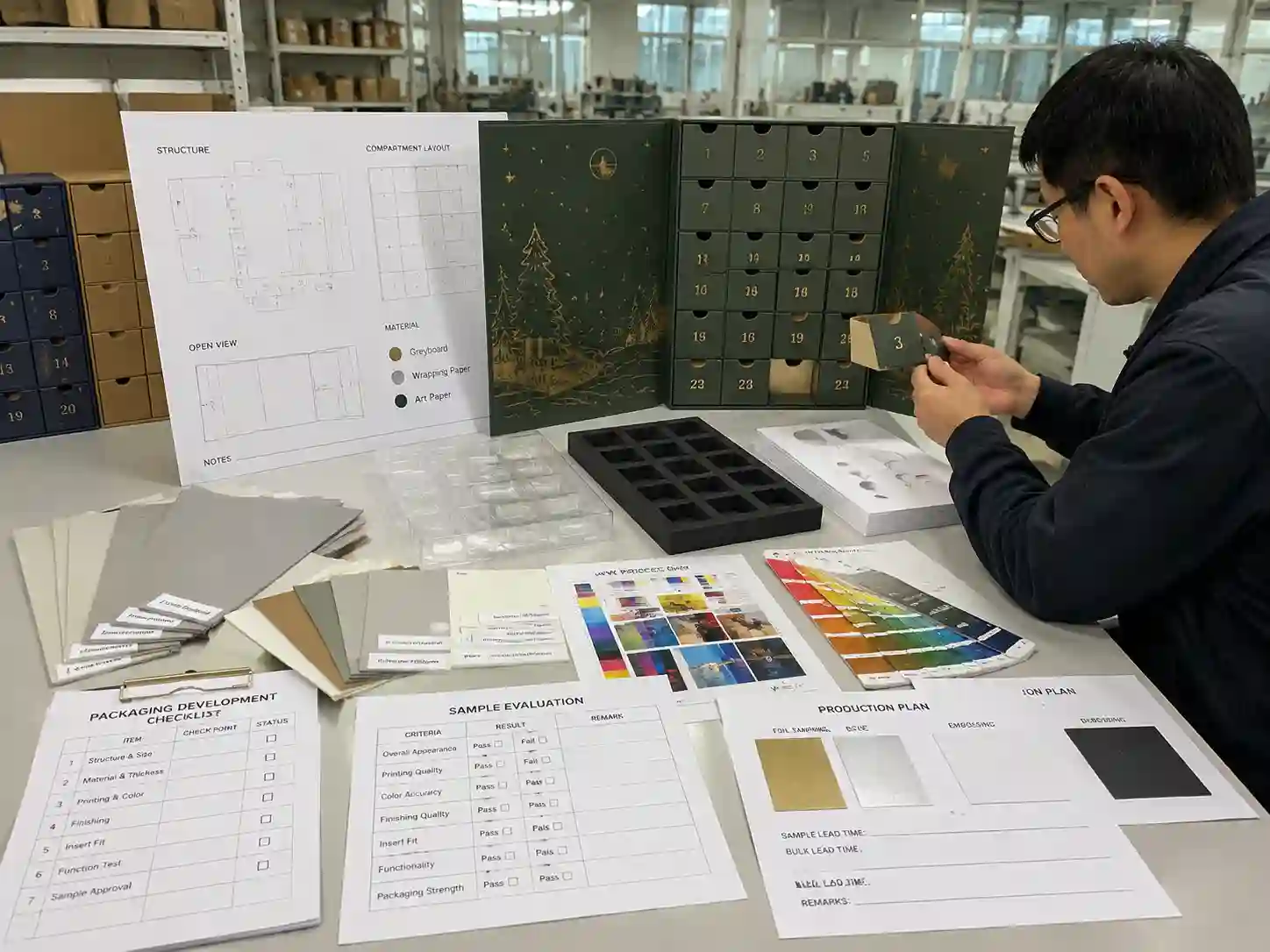
Key areas to review include:
- Board selection: Confirm greyboard thickness for rigid boxes and paperboard grade for folding cartons.
- Artwork preparation: Confirm dieline position, bleed area, folding direction, and artwork file requirements.
- Color control: Review CMYK printing proofs and Pantone references when color consistency is important.
- Surface finishing: Confirm matte lamination, gloss lamination, foil stamping, embossing, or spot UV requirements.
- Assembly tolerance: Check whether panels, doors, drawers, and inserts align correctly after production.
A professional supplier should provide a clear production path from artwork review to prototype approval and mass production. Buyers should avoid suppliers that skip proofing steps or cannot explain how colors and finishing will be controlled.
How should buyers compare supplier samples before placing a bulk order?
The sample stage is one of the most important opportunities to identify supplier capability. A good sample is not only a visual model; it is a production verification step.
Before approving a sample, buyers should check:
- Does the box structure match the approved dieline?
- Are doors, drawers, and opening mechanisms functioning smoothly?
- Do inserts hold products securely without excessive pressure?
- Are printing colors consistent with approved CMYK or Pantone references?
- Are foil stamping, embossing, and other finishes correctly positioned?
- Does the packaging survive repeated opening and closing?
Factory tip: A reliable supplier should create a prototype or pre-production sample that reflects the actual production method. A handmade sample using different materials may not represent mass production quality.
What MOQ, lead time, and quotation details should buyers confirm?
Buyers should compare suppliers based on total project requirements, not only unit price. A lower quotation may exclude important costs such as inserts, finishing, assembly, inspection, or export packing.
| Quotation Item | Questions Buyers Should Ask |
|---|---|
| MOQ | What is the minimum order quantity and how does quantity affect unit cost? |
| Sample cost | Is prototype development included or charged separately? |
| Production lead time | How long from artwork approval to completed bulk production? |
| Materials | Are board thickness, paper type, and insert materials specified? |
| Packaging | Are export cartons, protective materials, and pallet options included? |
Before requesting a quotation, prepare:
- Box structure preference or reference samples.
- Product dimensions, weight, and quantity per compartment.
- Artwork files or branding requirements.
- Required printing and finishing methods.
- Target order quantity and delivery location.
- Preferred shipping method and required timeline.
How do quality control and export packing reveal supplier reliability?
Quality control should continue after sampling. Reliable suppliers use production checks during printing, assembly, inspection, and packing to reduce problems before shipment.
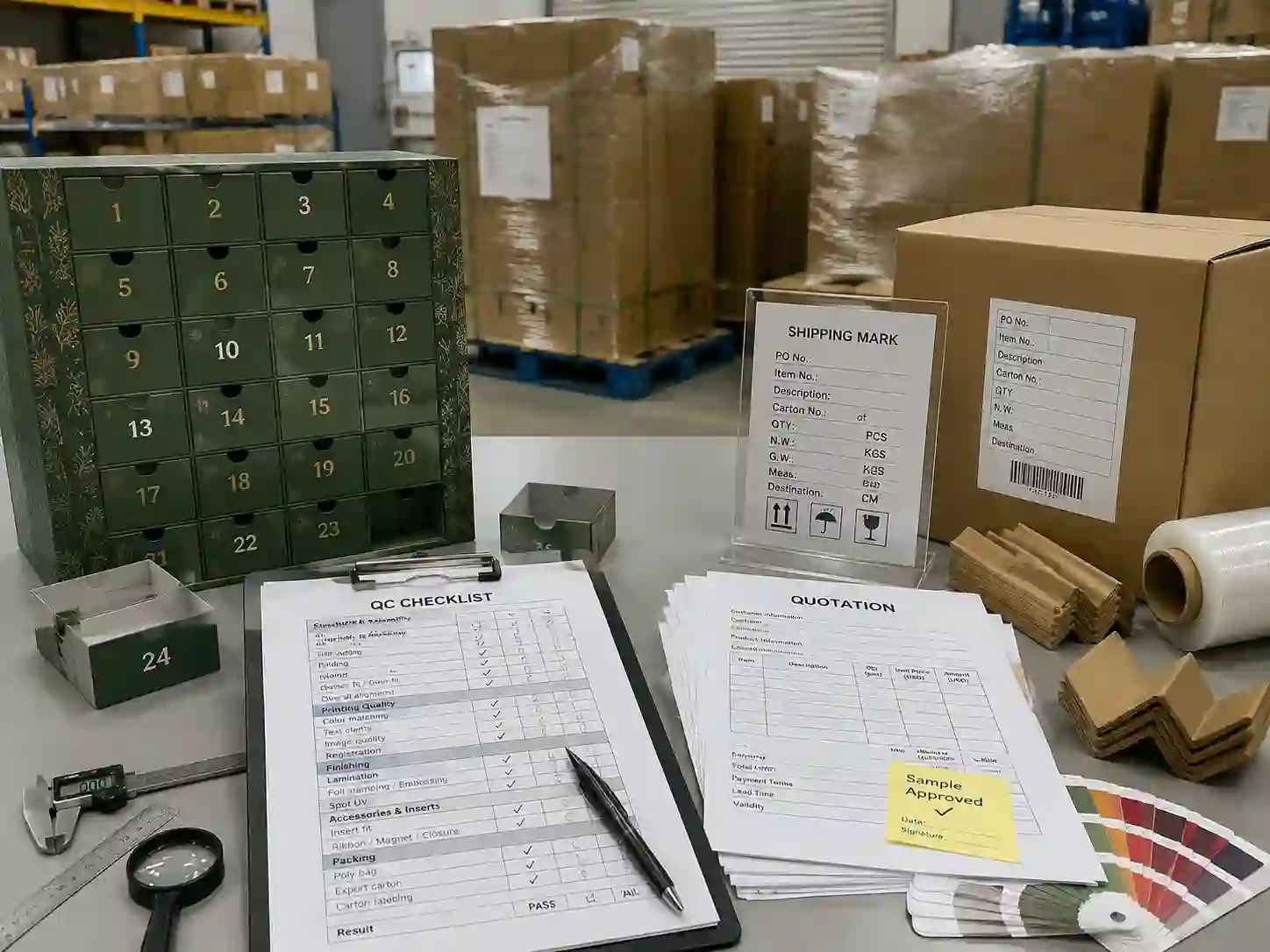
Important QC checkpoints include:
- Incoming material inspection for paperboard and greyboard quality.
- Printing inspection for color accuracy and registration.
- Structural inspection for size, alignment, and strength.
- Insert inspection for fit and product protection.
- Final inspection before export packing.
Export packing is equally important because seasonal packaging orders often travel internationally. Buyers should confirm the use of suitable export cartons, corner protection, protective sleeves, pallet wrap, and accurate shipping marks when required.
For international shipment preparation, buyers can also review official packaging and logistics guidance from organizations such as ISTA packaging standards resources and product identification guidance from GS1.
What is the best way to compare advent calendar box suppliers?
The best supplier comparison method is to evaluate capability, communication, and production control together. A supplier matrix helps purchasing teams make decisions based on measurable factors.
- Structure knowledge and engineering support.
- Material and finishing recommendations.
- Sample accuracy and prototype process.
- Production capacity and lead time management.
- Quality inspection process.
- Export packing experience.
- Quotation transparency.
Giftpackpro supports buyers who need custom advent calendar boxes manufacturer solutions with attention to structure, inserts, printing, sampling, and production requirements. Buyers can review available custom advent calendar box products and learn more about custom advent calendar box services before preparing a project.
FAQ: How to avoid low quality advent calendar box suppliers?
What is the biggest warning sign of a low-quality supplier?
The biggest warning sign is a supplier that focuses only on low pricing while avoiding details about materials, sampling, QC, and production processes.
Should buyers always request a sample before bulk production?
Yes. A sample or prototype helps verify structure, insert fit, printing, finishing, and assembly before committing to mass production.
How early should buyers contact an advent calendar box supplier?
Seasonal projects should begin planning early because design approval, sampling, production, inspection, and international shipping all require time. Exact lead time depends on structure, quantity, customization level, and supplier schedule.
What information should be included in an RFQ?
A complete RFQ should include box style, dimensions, product details, quantity, artwork requirements, insert requirements, finishing options, delivery destination, and requested timeline.
How can buyers prepare before requesting a quotation from Giftpackpro?
Before contacting a packaging supplier, prepare your product dimensions, preferred box structure, quantity, artwork status, insert requirements, finishing preferences, and delivery timeline. Clear project information allows suppliers to recommend suitable materials, estimate MOQ, calculate costs, and prepare accurate samples.
Giftpackpro provides a practical approach for brands, wholesalers, and retail buyers looking for dependable seasonal packaging production. Explore more advent calendar box buying guides, learn about the Giftpackpro packaging factory, or request a custom quote with your project details.