
Quick answer: To design retail advent calendar boxes for seasonal campaigns, buyers should start with product size, retail shelf plan, opening style, insert protection, artwork requirements, MOQ, sample approval, and export packing method. The best structure depends on whether the calendar must stand on shelf, ship through e-commerce, display premium value, or hold mixed products safely. Before requesting a quotation, prepare product dimensions, weight, quantity, artwork direction, target delivery date, retail barcode area, shipping method, and any testing or compliance requirements. A factory can then recommend a rigid box, folding carton, drawer box, door-opening box, or fold-out structure with a practical dieline and insert plan.
What should buyers decide before designing retail advent calendar boxes?
Buyers should decide the campaign channel, product mix, opening experience, shelf footprint, budget level, and delivery deadline before choosing the box structure. These decisions affect every later step, including dieline, paperboard thickness, insert type, printing process, MOQ, sample cost, lead time, QC standards, and export packing.
Retail advent calendar boxes are not simple gift boxes with numbered doors. They are seasonal retail packaging systems. A buyer may need the box to stand upright on a shelf, survive pallet transport, present 12, 24, or 25 items clearly, support barcode labels, protect fragile products, and match a campaign launch window. If these points are not confirmed early, the sample may look attractive but fail during loading, display, opening, or shipping.
For a buyer comparing custom advent calendar box products, the first question should not be “Which design looks best?” It should be “Which structure protects our products, fits the retail channel, and can be produced at the required quantity and deadline?”
Which retail advent calendar box structure fits your seasonal campaign?
The right structure depends on product weight, shelf display style, unboxing sequence, and budget. Rigid boxes are stronger and more premium, folding cartons are lighter and cost-efficient, drawer boxes create a high-value opening experience, and door-opening boxes are practical for retail shelf calendars.
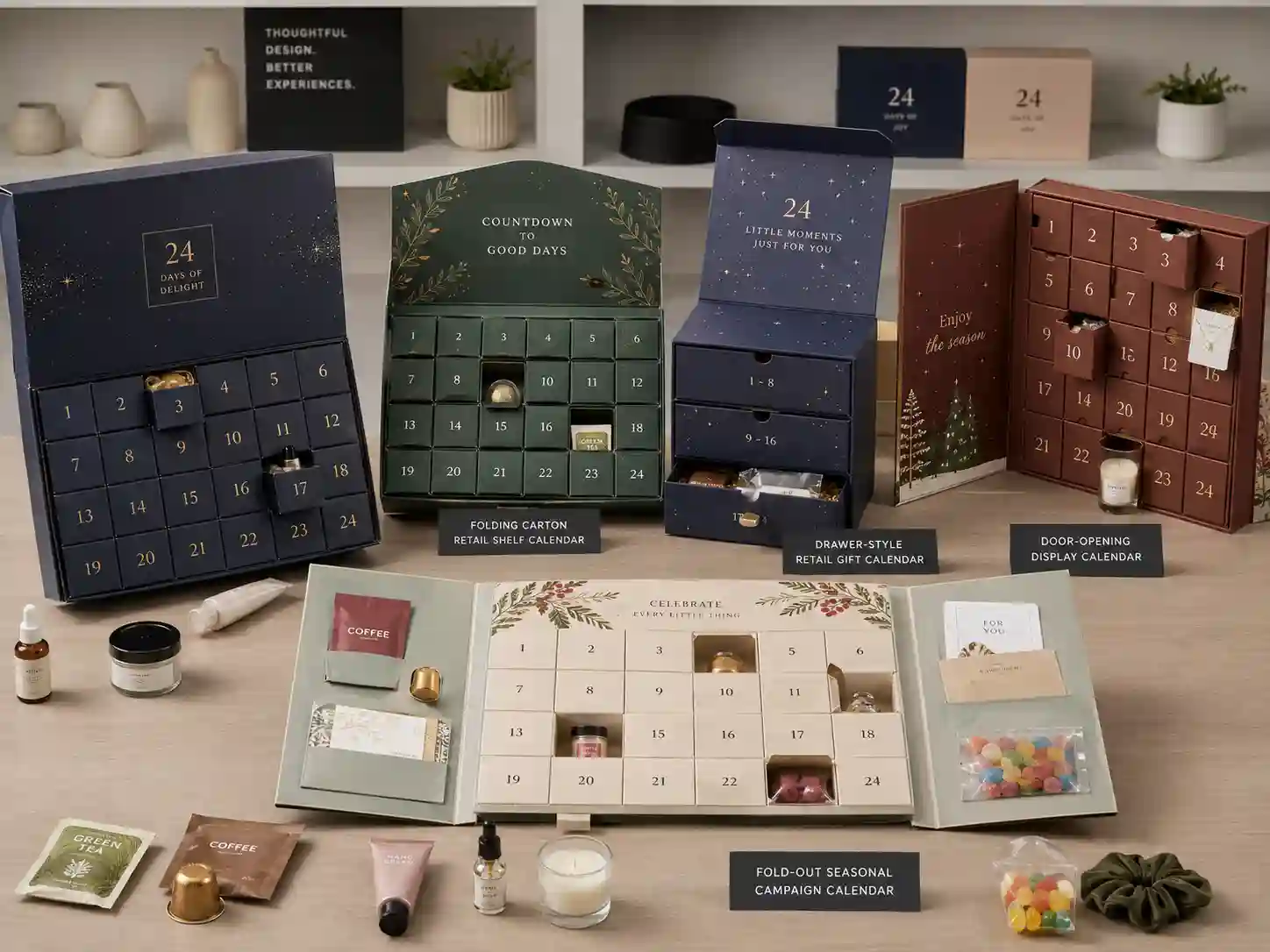
| Structure option | Best for | Key design points | Buyer watch-outs |
|---|---|---|---|
| Rigid advent calendar box | Premium retail gifts, cosmetics, candles, jewelry, multi-product gift sets | Uses greyboard wrapped with printed paper; suitable for magnetic, book-style, drawer, or fold-out structures | Higher unit cost, larger carton volume, longer assembly time, and stricter sample approval needed |
| Folding carton advent calendar | Lightweight products, high-volume retail campaigns, promotional seasonal programs | Uses paperboard with die-cut doors, internal partitions, and efficient flat or semi-assembled packing | Not ideal for heavy or fragile products unless insert support is engineered carefully |
| Drawer box calendar | Premium sets, reusable gift packaging, high perceived value displays | Each drawer needs sliding clearance, pull tab strength, and repeatable numbering alignment | Drawer tolerance is critical; tight drawers cause complaints, loose drawers reduce quality feel |
| Door-opening box | Classic retail shelf calendars and impulse seasonal displays | Each perforated or kiss-cut door must open cleanly without damaging neighboring compartments | Door size, paper grain direction, and insert backing must be tested with loaded products |
| Fold-out advent calendar | Large storytelling layouts, flat shelf presentation, PR and retail campaign displays | Panels open outward and may include trays, pockets, or paper insert compartments | Needs hinge testing, weight balance review, and export carton protection against panel deformation |
Buyer tip: For retail shelf programs, ask the factory to confirm whether the box is designed for upright shelf display, flat table display, hanging display, or e-commerce shipping. A calendar that looks stable in a photo may lean forward on shelf if the product weight is concentrated near the front doors.
When should you choose a rigid box?
Choose a rigid box when the campaign needs premium presentation, stronger structure, or heavier product support. Rigid retail advent calendar boxes usually use greyboard wrapped with printed art paper, which gives better stiffness and a higher-end hand feel than standard folding carton board.
Rigid construction is useful for cosmetics, skincare minis, perfume samples, jewelry cards, candles, premium tea, coffee capsules, and mixed gift sets. The structure can support drawers, book-style opening, magnetic closures, ribbon pulls, and layered trays. However, it also increases material cost, labor time, carton volume, and sampling complexity. Buyers should approve a blank sample first to confirm structure before moving to printed samples.
When does a folding carton make more sense?
A folding carton is better when the order requires lighter weight, higher quantity, lower shipping volume, or a more economical retail program. It is often used for candy, tea sachets, small stationery, lightweight promotional gifts, and mass retail seasonal campaigns.
The main engineering question is whether the paperboard can support the product after die-cutting doors and compartments. Door cuts reduce panel strength. If the products are heavy, the factory may need extra backing board, internal partitions, a paper insert, or a PET tray to prevent sagging.
How should buyers plan size, layout, and dieline decisions?
Buyers should plan the layout around real product dimensions, not around a preferred visual mockup. A correct dieline must include product clearance, board thickness, folding direction, door-opening path, insert depth, glue area, barcode label area, and export packing limitations.
A common retail mistake is designing 24 equal doors before confirming the actual product mix. In practice, a seasonal calendar may include different product heights, weights, and shapes. A skincare tube, coffee capsule, jewelry card, candle tin, and candy pouch all require different compartment support. If every compartment is forced into the same size, some products may rattle while others are difficult to remove.
For custom advent calendar boxes manufacturer projects, buyers should provide physical product samples or accurate 3D dimensions whenever possible. Product drawings alone may not show cap shape, flexible pouch thickness, label seam, or weight distribution.
What dieline details should be checked before sampling?
The dieline should be checked for both artwork layout and packaging function. Buyers should review cut lines, crease lines, glue flaps, door numbers, perforation areas, insert slots, hanging holes, barcode zones, and carton packing direction before approving the sample.
- Confirm each product compartment has enough length, width, height, and removal clearance.
- Check whether the opening door hides or exposes the product correctly.
- Reserve space for barcode, legal text, recycling marks, batch stickers, or retail price labels.
- Check whether foil stamping, embossing, spot UV, or window areas conflict with creases or die cuts.
- Confirm paper grain direction for folding strength and clean door opening.
- Review the export carton direction so the most vulnerable panels are protected during shipping.
Factory tip: A dieline for retail advent calendar boxes should be reviewed with loaded product weight, not only with flat artwork. Door cuts, drawer cavities, and fold-out panels change strength after assembly.
Which insert should you choose for product fit and retail protection?
The insert should match product weight, shape, fragility, sustainability target, and opening style. Paper inserts are common for cost control and recyclability, PET trays offer clear molded fit, EVA and foam inserts protect premium or fragile items, and molded pulp can support sustainability-focused campaigns.
| Insert type | Suitable products | Advantages | Limitations |
|---|---|---|---|
| Paper insert | Tea sachets, cards, flat gifts, light cosmetics, candy pouches | Cost-effective, printable, paper-based, easy to customize | May need reinforcement for heavy or rounded products |
| PET tray | Cosmetic minis, capsules, small bottles, mixed retail items | Precise product cavity, good display control, stable loading | Tooling or mold cost may apply; recycling requirements should be checked by market |
| EVA insert | Perfume samples, jewelry, fragile premium items | Clean premium look, strong cushioning, accurate cutouts | Higher cost and less suitable for sustainability-led paper packaging claims |
| Foam insert | Glass, candles, small bottles, delicate gift items | Good shock absorption and product holding | Can increase material and labor cost; appearance must match brand level |
| Molded pulp insert | Eco-positioned retail campaigns, heavier items, food-adjacent gift sets | Paper-based feel, protective structure, suitable for sustainability messaging | Requires thickness allowance and sample testing for surface finish and fit |
For retail shelf use, insert testing should include shaking, tilting, opening, removal, and re-closing. A product that fits inside the cavity may still move during pallet transport if the insert depth is too shallow or the door panel has too much empty space behind it.
How do printing and finishing choices affect retail impact and production risk?
Printing and finishing should support shelf visibility without creating production risks around die cuts, folds, and assembly. CMYK is suitable for full-color artwork, Pantone helps control brand colors, and finishing options such as foil stamping, embossing, spot UV, matte lamination, and gloss lamination should be tested on the actual paper surface.
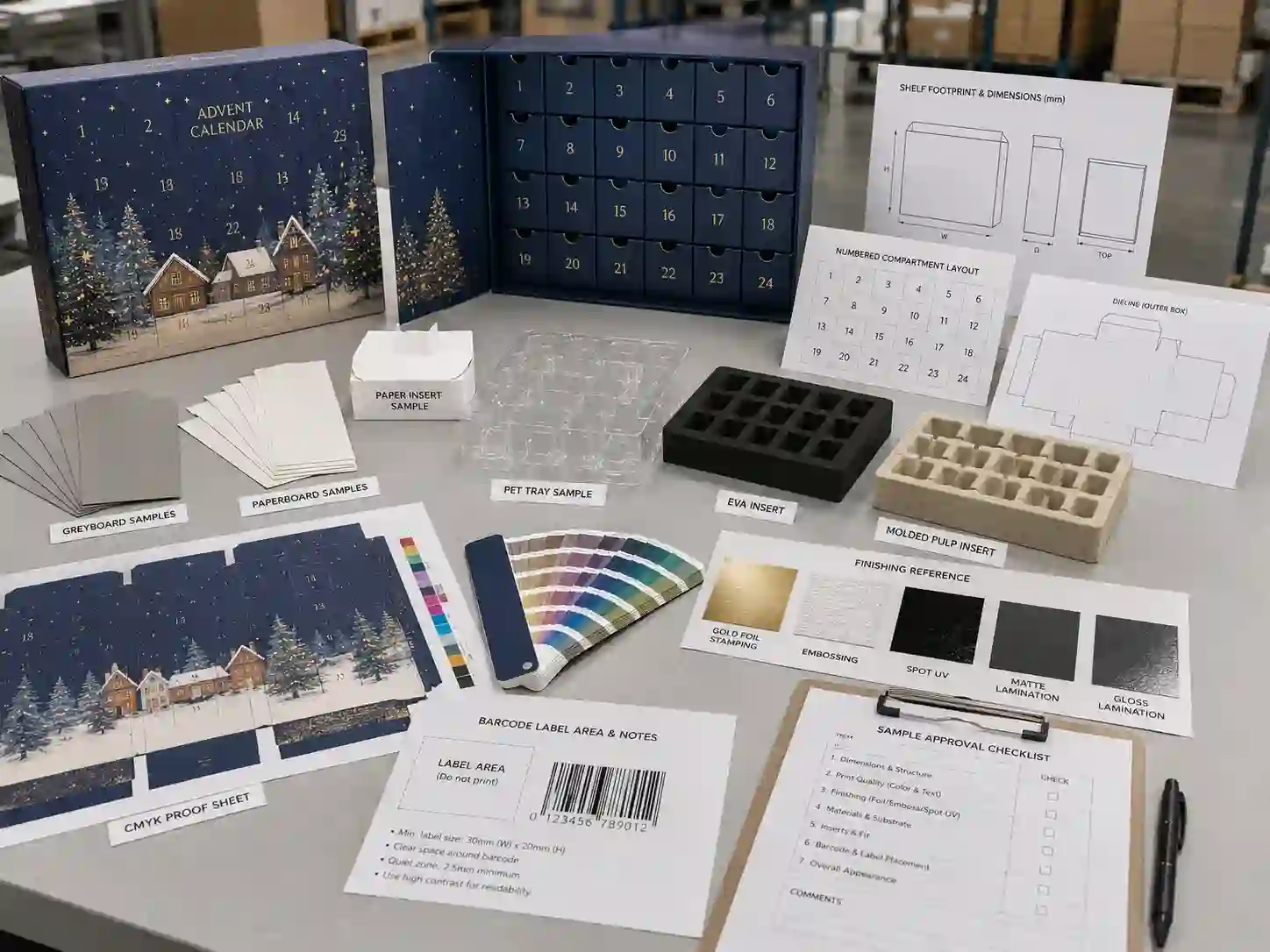
Retail campaigns often use strong front-panel artwork, numbered doors, promotional messaging, and product benefit callouts. Buyers should confirm whether artwork is needed only on the outer box or also on drawers, inner panels, inserts, door backs, sleeves, or belly bands. Each printed surface adds artwork preparation, color checking, and assembly control.
For barcode and retail compliance, brands should reserve a clean label area that is not distorted by folding, lamination texture, or curved surfaces. For barcode identification guidance, buyers can refer to GS1 barcode standards and confirm retailer-specific requirements before mass production.
Buyer tip: Do not approve color from a screen image only. For retail advent calendar boxes, request a printed proof or printed sample when color accuracy matters, especially for Pantone brand colors, skin-tone product photography, metallic ink effects, and dark matte backgrounds.
Which finishes are practical for retail advent calendar campaigns?
Matte lamination gives a soft premium surface and reduces glare under store lighting. Gloss lamination can make colors appear brighter but may show scratches more easily. Foil stamping highlights logos, numbers, or seasonal details, while embossing adds texture but needs careful pressure control near doors and folds. Spot UV is useful for contrast, but it must align accurately with printed artwork and die-cut areas.
If the box has many small doors, avoid placing heavy foil or embossing directly over perforation or crease lines. These areas can crack, misalign, or make doors harder to open. The factory should check finishing placement on the dieline before making the printing plate, foil die, embossing plate, or spot UV screen.
What is the best sample approval process before mass production?
The safest process is to approve structure first, then artwork, then a pre-production sample before mass production. Buyers should not skip blank samples when the calendar has drawers, irregular compartments, heavy items, or a new insert design.
A practical sample sequence usually includes a blank structural sample, a printed sample, and a pre-production sample. The blank sample checks size, strength, opening direction, drawer sliding, door tearing, product fit, and insert performance. The printed sample checks CMYK, Pantone, finishing, lamination, numbering, barcode area, and overall appearance. The pre-production sample confirms the final factory method before bulk production.
Giftpackpro offers custom advent calendar box services for buyers who need help turning product dimensions, retail goals, and artwork requirements into a manufacturable structure. Sample approval is especially important when the box must match a fixed launch date or retailer delivery window.
What should be included in a sample approval checklist?
- Outer size, shelf footprint, and display angle match the retail plan.
- Each product fits securely and can be removed without tearing the box.
- Drawer sliding or door-opening function works after products are loaded.
- Paperboard or greyboard thickness supports the total product weight.
- Printed colors match the approved proof under normal lighting.
- Foil stamping, embossing, spot UV, matte lamination, or gloss lamination are correctly placed.
- Barcode area, shipping marks, and carton label areas are reserved where needed.
- Export carton packing method protects corners, doors, and finished surfaces.
How do MOQ, cost drivers, and lead time affect design choices?
MOQ, cost, and lead time are affected by structure complexity, material thickness, insert type, printing process, finishing, assembly labor, sample rounds, and export packing. A simple folding carton calendar is usually more production-efficient than a rigid drawer calendar with multiple inserts and finishing processes.
Buyers should avoid asking suppliers to quote only by box size and quantity. Retail advent calendar boxes require more details because two calendars with the same outer size can have very different costs. One may use standard paperboard, one-color printing, and a paper insert. Another may use greyboard, wrapped art paper, EVA insert, foil stamping, embossing, spot UV, and hand assembly. The unit price, sample fee, production time, and carton volume will not be comparable.
Decision guide: how should you balance structure, budget, and campaign risk?
- Choose folding carton when products are light, quantity is high, cost control is important, and the campaign needs efficient production.
- Choose rigid box when premium value, stronger protection, and gift presentation are more important than the lowest unit cost.
- Choose drawer structure when the buyer wants a reusable or premium opening experience and can allow tighter assembly control.
- Choose door-opening structure when the calendar must feel familiar to retail shoppers and show a clear numbered countdown layout.
- Choose fold-out structure when the design needs larger visual space, multi-panel display, or a campaign presentation effect.
Factory tip: Cost reduction should start with structure and insert engineering, not only with thinner paper. Reducing board thickness without changing layout can lead to bowed panels, weak doors, crushed corners, and higher after-sales risk.
What QC points matter most for retail advent calendar boxes?
QC should focus on product fit, opening function, print consistency, assembly tolerance, surface defects, carton strength, and export packing. Retail calendars have more failure points than standard boxes because each drawer, door, compartment, and insert must work together.
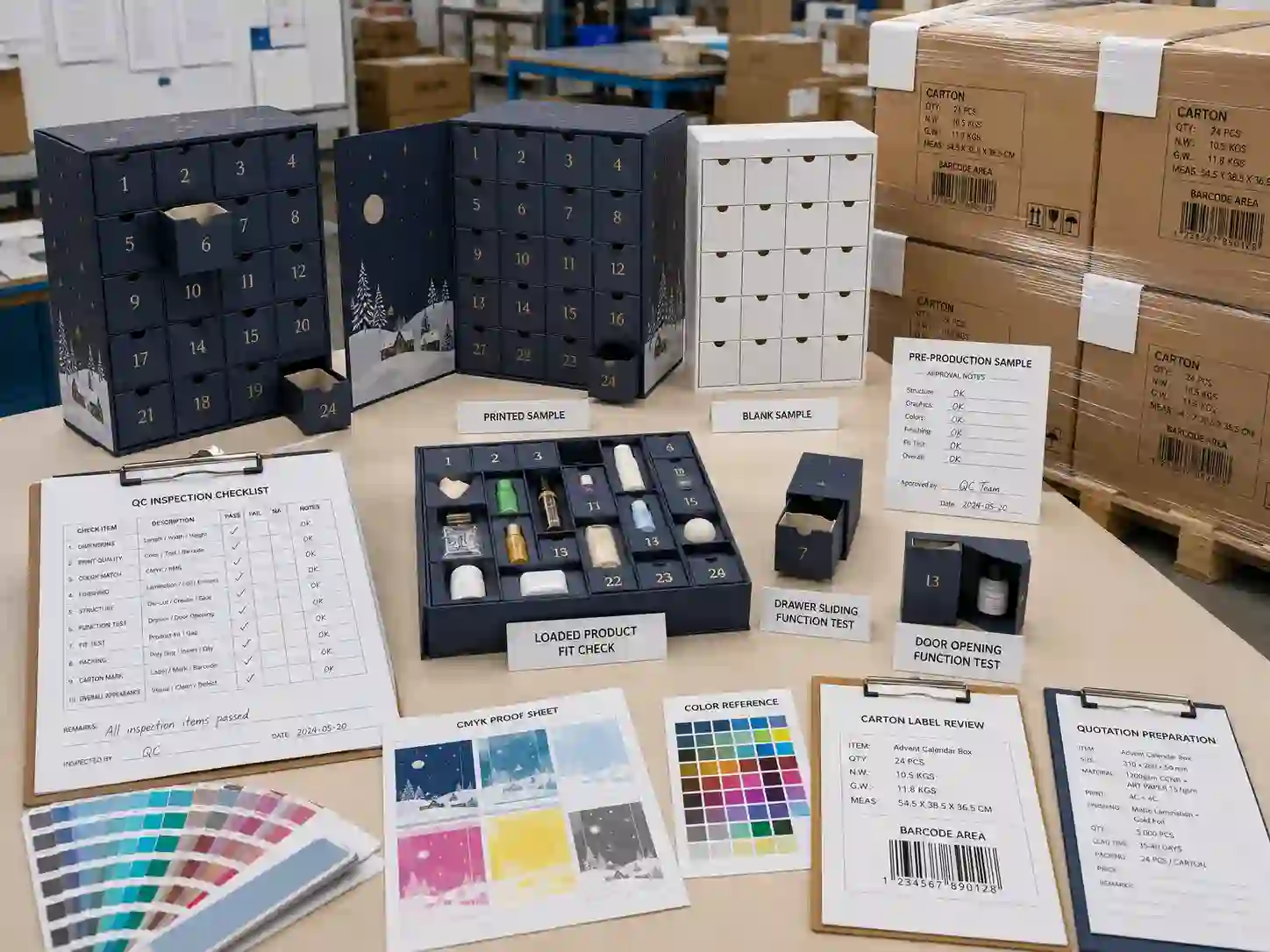
For door-opening calendars, inspectors should test whether the doors open cleanly without tearing neighboring areas. For drawer boxes, they should check sliding resistance, handle strength, drawer alignment, and whether loaded drawers fall out when tilted. For fold-out calendars, hinge areas, panel flatness, and weight balance need extra attention.
Final inspection should include random loaded product checks when product samples are available. If the factory only inspects empty boxes, it may miss compartment sagging, drawer friction, insert deformation, or door pressure caused by real product weight.
QC checklist for buyers and factories
- Check approved sample against mass production cartons before packing.
- Measure outer dimensions, compartment sizes, and insert cavity dimensions.
- Inspect printing defects, color variation, lamination bubbles, glue marks, scratches, and crushed corners.
- Test drawer sliding, door-opening, fold-out hinge strength, and product removal.
- Confirm carton labels, shipping marks, barcode label areas, and retailer packing instructions.
- Check export carton strength, inner protection, corner protectors, pallet pattern, and pallet wrap.
- Review whether moisture control, carton orientation, or container loading requirements are needed.
For transport validation, buyers with retailer or e-commerce distribution requirements may ask suppliers about carton drop testing or packaged-product testing based on recognized procedures such as ISTA test procedures. The exact test plan should match the product, route, retailer, and risk level.
How should export packing be planned for overseas retail buyers?
Export packing should protect the finished calendar surface, corners, doors, drawers, and retail display shape from factory to warehouse. Buyers should confirm export carton size, quantity per carton, carton weight, pallet method, shipping marks, carton labels, and whether the goods ship by sea, air, truck, or courier.
Retail advent calendar boxes often have large front panels and decorative finishes that can be scratched or compressed. Rigid boxes may need tissue paper, polybag, paper wrap, corner protection, or dividers. Folding carton calendars may need correct stacking direction to prevent door deformation. Drawer boxes should not be packed so tightly that drawer faces are pressed inward during transit.
Shipping marks should be generic unless the buyer or retailer requires specific text. Carton labels may include item number, quantity, gross weight, net weight, carton size, destination, barcode, or purchase order reference. Buyers should provide retailer carton label requirements before mass packing begins, not after cartons are sealed.
What information should buyers prepare before requesting a quotation?
Buyers should prepare product details, structure preference, quantity, artwork requirements, insert preference, delivery deadline, shipping destination, and quality expectations before requesting a quotation. Better RFQ information helps the supplier quote accurately and recommend a practical structure.
Before contacting request a custom quote, prepare the following:
- Product list with dimensions, weight, photos, and quantity per calendar.
- Target calendar count, such as 12-day, 24-day, 25-day, or custom compartment layout.
- Preferred structure: rigid box, folding carton, drawer box, door-opening box, fold-out box, or open to factory advice.
- Material direction: paperboard, greyboard, recycled paper, molded pulp insert, PET tray, EVA insert, foam, or paper insert.
- Artwork files, brand color references, CMYK or Pantone requirements, and finishing ideas.
- Retail needs: shelf display direction, barcode area, legal label area, price sticker area, and carton label requirements.
- Sample needs: blank sample, printed sample, prototype, or pre-production sample.
- MOQ target, launch date, delivery address, shipping method, and any retailer testing requirements.
Buyers who are still comparing suppliers can review more advent calendar box buying guides to understand how structure, sampling, printing, inserts, and export packing affect the final project.
How should buyers compare retail advent calendar box suppliers?
Buyers should compare suppliers by engineering support, sample quality, communication clarity, material options, QC process, export packing experience, and quotation detail. The lowest unit price is not always the lowest project risk.
A reliable supplier should ask detailed questions before quoting: product size, weight, insert needs, structure preference, artwork status, quantity, shipping market, and deadline. If a supplier quotes a complex calendar immediately without confirming product fit or dieline requirements, the quotation may not include the real production cost.
When reviewing a Giftpackpro packaging factory or any other supplier, buyers should ask for sample photos, blank structure review, insert suggestions, lead time explanation, and QC checkpoints. Do not assume that a supplier who can make a standard gift box can automatically engineer a multi-compartment retail advent calendar.
What common mistakes should buyers avoid?
The biggest mistakes are designing artwork before confirming structure, choosing inserts without product testing, ignoring shelf and carton dimensions, approving samples without loaded-product checks, and requesting quotes without enough technical detail.
- Mistake 1: Starting with artwork only. The dieline must be confirmed before final artwork is locked.
- Mistake 2: Using equal compartments for unequal products. Mixed items often need mixed cavity sizes and support depths.
- Mistake 3: Forgetting retail label areas. Barcode, warning text, recycling icons, and price stickers need clean placement.
- Mistake 4: Skipping pre-production samples. Bulk production should follow an approved sample, not only a digital render.
- Mistake 5: Reducing cost by weakening the structure. Thin board, shallow inserts, or weak glue can create retail damage and returns.
- Mistake 6: Confirming export packing too late. Carton quantity, pallet plan, and shipping marks should be discussed before final packing.
FAQ: Retail advent calendar boxes for seasonal campaigns
What is the most popular structure for retail advent calendar boxes?
Door-opening and drawer structures are common, but the best choice depends on product type, retail channel, and budget. Door-opening boxes work well for classic shelf calendars, while drawer boxes are better for premium gift presentation.
Can one advent calendar hold different product sizes?
Yes, but the dieline and insert should be designed around the real product mix. Different product sizes may require varied compartment depths, paper insert supports, PET tray cavities, EVA cutouts, or foam protection.
Should buyers request a blank sample or printed sample first?
For new structures, buyers should usually start with a blank structural sample. After size, function, and insert fit are approved, a printed sample can check color, finishing, branding, and retail appearance.
What affects the MOQ for custom advent calendar boxes?
MOQ depends on structure, material, printing, finishing, insert type, mold or tooling needs, and factory production setup. Complex rigid boxes with custom inserts may require different MOQ planning than simple folding carton calendars.
How early should buyers start a seasonal retail calendar project?
Buyers should start early enough to allow product measurement, dieline design, sample rounds, artwork correction, material purchasing, mass production, QC, export packing, and international shipping. A rushed timeline increases the chance of sample changes, air freight cost, or missed retail delivery windows.
CTA: Prepare a better brief for retail advent calendar boxes
Retail advent calendar boxes work best when structure, insert, artwork, sample, QC, and export packing are planned together. Before asking for a quotation, prepare your product list, dimensions, weight, preferred structure, target quantity, artwork files, delivery deadline, shipping destination, and retail label requirements.
Giftpackpro can help overseas brands, wholesalers, purchasing teams, and gift companies compare structure options and develop practical seasonal packaging. Share your project details through the request a custom quote page, or review custom advent calendar box services if you need support with dieline, sampling, inserts, printing, mass production, QC, and export packing.


