Quick answer: To design bracelet advent calendar boxes for seasonal campaigns, buyers should start with bracelet size, weight, material, display style, and launch channel, then select a box structure, insert material, artwork process, sampling route, QC checklist, and export-packing method. A bracelet calendar is not only a printed gift box; it is a multi-compartment packaging system that must hold chain bracelets, bangles, charm bracelets, bead bracelets, or bracelet cards securely through assembly, transport, storage, and retail handling. The best result comes from confirming the dieline, insert fit, printing proof, pre-production sample, carton packing, and quotation details before mass production.
What should buyers confirm before designing bracelet advent calendar boxes?
Buyers should confirm the bracelet assortment, calendar count, target retail channel, budget level, and delivery deadline before choosing the packaging structure. These decisions affect box size, insert engineering, material thickness, handwork, printing method, MOQ, lead time, and export packing.
Bracelet products create different packaging challenges from cosmetics, chocolate, or candle gifts. Chain bracelets may tangle if the compartment is too large. Bangles require larger cavities and stronger support. Charm bracelets can scratch printed surfaces if the insert material is too rough. Bead bracelets may roll inside a drawer or tray unless the cavity is shaped correctly. If the bracelet is mounted on a card, the card size becomes as important as the bracelet size.
Before requesting design advice from a custom advent calendar boxes manufacturer, prepare product measurements for every bracelet type. Include length, width, thickness, weight, card size, pouch size, and whether each item is packed naked, bagged, carded, or wrapped. A 24-day bracelet calendar with lightweight chain bracelets can use a different internal structure from a 12-day bangle and charm bracelet gift set.
Buyer tip: Do not approve the outer box size before the insert layout is tested. For bracelet advent calendar boxes, the inside fit controls the outside dimensions, not the other way around.
Which box structure works best for a seasonal bracelet campaign?
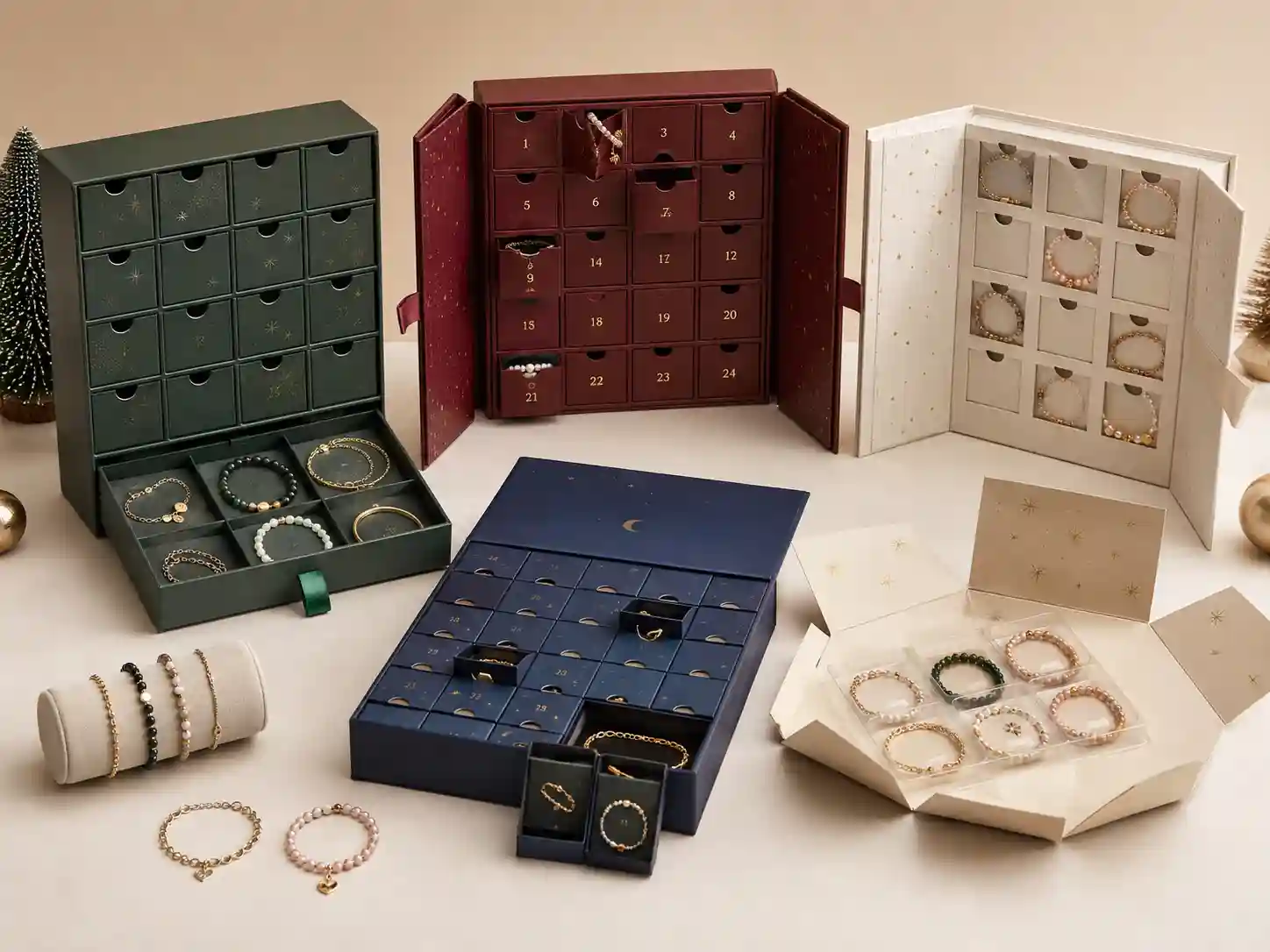
The best structure depends on retail price point, bracelet weight, unboxing method, packing efficiency, and shipping risk. Rigid drawer boxes and door-opening boxes are usually preferred for premium bracelet campaigns, while folding carton calendars can work for lighter, price-sensitive promotions.
| Structure option | Best use case | Bracelet-specific advantages | Buyer watch point |
|---|---|---|---|
| Rigid drawer box | Premium bracelet sets, jewelry gift campaigns, retail display | Strong greyboard frame, smooth drawer experience, good protection for bracelet cards and charm bracelets | Drawer tolerance must be controlled so drawers do not jam after lamination or assembly |
| Door-opening box | Seasonal gift sets with daily reveal doors | Strong shelf presentation and clear compartment sequence for chain bracelets, bead bracelets, and small jewelry accessories | Door perforation, thumb notch, and inner tray alignment must be tested during sampling |
| Book-style rigid box | Premium gifting, influencer kits, retail buyers needing high perceived value | Good for bracelet story cards, care cards, and organized insert presentation | Magnet position, hinge strength, and overall box weight affect export carton planning |
| Folding carton calendar | Large-volume campaigns with lightweight bracelets | Lower material usage, lighter shipping weight, suitable for carded bracelets or flat-packed components | Less protective than a rigid box; insert support and carton stacking strength need extra attention |
For buyers comparing custom advent calendar box products, the structure should be matched to the sales channel. Retail shelf programs often need a box that stands upright, resists handling, and keeps the front panel flat. E-commerce gift sets need stronger corners, secure closures, and master carton protection. Wholesale gift companies may prioritize assembly speed and consistent carton counts.
Factory tip: A bracelet calendar with many small compartments should be reviewed as a complete structure, not as separate artwork panels. Door cuts, drawer gaps, insert height, and bracelet removal space must all work together.
How should inserts be engineered for chain bracelets, bangles, charms, and bracelet cards?
The insert should prevent movement, tangling, scratching, and compression during packing and shipping. Bracelet advent calendar boxes often need mixed insert zones because chain bracelets, bangles, charm bracelets, bead bracelets, and bracelet cards do not behave the same way inside a compartment.
A paper insert is useful for lightweight bracelet cards, simple chain bracelets, and cost-controlled campaigns. PET tray inserts are suitable when buyers need clear formed cavities and faster assembly. EVA insert and foam can provide a more secure hold for heavier bangles or bracelet sets, but buyers should check surface contact, color transfer risk, and cutting tolerance. Molded pulp may be considered when a buyer wants a paper-based support option, but the texture and cavity accuracy should be tested with the actual bracelet surface.
For chain bracelets, the cavity should keep the bracelet compact without forcing sharp bends. For bangles, the diameter and height clearance should allow easy removal while avoiding rattle. For charm bracelets, the insert should reduce metal-to-metal movement because charms may scratch each other or the printed panel. For bead bracelets, round cavities or elastic retention can reduce rolling. For bracelet cards, the card slot must match paper thickness, card coating, and any hang hole or printed message area.
- Measure each bracelet in its final packed form, not only the loose jewelry size.
- Confirm whether bracelets will be inserted by hand at the factory or packed later by the buyer.
- Test the insert with real product weight, not only a paper mockup.
- Check finger access so consumers can remove the bracelet without tearing the door or insert.
- Confirm anti-scratch needs for metal charms, coated beads, plated parts, or bracelet cards.
Quotable B2B statement: For bracelet advent calendar boxes, insert fit is a production-control issue, not a decorative detail; a beautiful printed box can still fail if bracelets move, tangle, or damage the compartments during transit.
Which materials and finishes should buyers choose for production stability?
Buyers should choose materials according to bracelet weight, box structure, order quantity, finishing process, and export route. Greyboard, paperboard, coated paper, specialty paper, and insert materials must be selected together because each one affects durability, appearance, cost, and assembly tolerance.
Rigid box structures usually use greyboard wrapped with printed paper or specialty paper. A thicker greyboard can improve the premium feel and compression resistance, but it also increases box weight, shipping cost, and drying time after gluing. Folding carton calendars usually use paperboard that is printed, cut, creased, and assembled. This can be efficient for larger-volume campaigns, but the paperboard grade should be checked for door strength and crease performance.
For printing, CMYK is suitable for full-color artwork, while Pantone matching is useful when brand color consistency is important. Foil stamping can highlight date numbers, logos, or seasonal icons. Embossing and debossing can add texture to a premium bracelet campaign. Spot UV can emphasize pattern areas, but it should be tested near fold lines and door cuts. Matte lamination gives a soft retail look, while gloss lamination can make color more vivid but may show scratches more easily.
If buyers need paper from responsible forestry sources, they can ask suppliers to explain available options and verify claims through official references such as the Forest Stewardship Council. Do not assume a material claim is valid without documentation when it matters for your market or retailer.
What production steps affect quality control most?
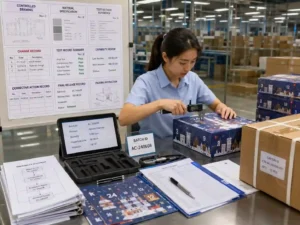
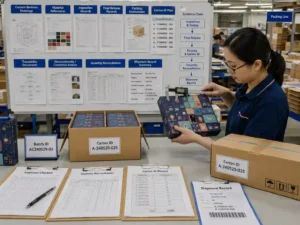
The most important production steps are dieline confirmation, printing proofing, material preparation, die-cutting, surface finishing, insert forming, box assembly, product-fit testing, final inspection, and export packing. Each step can create defects if tolerances are not controlled before mass production.
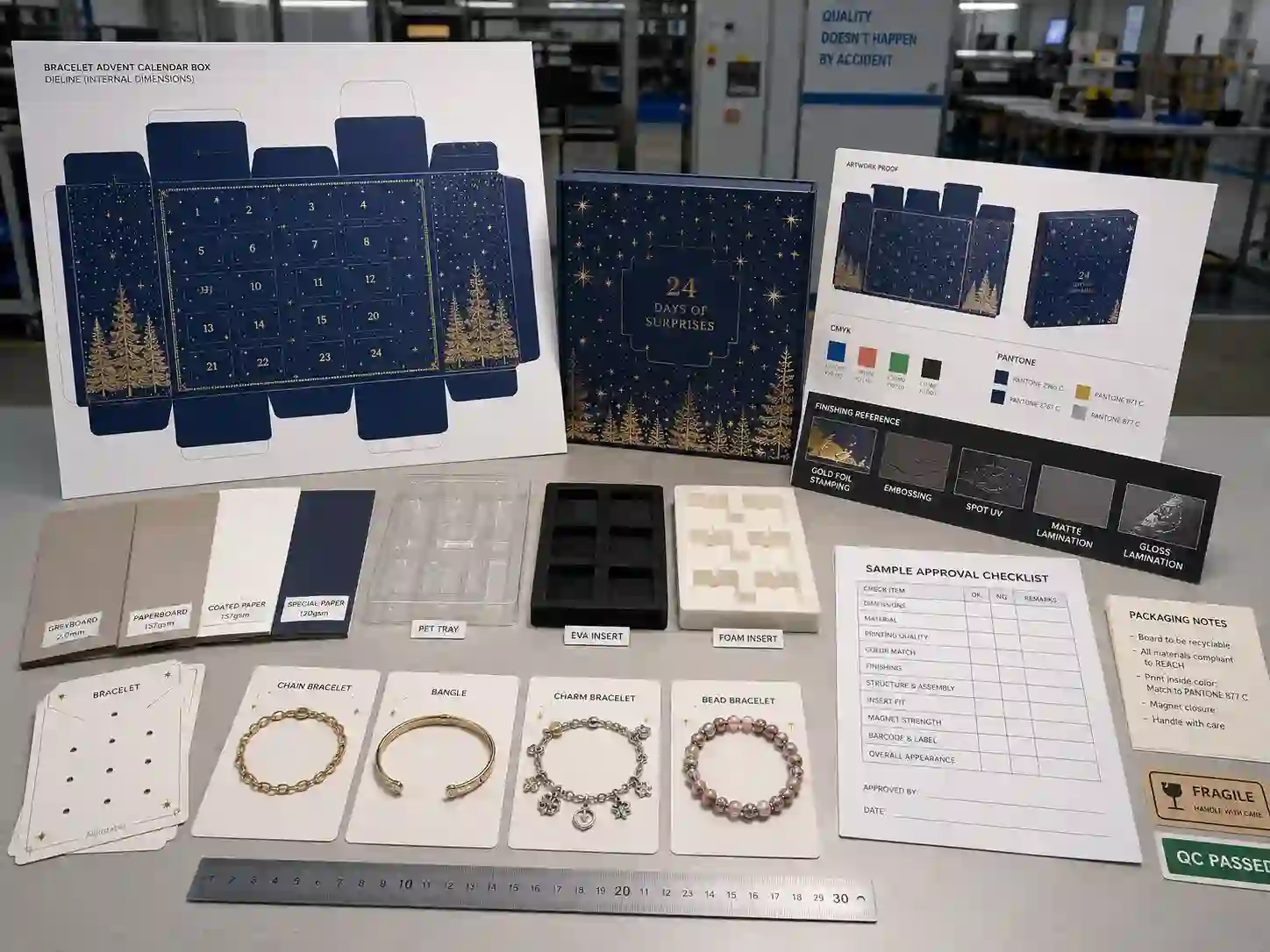
- Dieline checking: Confirm outer size, compartment layout, door cuts, drawer gaps, bleed, safe area, glue area, and barcode or label positions.
- Material preparation: Check paperboard, greyboard, wrapping paper, PET tray, EVA insert, foam, paper insert, or molded pulp material against the approved sample.
- Printing proof: Review CMYK output, Pantone matching, date numbers, small text, QR codes, warning text, and carton label artwork.
- Surface finishing: Confirm matte lamination, gloss lamination, foil stamping, embossing, debossing, and spot UV registration.
- Die-cutting and forming: Check door-opening lines, perforations, drawer panels, insert cavities, creasing pressure, and edge cleanliness.
- Assembly control: Inspect glue position, board alignment, drawer movement, magnetic closure if used, hinge strength, and panel flatness.
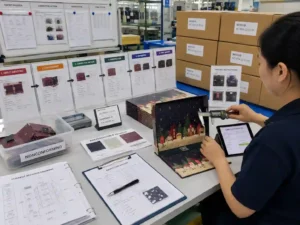
- Fit testing: Place real bracelets, bracelet cards, pouches, or accessories into the approved insert and perform a shake and removal test.
- Final QC: Inspect printing, dimensions, assembly, function, cleanliness, packing quantity, shipping marks, and export carton strength.
Buyers reviewing custom advent calendar box services should ask how the factory controls these steps, not only whether it can print attractive artwork. A reliable production plan should define approval samples, inspection points, defect categories, packing method, and communication timing before bulk production starts.
QC tip: Keep one approved pre-production sample at the factory and one with the buyer. During mass production, use the approved sample as the reference for color, structure, insert fit, finishing, and packing.
How should buyers check artwork before mass production?
Buyers should check artwork for dieline accuracy, color target, finishing layers, small text, date sequence, barcode placement, and country-specific labeling before releasing production. Artwork errors are expensive because bracelet calendar boxes often include many doors, drawers, numbers, and small panels.
For bracelet campaigns, pay special attention to compartment numbering. A 12-day or 24-day calendar with repeated or missing numbers can cause retail complaints even if the box structure is correct. If each bracelet has a different message card, charm theme, or SKU code, the insert layout and packing list must match the printed sequence.
Artwork files should include separate layers for CMYK printing, Pantone colors, foil stamping, embossing, spot UV, die-cut lines, crease lines, and non-printing guides. Bleed should extend beyond cut lines, and important text should stay inside the safe area. If a box includes a barcode, QR code, or retail label, ask for a scanned proof or test print before production. For global retail and logistics labels, buyers can also refer to official barcode and identification guidance from GS1 standards.
Factory tip: Finishing layers should not be treated as decoration only. Foil, embossing, and spot UV require registration tolerance, so they should be placed away from extremely narrow door cuts and fragile crease areas when possible.
What should a sample approval process include?
A sample approval process should include a blank structure sample, printed sample or digital proof, insert-fit test, pre-production sample, and written approval notes. Buyers should not move to mass production based only on a rendering or flat dieline.
A blank sample confirms structure, size, opening method, insert layout, and product fit before printing costs are added. A printed sample or proof checks color, artwork position, surface finishing, and brand presentation. A pre-production sample should represent the final material, printing, insert, assembly, and export packing method as closely as possible.
- Check whether bracelet doors open cleanly without tearing neighboring compartments.
- Confirm drawers slide smoothly after lamination, wrapping, and gluing.
- Test whether bangles or charm bracelets press against the lid or door panel.
- Review whether bracelet cards stay upright and do not bend during handling.
- Approve color under realistic lighting, not only from a screen photo.
- Record all changes in one approval document, including dimensions, material, finishing, and packing.
Sampling is also the right stage to compare suppliers. Strong suppliers will ask for bracelet dimensions, product weight, artwork format, target quantity, and packing requirements before quoting final production. A vague quotation without insert testing may look cheaper, but it can create higher risk during assembly and export.
How do MOQ, lead time, and cost drivers affect the design?
MOQ, lead time, and cost are affected by structure complexity, material choice, printing, finishing, insert type, hand assembly, and carton packing. Buyers should design for the target campaign volume instead of copying a luxury structure that may not suit the project budget.
Rigid bracelet advent calendar boxes usually require more manual work than simple folding carton packaging. Drawer assembly, wrapped greyboard, magnetic closures, fitted inserts, foil stamping, and multi-part packing can increase labor time. Folding carton calendars may reduce unit weight and material cost, but they require careful engineering if bracelets are heavy or if the calendar must stand upright in retail displays.
Lead time is also linked to approval speed. Delayed artwork, unclear product dimensions, repeated sample revisions, or late changes to bracelet assortment can push back production. For seasonal campaigns, buyers should leave time for prototype review, pre-production approval, mass production, final inspection, export packing, customs documents, and shipping.
Decision guide: when should buyers choose each route?
- Choose a rigid drawer box when the campaign has premium pricing, heavier bracelets, or a gift-set positioning that needs stronger presentation.
- Choose a door-opening box when the daily reveal experience and front-panel display are more important than drawer function.
- Choose a folding carton calendar when the order is high-volume, bracelets are lightweight, and cost control matters more than luxury structure.
- Choose PET tray or EVA insert when cavity accuracy and product stability are critical.
- Choose paper insert or molded pulp when buyers want paper-based support and the bracelet shape can be held securely.
Buyer tip: The lowest unit price is not always the lowest campaign cost. A weak insert, thin export carton, or untested drawer tolerance can create replacements, delays, and retail complaints after shipment.
What QC inspection points matter for bracelet advent calendar boxes?
QC should verify appearance, dimensions, function, insert fit, durability, packing accuracy, and carton protection. Bracelet calendars have many small components, so inspection should cover both visual quality and practical use.
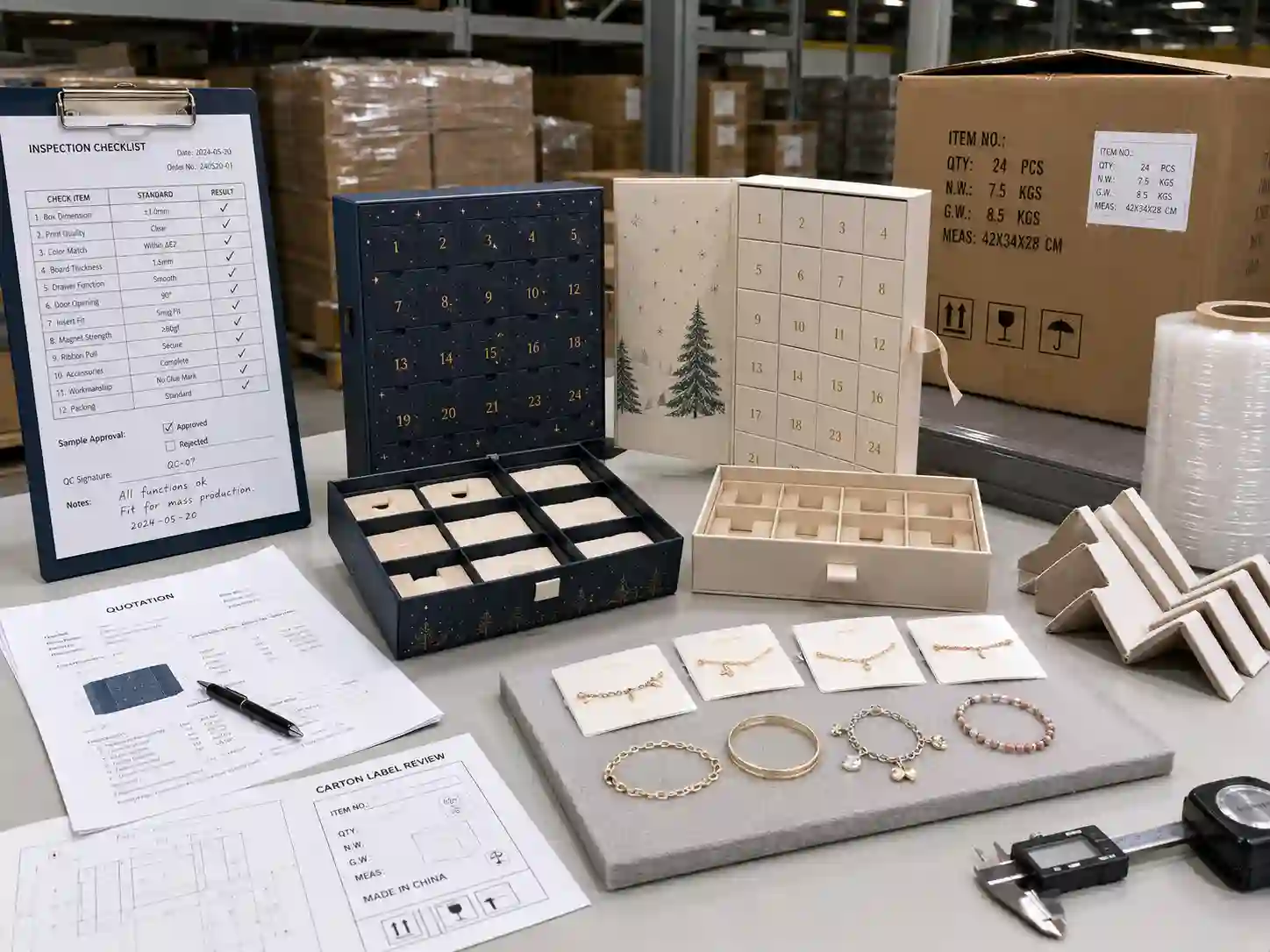
- Printing checks: Color consistency, registration, date numbers, text sharpness, barcode readability, foil position, embossing depth, and spot UV alignment.
- Structure checks: Box size, drawer gap, door cut, hinge line, magnetic closure, panel flatness, corner strength, and board warping.
- Insert checks: Cavity size, bracelet movement, card slot fit, PET tray forming, EVA cutting, foam cleanliness, molded pulp shape, and removal space.
- Assembly checks: Glue marks, loose panels, uneven wrapping, exposed greyboard edges, wrong door sequence, and compartment alignment.
- Durability checks: Opening test, light shake test, stacking check, carton drop-risk review, and handling simulation for export packing.
- Packing checks: Quantity per export carton, polybag or tissue protection if used, corner protectors, carton label, pallet plan, and shipping marks.
For international orders, buyers can ask the supplier how packaging performance is evaluated for the intended shipping route. If third-party transit testing is required by a retailer or marketplace, buyers may reference official procedures from organizations such as ISTA and confirm the exact test requirement with their logistics team.
Quotable B2B statement: Final inspection for bracelet advent calendar boxes should test opening function and product retention, not only print appearance, because the buyer is purchasing a working seasonal packaging system.
How should export packing be planned for overseas buyers?
Export packing should protect the assembled calendar box from corner damage, compression, moisture exposure, label confusion, and handling risk. The right export carton plan depends on box size, weight, structure, and whether the calendar is shipped assembled or flat-packed.
Rigid bracelet calendars are often shipped assembled because their structure and insert system are already fixed. This protects presentation quality but increases carton volume. Folding carton calendars may allow more efficient packing, but buyers must confirm whether final assembly happens at the packaging factory, the buyer’s facility, or a co-packer. If bracelets are inserted before export, the packaging plan must also protect the jewelry and prevent movement inside each compartment.
Export cartons should be sized to avoid excessive empty space. Corner protectors may be useful for premium rigid boxes. Pallet wrapping should keep cartons stable without crushing them. Shipping marks should match the buyer’s purchase order, SKU, destination, carton number, gross weight, net weight, and handling requirements. If retail labels or Amazon/e-commerce labels are needed, confirm label size and placement before carton production.
The Giftpackpro packaging factory can support buyers by checking structure, insert fit, assembly feasibility, and export packing details before bulk shipment, but buyers should still provide destination requirements and any retailer packing rules early in the project.
How should buyers compare suppliers for this packaging project?
Buyers should compare suppliers by engineering support, sampling accuracy, material control, printing capability, QC process, export packing experience, communication speed, and quotation clarity. A supplier that only shows attractive photos may not be the best choice for a bracelet calendar with many compartments and fit requirements.
Ask whether the supplier can review bracelet dimensions before finalizing the dieline. Check whether it can produce blank samples, printed samples, and pre-production samples. Review how revisions are recorded. Confirm whether mass production will follow the approved sample. Ask how cartons, pallets, and shipping marks are handled for overseas orders.
A practical supplier comparison should include these questions:
- Can the supplier recommend a structure based on bracelet weight and retail channel?
- Can it test paper insert, PET tray, EVA insert, foam, or molded pulp options with real bracelet samples?
- Does the quotation separate structure, material, printing, finishing, insert, packing, and tooling costs?
- How are color proofing, Pantone matching, foil stamping, embossing, and spot UV approved?
- What QC photos, inspection reports, or production updates can be provided before shipment?
- Can the supplier meet the campaign lead time after sample approval, not only from the first inquiry date?
Buyers can use advent calendar box buying guides to review related packaging planning topics before sending an RFQ. This helps purchasing teams compare suppliers using the same structure, insert, printing, and packing assumptions.
What information should be prepared before requesting a quotation?
Buyers should prepare product details, structure preference, quantity, artwork needs, insert requirements, sample expectations, packing method, and delivery deadline before asking for a quotation. Clear RFQ details help the factory quote accurately and reduce revision time.
Practical RFQ checklist for bracelet advent calendar boxes
- Target quantity and expected reorder possibility.
- Number of compartments, such as 12-day, 24-day, or custom layout.
- Bracelet type: chain bracelet, bangle, charm bracelet, bead bracelet, bracelet card, pouch, or mixed set.
- Product dimensions and weight for each bracelet or packed bracelet unit.
- Preferred structure: rigid box, drawer box, door-opening box, book-style box, or folding carton.
- Insert preference: paper insert, PET tray, EVA insert, foam, molded pulp, or supplier recommendation.
- Material and finishing needs: paperboard, greyboard, CMYK, Pantone, foil stamping, embossing, spot UV, matte lamination, or gloss lamination.
- Artwork status: final AI/PDF dieline artwork, draft design, or need for factory dieline support.
- Sample requirement: blank sample, printed sample, prototype, or pre-production sample.
- Export packing requirements: carton size limit, pallet requirement, shipping marks, retailer labels, or e-commerce label rules.
- Delivery destination, target ship date, and preferred shipping method.
For a faster response, buyers can share these details when they request a custom quote. If some information is not ready, provide the available product size, campaign quantity, and reference structure so the factory can recommend the next step.
What common mistakes should buyers avoid?
Buyers should avoid approving designs before fit testing, ignoring assembly tolerance, choosing inserts only by cost, sending incomplete artwork, and treating export packing as an afterthought. These mistakes often appear late, when changes are more expensive.
One common mistake is using the same cavity size for every bracelet. A chain bracelet, bangle, and bracelet card may need different support. Another mistake is placing foil stamping or spot UV too close to perforated doors, where registration tolerance and cracking risk may be higher. Buyers also sometimes approve a beautiful printed sample without testing the actual bracelet assortment inside the box. That can lead to rattling, tangled chains, or doors that bulge after packing.
Another avoidable issue is late carton-label confirmation. Export carton labels, shipping marks, pallet requirements, and retailer barcode rules should be discussed before mass production finishes. If labels are changed after cartons are packed, the project may lose valuable shipping time.
FAQ: bracelet advent calendar boxes for seasonal campaigns
Can one bracelet calendar box hold different bracelet styles?
Yes, but the insert layout must be engineered for the largest and most delicate items. Mixed bracelet calendars may need different cavity shapes for chain bracelets, bangles, charm bracelets, bead bracelets, and carded bracelets.
Is a rigid box always better than a folding carton?
No. A rigid box offers stronger presentation and protection, but a folding carton may be better for lightweight bracelets, high-volume campaigns, and lower shipping weight. The best choice depends on product value, quantity, budget, and retail channel.
Should buyers request a blank sample or printed sample first?
For new bracelet structures, start with a blank sample to confirm size, opening function, and insert fit. After the structure is approved, move to printed sample or pre-production sample for color, finishing, and final assembly checks.
What usually drives cost in bracelet advent calendar boxes?
Main cost drivers include box structure, greyboard or paperboard thickness, insert material, number of compartments, printing area, foil stamping, embossing, spot UV, lamination, assembly labor, export carton strength, and total order quantity.
How can buyers reduce production risk?
Provide accurate bracelet dimensions, test inserts with real products, approve a pre-production sample, define QC criteria, and confirm export packing before mass production. Clear approval records reduce misunderstandings between purchasing, design, and factory teams.
Ready to develop bracelet advent calendar boxes with production-ready details?
Bracelet advent calendar boxes should be designed as a complete packaging system: structure, insert, artwork, sample, QC, export carton, pallet plan, shipping marks, lead time, and quotation must all work together. Before contacting Giftpackpro, prepare bracelet dimensions, product weights, target quantity, preferred structure, insert expectations, artwork status, sample needs, and delivery schedule. With these details, Giftpackpro can review the project more accurately, recommend suitable custom advent calendar boxes, and help buyers move from concept to sample approval and mass production with fewer avoidable revisions.