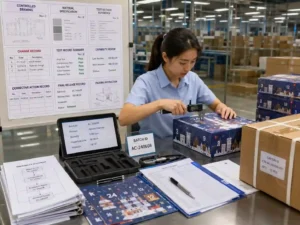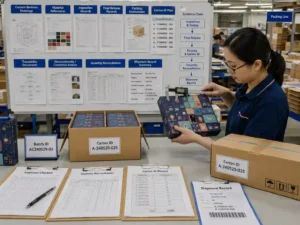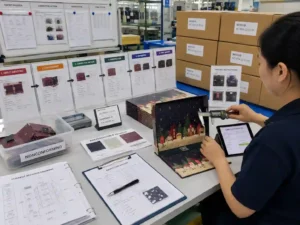
Quick answer: Food advent calendar boxes are custom seasonal packaging systems designed to hold multiple food gifts, such as chocolates, tea sachets, coffee packets, snack bars, biscuits, or confectionery, in separate compartments. For B2B buyers, the most important decisions are box structure, insert material, product separation, artwork accuracy, sample approval, MOQ, quality control, export carton strength, and quotation clarity. A reliable supplier should help check the dieline, match inserts to product size, protect food packaging from crushing or odor transfer, and prepare bulk production for retail, e-commerce, or wholesale distribution.
For brands and purchasing teams, food advent calendar boxes are not only decorative seasonal packaging. They are multi-SKU packaging projects with structural, printing, assembly, and logistics requirements. A calendar that looks attractive but has weak doors, loose inserts, poor labeling space, or insufficient carton protection can create problems during filling, shipping, and retail display.
This buying guide explains how to compare structures, inserts, materials, printing, samples, MOQ, QC, export packing, and quotation details before sourcing from a custom advent calendar boxes manufacturer such as Giftpackpro.
What should buyers understand before choosing food advent calendar boxes?
Buyers should understand that food advent calendar boxes combine gift packaging, compartment engineering, retail presentation, and export protection in one project. The best choice depends on product size, food packaging format, filling method, selling channel, target price, and delivery deadline.
A food calendar may hold individually wrapped chocolates, tea bags, coffee sachets, mini jams, candy, snack bars, cookies, spices, or mixed gift samples. Each item has a different thickness, weight, odor profile, moisture sensitivity, and labeling requirement. The outer box must create a premium gift experience, while the insert must keep each food item stable during handling.
Buyer tip: Before discussing design, prepare a product list with size, weight, packaging material, quantity per calendar, and whether each item is already individually packed. A supplier cannot design a reliable insert from artwork alone.
Which food advent calendar box structure fits your campaign?
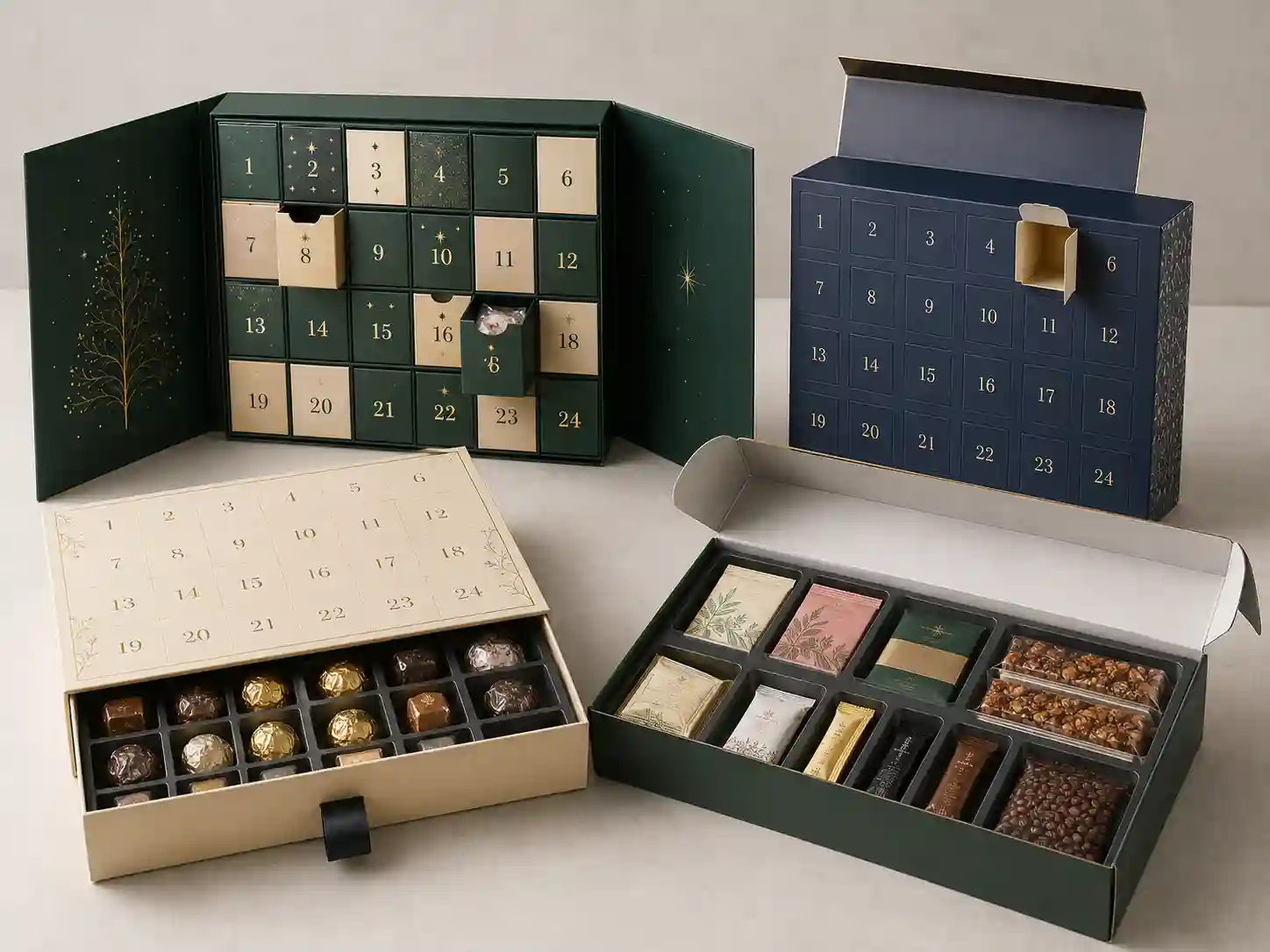
The right structure depends on the product weight, retail positioning, packing method, and budget. Rigid boxes are usually selected for premium food gifts, while folding cartons and drawer boxes can be better for lighter products or larger promotional runs.
| Structure option | Best use | Main advantages | Buyer considerations |
|---|---|---|---|
| Rigid door-opening box | Premium chocolate, tea, coffee, or mixed food gift calendars | Strong greyboard structure, high perceived value, good for luxury finishes | Higher unit cost, more assembly time, larger shipping volume |
| Folding carton calendar | Lightweight candy, sachets, snacks, or retail promotional calendars | Efficient for mass production, lower freight volume, suitable for paperboard printing | Needs careful paperboard thickness and door-tear testing |
| Drawer box calendar | Gift sets where each drawer holds a small food item or sachet | Reusable feel, organized product reveal, strong shelf appeal | Drawer tolerance and insert fit must be checked during sampling |
| Book-style box | Premium gift collections with printed storytelling panels | Large branding surface, magnetic or ribbon closure options | Magnet position, hinge durability, and closing strength need testing |
Rigid box structures are usually made with greyboard wrapped by printed paper. They are suitable when buyers want a solid hand feel and stronger display impact. Folding carton calendars use paperboard and are often chosen for lighter food packaging where cost and shipping efficiency matter. Drawer boxes can create a reusable gift format but require precise assembly tolerance so drawers do not stick or slide open too easily.
Factory tip: For food gift calendars, structure selection should start with the heaviest product and the most fragile product. If one compartment fails, the entire calendar experience is affected.
How should inserts be selected for food separation and protection?
Insert selection should be based on product size, weight, packing format, sustainability goals, and filling process. The insert must separate food items, prevent movement, and support the opening experience without making production too slow.
Common insert options include paper insert, PET tray, EVA insert, foam, and molded pulp. For food advent calendar boxes, paper inserts and PET trays are often practical because they can be shaped into multiple compartments. Molded pulp may fit some sustainability-focused projects, while EVA or foam is usually reserved for heavier or more delicate gift items, not direct food contact.
- Paper insert: Suitable for wrapped chocolates, tea sachets, coffee packets, small snack bars, and dry food gifts. It is printable and can match the box design.
- PET tray: Useful when buyers need stable cavities, clear product positioning, or higher moisture resistance around individually packed items.
- Molded pulp: Useful for a natural look and shaped cavities, but sampling time and tooling should be considered.
- EVA or foam: Provides cushioning but should be evaluated carefully for odor, appearance, and suitability for the food gift concept.
Food items should normally be individually wrapped before being placed into the calendar. The calendar box and insert are usually secondary packaging, not a substitute for primary food packaging. Buyers should verify food-contact requirements with their product team, local market rules, and relevant material documentation. For general U.S. food packaging guidance, buyers can review the FDA’s official information on food contact substances.
QC tip: During insert testing, shake the packed sample gently in different directions and then open every door or drawer. If products shift, block the opening, or deform the door, the insert needs adjustment.
What material and printing choices affect appearance, cost, and lead time?
Material and printing choices affect unit cost, sampling time, color consistency, production speed, and export durability. Buyers should choose finishes after confirming structure and insert design, not before.
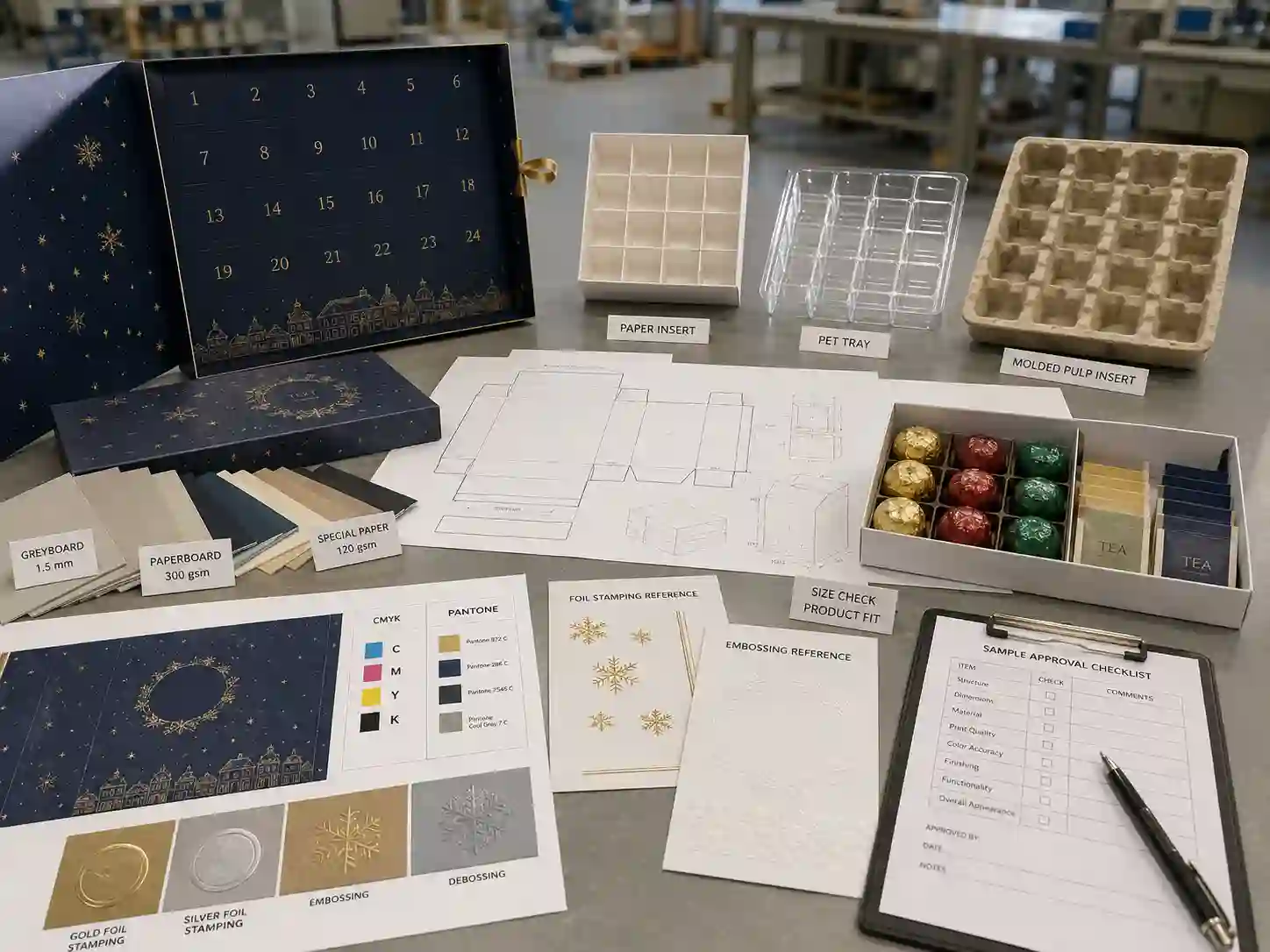
Common materials include greyboard for rigid boxes, paperboard for folding cartons, coated paper for wrapping, and specialty paper for premium gift packaging. Printing may use CMYK for full-color artwork and Pantone colors for more controlled brand color matching. Popular finishing options include matte lamination, gloss lamination, foil stamping, embossing, debossing, and spot UV.
For food gift packaging, finishes should be attractive but practical. Heavy foil stamping over many small calendar doors can increase cost and may affect cracking or alignment if not planned correctly. Matte lamination can give a premium feel but may show scratches during handling. Gloss lamination can make colors appear brighter but may not match every brand style.
Which artwork details should be checked before sampling?
Artwork should be checked against the dieline before a prototype or pre-production sample is made. Buyers should confirm door numbers, cut lines, bleed, barcode position, ingredient label space, recycling marks, country-specific text, and any retailer-required information.
- Confirm whether the box needs 12, 24, 25, or another number of compartments.
- Check that door numbers do not sit too close to perforation or cutting lines.
- Leave enough space for product descriptions, allergen notes, importer information, or barcode labels where required.
- Use CMYK for general print artwork and Pantone references where color matching is important.
- Mark foil stamping, embossing, spot UV, and lamination areas clearly on separate artwork layers.
Buyer tip: A beautiful visual mockup is not enough for production. Ask for a production dieline and confirm every opening, fold, glue area, tray cavity, and outer carton direction before approving mass production.
How do MOQ, sampling, and lead time usually work?
MOQ, sampling, and lead time depend on structure complexity, material availability, printing process, insert tooling, and seasonal production capacity. Buyers should discuss timing early because advent calendar projects often require more steps than simple gift boxes.
A typical project may include quotation, dieline confirmation, white sample, printed sample, pre-production sample, mass production, final inspection, export packing, and shipment. The actual timing varies by order quantity, finish complexity, factory schedule, and approval speed from the buyer’s team.
| Stage | Buyer decision | What the factory checks |
|---|---|---|
| RFQ and quotation | Quantity, size, structure, inserts, materials, shipping terms | Cost drivers, production feasibility, packing method |
| Dieline and white sample | Compartment layout and product fit | Door opening, insert tolerance, assembly strength |
| Printed sample | Color, finish, branding, label space | CMYK/Pantone accuracy, foil or embossing position, lamination quality |
| Pre-production sample | Final approval before bulk production | Mass production standard, QC reference, export carton plan |
| Mass production | Inspection schedule and delivery plan | Material control, printing consistency, assembly, packing |
Buyers sourcing through custom advent calendar box services should ask whether the quoted MOQ applies to one design, one size, or multiple artwork versions. Changing the structure, insert, or finish after sample approval can affect cost and lead time.
Quotable B2B statement: The most expensive delay in food advent calendar boxes often happens when product dimensions change after the insert and dieline have already been approved.
What food-gift packaging details should not be missed?
Food gift packaging needs extra attention to separation, odor, moisture, labeling space, and carton protection. Even when the calendar box is secondary packaging, buyers should avoid material choices or packing methods that create risk for the food gift experience.
Odor awareness is important because paper, glue, lamination, foam, and inks can have production smells if not properly aired or selected. Moisture awareness matters because tea, coffee, biscuits, candy, and chocolate may have different storage needs. The box supplier should know the product packaging format, but the food brand remains responsible for verifying product safety and market compliance.
- Keep strongly scented items separated from mild-flavor products where possible.
- Use individually sealed primary packaging for food items before insertion.
- Avoid overly tight cavities that crush sachets, wrappers, or chocolate packs.
- Reserve space for ingredient, allergen, importer, barcode, or retailer labels.
- Confirm whether the calendar will be shipped flat, semi-assembled, or fully assembled.
- Check storage and transport conditions for chocolate or heat-sensitive products.
For paper sourcing claims, buyers should ask suppliers for documentation instead of relying on assumptions. If FSC-related paper is required, verify the specific chain-of-custody claim and artwork use rules through the official Forest Stewardship Council information and supplier documents.
How should buyers compare food advent calendar box suppliers?
Buyers should compare suppliers by engineering support, sample quality, insert accuracy, communication speed, QC process, export packing experience, and quotation transparency. A low unit price is not useful if the supplier cannot control door opening, tray fit, printing color, or shipping damage.
A practical supplier comparison should include more than the box price. Ask each supplier how they handle dieline checking, product-fit testing, sample approval, color proofing, assembly tolerance, final inspection, export carton strength, and shipping marks.
| Comparison point | Weak supplier answer | Stronger supplier answer |
|---|---|---|
| Structure recommendation | “Any style is okay.” | Explains rigid box, folding carton, drawer box, and door-opening box trade-offs based on product weight and budget. |
| Insert design | Only asks for artwork. | Requests product size, weight, packing method, and sample products for insert testing. |
| Food packaging awareness | Makes unsupported compliance claims. | Discusses secondary packaging, material documents, odor control, and buyer-side verification. |
| QC process | Checks only finished appearance. | Checks material, printing, door opening, insert fit, assembly, carton packing, and shipping marks. |
| Quotation | Gives one simple price. | Breaks down size, material, structure, insert, finish, MOQ, sample cost, packing, and shipping terms. |
The Giftpackpro packaging factory works with buyers who need structured communication from concept to bulk packing. Buyers can also review custom advent calendar box products to compare common formats before preparing an RFQ.
What QC steps matter before mass shipment?
QC should confirm that the approved sample can be repeated consistently in mass production. For food advent calendar boxes, inspection should cover structure, print, insert fit, compartment opening, cleanliness, packing quantity, carton labeling, and export protection.
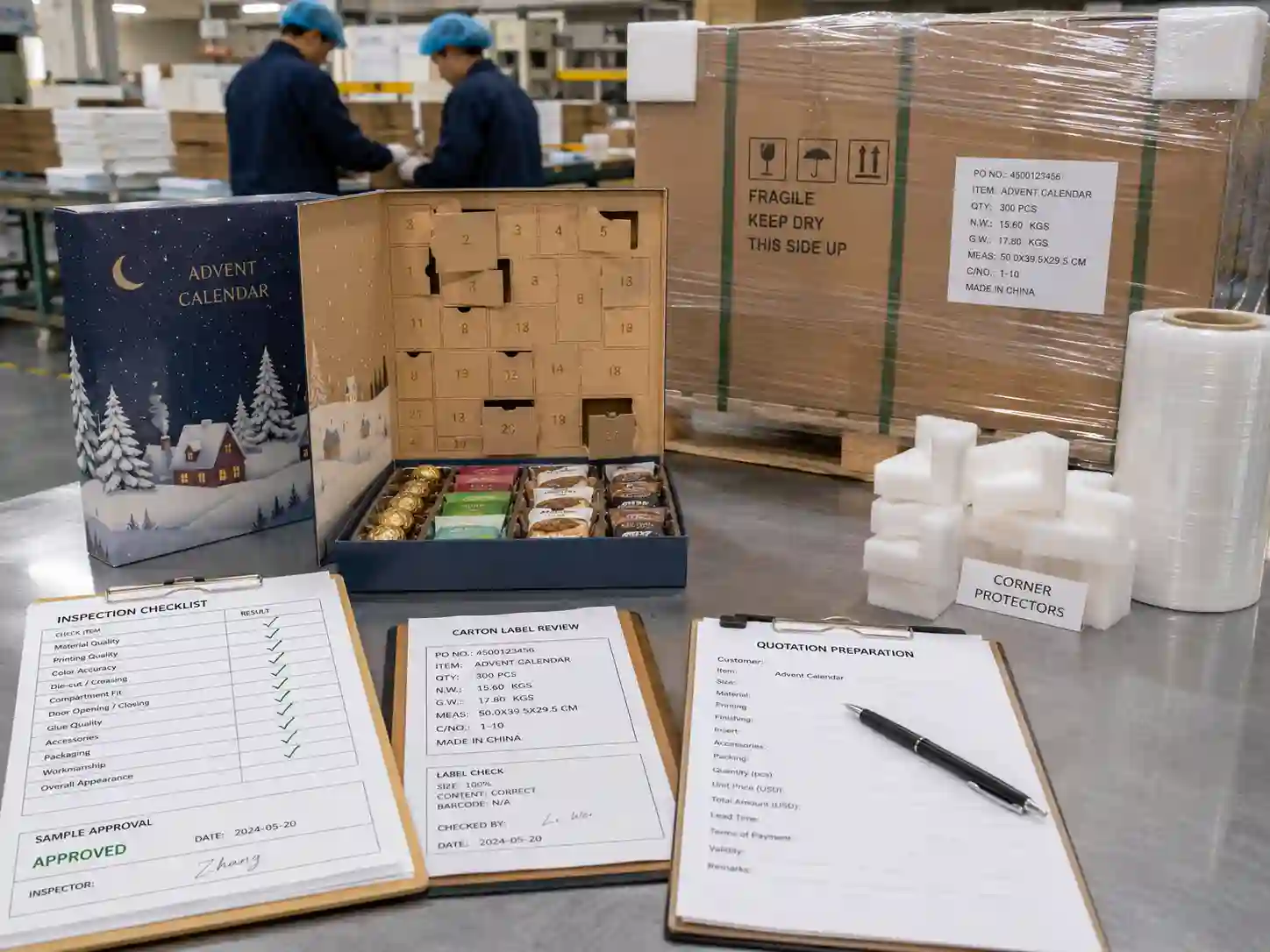
Final inspection should not be limited to checking the outside appearance. The inspector should open sample doors or drawers, verify the insert position, check glue strength, review color consistency, confirm carton count, and inspect shipping marks. If products are filled by the buyer or a co-packer, the empty packaging should still be tested with representative product samples.
Practical QC checklist for buyers
- Approved pre-production sample is available as the inspection standard.
- Outer box size, compartment size, and insert cavities match the approved dieline.
- Doors open cleanly without tearing surrounding artwork.
- Drawer movement is smooth and not too loose.
- Paper insert, PET tray, molded pulp, EVA, or foam insert fits the food items correctly.
- CMYK color, Pantone color, foil stamping, embossing, spot UV, and lamination match the approved sample.
- No obvious glue marks, scratches, crushed corners, stains, or strong production odor.
- Retail labels, barcode area, and required blank label space are in the correct position.
- Export carton size, carton weight, shipping marks, and pallet plan match the shipping requirement.
QC tip: For calendar packaging, inspect both the closed appearance and the opening experience. Many defects only appear when doors, drawers, or inserts are used.
How should export packing be planned for overseas delivery?
Export packing should protect the calendar structure from compression, corner damage, moisture exposure, and rough handling during international transport. The stronger and heavier the calendar, the more important carton strength and pallet planning become.
Common export packing details include inner polybags where appropriate, master export cartons, corner protectors, carton labels, shipping marks, pallet wrapping, and loading direction. For rigid food gift calendars, buyers should avoid cartons that are too heavy for manual handling or too loose for long-distance shipping.
Carton protection is especially important for door-opening boxes and drawer boxes because crushed corners can affect both appearance and function. If the order will go to Amazon, retail distribution centers, or multiple warehouses, buyers should confirm carton labeling, barcode placement, and pallet requirements before mass packing.
Factory tip: Export cartons should be designed around the finished box size after lamination, wrapping, and insert assembly, not only around the flat dieline size.
What information should buyers prepare before requesting a quotation?
Buyers should prepare product details, target structure, quantity, artwork status, insert requirements, finish preferences, packing method, destination, and delivery deadline. A complete RFQ helps the supplier quote accurately and avoid repeated revisions.
- Calendar size or target retail shelf size.
- Number of compartments, such as 12, 24, or 25.
- Product list with dimensions, weight, and packing material for each food item.
- Preferred structure: rigid box, folding carton, drawer box, book-style box, or door-opening box.
- Insert preference: paper insert, PET tray, molded pulp, EVA, foam, or supplier recommendation.
- Material and finish request: paperboard, greyboard, matte lamination, gloss lamination, foil stamping, embossing, or spot UV.
- Artwork status: concept only, print-ready artwork, or dieline needed.
- Estimated order quantity and expected MOQ flexibility.
- Sample requirement: white sample, printed sample, or pre-production sample.
- Destination country, shipping method, carton requirements, and delivery deadline.
Buyers can use the advent calendar box buying guides for planning and then request a custom quote when product details are ready. For complex food advent calendar boxes, sending physical product samples or accurate dummy samples can make insert development much more reliable.
Decision guide: which option should your team choose?
Choose the option that best balances product protection, brand positioning, production speed, and landed cost. The best food calendar structure is the one that can be produced consistently, filled efficiently, shipped safely, and displayed clearly.
| Buyer priority | Recommended direction | Why it helps |
|---|---|---|
| Premium gift positioning | Rigid box with paper insert or PET tray | Improves perceived value and supports stronger seasonal presentation. |
| Large retail promotion | Folding carton with efficient paperboard structure | Controls cost and shipping volume for higher quantities. |
| Mixed food items | Custom insert with separate cavities | Reduces product movement and improves opening experience. |
| Shorter development timeline | Use a proven structure and limit special finishes | Reduces sampling revisions and production complexity. |
| E-commerce delivery | Stronger outer structure and export carton testing | Helps protect corners, doors, and inserts during parcel or warehouse handling. |
If the campaign requires multiple food types, ask the supplier to design around the most difficult product first. For example, a fragile biscuit pack, thick snack bar, or scented tea sachet may define the insert depth and separation more than a simple candy wrapper.
Common mistakes to avoid when sourcing food advent calendar boxes
The most common mistakes are approving artwork before testing product fit, choosing inserts too late, underestimating export packing, and comparing suppliers only by unit price. These issues can cause delays, rework, or avoidable damage.
- Starting with a graphic design but no confirmed product dimensions.
- Using the same cavity size for products with different thicknesses.
- Ignoring odor and moisture awareness for mixed food gifts.
- Adding foil stamping or embossing across weak door areas without testing.
- Approving a sample without checking all compartments.
- Forgetting barcode, label, importer, or retailer-required information space.
- Choosing a carton plan after production instead of during quotation.
- Requesting a quotation without target quantity, delivery date, or destination.
Quotable B2B statement: A food advent calendar box should be quoted as a complete packaging system: outer structure, insert, print finish, assembly method, QC standard, and export packing must be considered together.
FAQ: Food advent calendar boxes for B2B buyers
Are food advent calendar boxes usually direct food-contact packaging?
Most custom food advent calendar boxes are secondary packaging used to hold individually wrapped food items. Buyers should confirm food-contact requirements for any material that may directly touch food and verify local compliance with their regulatory or quality team.
What is the best insert for chocolates, tea, coffee, and snacks?
There is no single best insert for every product. Paper inserts work well for many wrapped items, PET trays provide stable cavities, molded pulp can support a natural presentation, and foam or EVA may suit special gift components when appropriate.
Can one advent calendar box hold different food products?
Yes, but the insert must be designed for different product sizes and separation needs. Mixed food calendars should consider odor transfer, moisture sensitivity, product weight, and opening sequence.
What affects the MOQ of custom food advent calendar boxes?
MOQ is affected by structure, material purchasing, printing setup, insert tooling, finish complexity, and production schedule. A folding carton may have a different MOQ from a rigid box or drawer box.
Should buyers approve a white sample or printed sample?
For new structures, a white sample is useful for checking size, compartments, and insert fit. A printed sample is needed to confirm artwork, color, finishing, and the final presentation before mass production.
How can buyers reduce cost without weakening the packaging?
Buyers can simplify the structure, reduce special finishes, use a more efficient insert, optimize box size, increase order quantity, or choose export carton dimensions that improve shipping efficiency.
What should be checked before mass production starts?
Check the final dieline, product fit, insert layout, material, print proof, finish position, sample approval comments, MOQ, production timeline, carton packing method, and shipping marks.
CTA: Prepare a clear RFQ for food advent calendar boxes
To request accurate pricing for food advent calendar boxes, prepare the product list, compartment count, target box size, preferred structure, insert requirement, artwork status, quantity, destination, and delivery deadline. If available, share product samples, reference photos, dieline files, or packing instructions.
Giftpackpro can support buyers with structure discussion, insert planning, sample development, printing and finishing review, QC coordination, and export packing for custom food gift calendar projects. When your product details are ready, send them through the request a custom quote page so the quotation can reflect real production requirements instead of rough assumptions.