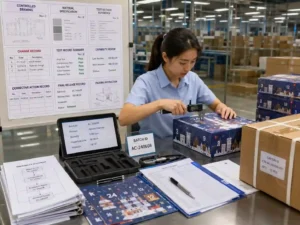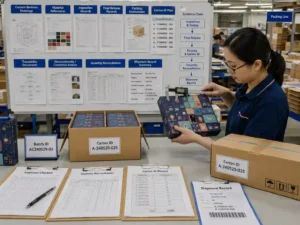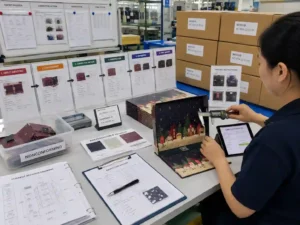
Quick answer: Makeup advent calendar boxes are custom seasonal packaging systems designed to hold mixed beauty products such as palettes, lipsticks, tubes, mini bottles, brushes, and cosmetic samples in a controlled retail presentation. For B2B buyers, the key decisions are box structure, insert material, artwork control, finishing, MOQ, sampling, supplier communication, QC, export packing, and quotation detail. A reliable China packaging supplier should help check dielines, test insert fit, confirm color consistency, review pre-production samples, and pack finished boxes safely for overseas shipment.
For overseas brands, wholesalers, retail buyers, e-commerce sellers, and packaging distributors, makeup advent calendar boxes are not only decorative gift packaging. They are a production project that combines structure engineering, cosmetic presentation, mixed-SKU protection, printing accuracy, assembly control, and export logistics. The right supplier should understand both packaging manufacturing and buyer-side purchasing concerns.
This guide explains how to compare structures, inserts, materials, printing options, China suppliers, quotation details, QC steps, and export-packing methods before starting a custom makeup advent calendar project with a custom advent calendar boxes manufacturer.
What should buyers understand before sourcing makeup advent calendar boxes?
Buyers should understand that makeup advent calendar boxes are made around the actual product list, not around a generic box size. The number of days, product dimensions, product weight, insert style, opening method, retail display requirement, and export route all affect structure, cost, lead time, and packing safety.
Makeup products create more packaging variables than many other gift categories because one calendar may include fragile palettes, compact powders, lipstick tubes, mini perfume-style bottles, brushes, mascara, sponge applicators, jars, sachets, and small accessories. Each item may require a different cavity depth, support point, and removal method.
Buyer tip: Do not ask factories to quote only from a general size such as “24-day makeup calendar box.” A serious quotation needs the product list, cavity count, approximate product sizes, insert preference, artwork quantity, finishing requirements, and packing method.
Before choosing a supplier, prepare answers to these early questions:
- How many makeup SKUs will be packed inside the calendar?
- Are the products supplied to the packaging factory for assembly, or will the buyer pack products later?
- Will the box be sold in retail stores, shipped through e-commerce, or distributed as a promotional gift?
- Does the design require drawers, doors, trays, sleeves, magnetic closure, or flat packing?
- Are there fragile items such as powder palettes, glass mini bottles, mirrors, or pressed cosmetics?
- Does the buyer need FSC-related paper sourcing, barcode placement, shipping marks, or special labeling?
Which box structure is best for makeup advent calendar boxes?
The best structure depends on product weight, retail price point, assembly method, shipping budget, and desired presentation. Rigid boxes usually feel more premium, folding cartons are more cost-efficient, drawer boxes create a strong reveal experience, and door-opening boxes are practical for numbered daily access.
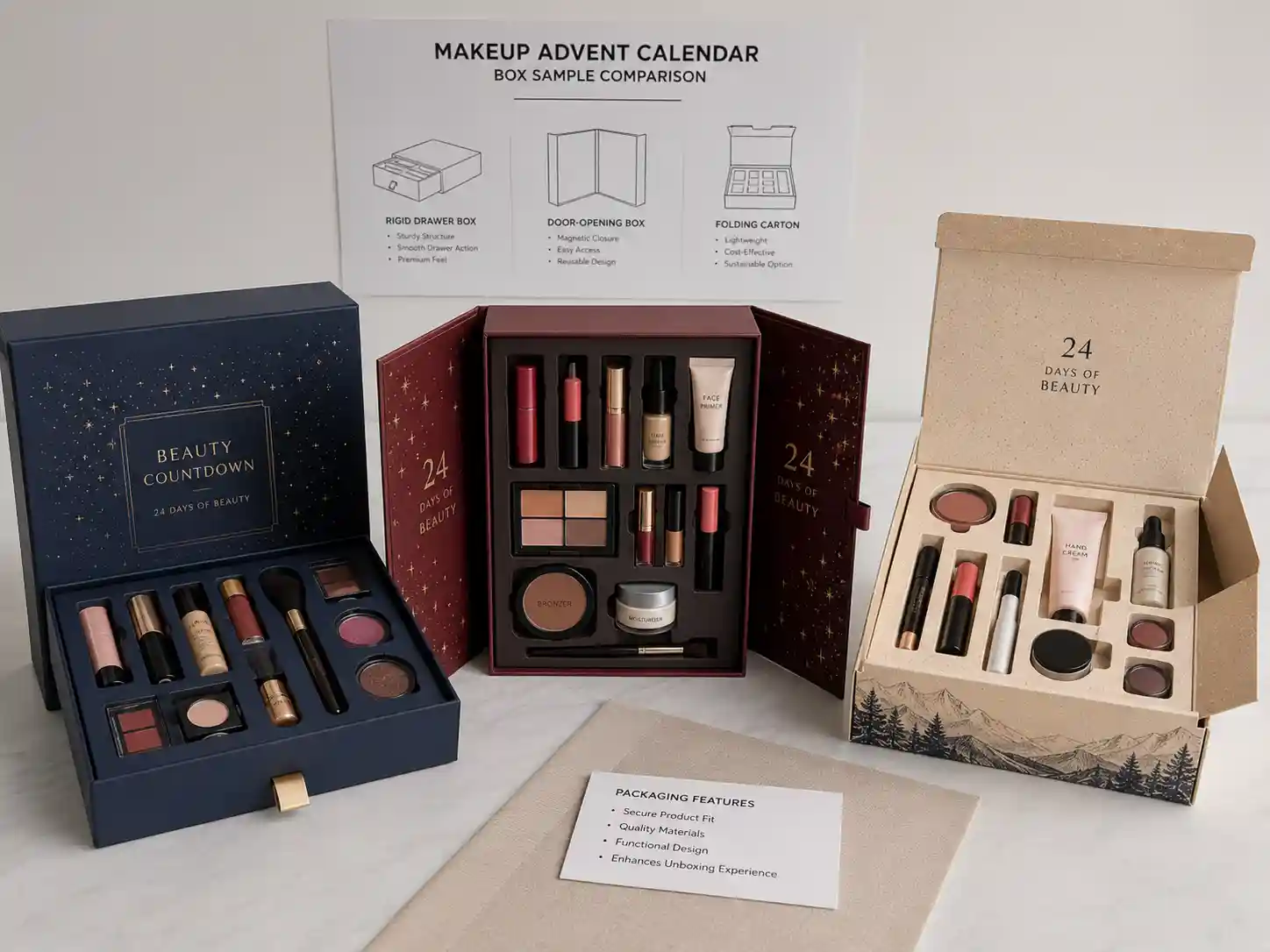
For makeup, structure selection must balance shelf impact with product protection. A beautiful exterior will fail commercially if a palette cracks, a drawer jams, or a mini bottle moves during transit. Buyers should compare structure, insert support, packing volume, and labor time together instead of choosing based only on appearance.
| Structure option | Best for | Buyer advantages | Key sourcing concerns |
|---|---|---|---|
| Rigid box | Premium makeup gift sets, influencer kits, retail campaigns | Strong presentation, good durability, supports premium finishing | Higher material cost, larger shipping volume, longer production time |
| Drawer box | Mixed cosmetics, lipstick sets, small accessories, luxury launches | Good unboxing experience, easy product separation, strong gift value | Drawer tolerance, sliding resistance, assembly labor, insert alignment |
| Door-opening box | 24-day or 12-day beauty calendars with numbered windows | Classic advent function, clear daily access, strong retail storytelling | Door tear strength, cavity matching, product movement behind doors |
| Folding carton calendar | Cost-sensitive promotions, lightweight samples, e-commerce bundles | Lower unit cost, easier flat packing, efficient shipping | Lower rigidity, needs careful insert support, less premium feel |
| Sleeve and tray box | Compact makeup sets, limited-edition gift packs, wholesale programs | Clean structure, simple assembly, good for branded artwork | Tray strength, sleeve friction, protection during carton packing |
When should a buyer choose a rigid makeup calendar box?
A rigid box is suitable when the retail price point, product weight, and brand positioning justify stronger board and premium finishing. It is often used for makeup advent calendar boxes that contain palettes, glass components, multiple drawers, or high-value retail presentation.
Rigid structures usually use greyboard wrapped with printed paper. Common thickness choices depend on size and weight, but the final decision should be tested by sample, not guessed from a catalog. For larger calendars, the supplier should check corner strength, door stability, drawer clearance, and whether the box can stand upright without deformation.
When is a folding carton calendar enough?
A folding carton can be enough when the products are light, the sales channel is price-sensitive, and flat-packing efficiency matters. It is useful for sample-size makeup, small tubes, sachets, brushes, and low-weight cosmetic accessories.
The risk is that folding carton calendars may bend or crush more easily if the paperboard, insert, and export carton are not specified properly. Buyers should ask the supplier to test whether the product remains fixed after handling, carton stacking, and simulated shipping movement.
How should buyers choose inserts for mixed makeup SKUs?
Inserts should be selected according to product shape, fragility, weight, sustainability preference, and assembly workflow. A makeup calendar often needs different support methods for palettes, tubes, mini bottles, jars, pencils, brushes, and irregular accessories.
The insert is one of the most important cost and quality-control parts of custom advent calendar boxes. A weak insert allows products to shift. An overly tight insert slows assembly, scratches packaging, or makes products difficult for consumers to remove. The best insert feels secure during transit and easy during use.
| Insert type | Suitable makeup items | Advantages | Watch points |
|---|---|---|---|
| Paper insert | Lipsticks, pencils, small tubes, light accessories | Paper-based look, printable, easier to recycle in many markets | May need reinforcement for heavier items or deep cavities |
| PET tray | Mini bottles, jars, compacts, mixed cosmetic sets | Accurate cavities, good visibility, stable shape | Tooling, plastic policy concerns, surface scratching, tray thickness |
| EVA insert | Fragile palettes, glass items, premium sets | Strong cushioning, clean cavity edges, premium support | Higher cost, sustainability questions, smell and color control |
| Foam insert | Delicate compacts, mirrors, special gift items | Good shock absorption and protection | May not match paper-based packaging goals |
| Molded pulp | Brands seeking paper-based protective packaging | Plastic reduction, molded support, natural appearance | Tooling, surface texture, color variation, cavity precision |
QC tip: Insert approval should include both product-fit testing and removal testing. If the cavity only looks correct on a dieline but the product is hard to remove, the consumer experience and assembly speed may suffer.
What printing and finishing options matter for beauty packaging?
For makeup advent calendar boxes, printing and finishing should protect brand consistency while supporting a premium retail appearance. CMYK, Pantone matching, matte lamination, gloss lamination, foil stamping, embossing, debossing, and spot UV can all work, but each option affects cost, lead time, and QC difficulty.
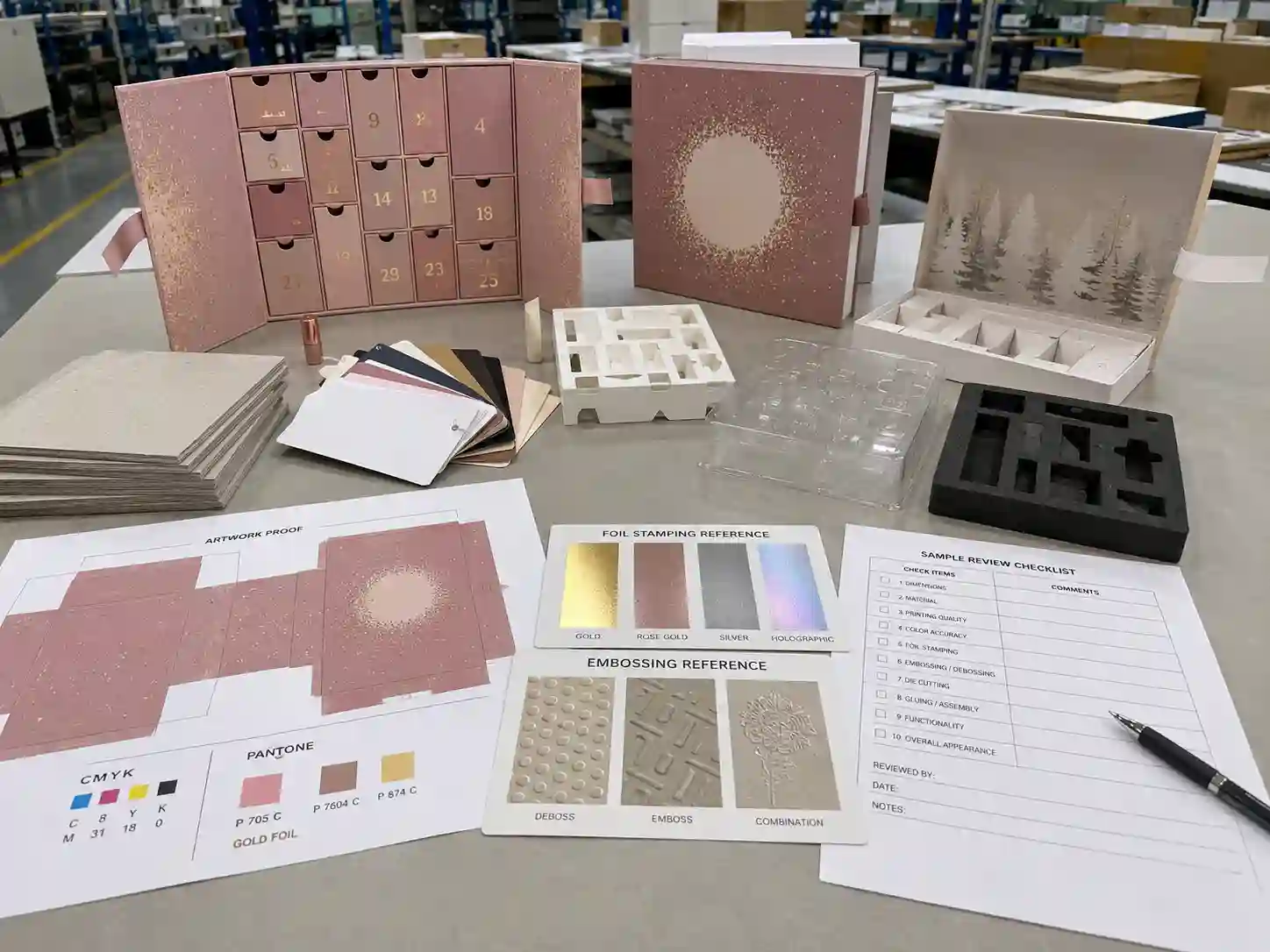
Beauty packaging buyers often care about color accuracy because the calendar may sit beside other cosmetic packaging, influencer mailers, retail displays, or campaign materials. A small color shift can make the packaging look inconsistent with the brand system.
Common print and finish decisions include:
- CMYK printing: suitable for full-color artwork, gradients, illustrations, and product campaign visuals.
- Pantone color control: useful for brand colors that must stay consistent across boxes, sleeves, inserts, and labels.
- Matte lamination: gives a soft premium surface and reduces glare in product photography.
- Gloss lamination: creates stronger shine but may show fingerprints or reflections.
- Foil stamping: works well for logos, numbers, festive accents, and premium limited-edition details.
- Embossing or debossing: adds tactile value but requires accurate registration.
- Spot UV: highlights selected artwork areas, but alignment should be checked carefully on samples.
Factory tip: Premium finishing should be tested on the same paper surface planned for mass production. Foil color, embossing depth, lamination texture, and spot UV effect can change when the paper, ink coverage, or board surface changes.
How should buyers compare China makeup calendar box suppliers?
Buyers should compare China suppliers by engineering ability, communication quality, sample accuracy, quotation transparency, QC process, export-packing experience, and reliability—not only by the lowest unit price. A low quote may become expensive if it misses insert tooling, assembly labor, thicker carton packing, or revision time.
For Month 10 sourcing and supplier comparison, the most useful question is not “Which factory is cheapest?” but “Which factory can turn my product list, artwork, and launch deadline into a stable production plan?” For custom makeup advent calendar boxes, sourcing mistakes often happen before production begins: unclear specifications, incomplete RFQs, unconfirmed samples, and weak communication.
Supplier comparison checklist
- Can the supplier explain suitable structures for your product weight and sales channel?
- Can they make dielines and revise them after sample testing?
- Do they ask for product dimensions, weight, and fragility before quoting?
- Can they compare paper insert, PET tray, EVA insert, foam, and molded pulp options?
- Do they provide clear quotation items for material, printing, finishing, insert, assembly, packing, and tooling?
- Can they support blank sample, printed sample, or pre-production sample approval?
- Do they have a clear QC process for printing, structure, insert fit, assembly, and export cartons?
- Can they communicate artwork requirements such as dieline, bleed, CMYK, Pantone, barcode area, and warning-label area?
- Do they understand export packing, palletizing, shipping marks, and carton-label review?
Giftpackpro positions its custom advent calendar box services around this type of B2B sourcing workflow, including structure discussion, sampling, material selection, production coordination, and export-packing planning.
What should be included in a reliable quotation?
A reliable quotation should separate structure, material, printing, finishing, insert, sample, tooling, assembly, packing, MOQ, lead time, and payment terms. Buyers should avoid vague quotations that only show one unit price without explaining what is included.
When comparing quotations from China factories, make sure every supplier is quoting the same specification. Otherwise, the cheapest offer may use thinner paperboard, simpler insert material, no product assembly, weaker export cartons, or fewer finishing steps.
| Quotation item | What buyers should confirm | Why it matters |
|---|---|---|
| Box structure | Rigid box, drawer box, door-opening box, folding carton, sleeve tray, or custom structure | Different structures have different material, labor, shipping volume, and tooling costs |
| Material | Paperboard grade, greyboard thickness, wrapping paper, insert material | Material affects strength, appearance, weight, and cost |
| Printing | CMYK, Pantone, inside printing, outside printing, number printing | Color control and print coverage affect production cost and QC |
| Finishing | Foil stamping, embossing, spot UV, matte lamination, gloss lamination | Premium effects add tooling, setup, and inspection requirements |
| Insert | Paper insert, PET tray, EVA insert, foam, molded pulp, cavity count | Insert choice controls product safety and assembly efficiency |
| Sample | Blank sample, digital printed sample, printed sample, pre-production sample | Sample type affects approval confidence and revision time |
| Packing | Flat packing, assembled packing, master carton, inner protection, pallet option | Packing method affects freight cost and damage risk |
| Lead time | Sampling time, production time, packing time, shipping preparation | Seasonal launches need schedule control before peak demand |
Buyer tip: Ask each supplier to state what is excluded from the quotation. Exclusions such as insert tooling, special color proofing, product assembly, pallet packing, or barcode label application can change the final landed cost.
What MOQ and lead-time factors affect makeup advent calendar projects?
MOQ and lead time depend on structure complexity, material sourcing, printing setup, finishing process, insert tooling, sample revisions, assembly labor, and peak-season capacity. Buyers should treat MOQ as a production-planning discussion, not only a number.
For simple folding carton calendars, MOQ may be influenced mainly by printing setup and paper material. For rigid drawer boxes or multi-cavity door-opening calendars, MOQ may also be affected by greyboard converting, wrapping labor, insert cutting or molding, finishing setup, and manual assembly.
Lead time should be divided into stages:
- Specification confirmation: product list, size, quantity, structure, insert, artwork direction, and packing method.
- Dieline and engineering: cavity layout, door position, drawer clearance, insert thickness, and tolerance check.
- Sampling: blank sample, printed sample, or pre-production sample depending on project risk.
- Sample approval and revision: buyer confirms structure, color, finishing, insert fit, and packing method.
- Mass production: printing, lamination, finishing, mounting, die cutting, wrapping, insert making, and assembly.
- Final QC and export packing: inspection, carton labeling, shipping marks, palletizing, and shipment preparation.
A supplier that gives a lead time without asking about artwork readiness, sample approval, finishing complexity, or packing method may not have fully evaluated the project.
How does sampling reduce risk before mass production?
Sampling reduces risk by checking structure, insert fit, artwork position, finishing effect, color consistency, and assembly practicality before mass production. For makeup advent calendar boxes, sample approval is especially important because cosmetic products vary widely in size, weight, and fragility.
There are several sample stages buyers may use:
- Blank structural sample: checks size, opening method, board strength, insert layout, and product fit without final printing.
- Digital printed sample: helps review artwork layout and general visual effect, but may not fully match mass-production color.
- Printed sample: tests printing, finishing, lamination, foil stamping, embossing, and display effect more accurately.
- Pre-production sample: confirms the approved standard before mass production begins.
QC tip: For fragile palettes or mini bottles, buyers should send actual products or accurate dummy samples for insert testing. A cavity approved with estimated sizes may fail once real makeup products arrive.
During sample review, buyers should check:
- Can each product be inserted and removed without damage?
- Do doors open cleanly without tearing neighboring areas?
- Do drawers slide smoothly without becoming too loose?
- Are printed numbers, icons, and product names aligned correctly?
- Is the brand color acceptable under normal viewing conditions?
- Are foil, embossing, and spot UV details registered correctly?
- Does the packed box survive normal handling and carton movement?
What artwork and dieline details should buyers prepare?
Buyers should prepare editable artwork, confirmed dieline requirements, color references, barcode locations, legal-copy zones, numbering rules, and finishing instructions before requesting a final production quote. Clear artwork preparation prevents delays and reduces the risk of wrong printing.
A dieline is the technical layout used for box cutting, folding, wrapping, doors, windows, drawers, and insert cavities. For custom makeup advent calendar boxes, the dieline should match product positions and opening sequence. Buyers should avoid placing important logos, text, or numbers too close to cut lines, fold lines, or door perforations.
Useful artwork preparation details include:
- Final artwork file in an editable format requested by the supplier.
- Bleed area, safe area, fold lines, cut lines, and glue areas clearly marked.
- CMYK values and Pantone references for brand colors.
- Separate finishing layers for foil stamping, embossing, debossing, or spot UV.
- Correct product names, shade names, SKU codes, and calendar numbers.
- Barcode and shipping-label areas if needed. Buyers can review barcode guidance from GS1 barcode standards.
- Paper-sourcing preference, such as asking the supplier to verify FSC-related material options through official FSC information when relevant.
Factory tip: Artwork approval should include both flat-file review and physical sample review. Flat artwork can look correct on screen while foil position, door alignment, or number visibility still needs adjustment on the actual box.
What QC points matter most before export shipment?
The most important QC points are structure strength, insert fit, print accuracy, color consistency, finishing registration, product placement, assembly cleanliness, carton strength, and shipping-mark accuracy. Final inspection should compare production goods against the approved sample and the purchase specification.
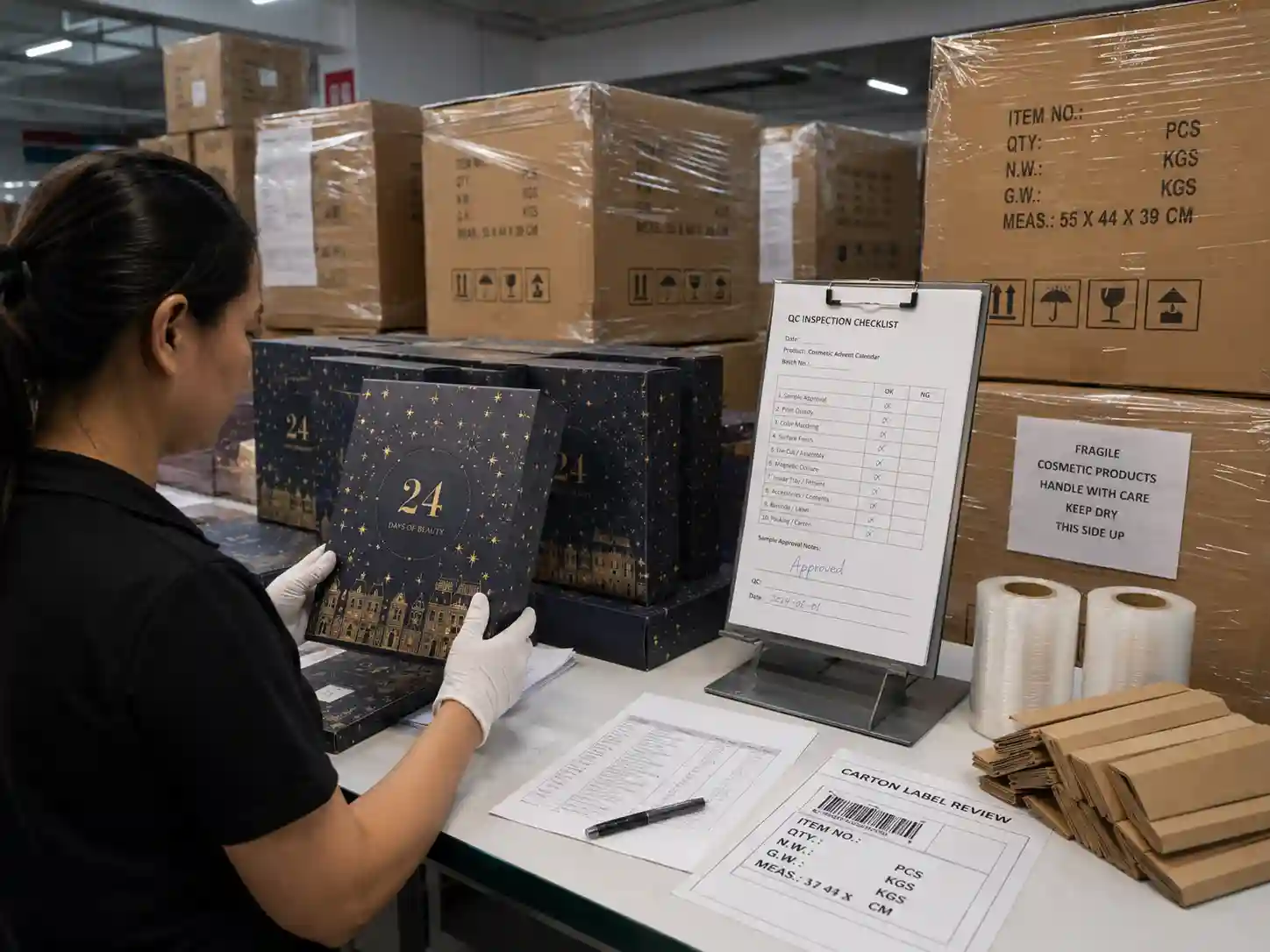
Makeup calendar boxes often have many small components, so quality control should be organized by inspection stage rather than only by final appearance. A factory-side QC workflow may include incoming material inspection, printing inspection, finishing inspection, die-cutting inspection, assembly inspection, insert-fit inspection, and final packed-carton inspection.
Practical QC checklist for buyers
- Structure: box size, board thickness, door opening, drawer movement, corner strength, standing stability.
- Insert: cavity size, product fit, removal space, tray stability, glue or tape position if used.
- Printing: color consistency, text clarity, number order, artwork position, barcode readability where applicable.
- Finishing: foil stamping coverage, embossing depth, spot UV alignment, lamination bubbles, scratches, glue marks.
- Assembly: clean edges, correct sequence, no missing parts, no upside-down inserts, no loose panels.
- Product protection: fragile palettes, tubes, jars, and mini bottles fixed securely inside the calendar.
- Packing: inner protection, export carton strength, carton label, shipping marks, pallet condition if used.
Buyers can also ask suppliers whether packaging tests or transport-simulation references are suitable for their project. For more structured distribution testing information, buyers may review official resources from ISTA and discuss practical test requirements with their logistics or quality team.
How should makeup advent calendar boxes be packed for export?
Export packing should be chosen according to box structure, product fragility, shipping method, and whether the calendars are packed flat or assembled. Good export packing reduces crushed corners, scratched surfaces, broken inserts, and carton-label confusion during international transport.
Common export-packing decisions include:
- Flat packing: useful for some folding structures when the buyer wants lower shipping volume and will assemble later.
- Assembled packing: suitable for rigid boxes, drawer boxes, or calendars that need factory assembly and insert placement.
- Inner protection: may include tissue, polybag, paper wrap, corner protectors, dividers, or cushioning depending on finish and surface sensitivity.
- Master carton: should match box size, weight, stacking requirement, and export handling conditions.
- Palletizing: helps reduce handling damage for larger shipments, especially when cartons contain premium finished boxes.
- Shipping marks: should show agreed carton information, item code, quantity, gross weight, net weight, carton size, and destination details if required.
QC tip: Premium matte lamination, foil stamping, and dark-color printing can show scratches more easily. Ask the supplier how finished surfaces will be separated inside export cartons before approving the packing method.
Decision guide: how should buyers choose the right packaging plan?
Buyers should choose the packaging plan by matching product value, fragility, order quantity, launch schedule, and sales channel. A premium retail launch and a cost-sensitive online promotion should not use the same structure, insert, finishing, or packing plan.
| Buyer situation | Recommended direction | Reason |
|---|---|---|
| Premium makeup brand launch | Rigid drawer box with EVA or PET insert, matte lamination, foil details | Supports premium presentation and stronger protection for mixed SKUs |
| Retail chain seasonal program | Door-opening box with tested paper or PET insert and clear carton labeling | Balances daily access, shelf impact, and operational control |
| Wholesale promotional set | Folding carton calendar with paper insert and controlled finishing | Helps manage unit cost and shipping volume |
| E-commerce gift box | Compact rigid or sleeve-tray design with stronger export carton protection | Needs better transit protection and clean unboxing experience |
| Mixed fragile products | Custom insert test with actual products before printed sample approval | Reduces risk of cracked palettes, loose bottles, and damaged surfaces |
Buyers can review custom advent calendar box products to compare common structure directions before preparing a detailed RFQ.
What common sourcing mistakes should buyers avoid?
Buyers should avoid choosing a supplier based only on the lowest unit price, approving artwork without sample testing, ignoring insert fit, and leaving export packing until the end. Most calendar-box problems are caused by incomplete early specifications rather than by one isolated production mistake.
Common mistakes include:
- Requesting a quote without product sizes, weights, or SKU list.
- Using one cavity size for products with different shapes and protection needs.
- Approving a beautiful render without checking dieline, insert fit, and structure strength.
- Choosing premium finishing without checking scratch resistance and packing separation.
- Comparing quotations that use different materials, insert types, or packing methods.
- Ignoring carton size and pallet planning until shipment booking.
- Not confirming whether the supplier is quoting product assembly or packaging only.
- Leaving color approval until mass production instead of reviewing a printed sample.
- Assuming all factories understand cosmetic retail presentation and influencer-kit expectations.
Buyer tip: A clear RFQ saves more time than repeated price negotiation. When suppliers receive complete specifications, they can suggest more realistic structures, identify cost drivers earlier, and reduce revision cycles.
What information should buyers prepare before requesting a quotation?
Buyers should prepare the product list, target structure, quantity, artwork status, insert preference, finishing requirements, packing method, delivery market, and expected launch schedule. These details help the supplier provide a more accurate quotation and sample plan.
Use this RFQ checklist before contacting the Giftpackpro packaging factory or another China supplier:
- Project name and target sales channel.
- Calendar format, such as 12-day, 24-day, 25-day, or custom count.
- Product list with dimensions, weight, and fragility notes for each makeup item.
- Preferred structure: rigid box, drawer box, door-opening box, folding carton, or custom design.
- Insert preference: paper insert, PET tray, EVA insert, foam, molded pulp, or supplier recommendation.
- Approximate finished box size if already known.
- Artwork status: ready file, draft design, or need for dieline first.
- Printing requirements: CMYK, Pantone, inside printing, outside printing, numbered doors.
- Finishing requirements: foil stamping, embossing, spot UV, matte lamination, gloss lamination.
- Order quantity and expected repeat order possibility.
- Sample requirement: blank sample, printed sample, or pre-production sample.
- Packing method: flat packed, assembled, product-filled, or packaging-only.
- Export destination, carton-label requirements, and shipping marks.
- Target delivery date and product launch timeline.
For more planning articles, buyers can visit the advent calendar box buying guides section and compare structure, production, QC, and export-packing topics before finalizing specifications.
FAQ: Makeup advent calendar boxes for B2B buyers
Are makeup advent calendar boxes usually custom made?
Yes. Most B2B makeup advent calendar boxes are custom made because the product sizes, cavity count, artwork, insert layout, opening method, and retail presentation vary by brand and campaign. Stock structures may help early discussion, but final production usually needs a custom dieline and sample approval.
Which insert is best for fragile makeup palettes?
Fragile palettes often need stronger support than a basic paper insert. EVA, foam, PET tray, or reinforced paper structures may be considered depending on product weight, sustainability preference, and cost target. Actual product testing is more reliable than choosing insert material from photos.
Can one calendar box hold palettes, tubes, jars, and brushes together?
Yes, but the insert must be designed around each product. Mixed SKU sizes require different cavity shapes, depths, and support points. The supplier should test whether each product stays fixed during handling and can still be removed easily by the end user.
How can buyers control color consistency?
Buyers can provide Pantone references, approved printed samples, artwork files with clear color settings, and acceptable tolerance expectations. Color should be reviewed under realistic lighting and compared with other campaign packaging when brand consistency is important.
What makes a China supplier reliable for this type of project?
A reliable supplier asks technical questions before quoting, checks dielines, tests inserts, provides clear sample stages, explains cost drivers, communicates lead time honestly, performs QC against approved samples, and plans export packing before shipment.
Should buyers choose flat packing or assembled packing?
Flat packing can reduce shipping volume for some folding structures, but it transfers assembly work to the buyer or downstream partner. Assembled packing is usually better for rigid boxes, drawer boxes, complex inserts, or projects where the factory controls final presentation and QC.
What is the most important step before mass production?
The most important step is approving a realistic sample that confirms structure, insert fit, artwork, finishing, assembly, and packing method. For makeup products, actual product or accurate dummy-product testing is strongly recommended before mass production.
Ready to plan custom makeup advent calendar boxes?
Before asking for a sample or quotation, prepare your product list, sizes, quantity, structure preference, ar