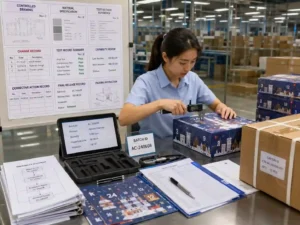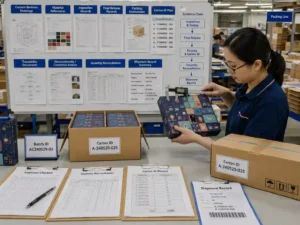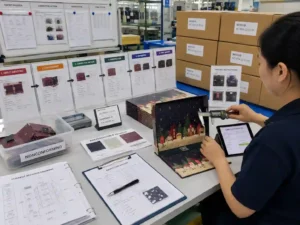
Quick answer: Skincare advent calendar boxes should be planned around product fit, insert protection, print finish, assembly method, and export packing before pricing starts. For skincare brands, the key risks are glass bottle breakage, jar movement, pump height, dropper leakage, label orientation, surface scuffing, and carton damage during overseas shipping. Buyers should compare rigid drawer boxes, door-opening boxes, and folding carton structures by SKU size, retail display needs, MOQ, packing method, and freight volume. A reliable supplier should check the dieline, make samples, test inserts, inspect printing, confirm master cartons, apply clear shipping marks, and prepare the goods for palletized export.
Skincare advent calendar boxes are not only seasonal display packaging. For overseas brands, wholesalers, gift companies, retail buyers, e-commerce sellers, and purchasing teams, they are a combined packaging project involving structure engineering, insert testing, artwork control, hand assembly, and export logistics. A beautiful box that fails in transit can create returns, retailer complaints, and repacking costs. A practical box that protects each bottle, jar, tube, dropper, cap, and pump gives buyers a better chance of launching on time.
Giftpackpro works as a B2B custom advent calendar boxes manufacturer for seasonal paper gift packaging projects. This guide explains how buyers can compare structures, inserts, printing methods, sampling stages, MOQ factors, QC checks, and export packing details before requesting a quotation.
What should buyers understand before ordering skincare advent calendar boxes?
Buyers should understand that the box structure, insert layout, product weight, and export packing plan must be developed together. If the structure is approved before the skincare items are measured and weighed, the final box may look good but fail during assembly or shipping.
Skincare packaging has more fit risk than many lightweight gift categories. A 30 ml glass bottle, a plastic tube, a wide cosmetic jar, and a dropper bottle may all need different cavity depths and holding points. Pumps and caps may be taller than the main bottle body. Some products need upright storage to reduce leakage risk. Label direction also matters because buyers often want every product facing the same way when the calendar is opened.
Buyer tip: Prepare physical product samples or accurate 3D drawings before confirming the insert. For skincare advent calendar boxes, a 1-2 mm difference in bottle diameter, cap width, or pump height can affect insert fit, drawer movement, and door closure.
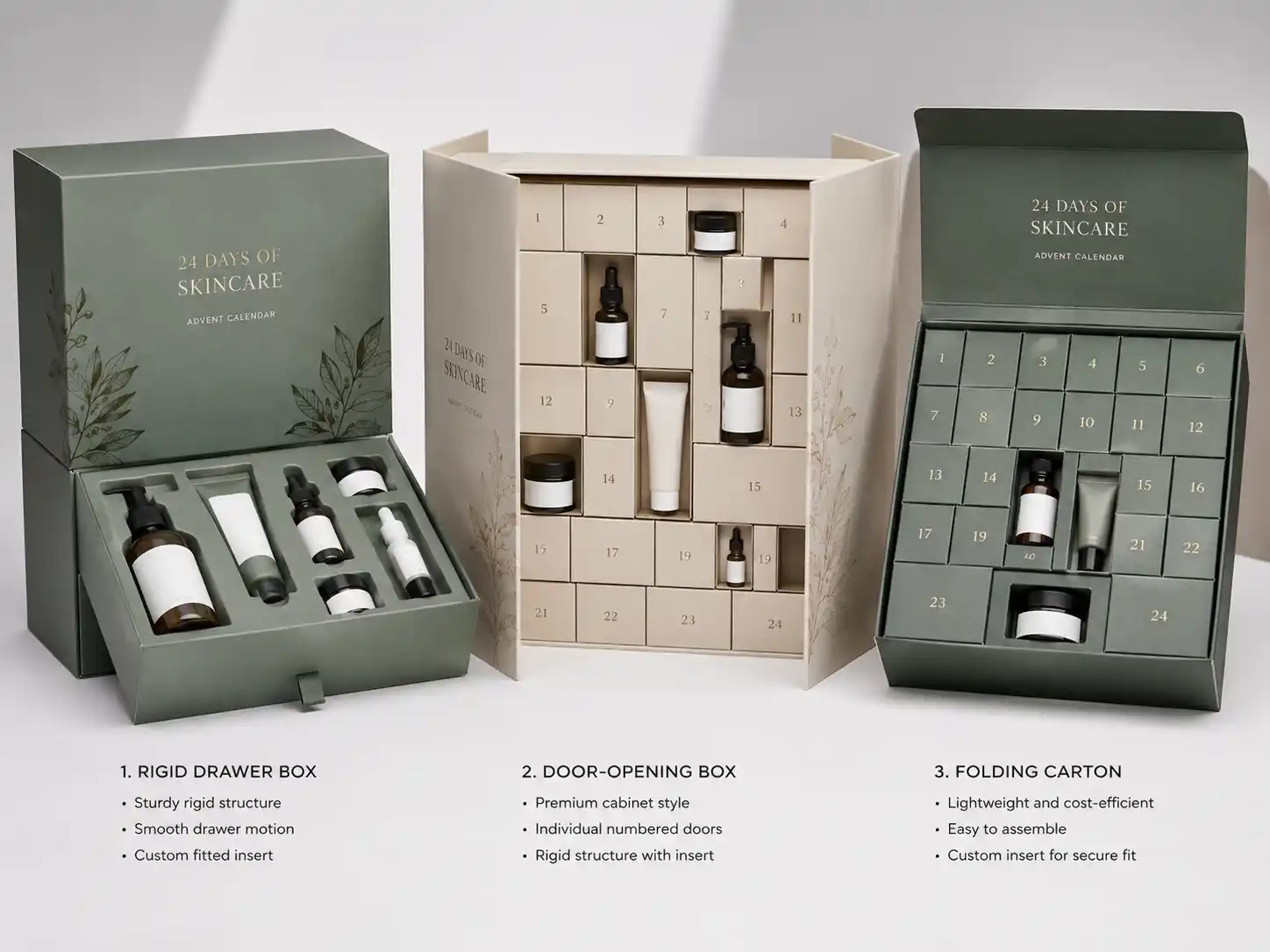
Which structure is best for skincare advent calendar boxes?
The best structure depends on product weight, retail display style, assembly budget, shipping volume, and premium positioning. Rigid drawer boxes often feel premium and protect heavier skincare items well, while door-opening boxes create a classic reveal effect, and folding carton options can help reduce freight volume for larger orders.
| Structure option | Best for | Buyer advantages | Key risks to check |
|---|---|---|---|
| Rigid drawer box | Premium skincare sets, glass bottles, heavier jars, high-value retail gifts | Strong greyboard frame, smooth drawer experience, good display value, suitable for foil stamping and embossing | Higher unit cost, larger shipping volume if fully assembled, drawer tolerance must be tested |
| Door-opening box | 24-day or 12-day skincare calendars with numbered windows | Strong seasonal presentation, clear product reveal, flexible layout for mixed bottles and tubes | Door tearing strength, insert alignment, product pushing against doors during transit |
| Book-style rigid box | Luxury skincare kits, influencer seeding, retail gift sets | Premium opening experience, large branding surface, magnetic closure option | Magnet position, spine durability, higher material and assembly cost |
| Folding carton calendar | Lightweight tubes, sachets, mini jars, cost-sensitive campaigns | Can be flat packed, better freight efficiency, lower material weight | Less rigid protection, needs stronger insert or outer carton for export |
| Hybrid paperboard structure | Mid-range branded skincare promotions | Balances cost, display effect, and protection when engineered correctly | Requires careful dieline testing and clear assembly instructions |
For heavier skincare products, greyboard thickness, box depth, drawer rail strength, and insert support should be checked during sampling. For lightweight tubes or sachets, a folding carton or paperboard structure may work, but buyers should still confirm whether the calendar will be shipped flat, semi-assembled, or fully assembled.
Factory tip: Structure selection should be made after checking the heaviest product, tallest pump, widest jar, and most fragile glass item. The weakest item often defines the insert and export packing plan.
How should inserts be selected for bottles, jars, tubes, droppers, and pumps?
Inserts should hold each skincare item firmly without deforming labels, scratching finishes, or forcing the buyer to use excessive assembly labor. The correct insert depends on product shape, weight, fragility, environmental preference, and presentation requirements.
Paper inserts are common for custom advent calendar boxes because they are printable, recyclable in many markets, and suitable for many lightweight to medium-weight skincare items. PET trays provide precise cavities and smooth loading for bottles or jars, but buyers should check material requirements in the destination market. EVA or foam inserts can protect fragile glass, but they may not match every sustainability policy. Molded pulp can be useful for eco-positioned projects, but cavity precision and surface smoothness must be tested for premium skincare packaging.
Which insert details matter most for skincare products?
The most important insert details are cavity size, holding depth, finger notch position, label direction, leakage orientation, and clearance between the product and the door, drawer, or lid. If the product is too loose, it may rotate during shipping. If it is too tight, workers may damage caps or labels during loading.
- Glass bottles need side support and enough clearance to avoid direct impact against the outer wall.
- Jars need cavity depth that prevents lifting, tilting, or lid rubbing.
- Tubes need shape control so the printed front panel faces the opening direction.
- Dropped bottles should usually be tested upright and sideways to understand leakage risk.
- Pumps and caps need extra top clearance because they are often wider or taller than the bottle body.
- Premium coated bottles need scuffing checks against paperboard edges, PET cavities, and neighboring products.
QC tip: During sample review, shake the filled calendar gently in several directions. If products rotate, knock, or push against the doors, the insert layout should be adjusted before mass production.
What materials and printing finishes should buyers compare?
Buyers should compare materials and finishes based on structure strength, visual positioning, surface durability, and export handling risk. A premium finish is only useful if it survives assembly, packing, palletizing, and overseas shipment without visible scuffing.
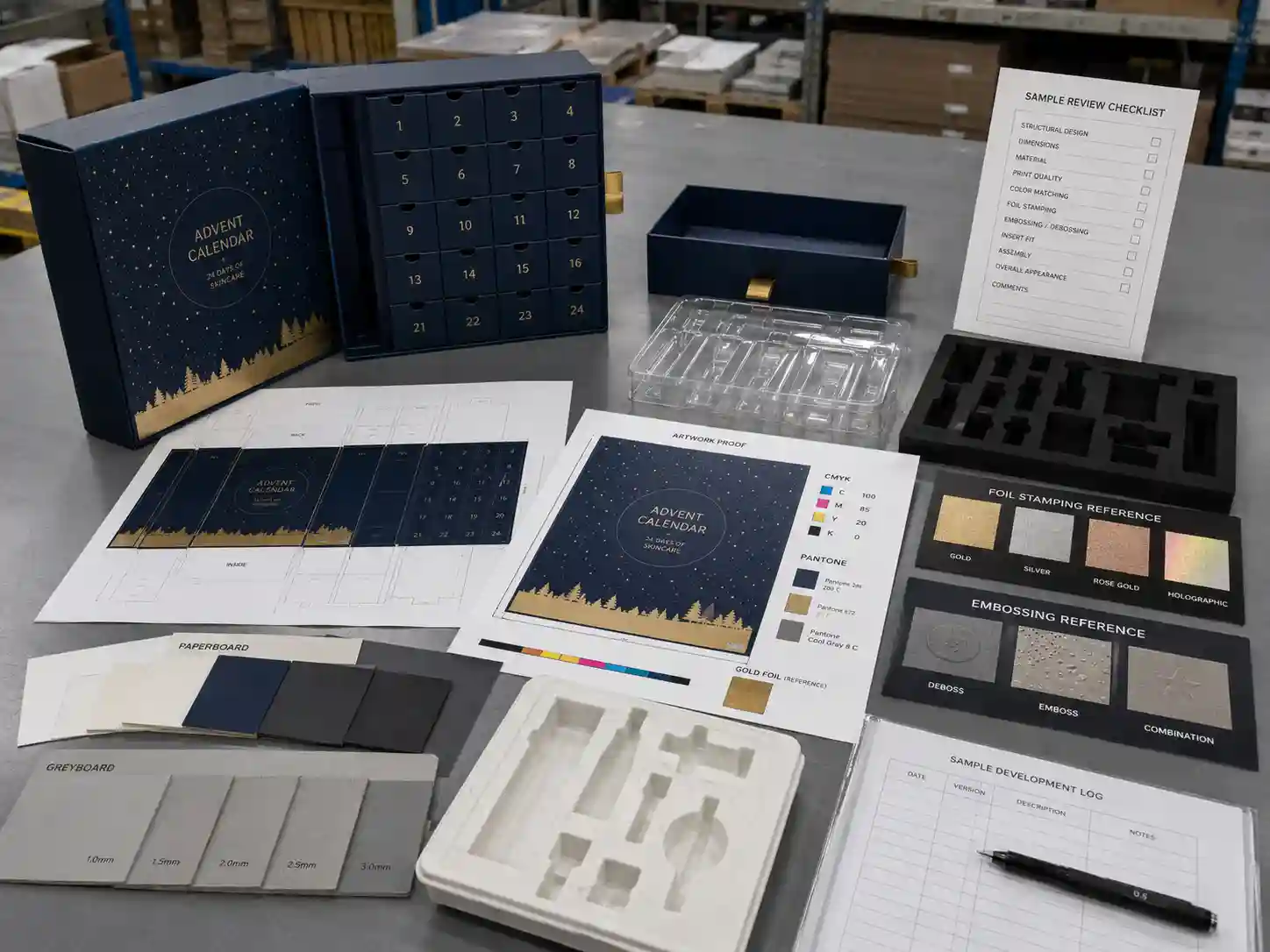
Common material choices include paperboard, greyboard, coated paper, specialty paper, corrugated master carton material, PET tray material, paper insert board, EVA, foam, and molded pulp. For premium skincare calendars, rigid box structures often use greyboard wrapped with printed art paper. Folding carton options may use SBS, CCNB, or other paperboard grades depending on target strength and price.
Printing usually starts with CMYK for full-color artwork. Pantone colors may be used when brand colors must be closer and more repeatable. Buyers should provide print-ready artwork, dieline-based layout, bleed, safety margins, barcode area, warning text, recycling marks, and shipping label space when needed.
Which finishes work well for skincare advent calendar boxes?
Matte lamination, gloss lamination, foil stamping, embossing, debossing, spot UV, and soft-touch effects can all work for skincare packaging. The right choice depends on brand positioning and handling risk.
- Matte lamination: Popular for premium skincare, but dark matte surfaces may show scratches or fingerprints more easily.
- Gloss lamination: Offers stronger shine and can be easier to wipe, but may look less subtle for luxury positioning.
- Foil stamping: Useful for logos, numbers, borders, and festive accents, but registration should be checked on samples.
- Embossing or debossing: Adds tactile branding, but deep effects need enough paper thickness and stable pressure control.
- Spot UV: Works well for highlighting numbers or patterns, but the contrast should be checked under retail lighting.
Buyer tip: Ask for a printed sample or at least a printed proof for color-critical projects. Screen color is not a reliable approval standard for mass production printing.
How do sampling and prototype approval reduce export damage?
Sampling reduces export damage by proving the structure, insert, print, assembly method, and packing plan before bulk production. A sample should not be reviewed only for appearance; it should also be checked for fit, loading speed, product movement, closure strength, and carton packing method.
A typical project may include a blank sample, a printed sample, and a pre-production sample. The blank sample checks size, structure, insert layout, door opening, drawer movement, and product fit. The printed sample checks CMYK, Pantone, foil stamping, lamination, embossing, spot UV, numbering, barcode position, and text accuracy. The pre-production sample confirms the final approved materials, artwork, finishing, assembly tolerance, and packing method before mass production.
For buyers comparing custom advent calendar box services, the most useful suppliers are those who ask detailed questions before sampling. If a supplier quotes too quickly without product sizes, weights, insert requirements, packing method, or delivery terms, the quote may not reflect the real production cost.
What MOQ, lead time, and cost drivers should buyers expect?
MOQ, lead time, and cost depend on structure complexity, material selection, insert type, printing method, finishing, assembly labor, and export packing requirements. Buyers should avoid comparing only the unit price because two quotes may include very different materials, packing standards, and service scope.
For custom skincare advent calendar boxes, cost drivers usually include greyboard thickness, paper grade, number of cavities, insert material, hand assembly time, foil stamping area, embossing mold, spot UV screen, sample fees, carton strength, pallet requirements, and shipping volume. Fully assembled rigid calendars may cost more to ship than flat-packed folding structures, but they can reduce packing work for the buyer or fulfillment center.
Quotable B2B statement: “For skincare advent calendar boxes, the lowest unit price is not always the lowest landed cost; insert failure, carton damage, repacking labor, and delayed launch timing can cost more than a stronger structure.”
Should buyers choose flat packing or assembled packing for export?
Buyers should choose flat packing when freight efficiency and local assembly are priorities, and assembled packing when presentation control, speed of fulfillment, or retailer-ready delivery is more important. The right option depends on structure type, order quantity, product loading location, and destination handling process.
| Packing method | When it works best | Advantages | Questions to ask before approval |
|---|---|---|---|
| Flat packing | Folding carton calendars, simple paperboard structures, projects with buyer-side assembly | Lower shipping volume, better container efficiency, reduced warehouse space | Who will assemble? Are instructions clear? Will local labor damage printed surfaces? |
| Semi-assembled packing | Hybrid structures where some parts are fixed and inserts are loaded later | Balances freight volume and factory-controlled quality | Which parts are pre-glued? How are inserts protected? Is assembly tolerance stable? |
| Fully assembled packing | Rigid drawer boxes, luxury calendars, retailer-ready gift sets | Better factory control, easier final loading, stronger presentation consistency | Can the master carton protect corners? Is palletizing required? What is the carton quantity per layer? |
Flat packing can save freight, but buyers must confirm whether the destination team can assemble boxes consistently. Fully assembled packing may increase carton volume, but it helps protect structure quality and reduces the risk of incorrect folding or gluing after arrival.
How should master cartons, pallets, and shipping marks be planned?
Master cartons, pallets, and shipping marks should be planned before mass production because they affect carton strength, warehouse handling, customs identification, and damage reduction. Export packing is part of the product specification, not a last-minute warehouse decision.
For skincare calendars, master cartons should protect corners, printed surfaces, and finished edges. Heavy rigid boxes may need fewer pieces per carton to avoid compression. Lightweight folding calendars may allow more units per carton, but buyers should check whether the carton becomes too large for manual handling.
- Use suitable export carton board strength for the gross weight and shipping route.
- Add corner protectors when rigid boxes have sharp edges or premium printed corners.
- Separate printed surfaces with tissue paper, polybag, paper sleeve, or other approved protection when needed.
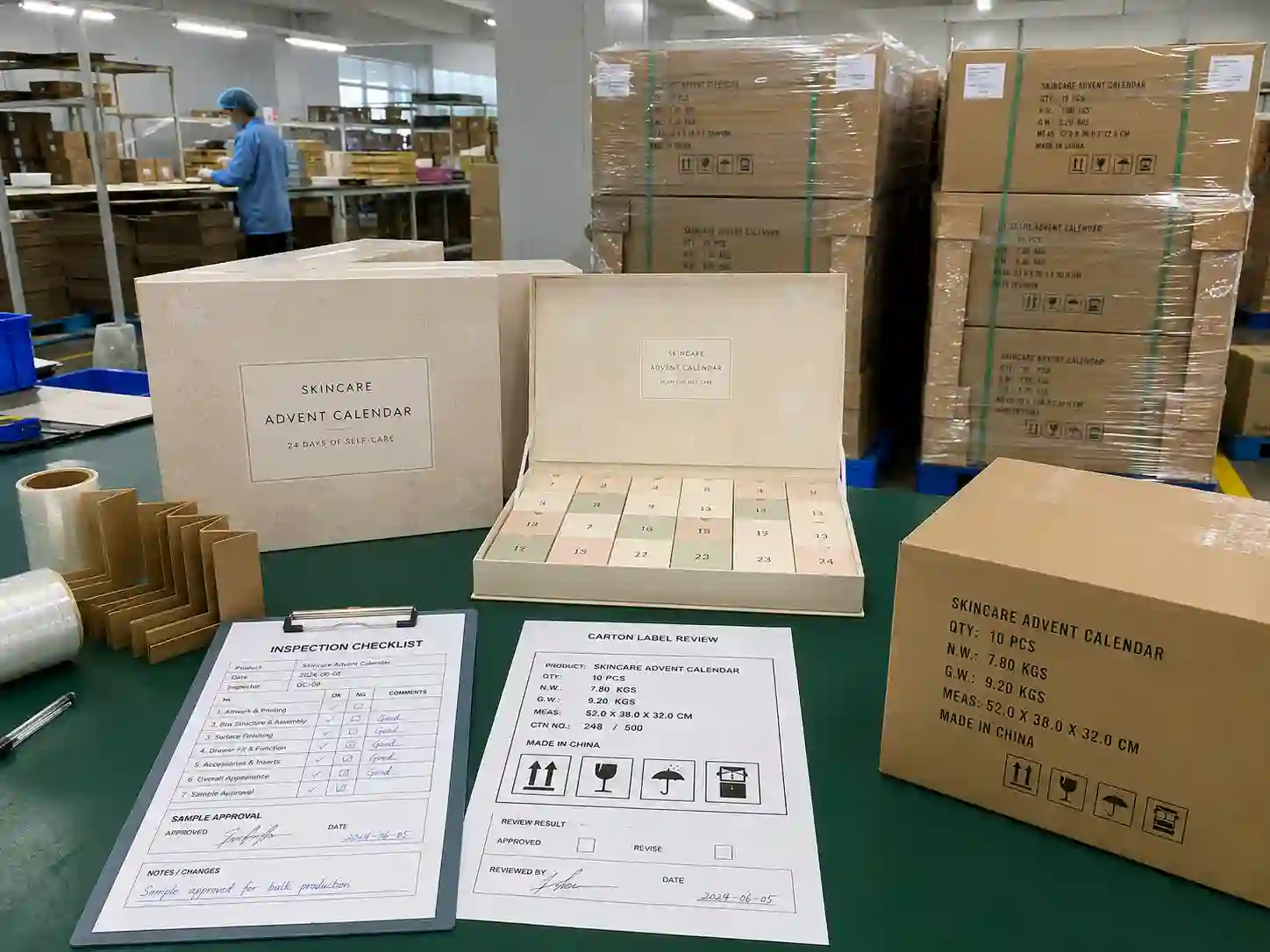
- Confirm carton dimensions, gross weight, net weight, and quantity per carton before booking freight.
- Use pallet wrap, pallet labels, and corner boards for palletized shipments when required.
- Keep shipping marks generic but clear: item number, PO number, carton number, quantity, destination, gross weight, net weight, and carton size.
For transport testing, buyers can discuss whether their project should follow recognized package test methods. The International Safe Transit Association test procedures are a useful official reference when buyers want to evaluate packaged-product performance for distribution conditions. For paper sourcing claims, buyers should verify supplier information through the official FSC Search database instead of relying only on logo placement in artwork.
What QC checks matter before shipping skincare advent calendar boxes?
QC should check structure, print, finishing, insert fit, assembly accuracy, product movement, carton strength, and shipping marks before export. Final inspection should include both cosmetic appearance and functional packaging performance.
Practical QC checklist for buyers
- Confirm approved sample, dieline version, artwork version, and material specification.
- Check box dimensions, cavity dimensions, drawer movement, door opening, and closure strength.
- Inspect CMYK color, Pantone color, foil stamping, embossing, spot UV, lamination, and registration.
- Check numbered doors, product sequence, label orientation, barcode area, and warning text.
- Test fit for glass bottles, jars, tubes, droppers, pumps, and caps using real products when possible.
- Check whether products move, rotate, scratch, or press against the calendar doors during handling.
- Review surface scuffing, corner damage, glue marks, paper cracking, and color transfer.
- Confirm inner packing, master carton quantity, carton size, gross weight, net weight, and shipping marks.
- Check pallet pattern, pallet height, stretch wrap, corner protectors, and loading direction if palletized.
- Keep inspection photos and approval records before releasing the shipment.
QC tip: A final inspection should include at least one fully packed master carton review. Inspecting only loose finished boxes may miss compression, corner, labeling, and carton-count problems.
How should buyers compare skincare advent calendar box suppliers?
Buyers should compare suppliers by engineering ability, sample communication, insert testing, print control, assembly experience, export packing knowledge, and quotation clarity. A supplier with a slightly higher unit price may be safer if the quote includes better structure advice, clearer QC, and stronger shipping preparation.
Use this decision guide when comparing options:
- If your products include glass bottles or heavy jars, prioritize rigid box strength, insert support, carton compression protection, and sample testing.
- If your project is cost-sensitive and lightweight, compare folding carton or hybrid paperboard options with flat packing.
- If your retail launch date is fixed, choose a supplier that can define sampling, artwork approval, mass production, inspection, and export timing clearly.
- If your brand color is important, request Pantone guidance, printed proofing, and clear tolerance discussion before bulk printing.
- If your buyer or retailer requires responsible paper sourcing, ask for verifiable documentation and check certificate details through official sources.
- If your shipment will be palletized, ask for carton dimensions, pallet pattern, pallet height, shipping marks, and loading photos.
Giftpackpro provides custom advent calendar box products and project support for overseas seasonal packaging buyers. Buyers who need to review factory capability can also learn more about the Giftpackpro packaging factory before sending a request.
What information should buyers prepare before requesting a quotation?
Buyers should prepare product sizes, weights, structure preference, insert requirements, artwork status, order quantity, packing method, delivery terms, and target launch schedule before requesting a quotation. Better RFQ details help the supplier quote the real project instead of guessing.
RFQ preparation checklist
- Product list with dimensions, weight, material, and quantity for each skincare item.
- Photos or samples of bottles, jars, tubes, droppers, pumps, and caps.
- Preferred calendar format, such as 12-day, 24-day, drawer box, door-opening box, or book-style box.
- Approximate finished box size or target retail shelf size.
- Insert preference: paper insert, PET tray, EVA insert, foam, molded pulp, or supplier recommendation.
- Artwork files, dieline status, CMYK or Pantone requirements, and finishing requests.
- Surface protection expectations for matte lamination, foil stamping, embossing, or spot UV.
- Order quantity, target MOQ range, sample requirement, and pre-production approval process.
- Packing preference: flat packed, semi-assembled, fully assembled, or palletized export packing.
- Shipping marks, retailer carton label rules, destination country, and required delivery date.
Buyers can also review more advent calendar box buying guides to compare packaging formats before sending a final RFQ.
What common mistakes should skincare packaging buyers avoid?
The most common mistakes are approving artwork before product fit is checked, choosing inserts without real samples, ignoring export carton strength, and comparing quotes without matching specifications. These mistakes often appear after mass production, when changes are expensive and launch timing is tight.
- Mistake 1: Measuring only the bottle body. Pumps, caps, droppers, and lids often require larger cavities than the main container.
- Mistake 2: Ignoring label orientation. Products may rotate inside the insert if the cavity does not control direction.
- Mistake 3: Using premium matte surfaces without scuffing tests. Dark matte boxes can show handling marks during assembly and transit.
- Mistake 4: Selecting flat packing without assembly planning. Freight savings can disappear if local assembly is slow or inconsistent.
- Mistake 5: Approving a beautiful sample without carton testing. Export damage often comes from compression, vibration, corner impact, and poor pallet handling.
- Mistake 6: Requesting a quote without packing details. Master carton size, carton quantity, pallet requirements, and shipping marks can change the landed cost.
FAQ: Skincare advent calendar boxes for B2B buyers
Can skincare advent calendar boxes hold glass bottles safely?
Yes, but the structure and insert must be designed around the bottle weight, height, cap style, and shipping route. Glass bottles usually need stronger cavities, controlled movement, and suitable master carton protection.
Are paper inserts strong enough for skincare products?
Paper inserts can work for many mini bottles, tubes, and jars when the board thickness, folding design, and support points are correct. For heavier glass items, buyers may need reinforced paperboard, PET trays, EVA, foam, molded pulp, or a combined insert solution.
Should buyers request a blank sample or printed sample first?
A blank sample is usually best for checking structure, fit, and assembly before investing in full printing. A printed sample is useful after the dieline, product layout, and major structure decisions are approved.
What affects MOQ for custom advent calendar boxes?
MOQ is affected by material purchasing, printing setup, finishing molds, insert tooling, assembly labor, and carton packing requirements. Buyers should ask what changes if they adjust size, structure, print finish, or packing method.
How can buyers reduce damage during export shipping?
Buyers can reduce damage by approving the insert with real products, using suitable inner protection, confirming export carton strength, limiting carton weight, applying clear shipping marks, and reviewing palletizing before shipment.
What files are needed for printing?
Buyers should provide editable artwork based on the final dieline, with bleed, safety margins, CMYK or Pantone color instructions, finishing layers, barcode positions, legal text, and any retailer-required marks.
CTA: How to request a sample or quotation from Giftpackpro
To request skincare advent calendar boxes from Giftpackpro, prepare your product dimensions, product weights, target quantity, preferred structure, insert requirement, artwork files, finish preferences, packing method, shipping marks, and target delivery date. If you are unsure which structure fits your skincare set, send product photos and an approximate retail concept so the team can suggest a practical direction.
For custom structure, inserts, printing, sampling, QC, and export packing support, you can request a custom quote from Giftpackpro. Clear RFQ information helps the packaging team recommend the right rigid box, folding carton, drawer box, door-opening box, paper insert, PET tray, finish, master carton, and palletizing plan for your next skincare advent calendar boxes project.