
Quick answer: To design skincare advent calendar boxes for seasonal campaigns, buyers should confirm the product mix, box structure, insert protection, artwork requirements, sample approval process, MOQ, quality control checkpoints, and export packing method before mass production. Skincare sets often include glass bottles, jars, tubes, droppers, pumps, and caps, so insert fit and transit durability are not decoration details; they directly affect product presentation and breakage risk. A reliable supplier should help check dielines, printing proofs, assembly tolerance, insert testing, carton packing, shipping marks, and quotation details before production starts.
What should buyers confirm before designing skincare advent calendar boxes?
Buyers should confirm the product list, retail channel, sales season, target price range, packaging structure, insert material, artwork schedule, sample approval deadline, MOQ, and shipping method before choosing a final design. These decisions control the cost, lead time, appearance, and durability of skincare advent calendar boxes.
For skincare campaigns, the first design question is not only “what looks premium?” but “can the box safely hold all products from packing line to customer unboxing?” A 24-day skincare advent calendar may include serum bottles, cream jars, mini tubes, ampoules, droppers, pumps, sachets, and accessories. Each item has a different height, diameter, cap shape, label direction, leakage risk, and surface sensitivity.
Before asking for a quotation, prepare a product packing list with dimensions, weight, material, and quantity for each item. If glass bottles or jars are included, mark them clearly because they may need stronger cavities, tighter holding points, dividers, or extra cushioning. If products must face forward in retail photography or store display, label orientation should be built into the insert design instead of corrected manually during packing.
Buyer tip: Treat the advent calendar box as a retail display, protective shipper, and assembly project at the same time. A beautiful structure can still fail if the inserts are loose, the drawers rub against printed panels, or the export cartons cannot protect corners during long-distance shipment.
Which box structure works best for a skincare seasonal campaign?
The best structure depends on product weight, campaign positioning, packing speed, display method, and budget. Rigid box styles usually support premium skincare campaigns, while folding carton and lighter paperboard structures may suit lower-weight promotions or e-commerce bundles.
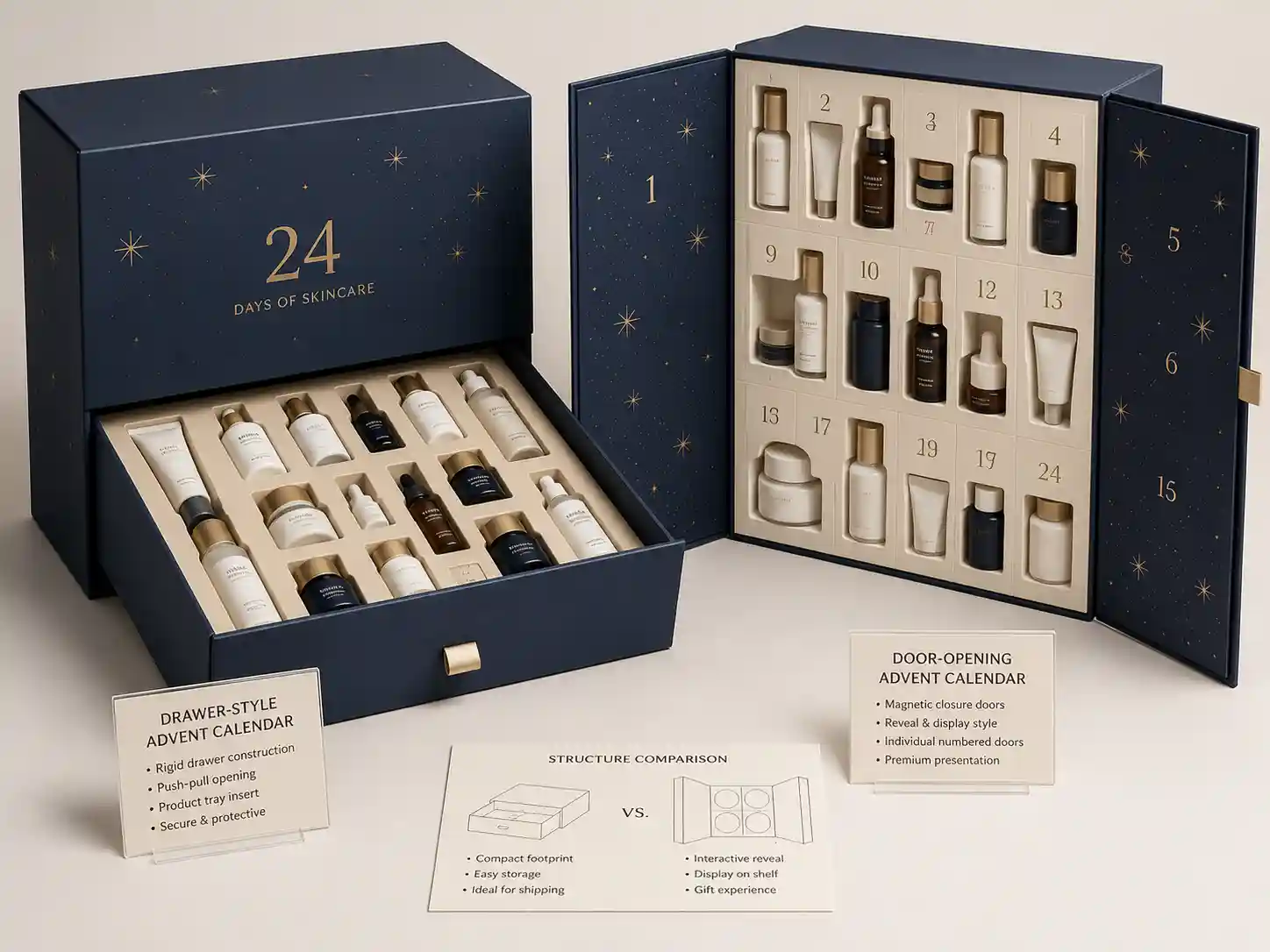
| Structure option | Best use case | Buyer advantages | Points to check before ordering |
|---|---|---|---|
| Rigid box | Premium skincare advent calendar boxes with glass bottles, jars, or heavier sets | Strong presentation, better shelf impact, suitable for foil stamping, embossing, spot UV, and premium finishes | Greyboard thickness, drawer movement, corner strength, insert support, carton packing weight |
| Drawer box | Calendars with multiple small skincare items that need daily opening | Good user experience, clear product separation, premium unboxing feel | Drawer tolerance, pull ribbon strength, label orientation, scuffing between drawer fronts |
| Door-opening box | Retail campaigns where numbered doors create a clean front display | Efficient seasonal layout, good for printed graphics and countdown campaigns | Door perforation, product cavity depth, door tearing, inner tray alignment |
| Folding carton | Lightweight skincare samples, sachets, mini tubes, or lower-cost promotional sets | Lower unit weight, easier flat packing, potentially lower freight volume | Board stiffness, folding accuracy, insert support, deformation risk during shipping |
For heavier skincare sets, a rigid box made with greyboard and wrapped paper often provides better structure than a thin folding carton. For light products such as sachets, sample tubes, or mini masks, a folding carton may be enough if the internal insert is well engineered. Door-opening boxes are popular when the front panel carries strong seasonal artwork, while drawer boxes work well when the brand wants a premium opening experience and repeated product interaction.
Giftpackpro supports buyers who need custom advent calendar box products across different structures, including rigid box, drawer box, and door-opening box formats. Buyers can compare options based on product weight, display style, assembly method, and quotation target.
Quotable B2B statement: The correct advent calendar structure is not the one with the most decoration; it is the one that keeps every bottle, jar, tube, and cap in the right position after assembly, carton packing, export handling, and final retail display.
How should inserts be designed for bottles, jars, tubes, droppers, and pumps?
Insert design should start from real product dimensions, not estimated artwork layouts. Skincare items need cavities that control movement, protect surfaces, support caps, and keep labels facing the intended direction.
Paper insert, PET tray, EVA insert, foam, and molded pulp can all be used, but each material has different cost, appearance, protection, and sustainability considerations. Paper inserts are common for paper-based packaging and can be designed with folded walls, locking tabs, and stepped platforms. PET trays offer accurate cavities and visibility, but buyers should consider recycling expectations in the sales market. EVA and foam provide cushioning for fragile items, though they may not match every brand’s environmental positioning. Molded pulp can support natural skincare campaigns, but tooling, surface texture, and dimensional tolerance should be reviewed carefully.
Glass bottles and jars usually need tighter support than tubes. Droppers and pump bottles require attention to cap height and top clearance. If the cavity presses the pump or dropper cap too tightly, leakage or cap loosening may occur during transit. If the cavity is too loose, bottles can rotate, labels can face the wrong direction, and premium surface finishes may be scratched.
Factory tip: For skincare advent calendar boxes, insert testing should include product loading, shaking, opening, closing, drawer movement, and carton packing simulation. A static product photo is not enough to approve insert performance.
What materials and finishes should buyers compare?
Buyers should compare paperboard strength, greyboard thickness, wrapping paper quality, insert material, lamination, and decorative finishes based on product weight and campaign positioning. Premium skincare packaging often uses stronger board and controlled surface finishing to reduce scuffing during handling.
Common material choices include coated paper, specialty paper, kraft paper, greyboard, corrugated support layers, and various insert materials. For premium sets, matte lamination can create a soft luxury look, while gloss lamination may make colors brighter but can show fingerprints or scratches more clearly. Foil stamping, embossing, debossing, and spot UV can highlight logos, numbers, doors, or seasonal graphics. These finishes should be placed where they do not crack on folds, rub against drawers, or increase reject risk during assembly.
If the buyer has sustainability targets, request material information early. For paper sourcing, buyers may verify certification claims directly through official resources such as FSC. Do not rely only on a logo shown in a sales presentation; ask the supplier what documentation can be provided for the specific material and order.
How should artwork, dielines, and printing proofs be controlled?
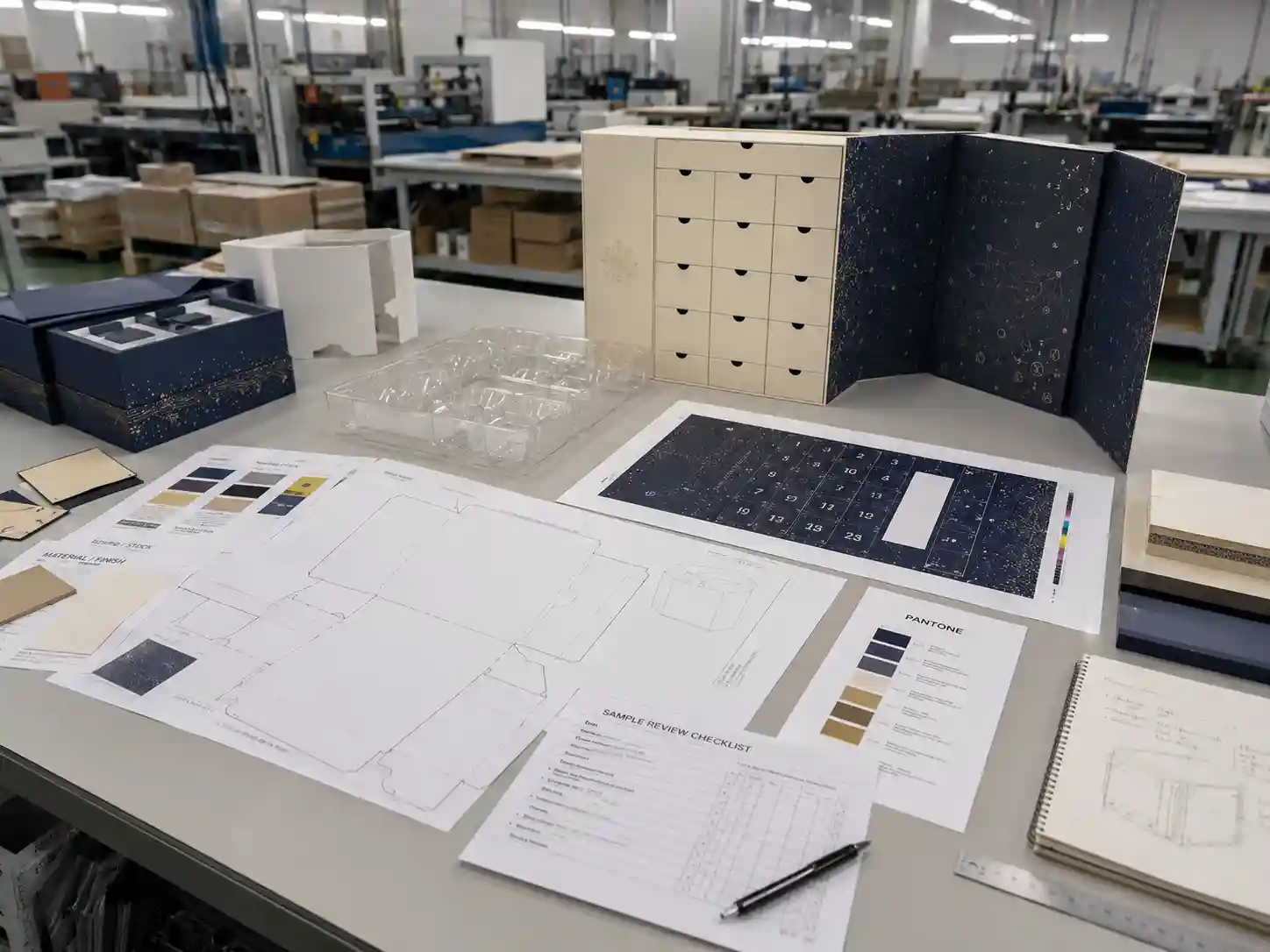
Artwork should be checked against the final dieline before sampling and again before mass production. Buyers should confirm bleed, safe areas, door numbers, drawer front alignment, CMYK or Pantone color references, finish layers, barcode location, and any legal or recycling marks.
A dieline for a skincare advent calendar is more complex than a simple folding carton because it may include outer panels, inner trays, drawer sleeves, door cut lines, insert layers, ribbons, magnets, or product cavities. If the artwork is not mapped correctly to the structure, numbers may shift, doors may not open cleanly, or premium graphic elements may land on fold lines.
For color-sensitive skincare brands, request a digital proof and, when needed, a printed sample or color drawdown. CMYK printing may vary across materials and machines, while Pantone references help define target colors more clearly. Buyers should also check whether foil stamping, embossing, and spot UV are shown as separate production layers in the artwork file.
QC tip: The most common printing approval mistake is checking the front image only. Buyers should also review side panels, inside panels, drawer fronts, date numbers, barcode readability, finish registration, and whether matte or gloss lamination changes the perceived color.
What should happen during sampling and pre-production approval?
Sampling should prove structure, fit, artwork position, opening experience, and packing feasibility before mass production. A pre-production sample is especially important when the order includes mixed skincare products with different weights and shapes.
Buyers can usually review several sample stages. A blank sample checks structure, size, insert layout, and assembly method without final printing. A printed sample checks artwork, color, finishing, and retail appearance. A pre-production sample confirms the final material, final dieline, final insert, final printing, and approved production method before bulk manufacturing.
For seasonal campaigns, sampling should be scheduled early because revisions can affect MOQ planning, material purchasing, and production line booking. If buyers change product sizes after insert approval, the supplier may need to adjust the dieline and remake samples. This can affect lead time, especially before peak seasonal production months.
Giftpackpro provides custom advent calendar box services for buyers who need help moving from structure selection to dieline review, sample development, and production preparation. The goal is to reduce avoidable changes after bulk materials are ordered.
Which production and quality control checkpoints matter most?
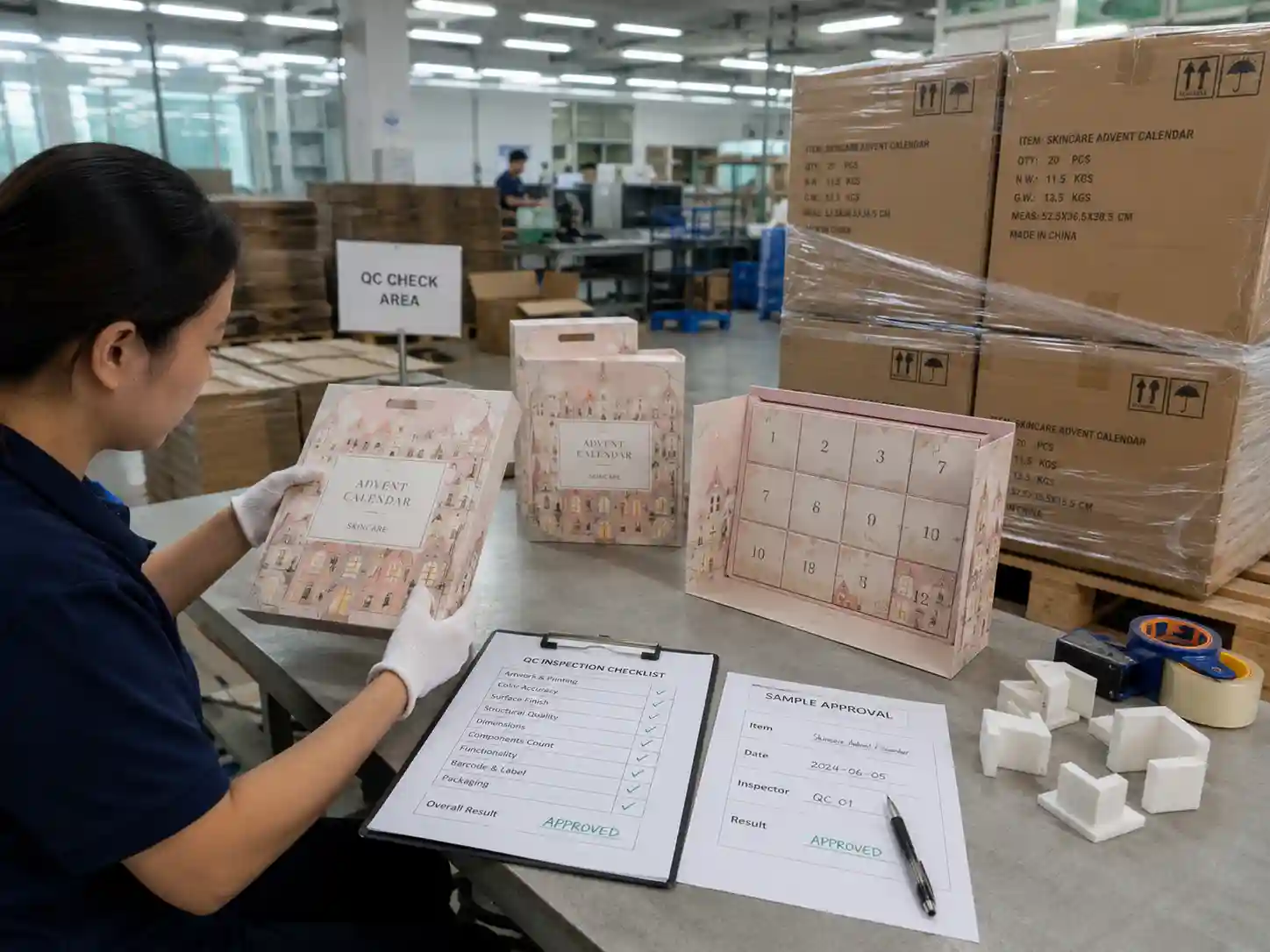
The most important QC checkpoints are material inspection, printing inspection, surface finishing inspection, die-cutting accuracy, insert fit, assembly tolerance, product loading test, carton packing, and final random inspection. Each checkpoint should connect to a buyer-approved sample or written specification.
During material inspection, the factory checks paper, greyboard, insert material, lamination film, ribbons, magnets, glue, and accessories. During printing inspection, operators compare color, registration, text clarity, date numbers, and finish position against approved proofs. During die-cutting and assembly, the team checks whether doors open cleanly, drawers slide smoothly, inserts sit flat, and outer panels close correctly.
Skincare packaging needs extra attention to surface scuffing. Matte lamination, dark solid colors, foil areas, and soft-touch effects can show scratches if parts rub during assembly or shipping. Drawer boxes should be tested for repeated opening and closing. Door-opening boxes should be checked for clean tearing, not accidental breakage. Heavy glass products should be tested in the insert and then inside the export carton, not only on the sample table.
Practical QC checklist for skincare advent calendar boxes
- Confirm approved sample, artwork file, dieline version, material specification, and packing method are the same as production documents.
- Check paperboard and greyboard thickness against the agreed quotation specification.
- Inspect CMYK or Pantone color consistency under suitable lighting.
- Check foil stamping, embossing, spot UV, matte lamination, or gloss lamination for registration and surface defects.
- Test all doors, drawers, ribbons, magnets, locks, and opening points.
- Load real bottles, jars, tubes, droppers, pumps, and caps into inserts to check fit and orientation.
- Check for leakage risk caused by pressure on pumps, caps, or dropper tops.
- Inspect surface scuffing after assembly, handling, and carton packing.
- Verify export carton strength, quantity per carton, shipping marks, and pallet plan.
- Record defects and approval decisions before shipment release.
How do MOQ, cost drivers, and lead time affect design decisions?
MOQ, cost, and lead time are affected by structure complexity, material selection, printing method, finishing, insert tooling, hand assembly, packing requirements, and production season. Buyers should request a quotation based on the same specification they plan to approve for sampling.
A rigid drawer box with foil stamping, embossing, EVA insert, ribbons, and multiple hand-assembled parts will cost more and take longer than a simple folding carton with a paper insert. However, the premium structure may be justified for higher-value skincare campaigns. A lower unit price is not always better if the box increases breakage, assembly delays, or retail complaints.
Insert choice can also affect MOQ. PET trays, molded pulp, and some custom-shaped inserts may require tooling or minimum material runs. Special paper, Pantone printing, foil colors, and custom hardware can also affect order quantity and purchasing lead time. Buyers should ask which design elements are standard and which require custom sourcing.
Buyer tip: When comparing quotations, check whether suppliers are quoting the same board thickness, insert material, surface finishing, carton packing, and inspection level. A cheaper quote may simply remove protection or reduce material strength.
How should buyers compare suppliers for custom advent calendar boxes?
Buyers should compare suppliers by structure experience, sampling accuracy, production control, communication quality, export packing knowledge, and willingness to provide clear specifications. Supplier reliability is more important than a low first quote for seasonal skincare launches.
A qualified custom advent calendar boxes manufacturer should be able to discuss structure, inserts, dielines, material options, printing, assembly, and final inspection in practical detail. Buyers should ask for similar sample references without requiring real customer brand disclosure. The supplier should also explain possible risks, such as glass product movement, drawer friction, surface scuffing, or carton compression.
The Giftpackpro packaging factory works with overseas buyers who need custom seasonal paper gift packaging and packaging development support. For procurement teams, this can be helpful when the project requires artwork coordination, sample confirmation, MOQ planning, and export packing before a fixed retail launch date.
Decision guide: which supplier option is safer?
| Buyer situation | Safer supplier choice | Reason |
|---|---|---|
| Heavy skincare set with glass jars and bottles | Factory with rigid box and insert testing experience | Structure strength and cavity control are critical for durability. |
| Fast seasonal launch with fixed delivery date | Supplier with clear sample and production schedule | Late dieline or artwork changes can delay mass production. |
| Premium retail campaign | Supplier that can control printing, foil, embossing, and surface protection | Premium finishes need careful registration and handling. |
| E-commerce or overseas distribution | Supplier that understands export carton, pallet, and shipping mark requirements | Long-distance transit can damage corners, surfaces, and inserts. |
What export packing details protect seasonal skincare packaging?
Export packing should protect the finished advent calendar boxes from compression, corner damage, moisture exposure, surface rubbing, and handling during international logistics. Buyers should confirm carton size, carton material, packing quantity, corner protection, pallet method, shipping marks, and inspection records before shipment.
Skincare advent calendars can be bulky and heavy, especially when packed with glass or premium rigid structures. Even if the product is shipped empty to a co-packer, the box still needs carton protection to prevent crushed corners, dented panels, and scratched surfaces. If the box is shipped with skincare products inside, the packing plan should also consider product weight distribution and internal movement.
For transport testing, buyers can reference recognized packaging test organizations such as ISTA when discussing drop, vibration, and distribution simulation needs with their logistics or quality team. The exact test level should be selected based on product value, shipping route, carton weight, and retail channel requirements.
What information should buyers prepare before requesting a quotation?
Buyers should prepare product dimensions, box quantity, structure preference, insert preference, artwork requirements, finishing details, packing method, destination, target delivery date, and inspection expectations before asking for a quotation. Complete information helps the supplier quote the real project instead of a rough estimate.
A good RFQ should include the number of calendar days or compartments, product list, product weight, bottle and jar dimensions, tube diameter, dropper height, pump cap size, label orientation needs, and whether the box will be shipped empty or filled. Also include preferred material, rigid box or folding carton structure, insert type, CMYK or Pantone printing, foil stamping, embossing, spot UV, matte lamination, gloss lamination, and any retail compliance marks.
Buyers should also state whether they need a blank sample, printed sample, pre-production sample, or full mass production quotation. If the campaign has a fixed selling season, include the required delivery date and destination port or warehouse location. This helps the supplier evaluate lead time, production capacity, export carton planning, and freight volume.
Quotation preparation checklist
- Project name, campaign season, and target launch date.
- Order quantity or expected MOQ range.
- Number of compartments, drawers, or doors.
- Product dimensions, weight, materials, and leakage-sensitive items.
- Preferred box structure: rigid box, drawer box, door-opening box, or folding carton.
- Insert preference: paper insert, PET tray, EVA insert, foam, molded pulp, or open recommendation.
- Artwork status: ready file, draft concept, or need dieline support.
- Printing and finish requirements: CMYK, Pantone, foil stamping, embossing, spot UV, matte lamination, or gloss lamination.
- Sample requirement: blank sample, printed sample, or pre-production sample.
- Export packing details: carton quantity, pallet needs, shipping marks, and destination.
What common mistakes should skincare packaging buyers avoid?
The most common mistakes are approving design visuals without testing real products, changing product dimensions after sampling, ignoring insert tolerance, underestimating surface scuffing, and comparing quotations with different specifications. These mistakes often appear late, when the campaign schedule is already tight.
Another common issue is treating artwork and structure as separate projects. For advent calendars, the artwork must match the dieline, opening method, insert layout, and numbered sequence. If the dieline changes but artwork is not updated, print alignment problems can appear during production. Buyers should also avoid approving product cavities based only on empty samples. Real skincare products must be tested because pumps, caps, labels, and glass bodies can change how the insert performs.
Buyers can review more related procurement topics through Giftpackpro’s advent calendar box buying guides, especially when comparing structure, sample timing, MOQ planning, and export packing for seasonal paper gift packaging.
FAQ: buyer questions about skincare advent calendar boxes
What is the best structure for premium skincare advent calendar boxes?
For premium skincare campaigns, a rigid box or drawer box is often stronger and more presentation-focused than a light folding carton. The final choice should depend on product weight, number of compartments, retail positioning, and export packing requirements.
Which insert material is best for glass bottles and jars?
There is no single best insert for every project. Paper inserts can work well when engineered correctly, PET trays provide accurate cavities, EVA and foam add cushioning, and molded pulp may support natural positioning. The key is to test real products for movement, label orientation, cap pressure, and surface contact.
How early should buyers start sampling?
Buyers should start sampling as early as possible before seasonal production peaks. Blank samples, printed samples, revisions, pre-production approval, material purchasing, and mass production all require time, especially when the project includes custom inserts and premium finishes.
Can the same box design be used for different skincare product sets?
Sometimes, but only if the product dimensions and weights are similar. If a bottle, jar, tube, dropper, or pump changes size, the insert may need adjustment. Reusing the outer structure may save time, but insert fit should still be tested again.
What affects the quotation most?
The main quotation drivers are order quantity, structure type, box size, board thickness, insert material, printing colors, surface finishes, hand assembly steps, sample requirements, export carton specification, and delivery schedule.
How should buyers move from design idea to production with Giftpackpro?
To develop skincare advent calendar boxes efficiently, prepare your product list, quantity target, structure preference, artwork status, finish requirements, sample needs, and delivery schedule before contacting the supplier. This allows Giftpackpro to review structure, insert fit, printing, QC, export packing, and quotation details with fewer assumptions.
If you are planning a seasonal skincare campaign, send bottle, jar, tube, dropper, pump, and cap dimensions together with your preferred box style. Giftpackpro can help evaluate whether a rigid box, drawer box, door-opening box, or folding carton is more suitable for your campaign. Buyers who are ready to compare specifications or begin sample planning can request a custom quote with project details and expected order quantity.


