
Customizing rigid advent calendar boxes for a B2B packaging project is not only about choosing a box shape. Buyers also need to confirm artwork files, print colors, surface finishing, sample proofing, insert fit, carton packing, and the information needed for an accurate quotation.
For overseas brands, wholesalers, gift companies, and retail purchasing teams, the best result usually comes from matching structure, printing, finishing, and production checks before bulk orders begin. Giftpackpro supports buyers who need practical custom advent calendar box services for seasonal campaigns, gift sets, retail launches, and private label packaging projects.
Start With the Packaging Structure Before Printing
Printing and finishing decisions should come after the box structure is clear. A rigid advent calendar box may use doors, drawers, magnetic closure, book-style opening, sleeve structure, or a foldable rigid format. Each structure affects artwork size, opening direction, insert design, packing method, and final cost.
Before choosing foil stamping or spot UV, buyers should confirm the box size, product weight, insert material, product placement, and how the calendar will be displayed in stores or shipped to customers. This helps avoid artwork changes after the dieline has already been prepared.
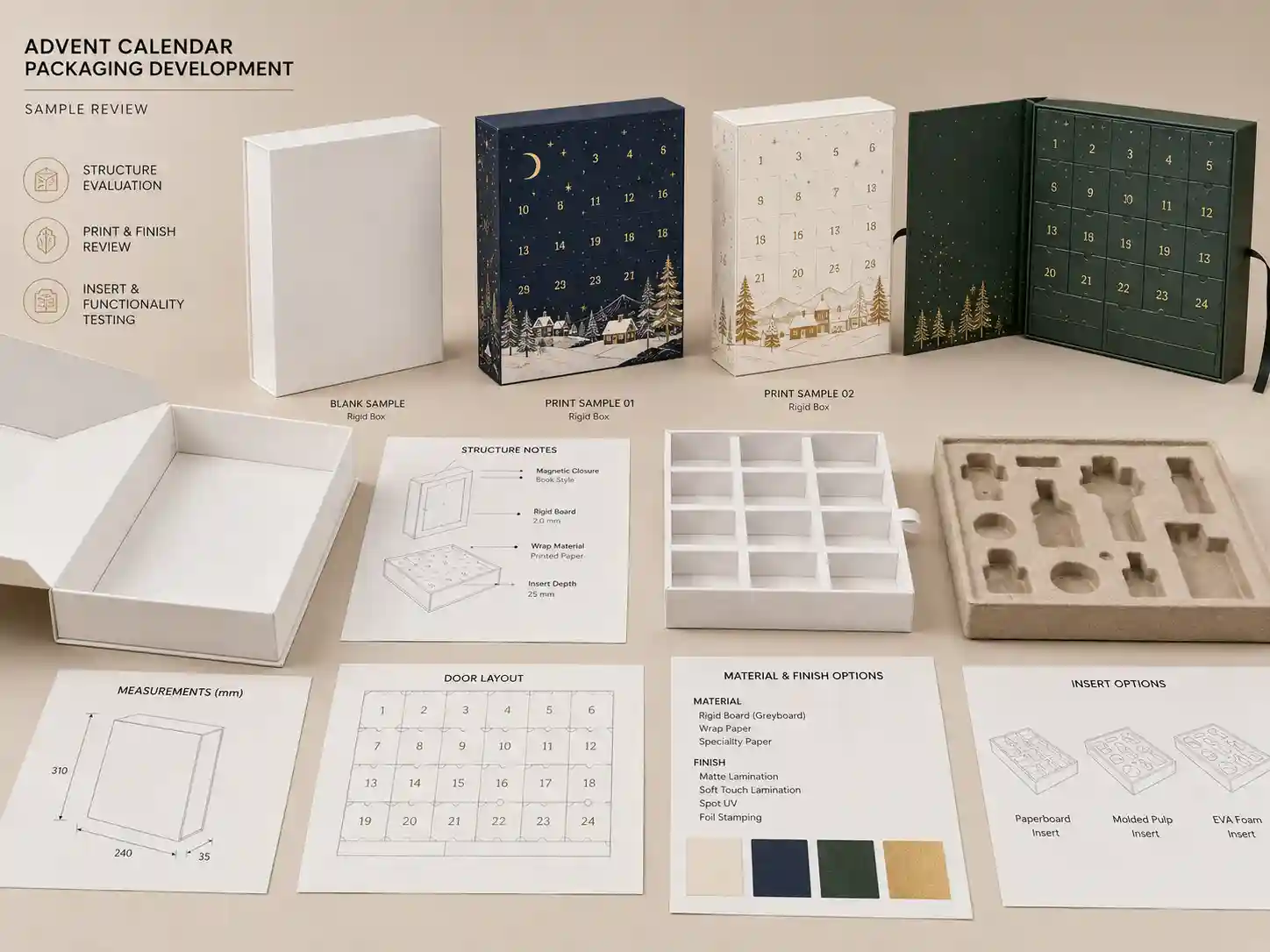
Common B2B Structure Questions
When preparing a project brief, buyers should answer a few practical questions first. How many compartments are needed? Will each door hold a different product? Are the products fragile, heavy, liquid-filled, or irregular in shape? Will the box be sold as a retail gift set, used for promotional gifting, or shipped as part of an e-commerce campaign?
For example, a skincare brand may need 24 small compartments with paperboard inserts, while a candle gift company may need stronger EVA or foam inserts for heavier items. A retailer may prefer flat outer cartons and clear carton marks for warehouse receiving. These details help the custom advent calendar boxes manufacturer prepare a more realistic sample and quotation.
Choose CMYK or Pantone Printing Based on Color Requirements
Most rigid advent calendar boxes use CMYK printing for full-color artwork, lifestyle graphics, gradients, product illustrations, and seasonal designs. CMYK is suitable when the artwork includes photos, multiple colors, and detailed background patterns.
Pantone printing is often used when a buyer needs accurate brand color matching. If your packaging must follow a brand guideline, Pantone references should be included in the artwork file or project brief. For important seasonal retail displays, color consistency between the sample and bulk production should be checked carefully before mass production starts.
When CMYK Works Well
CMYK is usually suitable for rich visual designs, illustrated advent calendar artwork, festive packaging, and product-themed graphics. It is also practical when buyers want flexible artwork effects without strict single-color matching.
When Pantone Is Better
Pantone is helpful for brand colors, solid background panels, logos, and repeated production batches. Buyers who manage several packaging SKUs may use Pantone references to keep color closer across different box sizes and structures.
Select Surface Finishing for Brand Positioning and Budget
Finishing choices can change the appearance, cost, and production complexity of rigid advent calendar boxes. For B2B buyers, the goal is not to add every possible finish. The goal is to choose finishes that support the brand look, protect the print surface, and stay suitable for the target price range.
| Finishing Option | Best Use | B2B Notes |
|---|---|---|
| Matte Lamination | Premium gift packaging, soft visual effect, modern retail look | Good for rigid boxes with clean artwork and understated branding. |
| Gloss Lamination | Bright colors, festive artwork, strong shelf visibility | Useful for colorful seasonal campaigns, but may show reflections in photos. |
| Foil Stamping | Logos, numbers, borders, limited-edition packaging details | Requires clear foil area artwork and enough spacing for clean production. |
| Embossing or Debossing | Logo depth, tactile brand details, premium box covers | Works best on simple shapes, text, or graphic elements with enough line thickness. |
| Spot UV | Highlighting logos, patterns, product names, or selected artwork areas | Needs a separate spot UV layer in the artwork file. |
Use Foil Stamping, Embossing, and Spot UV Carefully
Foil stamping can give rigid advent calendar boxes a more premium look, especially on logos, calendar numbers, decorative lines, and limited-edition messages. Gold, silver, champagne, holographic, and colored foils can be used depending on the artwork style.
Embossing and debossing add a raised or recessed texture. These techniques are often used on brand marks or simple graphic areas. Very small text or complex thin lines may not produce clean results, so artwork should be checked before tooling.
Spot UV creates contrast between matte and glossy areas. It works well on selected logos, snowflake patterns, product icons, or decorative details. Buyers should provide a separate spot UV layer so the production team can clearly identify where the effect should be applied.
Prepare Artwork Files Before Sampling
Artwork preparation is one of the most important steps in a B2B packaging project. Incorrect dielines, missing fonts, low-resolution images, or unclear finishing layers can delay sample development and bulk production.
For customized projects, buyers can review related advent calendar box buying guides before preparing artwork, especially when several departments are involved, such as brand, design, purchasing, and logistics.
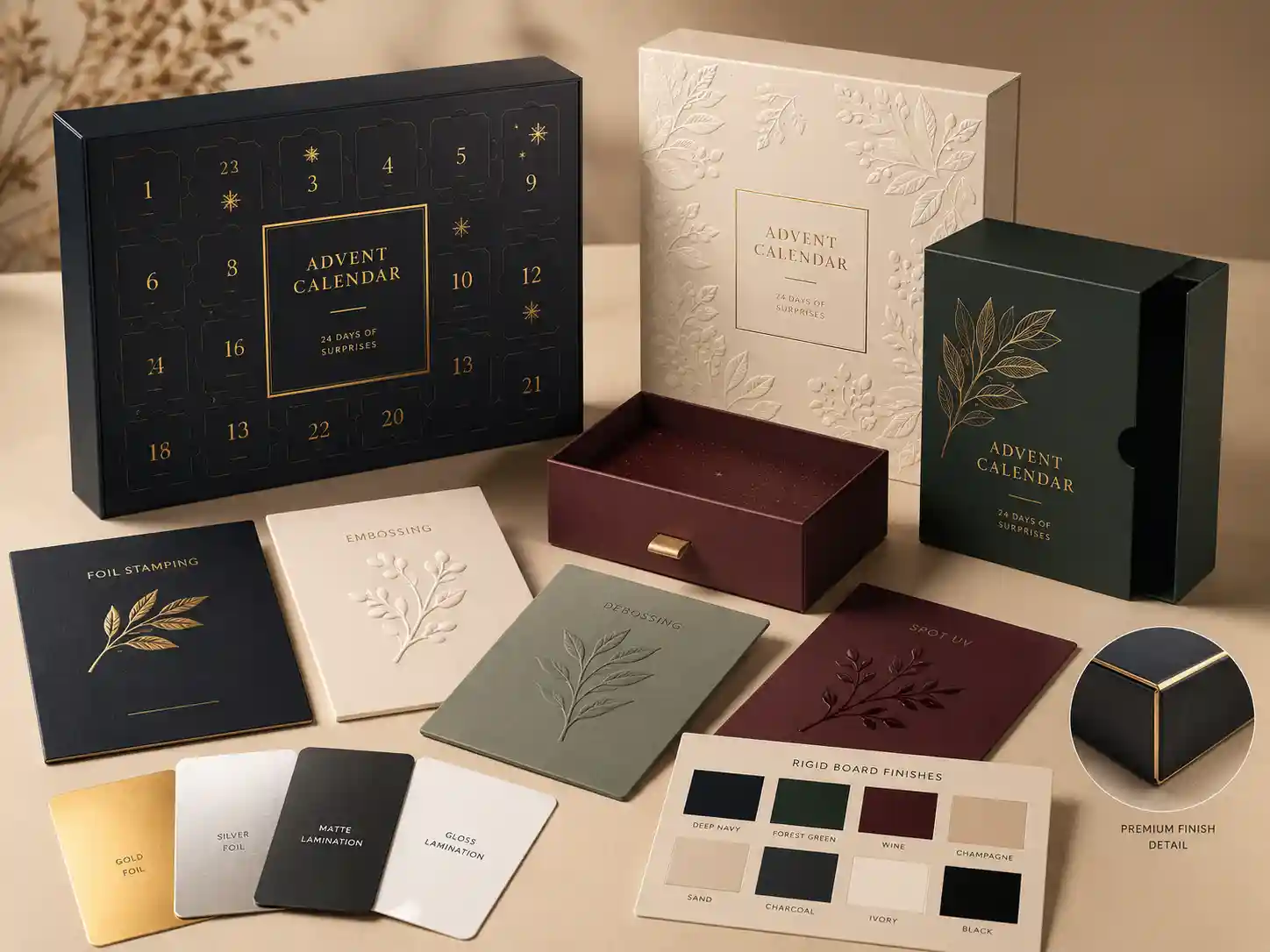
Artwork Checkpoints for Rigid Advent Calendar Boxes
Artwork files should usually include the correct dieline, bleed area, safe zone, CMYK color mode, Pantone references if needed, embedded or outlined fonts, high-resolution images, and separate layers for foil stamping, embossing, debossing, or spot UV.
Door numbers, compartment labels, barcode placement, warning text, recycling marks, and retail information should also be checked before proofing. If FSC-related claims are used, buyers should verify the correct certification and usage rules through official sources such as FSC.
Useful Files to Send for Quotation
For a faster quotation, buyers should send product dimensions, product weight, quantity, target box style, reference images, artwork draft if available, insert requirements, finishing preferences, destination country, and expected delivery schedule. If the project is still early, a rough brief is still useful for estimating structure and budget.
Confirm Color Proofing Before Bulk Production
Color proofing helps buyers reduce the risk of surprises in bulk production. A digital proof can confirm layout, text position, dieline placement, and general artwork direction. A physical printed proof or pre-production sample is better for checking color, lamination, foil, embossing, spot UV, and insert fit.
For retail packaging, it is useful to check the sample under neutral lighting instead of only under warm office lights. Buyers should also compare the proof with brand color references, approved Pantone codes, or previous production samples when available.
Practical Example: Skincare Advent Calendar
A skincare brand ordering 24-day rigid advent calendar boxes may use CMYK printing for the main artwork, Pantone printing for the brand color, matte lamination for a premium surface, and foil stamping for the logo and calendar numbers. Before bulk production, the buyer should check the door opening, insert tightness, bottle fit, barcode placement, and carton packing method.
Practical Example: Chocolate or Food Gift Project
A chocolate gift company may focus more on food-safe inner packaging coordination, compartment sizing, and clean surface finishing. If direct food contact is involved, buyers should confirm the correct inner packaging material and compliance requirements. For general quality management expectations, buyers can also review official information from ISO 9001 quality management.
Plan MOQ, Lead Time, and Bulk Production Early
Rigid advent calendar boxes usually need more planning than simple folding cartons because they involve greyboard, printed paper wrapping, inserts, finishing, assembly, and export packing. MOQ may vary based on box size, structure, material, finishing, and whether tooling is required. Many custom seasonal paper packaging projects start around a few hundred pieces, but the final MOQ should be confirmed based on the actual design.
Lead time also depends on artwork approval, sample revisions, material availability, finishing complexity, and order quantity. Projects with foil stamping, embossing, multiple insert types, or several box sizes should allow more time for proofing and production checks.
Buyers comparing different custom advent calendar box products should not only compare unit price. They should also compare structure strength, insert protection, artwork handling, carton packing, sample quality, and factory communication.
Quality Control for Printing and Finishing
Quality control should cover both the visual appearance and the physical function of the box. For rigid advent calendar boxes, common checks include color consistency, lamination adhesion, foil registration, embossing depth, spot UV alignment, door opening, drawer sliding, insert fit, glue marks, edge wrapping, corner strength, and carton protection.
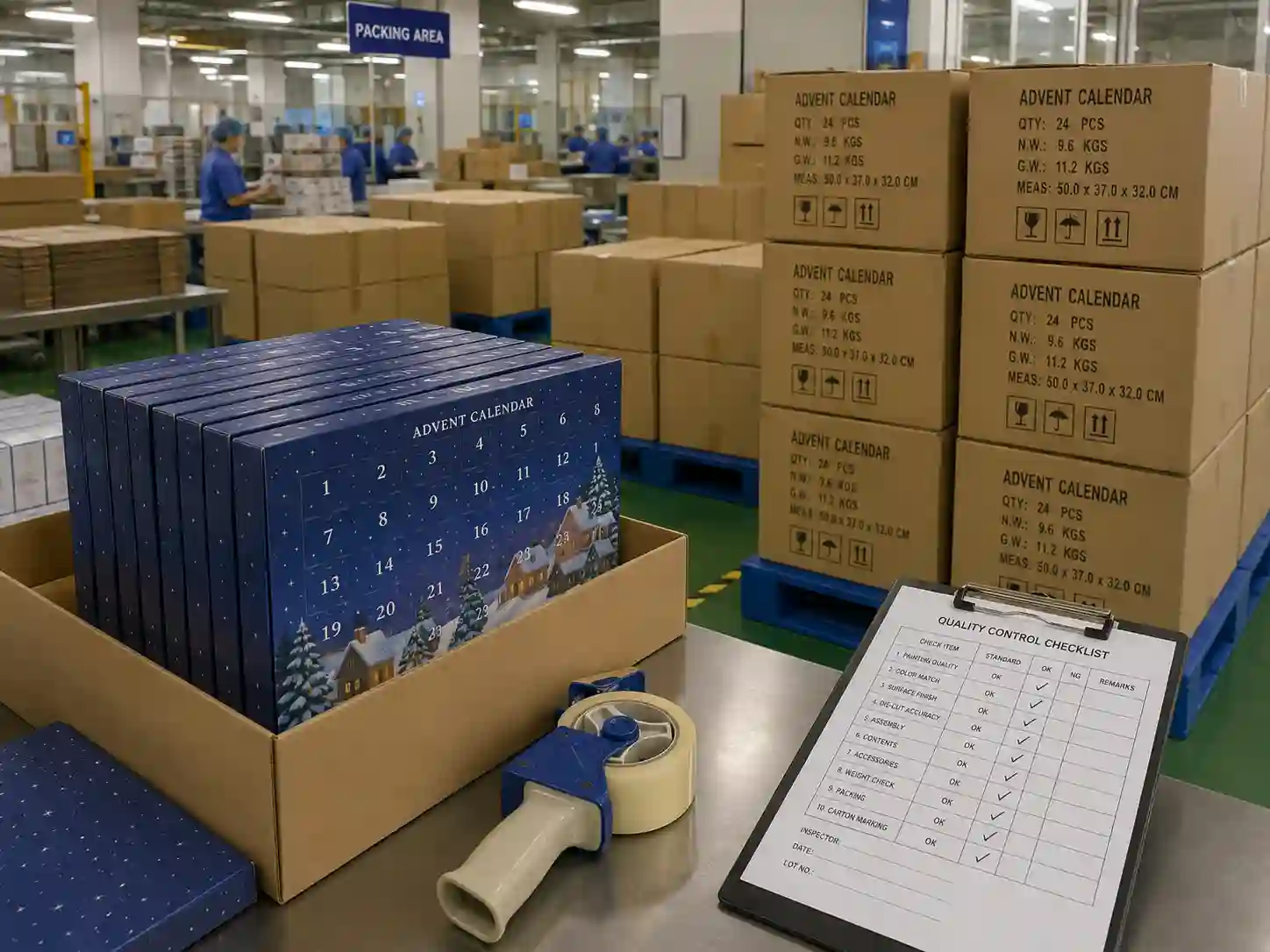
Export Packing Checks
Export packing should protect the finished boxes during long-distance shipping. Buyers should confirm inner polybag requirements, master carton size, carton marks, pallet requirements, moisture protection, and drop-test expectations if needed. For seasonal goods, shipment timing is also important because late delivery can reduce the value of the promotion.
The Giftpackpro packaging factory can support B2B buyers with sample review, structure discussion, printing and finishing planning, and bulk production checks. For complex projects, it is better to confirm all key details before the final sample is approved.
Quote Preparation Checklist for Buyers
Before asking for a quotation, prepare a clear project brief. This helps the supplier quote faster and reduces repeated communication.
Information to Include
Include the box type, open size, finished size, number of compartments, product dimensions, product weight, insert material, printing method, finishing options, order quantity, destination country, packing requirements, and target delivery date. If you already have a dieline or artwork file, send it together with the request.
If you are not sure which structure is suitable, share your product list and target retail use. Giftpackpro can suggest structure options through custom advent calendar box services and help buyers compare practical solutions before sampling.
Questions to Ask Before Approval
Ask whether the quotation includes sample cost, mold or tooling cost, printing proof, insert development, export carton packing, and shipping terms. Also ask what file format is required, how many sample rounds are included, and what details must be approved before bulk production.
For buyers planning a new campaign, the simplest next step is to send your product size, quantity, artwork idea, and preferred finishing style. You can request a custom quote with your project details, or review more advent calendar box buying guides before finalizing the brief.
Final Advice for Custom Printing and Finishing
The best rigid advent calendar boxes are developed through clear structure planning, accurate artwork files, suitable printing choices, realistic finishing decisions, and careful sample checks. A premium finish can improve shelf appeal, but only when the structure, insert, color proof, and production details are controlled properly.
For B2B packaging projects, do not wait until bulk production to solve artwork, color, or insert problems. Confirm the dieline, check CMYK and Pantone requirements, review foil and embossing layers, approve a reliable proof, and prepare export packing details early. This makes the whole project easier to quote, sample, produce, inspect, and deliver.


