Choosing the right paper materials for advent calendar boxes affects structure, printing, insert fit, shipping strength, cost, and the final retail presentation. For B2B buyers, the material decision should not be treated as a simple “thicker is better” question.
A good material choice starts with the box structure, product weight, door or drawer design, insert type, artwork requirements, target retail channel, and export packing method. This guide explains how brands, wholesalers, gift companies, and purchasing teams can prepare material requirements before asking suppliers for a quote.
Why Paper Material Selection Matters for Advent Calendar Box Projects
Advent calendar packaging usually has more structure than a standard gift box. It may include 12, 24, or more compartments, small doors, drawer units, inner trays, inserts, sleeves, magnets, ribbons, or paperboard dividers.
If the paperboard is too weak, doors may tear, drawers may bend, and cartons may deform during shipping. If the material is over-specified, the unit cost and shipping weight may rise without improving the buyer’s real use case.
When working with a custom advent calendar boxes manufacturer, buyers should connect material selection with the product inside the box, not only with the outer appearance.
Start With the Box Structure and Application
The first step is to decide the structure. Different advent calendar box styles place different stress on the paper material.
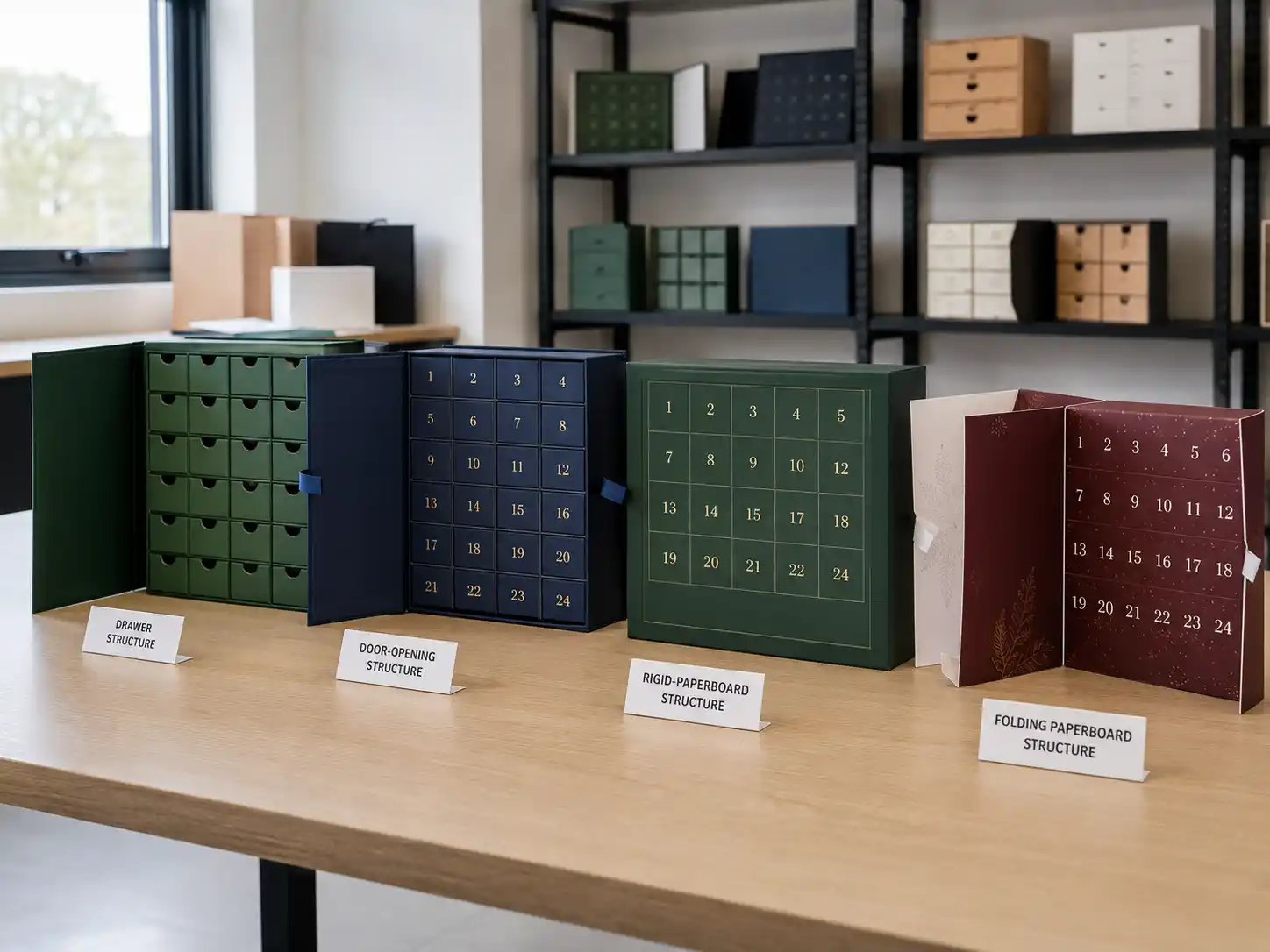
Door-opening advent calendar boxes
Door-opening structures usually need stable printed paper, accurate die-cutting, and suitable backing board. The small doors must open cleanly without tearing too easily. For lightweight products such as stickers, stationery, tea bags, sample sachets, or small gifts, paperboard and greyboard combinations are often enough.
Drawer-style advent calendar boxes
Drawer structures need stronger board because each drawer is handled separately. If the drawer contains candles, cosmetics, skincare jars, small bottles, or accessories, the supplier should check drawer wall strength, pull-out resistance, and inner support.
Rigid advent calendar boxes
Rigid structures often use greyboard wrapped with printed paper. They are suitable for premium seasonal gift packaging, cosmetics, candles, fragrance sets, corporate gifts, and retail programs where shelf appearance matters.
Folding paperboard advent calendar boxes
Folding paperboard structures can help reduce shipping volume and unit cost, but they need careful design. They are better for lighter products and projects where flat packing, easy assembly, and cost control are important.
Buyers comparing structures can review examples through custom advent calendar box products before preparing an RFQ.
Common Paper Materials for Advent Calendar Boxes
The phrase “paper materials for advent calendar boxes” usually covers several layers, not one single material. A box may include outer printed paper, greyboard, corrugated board, kraft paper, coated paper, inner paperboard trays, and insert materials.
| Material Type | Common Use | Best For | Buyer Notes |
|---|---|---|---|
| Greyboard | Rigid box base, drawer walls, frame structure | Premium advent calendar boxes, heavier gift sets | Ask supplier to recommend thickness based on product weight and box size. |
| Coated art paper | Printed wrapping paper or outer surface | High-quality graphics, retail display appearance | Works well with lamination, foil stamping, embossing, and detailed artwork. |
| White card paper | Folding box panels, dividers, light inner trays | Lightweight products and cost-sensitive projects | Check stiffness, folding performance, and printing result before bulk production. |
| Kraft paper | Natural-style outer paper, inner dividers, eco-style packaging | Organic, handmade, natural, or simple seasonal packaging concepts | Color printing may look more muted than on white coated paper. |
| Corrugated board | Stronger support, shipping-friendly structures, larger boxes | Bulkier products, export protection, practical retail programs | Useful when strength and logistics matter more than a luxury rigid feel. |
| Paperboard inserts | Compartments, dividers, inner product positioning | Tea, cosmetics, candles, stationery, small gifts | Insert design should match product size, loading direction, and packing process. |
How to Match Material With Product Weight
Material selection should follow the real product load. A calendar box for flat paper gifts does not need the same board as a calendar box for glass jars or candles.
Lightweight items
For stickers, cards, sachets, small stationery, tea bags, and flat promotional gifts, buyers can usually focus on print quality, clean die-cutting, compartment accuracy, and efficient packing.
Medium-weight items
For cosmetics, skincare samples, small candles, accessories, and mixed gift sets, the material should support repeated handling. The supplier may recommend stronger greyboard, reinforced drawers, or a better inner tray design.
Heavier or fragile items
For glass jars, bottles, ceramic items, or heavier candles, the paper material alone is not enough. Buyers should discuss insert support, drop-test expectations, export carton strength, and pallet packing with the supplier.
Giftpackpro can help buyers review these factors through custom advent calendar box services, especially when the project includes multiple SKUs or mixed product weights.
Do Not Choose Paper Thickness Without the Dieline
Many buyers ask for a material recommendation before the structure is confirmed. This is understandable, but paper thickness depends heavily on the dieline, box size, door shape, drawer depth, and insert layout.
For example, a 24-door calendar with small perforated windows may need a different board combination from a 12-drawer calendar with rigid compartments. A supplier can give a more accurate recommendation after receiving the product size, product weight, expected box style, and artwork direction.
For new projects, buyers can start by checking advent calendar box buying guides and then prepare a simple RFQ file.
Customization Factors That Affect Paper Material Choice
Paper material must also match the planned artwork and finishing process. A design that looks good on screen may need material adjustment before mass production.
Printing requirements
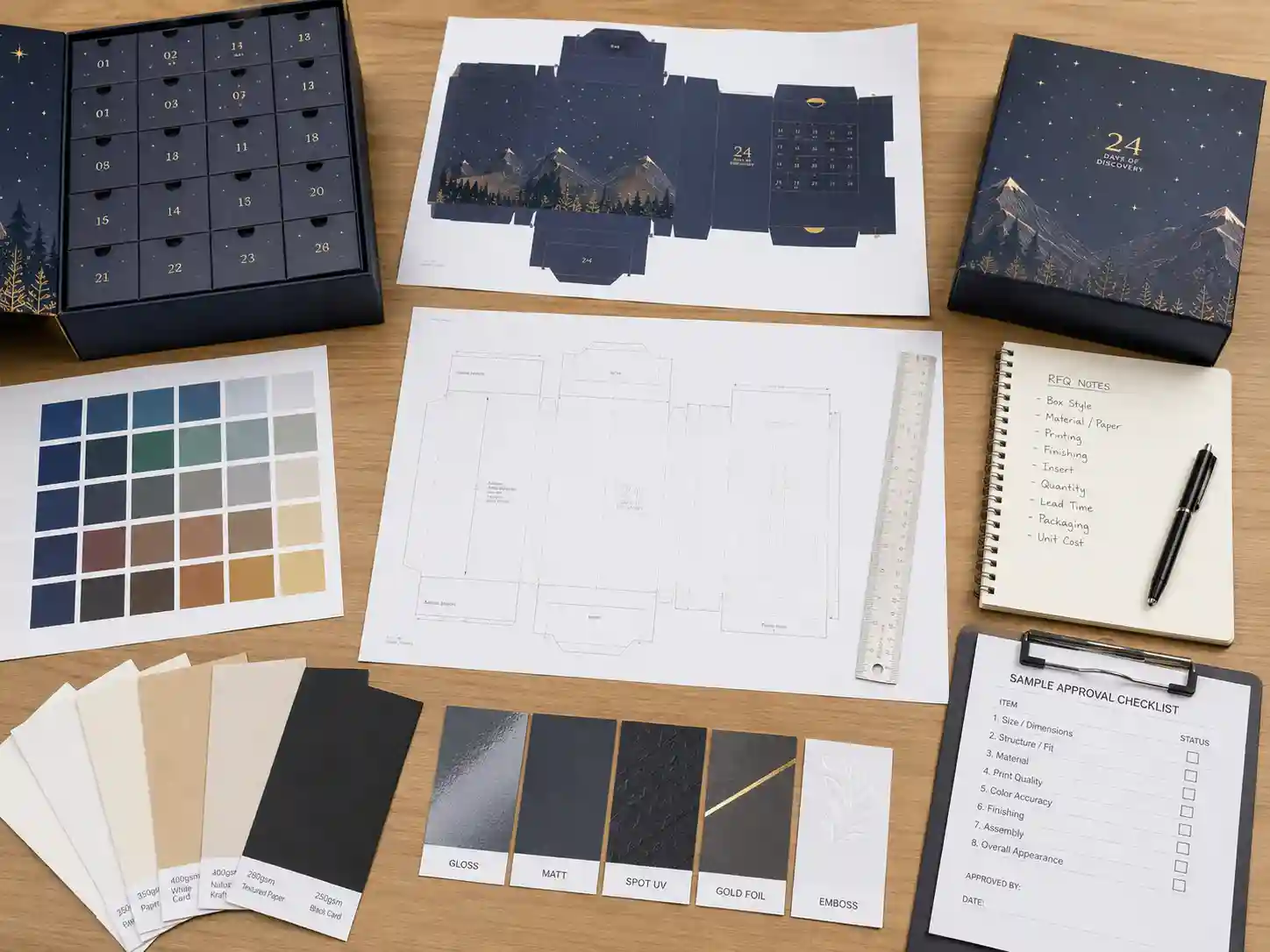
Detailed artwork, gradient backgrounds, dark colors, metallic effects, and large solid-color areas may need coated paper with stable print performance. Buyers should confirm whether the supplier uses CMYK printing, Pantone color matching, or special printing methods for the project.
Surface finishing
Matte lamination, gloss lamination, soft-touch film, spot UV, foil stamping, embossing, and debossing can all affect material choice. Some finishes need smoother paper surfaces, while others may not perform well on textured or kraft paper.
Insert design
Inserts may use paperboard, corrugated board, molded pulp, EVA, foam, or other materials depending on the product. For buyers who want a more paper-based solution, paperboard or molded pulp can be discussed during sampling.
Assembly method
Some advent calendar boxes are delivered fully assembled. Others are designed for flat packing or semi-assembly to save shipping volume. The material must fit the assembly method, or the final packing process may become slow and inconsistent.
When comparing custom advent calendar box services, buyers should ask whether the supplier can support structure design, material recommendation, sample making, artwork checking, bulk production, and export packing under one workflow.
Paper Material and Sustainability Questions
Many buyers want more sustainable packaging, but the right answer depends on the target market, product category, budget, and certification requirement.
For paper sourcing claims, buyers may review information from the Forest Stewardship Council. For broader environmental management systems, buyers can refer to ISO 14001 environmental management guidance.
In an RFQ, avoid vague phrases such as “eco-friendly material only.” Instead, state whether you need FSC-certified paper, recycled paper content, plastic-free inserts, recyclable structure, reduced lamination, or specific market compliance support.
Sample Testing Before Bulk Production
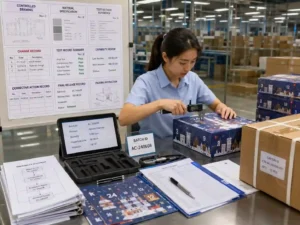
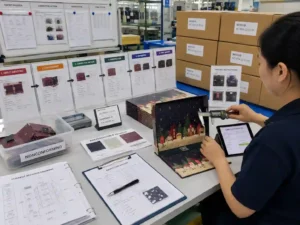
A material recommendation should be verified through sampling. A physical sample helps the buyer check structure, color, opening experience, insert fit, and packing method before mass production.
What to check in a material sample
Check whether the board feels strong enough for the product, whether doors open cleanly, whether drawers slide smoothly, whether corners stay flat, and whether the box stands properly after loading.
Also check color consistency, surface finish, glue marks, die-cut edges, folding lines, compartment accuracy, and whether the insert holds the product securely.
Why one sample may not answer everything
A white sample can confirm structure. A printed sample can confirm artwork, color, finishing, and final appearance. For complex retail programs, buyers may need both.
To reduce delays, send product dimensions, product weight, artwork files, target quantity, packing preference, and delivery market before sample making. This helps the supplier recommend materials based on the full project, not only the box image.
MOQ, Lead Time, and Cost Factors
Material selection affects MOQ and lead time because different papers, boards, finishes, and insert types may require different purchasing and production arrangements.
For many custom seasonal packaging projects, MOQ is usually around 300–500 pieces depending on structure, material, printing, finishing, and assembly needs. Buyers should confirm the exact MOQ with the supplier before final planning.
Lead time also depends on sample approval speed. If the buyer changes material, insert layout, surface finish, or structure after sampling, the timeline may need to be adjusted.
For quote preparation, buyers can request a custom quote with product details, target quantity, and preferred structure.
Quality Control and Export Packing
For B2B buyers, material choice is not complete until QC and export packing are considered. A box may look good in a sample room but still need stronger packing for long-distance shipping.
QC points related to paper materials
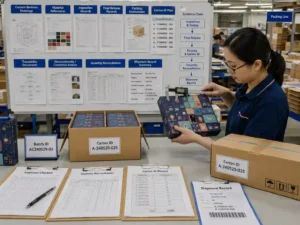
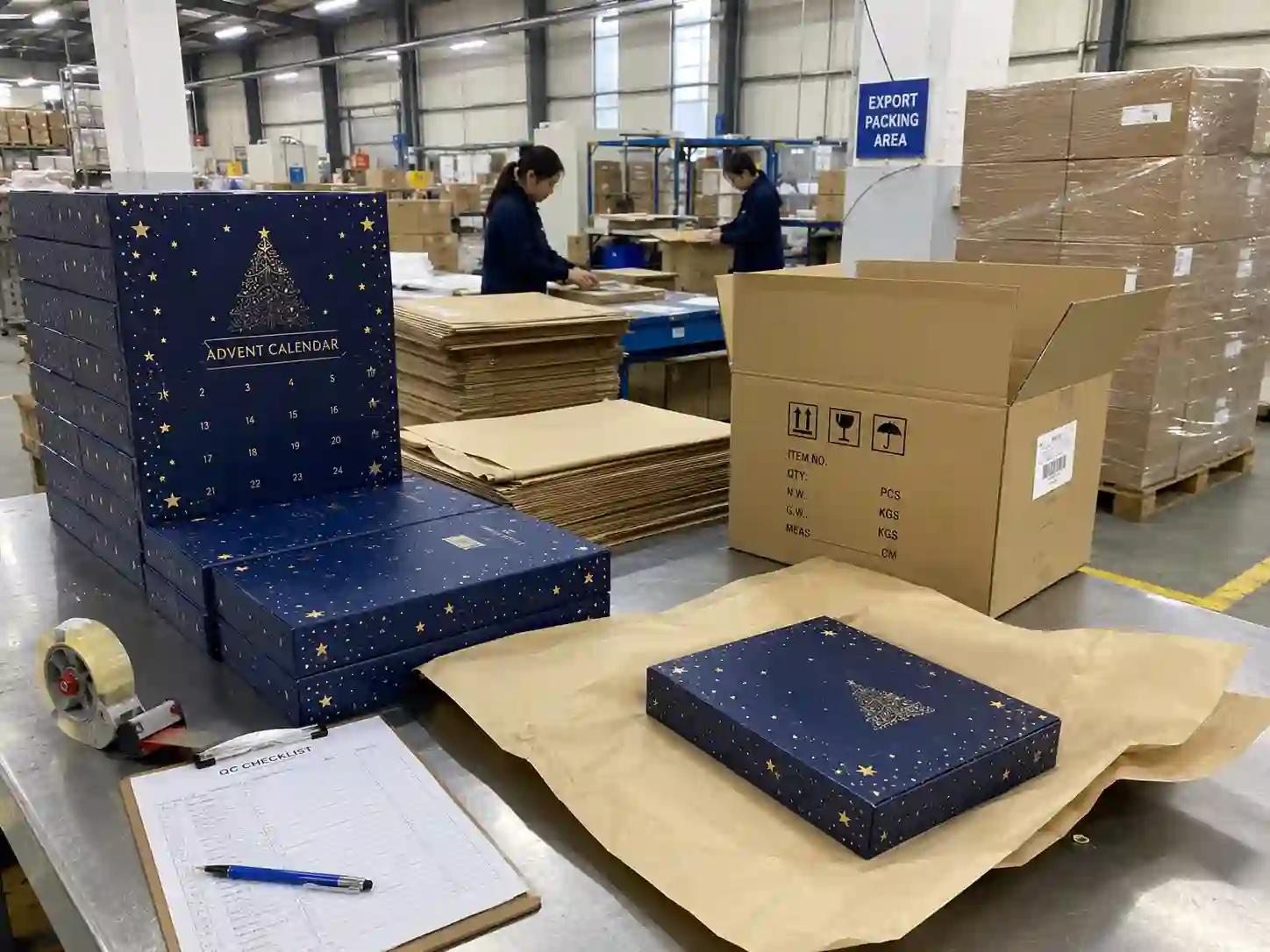
Common QC points include board thickness, paper surface quality, color consistency, lamination adhesion, foil stamping position, die-cut accuracy, glue strength, drawer movement, door opening quality, insert fit, and carton packing condition.
Export packing points
Buyers should ask how many units fit into each export carton, whether inner protection is needed, whether cartons require shipping marks, and whether pallet packing is recommended. Larger or heavier advent calendar boxes may need stronger outer cartons or additional protection.
A practical supplier should discuss material, structure, and packing together. Giftpackpro supports buyers from sample review to bulk packing through the Giftpackpro packaging factory workflow.
How to Prepare a Better RFQ for Paper Material Selection
A clear RFQ helps the supplier recommend the right paper materials for advent calendar boxes and avoid repeated revisions.
Include these details in your RFQ
Send the box style you prefer, product photos, product dimensions, product weight, number of compartments, target box size, artwork status, quantity, target market, preferred finish, insert requirement, packing method, and expected delivery schedule.
If you are not sure about the structure, share reference images and explain the product type. The supplier can suggest whether a door-opening, drawer-style, rigid, folding, or hybrid structure is more suitable.
Ask material comparison questions
Ask your supplier to compare at least two material options when possible. For example, you can ask for a cost-effective paperboard option and a stronger premium rigid option. This makes supplier comparison easier and helps your team balance price, appearance, and shipping safety.
Buyers planning multiple seasonal packaging projects can also review more advent calendar box buying guides before finalizing specifications.
Supplier Comparison Checklist
When comparing suppliers, do not only compare unit price. Ask how each supplier chooses materials, builds samples, checks artwork, controls production, and packs for export.
Useful questions to ask
Can the supplier recommend materials based on product weight? Can they make a structural sample before printing? Can they support inserts and dividers? Can they explain finishing limitations? Can they provide clear packing details? Can they handle seasonal bulk production timelines?
If a supplier only gives a price without checking structure, insert, and packing details, the quote may not reflect the real production requirement.
Final Material Selection Advice for B2B Buyers
The best paper material is not always the thickest or most expensive option. It is the material combination that fits the structure, product load, artwork, finish, assembly process, retail channel, and export packing plan.
For a new project, start with the product and structure first. Then confirm the insert, paper surface, board strength, finish, sample test, QC standard, and carton packing method.
Giftpackpro works with overseas brands, wholesalers, gift companies, and purchasing teams that need custom seasonal packaging. To compare material options for your next project, you can request a custom quote with your product details and target quantity.